Results by title
211 books match the query 'Working class' and 10 start with r
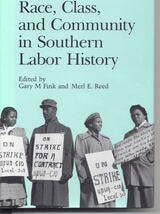
Race, Class, and Community in Southern Labor History
Gary M. Fink
University of Alabama Press, 1994
Exploring the intertwined histories of race, labor, and community in the American South.
Under the leadership of Gary M. Fink and Merl E. Reed, Georgia State University hosts the Southern Labor Studies Conferences approximately every two years. The conferences have yielded two previous volumes, published in 1977 and 1981, and this volume, which contains selected papers from the seventh conference held in 1991.
As evidence by the quality of these essays, the field of southern labor history has come into its own. Research interest is peaking: the practitioners are younger scholars, and much of their work emphasizes the new social and political history. While the topics covered in this volume usually reflect that methodology, their chronology ranges from the antebellum period to the 1970s, suggesting the variety of sources and changing research approaches that can be used in rendering new meaning to the past. Although the subject of gender was generally a minor theme in these sessions, work now being done leaves no doubt that at some future conference gender will attract a commanding amount of attention.
In introducing and describing their respective areas, the associate editors, Robert H. Zieger (textile workers), Joe W. Trotter (African Americans), and Clifford Kuhn (labor politics), have provided a rich historiographical background.
The essays in this volume will enlighten the reader on many important aspects of the history of southern labor, and they will also raise new questions to be explained by other scholars and future conferences.
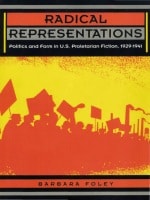
Radical Representations
Politics and Form in U.S. Proletarian Fiction, 1929–1941Barbara Foley
Duke University Press, 1994
Josephine Herbst, William Attaway, Jack Conroy, Thomas Bell and Tillie Olsen, are among the radical writers whose work Foley reexamines. Her fresh approach to the U.S. radicals' debates over experimentalism, the relation of art to propaganda, and the nature of proletarian literature recasts the relation of writers to the organized left. Her grasp of the left's positions on the "Negro question" and the "woman question" enables a nuanced analysis of the relation of class to race and gender in the proletarian novel. Moreover, examining the articulation of political doctrine in different novelistic modes, Foley develops a model for discussing the interplay between politics and literary conventions and genres.
Radical Representations recovers a literature of theoretical and artistic value meriting renewed attention form those interested in American literature, American studies, the U. S. left, and cultural studies generally.

Rainbow at Midnight
LABOR AND CULTURE IN THE 1940SGeorge Lipsitz
University of Illinois Press, 1994
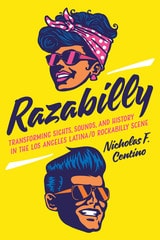
Razabilly
Transforming Sights, Sounds, and History in the Los Angeles Latina/o Rockabilly SceneBy Nicholas F. Centino
University of Texas Press, 2021
Vocals tinged with pain and desperation. The deep thuds of an upright bass. Women with short bangs and men in cuffed jeans. These elements and others are the unmistakable signatures of rockabilly, a musical genre normally associated with white male musicians of the 1950s. But in Los Angeles today, rockabilly's primary producers and consumers are Latinos and Latinas. Why are these "Razabillies" partaking in a visibly "un-Latino" subculture that's thought of as a white person's fixation everywhere else?
As a Los Angeles Rockabilly insider, Nicholas F. Centino is the right person to answer this question. Pairing a decade of participant observation with interviews and historical research, Centino explores the reasons behind a Rockabilly renaissance in 1990s Los Angeles and demonstrates how, as a form of working-class leisure, this scene provides Razabillies with spaces of respite and conviviality within the alienating landscape of the urban metropolis. A nuanced account revealing how and why Los Angeles Latinas/os have turned to and transformed the music and aesthetic style of 1950s rockabilly, Razabilly offers rare insight into this musical subculture, its place in rock and roll history, and its passionate practitioners.
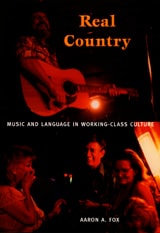
Real Country
Music and Language in Working-Class CultureAaron A. Fox
Duke University Press, 2004
Fox spent hundreds of hours observing, recording, and participating in talk and music-making in homes, beer joints, and garage jam sessions. He renders the everyday life of Lockhart’s working-class community in detail, right down to the ice cold beer, the battered guitars, and the technical skills of such local musical legends as Randy Meyer and Larry “Hoppy” Hopkins. Throughout, Fox focuses on the human voice. His analyses of conversations, interviews, songs, and vocal techniques show how feeling and experience are expressed, and how local understandings of place, memory, musical aesthetics, working-class social history, race, and gender are shared. In Real Country, working-class Texans re-imagine their past and give voice to the struggles and satisfactions of their lives in the present through music.
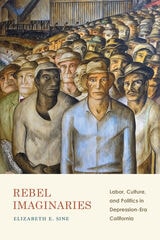
Rebel Imaginaries
Labor, Culture, and Politics in Depression-Era CaliforniaElizabeth E. Sine
Duke University Press, 2021
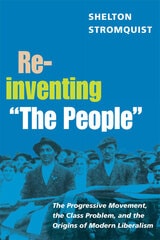
Reinventing "The People"
The Progressive Movement, the Class Problem, and the Origins of Modern LiberalismShelton Stromquist
University of Illinois Press, 2006
A comprehensive study of the Progressive movement, Reinventing "The People"contends that the persistence of class conflict in America challenged the very defining feature of Progressivism: its promise of social harmony through democratic renewal.
Shelton Stromquist profiles the movement's work in diverse arenas of social reform, politics, labor regulation and so-called race improvement. While these reformers emphasized different programs, they crafted a common language of social reconciliation in which an imagined civic community--"the People"--would transcend parochial class and political loyalties. But efforts to invent a society without enduring class lines marginalized new immigrants and African Americans by declaring them unprepared for civic responsibilities. In so doing, Progressives laid the foundation for twentieth-century liberals' inability to see their world in class terms and to conceive of social remedies that might alter the structures of class power.
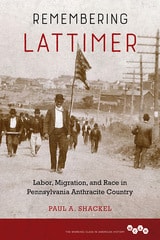
Remembering Lattimer
Labor, Migration, and Race in Pennsylvania Anthracite CountryPaul A. Shackel
University of Illinois Press, 2018
Paul A. Shackel confronts the legacies and lessons of the Lattimer event. Beginning with a dramatic retelling of the incident, Shackel traces how the violence, and the acquittal of the deputies who perpetrated it, spurred membership in the United Mine Workers. By blending archival and archaeological research with interviews, he weighs how the people living in the region remember--and forget--what happened. Now in positions of power, the descendants of the slain miners have themselves become rabidly anti-union and anti-immigrant as Dominicans and other Latinos change the community. Shackel shows how the social, economic, and political circumstances surrounding historic Lattimer connect in profound ways to the riven communities of today.
Compelling and timely, Remembering Lattimer restores an American tragedy to our public memory.

Renew Orleans?
Globalized Development and Worker Resistance after KatrinaAaron Schneider
University of Minnesota Press, 2018
Urban development after disaster, the fading of black political clout, and the onset of gentrification
Like no other American city, New Orleans since Hurricane Katrina offers powerful insight into issues of political economy in urban development and, in particular, how a city’s character changes after a disaster that spurs economic and political transition. In New Orleans, the hurricane upset an existing stalemate among rival factions of economic and political elites, and its aftermath facilitated the rise of a globally oriented faction of local capital.
In Renew Orleans? Aaron Schneider shows how some city leaders were able to access fragmented local institutions and capture areas of public policy vital to their development agenda. Through interviews and surveys with workers and advocates in construction, restaurants, shipyards, and hotel and casino cleaning, Schneider contrasts sectors prioritized during post-Katrina recovery with neglected sectors. The result is a fine-grained view of the way labor markets are structured to the advantage of elites, emphasizing how dual development produces wealth for the few while distributing poverty and exclusion to the many on the basis of race, gender, and ethnicity.
Schneider shows the way exploitation operates both in the workplace and the community, tracing working-class resistance that joins struggles for dignity at home and work. In the process, working classes and popular sectors put forth their own alternative forms of development.

Roots of Reform
Farmers, Workers, and the American State, 1877-1917Elizabeth Sanders
University of Chicago Press, 1999
Based on new evidence from legislative records and other sources, Sanders shows that this tenuous alliance of "producers versus plutocrats" shaped early regulatory legislation, remained powerful through the populist and progressive eras, and developed a characteristic method of democratic state expansion with continued relevance for subsequent reform movements.
Roots of Reform is essential reading for anyone interested in this crucial period of American political development.