Results by title
991 books match the query 'Writing' and 65 start with r
Race, Rhetoric, and Research Methods
Alexandria Lockett
University Press of Colorado, 2021
Racing Translingualism in Composition
Toward a Race-Conscious Translingualismedited by Tom Do and Karen Rowan
Utah State University Press, 2022
This collection extends the disciplinary conversations about translingualism by foregrounding the role race and racism play in the construction and maintenance of language differences. In doing so, the contributors examine the co-naturalization of race and language in order to theorize a race-conscious translingual praxis. The book begins by offering generative critiques of translingualism, centering on the ways in which the approach’s democratic orientation to language avoids issues of race, language, and power and appeals to colorblind racist tropes of equal opportunity. Following these critiques, contributors demonstrate the important intersections of race and translingualism by drawing upon voices typically marginalized by monolingual language ideologies and pedagogies. Finally, Racing Translingualism concludes by attending to the pedagogical implications of a race-conscious translingual praxis in writing and literacy education.
Making the case for race-conscious, rather than colorblind, theories and pedagogies, Racing Translingualism offers a unique take on how translingualism is theorized and practiced and moves the field forward through its direct consideration of the links between language, race, and racism.
Contributors: Lindsey Albracht, Steven Alvarez, Bethany Davila, Tom Do, Jaclyn Hilberg, Bruce Horner, Aja Martinez, Esther Milu, Stephanie Mosher, Yasmine Romero, Karen Rowan, Rachael Shapiro, Shawanda Stewart, Brian Stone, Victor Villanueva, Missy Watson

Radical Transparency
Perspectives on Graduate Education in Writing StudiesJustin H. Cook
Utah State University Press, 2027
Radical Transparency brings together candid, powerful accounts of what it means to live, work, and labor as a graduate student in writing studies in today’s academy. At a moment when higher education is defined by precarity, burnout, widening inequities, and political uncertainty, this collection names, without sanitizing, the emotional, embodied, and institutional realities that shape graduate education.
Blending scholarly analysis with personal narrative, the chapters document graduate student experiences across writing studies, rhetoric and composition, and related fields. Contributors take up issues often rendered invisible in official program materials and institutional discourse, including disability and access, queer and crip temporalities, financial and labor precarity, mentoring breakdowns, emotional labor, care work, grief, and the hidden curricula that govern graduate life. Together, these chapters reveal how graduate students navigate systems that demand resilience while frequently withholding transparency, support, and care. Organized around three intersecting threads—navigating precarity, building networks of care, and reimagining academic work—Radical Transparency also introduces an emotional-labor tagging system that allows readers to trace recurring forms of labor and affective demand as they surface in different institutional contexts.
Whether read cover to cover or approached nonlinearly, the text invites readers to see connections accumulate—and patterns emerge. Radical Transparency is for graduate students who suspect they’re not broken. It is for faculty and administrators willing to sit with discomfort, accountability, and complicity. And it is for anyone who believes that transparency without action is insufficient and that telling the truth, collectively and aloud, is a form of resistance.
Radical Writing Center Praxis
A Paradigm for Ethical Political EngagementLaura Greenfield
Utah State University Press, 2019
Large, intersecting systems of oppression manifest in the everyday practices of institutions, classrooms, and writing centers. Local practices in turn influence the surrounding world. Radical Writing Center Praxis therefore challenges the writing center field to resist assumptions of political neutrality and instead to redefine itself in terms of more explicit ethical commitments. In this paradigm it is clear that to engage in anti-oppression work is not merely a special interest but rather a vital interest to all.
Introducing the concepts and vocabulary of radical politics, Radical Writing Center Praxis examines the tensions between the field’s professed beliefs and everyday practices and offers a process by which the writing center discipline as a whole might rebuild itself anew. It will be invaluable to writing center directors, tutors, scholars, and students as well as to administrators and compositionists.
Rape Of Clarissa
Writing, Sexuality, and Class Struggle in Samuel RichardsonTerry Eagleton
University of Minnesota Press, 1982
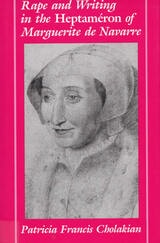
Rape and Writing in the Heptameron of Marguerite de Navarre
Patricia Francis Cholakian
Southern Illinois University Press, 1991
Marguerite de Navarre (1492–1549), the sister of the French king François I, composed the Heptaméron as a complex collection of seventy-two novellas, creating one of the first examples of realistic, psychological fiction in French literature. These novellas, framed by debates among ten storytellers, all noble lords and ladies, reveal the author’s desire to depart from the purely masculine voice of the age.
Cholakian contends that this Renaissance text is characterized by feminine writing. She reads the text as the product of the author’s personal experience. Beginning her study with the rape narrative in the autobiographical novella 4, she examines how the Heptaméron interacts with male literary traditions and narrative conventions about gender relations. She analyzes such words as rape, and honor, noting how they are defined differently by men and women and how these differences in perception affect the development of both plot and character.
Re-imagining Doctoral Writing
Cecile Badenhorst
University Press of Colorado, 2021
Re/Orienting Writing Studies
Queer Methods, Queer ProjectsWilliam P. Banks
Utah State University Press, 2018
While the humanities have engaged queer theory extensively, research methods have often been hermeneutic or interpretive. At the same time, social science approaches in composition research have foregrounded inquiry on human participants but have often struggled to understand where lesbian, gay, bisexual, transgender, and queer people fit into empirical research projects. Re/Orienting Writing Studies works at the intersections of humanities and social science methodologies to offer new insight into using queer methods for data collection and queer practices for framing research.
Contributors: Chanon Adsanatham, Jean Bessette, Nicole I. Caswell, Michael J. Faris, Hillery Glasby, Deborah Kuzawa, Maria Novotny, G Patterson, Stacey Waite, Stephanie West-Puckett
Re/Writing the Center
Approaches to Supporting Graduate Students in the Writing CenterSusan Lawrence
Utah State University Press, 2018
The essays in this volume show how to navigate the divide between traditional writing center theory and practices, developed to support undergraduate writers, and the growing demand for writing centers to meet the needs of advanced graduate writers. Contributors address core assumptions of writing center pedagogy, such as the concept of peers and peer tutoring, the emphasis on one-to-one tutorials, the positioning of tutors as generalists rather than specialists, and even the notion of the writing center as the primary location or center of the tutoring process. Re/Writing the Center offers an imaginative perspective on the benefits writing centers can offer to graduate students and on the new possibilities for inquiry and practice graduate students can inspire in the writing center.
Contributors: Laura Brady, Michelle Cox, Thomas Deans, Paula Gillespie, Mary Glavan, Marilyn Gray, James Holsinger, Elena Kallestinova, Tika Lamsal, Patrick S. Lawrence, Elizabeth Lenaghan, Michael A. Pemberton, Sherry Wynn Perdue, Doug Phillips, Juliann Reineke, Adam Robinson, Steve Simpson, Nathalie Singh-Corcoran, Ashly Bender Smith, Sarah Summers, Molly Tetreault, Joan Turner, Bronwyn T. Williams, Joanna Wolfe
Reaching All Writers
A Pedagogical Guide for Evolving College Writing ClassroomsJoanne Baird Giordano
Utah State University Press, 2023
Using threshold concepts and transfer as a foundation, the authors provide an invaluable resource for multiple contexts: instructors working off the tenure track and/or at multiple institutions; two-year college programs without a writing program administrator; and writing program graduate teaching assistant training courses. Each chapter includes an overview of a threshold concept, disciplinary background readings, practical teaching strategies, assignment and learning activity ideas, assessment principles, examples from student and instructor perspectives, and questions for reflection and discussion.
Reaching All Writers describes effective teaching practices to help all college writing instructors, regardless of their institutional contexts, make changes that support equitable and inclusive learning opportunities—with a focus on teaching students whose backgrounds and learning experiences are different from those with more educational or economic privilege. Both new and experienced teachers adapting first-year college writing courses will find the book’s blend of practical strategies and disciplinary knowledge a useful companion for facilitating new classroom and program needs or designing new teaching assistant training courses.
Reading and Writing Instruction in the Twenty-First Century
Recovering and Transforming the Pedagogy of Robert ScholesEllen C. Carillo
Utah State University Press, 2021
In this volume, Scholes’s scholarship is included alongside original essays, providing a resource for those considering everything from the place of the English major in the twenty-first century to best practices for helping students navigate misinformation and disinformation. Reading and Writing Instruction in the Twenty-First Century not only keeps Scholes’s legacy alive but carries it on through a commitment, in Scholes’s (1998) own words, to “offer our students . . . the cultural equipment they are going to need when they leave us.”
Contributors:
Angela Christie, Paul T. Corrigan, Lynée Lewis Gaillet, Doug Hesse, Alice S. Horning, Emily J. Isaacs, Christopher La Casse, Robert Lestón, Kelsey McNiff, Thomas P. Miller, Jessica Rivera-Mueller, Christian Smith, Kenny Smith
Reading and Writing the Ambiente
Queer Sexualities in Latino, Latin American, and Spanish CultureSusana Chávez-Silverman
University of Wisconsin Press, 2000
In this dynamic collection of essays, many leading literary scholars trace gay and lesbian themes in Latin American, Hispanic, and U.S. Latino literary and cultural texts. Reading and Writing the Ambiente is consciously ambitious and far-ranging, historically as well as geographically. It includes discussions of texts from as early as the seventeenth century to writings of the late twentieth century.
Reading and Writing the Ambiente also underscores the ways in which lesbian and gay self-representation in Hispanic texts differs from representations in Anglo-American texts. The contributors demonstrate that—unlike the emphasis on the individual in Anglo- American sexual identity—Latino, Spanish, and Latin American sexual identity is produced in the surrounding culture and community, in the ambiente. As one of the first collections of its kind, Reading and Writing the Ambiente is expressive of the next wave of gay Hispanic and Latin scholarship.
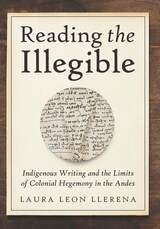
Reading the Illegible
Indigenous Writing and the Limits of Colonial Hegemony in the AndesLaura Leon Llerena
University of Arizona Press, 2023
The concept of legibility allows us to reconsider this unique manuscript within the intertwined histories of literacy, knowledge, and colonialism. Reading the Illegible shows that the anonymous author(s) of the Huarochirí Manuscript, along with two contemporaneous Andean-authored texts by Joan de Santa Cruz Pachacuti and Felipe Guaman Poma de Ayala, rewrote the history of writing and the notion of Christianity by deploying the colonizers’ technology of alphabetic writing.
Reading the Illegible weaves together the story of the peoples, places, objects, and media that surrounded the creation of the anonymous Huarochirí Manuscript to demonstrate how Andean people endowed the European technology of writing with a new social role in the context of a multimedia society.

Reading, Research, And Writing
Teaching InformationMary Snyder Broussard
Assoc of College & Research Libraries, 2017
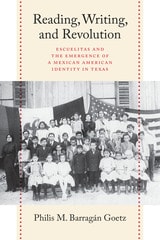
Reading, Writing, and Revolution
Escuelitas and the Emergence of a Mexican American Identity in TexasBy Philis M. Barragán Goetz
University of Texas Press, 2020
2022 National Association for Chicana and Chicano Studies Book Award
Tejas Foco Non-fiction Book Award, National Association for Chicana and Chicano Studies
2021 Tejano Book Prize, Tejano Genealogy Society of Austin
2021 Jim Parish Award for Documentation and Publication of Local and Regional History, Webb County Heritage Foundation
2021 Runner-up, Ramirez Family Award for Most Significant Scholarly Book
The first book on the history of escuelitas, Reading, Writing, and Revolution examines the integral role these grassroots community schools played in shaping Mexican American identity.
Language has long functioned as a signifier of power in the United States. In Texas, as elsewhere in the Southwest, ethnic Mexicans’ relationship to education—including their enrollment in the Spanish-language community schools called escuelitas—served as a vehicle to negotiate that power. Situating the history of escuelitas within the contexts of modernization, progressivism, public education, the Mexican Revolution, and immigration, Reading, Writing, and Revolution traces how the proliferation and decline of these community schools helped shape Mexican American identity.
Philis M. Barragán Goetz argues that the history of escuelitas is not only a story of resistance in the face of Anglo hegemony but also a complex and nuanced chronicle of ethnic Mexican cultural negotiation. She shows how escuelitas emerged and thrived to meet a diverse set of unfulfilled needs, then dwindled as later generations of Mexican Americans campaigned for educational integration. Drawing on extensive archival, genealogical, and oral history research, Barragán Goetz unravels a forgotten narrative at the crossroads of language and education as well as race and identity.
Rearticulating Writing Assessment for Teaching and Learning
Brian Huot
Utah State University Press, 2002
Brian Huot's aim for this book is both ambitious and provocative. He wants to reorient composition studies' view of writing assessment. To accomplish this, he not only has to inspire the field to perceive assessment--generally not the most appreciated area of study--as deeply significant to theory and pedagogy, he also has to counter some common misconceptions about the history of assessment in writing. In (Re)Articulating Writing Assessment, Huot advocates a new understanding, a more optimistic and productive one than we have seen in composition for a very long time. Assessment, as Huot points out, defines what is valued by a teacher or a society. What isn't valued isn't assessed; it tends to disappear from the curriculum. The dark side of this truth is what many teachers find troubling about large scale assessments, as standardized tests don't grant attention or merit to all they should. Instead, assessment has been used as an interested social mechanism for reinscribing current power relations and class systems.
Reasons and Feelings
Writing for the Humanities NowSarah Mesle
University of Chicago Press, 2025
Humanities experts today are embattled. In a world of crises undermining higher education at every turn, what can still motivate humanists to write? Galvanizing, imaginative, and unrepentantly nerdy, Sarah Mesle’s Reasons and Feeling offers practical writing and publishing advice alongside a forcefully affirmative account of why humanities writing matters.
Mesle proposes that writing can help envision sustainable community, but only when we recognize that humanist authority comes from both our reasons and our feelings. Alongside everyday compositional advice—including strategies for addressing different audiences, pitching publications, and managing writing anxiety—readers will find an account of how such craft practices connect to both their intellectual commitments and their historical conditions. Mesle shows how university-trained writers at all levels benefit from embracing a broader range of styles and affects. Doing so helps them harness their writing’s community-building potential and makes them better able to value their own expertise, whether they write for the classroom, in public venues, or for the specialized scholarly communities that share their niche, weird, or beloved, objects of study.
Reasons and Feelings draws on Mesle’s expertise as a professor of writing and her work as an editor helping academics shift between writing for scholarly venues and journalistic ones. In a voice that’s honest, warm, accessible, and bracingly funny, Reasons and Feelings gives humanists a path toward bolder fantasies of the worlds their writing can make.
Reclaiming Accountability
Improving Writing Programs through Accreditation and Large-Scale AssessmentsWendy Sharer
Utah State University Press, 2016
Reclaiming Accountability brings together a series of critical case studies of writing programs that have planned, implemented, and/or assessed the impact of large-scale accreditation-supported initiatives. The book reimagines accreditation as a way to leverage institutional or programmatic change.
Contributions to the volume are divided into three parts. Part 1 considers how specialists in composition and rhetoric can work most productively with accrediting bodies to design assessments and initiatives that meet requirements while also helping those agencies to better understand how writing develops and how it can most effectively be assessed. Parts 2 and 3 present case studies of how institutions have used ongoing accreditation and assessment imperatives to meet student learning needs through programmatic changes and faculty development. They provide concrete examples of productive curricular (part 2) and instructional (part 3) changes that can follow from accreditation mandates while providing guidance for navigating challenges and pitfalls that WPAs may encounter within shifting and often volatile local, regional, and national contexts.
In addition to providing examples of how others in the profession might approach such work, Reclaiming Accountability addresses assessment requirements beyond those in the writing program itself. It will be of interest to department heads, administrators, writing program directors, and those involved with writing teacher education, among others.
Contributors: Linda Adler-Kassner, William P. Banks, Remica Bingham-Risher, Melanie Burdick, Polina Chemishanova, Malkiel Choseed, Kyle Christiansen, Angela Crow, Maggie Debelius, Michelle F. Eble, Jonathan Elmore, Lorna Gonzalez, Angela Green, Jim Henry, Ryan Hoover, Rebecca Ingalls, Cynthia Miecznikowski, Susan Miller-Cochran, Cindy Moore, Tracy Ann Morse, Joyce Magnotto Neff, Karen Nulton, Peggy O’Neill, Jessica Parker, Mary Rist, Rochelle Rodrigo, Tulora Roeckers, Shirley K. Rose, Iris M. Saltiel, Wendy Sharer, Terri Van Sickle, Jane Chapman Vigil, David M. Weed
Reclaiming the Rural
Essays on Literacy, Rhetoric, and PedagogyEdited by Kim Donehower, Charlotte Hogg, and Eileen E. Schell
Southern Illinois University Press, 2012
In Reclaiming the Rural: Essays on Literacy, Rhetoric, and Pedagogy, editors Kim Donehower, Charlotte Hogg, and Eileen E. Schell bring together a diverse collection of essays that consider literacy, rhetoric, and pedagogy in the United States, Canada, and Mexico. The essays move beyond the typical arguments for preserving, abandoning, or modernizing by analyzing how rural communities sustain themselves through literate action. The contributors explore the rhetorics of water disputes in the western United States, the histories and influences of religious rhetorics in Mexico, agricultural and rural literacy curricula, the literacies of organizations such as 4-H and Academia de la Nueva Raza, and neoliberal rhetorics. Central to these examinations are the rural populations themselves, which include indigenous peoples in the rural United States, Canada, and Mexico, as well as those of European or other backgrounds.
The strength of the anthology lies in its multiple perspectives, various research sites, and the range of methodologies employed, including rhetorical analyses of economies and environments, media, and public spaces; classroom-based research; historical analysis and archival work; and qualitative research. The researchers engage the duality between the practices of everyday life in rural communities and the practices of reflecting on and making meaning.
Reclaiming the Rural reflects the continually changing, nuanced, context-dependent realities of rural life while acknowledging the complex histories, power struggles, and governmental actions that have affected and continue to affect the lives of rural citizens. This thought-provoking collection demonstrates the value in reclaiming the rural for scholarly and pedagogical analysis.
Reconceptualizing Response
Using Instructor Feedback to Promote Linguistic JusticeKelly Blewett
Utah State University Press, 2026
Reconceptualizing Response reframes instructor feedback, one of the most consequential practices in rhetoric and writing studies, as a site of linguistic justice. Instructor response is not merely technical commentary; it is contested terrain where students’ identities, experiences, and language varieties must be named, supported, and celebrated.
Contributors represent a wide range of institutional contexts—including two-year colleges, four-year universities, HBCUs, HSIs, SLACs, and PWIs—and write from diverse positionalities, amplifying current debates and productive tensions in the field. Organized around four key moves—looking back, looking within, looking up, and looking around—the book invites readers to critically examine the ideologies underlying feedback practices; recognize how instructors' positionality, values, and beliefs are communicated through feedback; align feedback with students’ needs; and reconsider the broader classroom ecology required for justice. Bridging linguistic justice and feedback studies, this collection provides concrete tools and frameworks, as well as sample rubrics, course policies, and fresh approaches to assessment.
Ideal for graduate students, writing program administrators, faculty teaching future writing instructors, and anyone seeking to transform classroom practice, Reconceptualizing Response offers guiding questions for reflection and practical strategies for change. This volume reimagines instructor response as a catalyst for equity, consciousness-raising, and transformation, calling instructors not only to comment on writing but also to use feedback to dismantle oppressive logics and foster linguistic justice.
Reconstructing Response to Student Writing
A National Study from across the CurriculumDan Melzer
Utah State University Press, 2023
Presenting the results of a national study of teacher and peer response and student self-assessment at institutions of higher education across the United States, Melzer analyzes teacher and peer response to over 1,000 pieces of student writing as well as 128 student portfolio reflection essays. He draws on his analysis and on a comprehensive review of the literature on response to introduce a constructivist heuristic for response aimed at both composition instructors and instructors across disciplines. Melzer argues that teachers and researchers should focus less on teacher response to individual pieces of student writing and more on engaging in dialogue with student self-assessment and peer response, focusing on growth and transfer rather than products and grades.
Reconstructing Response to Student Writing, especially when taken together with Melzer’s previous book Assignments across the Curriculum, provides a comprehensive and large-scale view of college writing and responding across the curriculum in the United States.
Redefining Roles
The Professional, Faculty, and Graduate Consultant’s Guide to Writing CentersMegan Swihart Jewell
Utah State University Press, 2021
Thirty-two authors, consultants, and administrators from diverse centers—from large public four-year institutions to a private, online for-profit university—provide both theoretical frameworks and practical applications in eighteen chapters. Ten chapters focus on graduate consultants and address issues of authority, training, professional development, and mentoring, and eight focus on professional and faculty consultant training as well as specific issues of identity and authority. By sharing these voices, Redefining Roles broadens the very idea of writing centers while opening the door to more dialogue on the important role these practitioners play.
Redefining Roles is designed for writing center practitioners, scholars, and staff. It is also a necessary addition to help campus administrators in the ongoing struggle to validate the intellectually complex work that such staff performs.
Contributors: Fallon N. Allison, Vicki Behrens, Cassie J. Brownell, Matt Burchanoski, Megan Boeshart Burelle, Danielle Clapham, Steffani Dambruch, Elise Dixon, Elizabeth Festa, Will Fitzsimmons, Alex Frissell, Alex Funt, Genie Giaimo, Amanda Gomez, Lisa Lamson, Miriam E. Laufer, Kristin Messuri, Rebecca Nowacek, Kimberly Fahle Peck, Mark Pedretti, Irina Ruppo, Arundhati Sanyal, Anna Scanlon, Matthew Sharkey-Smith, Kelly A. Shea, Anne Shiell, Anna Sicari, Catherine Siemann, Meagan Thompson, Lisa Nicole Tyson, Marcus Weakley, Alex Wulff
Reflection In The Writing Classroom
Kathleen Blake Yancey
Utah State University Press, 1998
Yancey explores reflection as a promising body of practice and inquiry in the writing classroom. Yancey develops a line of research based on concepts of philosopher Donald Schon and others involving the role of deliberative reflection in classroom contexts. Developing the concepts of reflection-in-action, constructive reflection, and reflection-in-presentation, she offers a structure for discussing how reflection operates as students compose individual pieces of writing, as they progress through successive writings, and as they deliberately review a compiled body of their work-a portfolio, for example. Throughout the book, she explores how reflection can enhance student learning along with teacher response to and evaluation of student writing.
Reflection in the Writing Classroom will be a valuable addition to the personal library of faculty currently teaching in or administering a writing program; it is also a natural for graduate students who teach writing courses, for the TA training program, or for the English Education program.
Reflection-in-Motion
Reimagining Reflection in the Writing ClassroomJaclyn Fiscus-Cannaday
Utah State University Press, 2024
underrepresented viewpoints about how reflection works in the writing classroom. Jaclyn Fiscus-Cannaday examines how its availability is subject to teacher/student power dynamics, the literacies welcomed (or not) in the class, the past and present pedagogies that students are engaging with and attending to, and the interactions among humans, materials, and emotions within the rhetorical context. She adopts an intersectional feminist perspective for an inclusive view of how practitioners name, identify, and practice reflection in the everyday moments of writing classrooms.
Fiscus-Cannaday invokes a Black feminist qualitative research method that Venus Evans-Winters calls a “mosaic.” When researchers collect both traditional and nontraditional texts to create a full view of students’ and teachers’ interviews at three institutions (a Hispanic Serving Institution, a Historically Black College and University, and an Asian American Native American Pacific Islander Serving Institution), she finds that practitioners often build definitions from past experiences with reflection—and then use those definitions as terministic screens to decide if an activity can be named, identified, and practiced as reflection. These definitions hold different rhetorical effects: reflection-for-introspection, reflection-for-learning, reflection-for-mindfulness, and reflection-for-awareness.
Reflection is used for these different rhetorical effects, but because classrooms so often focus on the Westernized view and its emphasis on growth, reflection has the underused and undertheorized potential rhetorical effect of helping students investigate their identities and positionalities, acknowledge deep-rooted ideologies, and consider new perspectives so they can better work across difference. Reflection-in-Motion will inspire teachers and writing program administrators to listen to how students define and practice reflection and why—thus making room for more capacious definitions of reflection and student-centered practices of what reflection can do and be.
Reformers, Teachers, Writers
Curricular and Pedagogical InquiriesNeal Lerner
Utah State University Press, 2019
Lerner’s mixed-methods approach—quantitative, qualitative, textual, historical, narrative, and theoretical—reflects the importance and effects of curriculum in a wide variety of settings, whether in writing centers, writing classrooms, or students’ out-of-school lives, as well as the many methodological approaches available to understand curriculum in writing studies. The richness of this approach allows for multiple considerations of the distinction and relationship between pedagogy and curriculum. Chapters are grouped into three parts: disciplinary inquiries, experiential inquiries, and empirical inquiries, exploring the presence and effect of curriculum and its relationship to pedagogy in multiple sites, both historical and contemporary, and for multiple stakeholders.
Reformers, Teachers, Writers calls out writing studies’ inattention to curriculum, which hampers efforts to enact meaningful reform and to have an impact on larger conversations about education and writing. The book will be invaluable to scholars, teachers, and administrators interested in rhetoric and composition, writing studies, and education.
Reframing Writing Assessment to Improve Teaching and Learning
Linda Adler-Kassner
Utah State University Press, 2010
Adler-Kassner and O'Neill show writing faculty and administrators how to frame discussions of writing assessment so that they accurately represent research-based practices, and promote assessments that are valid, reliable, and discipline-appropriate.
Public discourse about writing instruction is currently driven by ideas of what instructors and programs “need to do,” “should do,” or “are not doing,” and is based on poorly informed concepts of correctness and unfounded claims about a broad decline in educational quality. This discussion needs to be reframed, say Adler-Kassner and O'Neill, to help policymakers understand that the purpose of writing instruction is to help students develop critical thinking, reading, and writing strategies that will form the foundation for their future educations, professional careers, and civic engagement.
Reframing Writing Assessment to Improve Teaching and Learning is grounded in the best of writing assessment research, and focuses on how to communicate it effectively to publics beyond academe.
Rehearsing New Roles
How College Students Develop as WritersLee Ann Carroll
Southern Illinois University Press, 2002
In Rehearsing New Roles: How College Students Develop as Writers, Lee Ann Carroll argues for a developmental perspective to counter the fantasy held by many college faculty that students should, or could, be taught to write once so that ever after, they can write effectively on any topic, any place, any time. Carroll demonstrates in this volume why a one- or two-semester, first-year course in writing cannot meet all the needs of even more experienced writers. She then shows how students’ complex literacy skills develop slowly, often idiosyncratically, over the course of their college years, as they choose or are coerced to take on new roles as writers.
As evidence, Carroll offers a longitudinal study of a group of students and the literacy environment they experienced in a midsize, independent university. Her study follows the experiences that altered their conception of writing in college and fostered their growing capacities as writers.
Carroll’s analysis of the data collected supports a limited but still useful role for first-year composition, demonstrates how students do learn to write differently across the curriculum in ways that may or may not be recognized by faculty, and evaluates the teaching and learning practices that promote or constrain students’ development.
Reimagining Process
Online Writing Archives and the Future of Writing StudiesKyle Jensen
Southern Illinois University Press, 2015
For more than four decades, the dominant model for pedagogy and research in the field of composition has been a how-centered process approach to writing instruction, which involves studying the writing that students produce to expose the various stages of their writing process. By looking at notes, outlines, and multiple drafts, often presented by students together in the form of a portfolio, instructors can identify unproductive habits that students may have and provide techniques that help them improve their writing. In this groundbreaking volume, Kyle Jensen critiques traditional how-centered process instruction and presents a sound, practical methodology by which portfolios and online writing archives—digital interfaces that expose the marks of revision writers make during composition—might be employed to develop theories about what writing is: how it occurs, functions, circulates, creates meaning, and forms its subjects. Offering online writing archives as a way to envision a transdisciplinary approach to writing studies, Reimagining Process does not abandon the prevailing concepts of process pedagogy but rather casts them in wider contexts to conceive new ways of teaching and studying writing.
Reinventing (with) Theory in Rhetoric and Writing Studies
Essays in Honor of Sharon CrowleyAndrea Alden
Utah State University Press, 2019
For Crowley, theory is a basic building block of rhetoric “produced by and within specific times and locations as a means of opening other ways of believing or acting.” Doing theory, in this sense, is the practice of surveying the common sense of the community (doxa) and discovering the available means of persuasion (invention). The ultimate goal of doing theory is not to prescribe certain actions but to ascertain what options exist for rhetors to see the world differently, to discover new possibilities for thought and action, and thereby to effect change in the world.
The scholarship collected in Reinventing (with) Theory in Rhetoric and Writing Studies takes Crowley’s notion of theory as an invitation to develop new avenues for believing and acting. By reinventing the understanding of theory and its role in the field, this collection makes an important contribution to scholarship in rhetorical studies and writing studies. It will be valuable to scholars, teachers, and students interested in diverse theoretical directions in rhetoric and writing studies as well as in race, gender, and disability theories, religious rhetorics, digital rhetoric, and the history of rhetoric.
Publication supported in part by the Texas Tech University Humanities Center.
Contributors: Jason Barrett-Fox, Geoffrey Clegg, Kirsti Cole, Joshua Daniel-Wariya, Diane Davis, Rebecca Disrud, Bre Garrett, Catherine C. Gouge, Debra Hawhee, Matthew Heard, Joshua C. Hilst, David G. Holmes, Bruce Horner, William B. Lalicker, Jennifer Lin LeMesurier, James C. McDonald, Timothy Oleksiak, Dawn Penich-Thacker, J. Blake Scott, Victor J. Vitanza, Susan Wyche
Reinventing The University
Literacies and Legitimacy in the Postmodern AcademyChristopher L. Schroeder
Utah State University Press, 2001
Christopher Schroeder spends almost no time disputing David Bartholomae's famous essay, but throughout ReInventing the University, he elaborates an approach to teaching composition that is at odds with the tradition that essay has come to represent.
On the other hand, his approach is also at odds with elements of the pedagogies of such theorists as Berlin, Bizzell, and Shor. Schroeder argues that, for students, postmodern instability in literacy and meaning has become a question of the legitimacy of current discourse of education. Schroeder is committed, then, to constructing literacies jointly with students and by so doing to bringing students to engage more deeply with education and society.
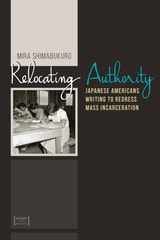
Relocating Authority
Japanese Americans Writing to Redress Mass IncarcerationMira Shimabukuro
University Press of Colorado, 2015
Relocating Authority examines the ways Japanese Americans have continually used writing to respond to the circumstances of their community’s mass imprisonment during World War II. Using both Nikkei cultural frameworks and community-specific history for methodological inspiration and guidance, Mira Shimabukuro shows how writing was used privately and publicly to individually survive and collectively resist the conditions of incarceration.
Examining a wide range of diverse texts and literacy practices such as diary entries, note-taking, manifestos, and multiple drafts of single documents, Relocating Authority draws upon community archives, visual histories, and Asian American history and theory to reveal the ways writing has served as a critical tool for incarcerees and their descendants. Incarcerees not only used writing to redress the “internment” in the moment but also created pieces of text that enabled and inspired further redress long after the camps had closed.
Relocating Authority highlights literacy’s enduring potential to participate in social change and assist an imprisoned people in relocating authority away from their captors and back to their community and themselves. It will be of great interest to students and scholars of ethnic and Asian American rhetorics, American studies, and anyone interested in the relationship between literacy and social justice.
Remixing Composition
A History of Multimodal Writing PedagogyJason Palmeri
Southern Illinois University Press, 2012
Using the concept of the remix, Palmeri outlines practical pedagogical suggestions for how writing teachers can build upon this heritage with digital activities, assignments, and curricula that meet the needs of contemporary students. He details a pluralist vision of composition pedagogy that explains the ways that writing teachers can synthesize expressivist, cognitive, and social-epistemic approaches.
Palmeri reveals an expansive history of now forgotten multimodal approaches to composing moving images and sounds and demonstrates how current compositionists can productively remix these past pedagogies to address the challenges and possibilities of the contemporary digital era. A strikingly original take on the recent history of composition, Remixing Composition is an important work for the future of writing instruction in a digital age.
Representations
Doing Asian American RhetoricLuMing Mao and Morris Young
Utah State University Press, 2008
Mao, Young, and their contributors propose that Asian American discourse should be seen as a spacious form, one that deliberately and selectively incorporates Asian “foreign-ness” into the English of Asian Americans. These authors offer the concept of a dynamic “togetherness-in-difference” as a way to theorize the contact and mutual influence. Chapters here explore a rich diversity of histories, theories, literary texts, and rhetorical practices. Collectively, they move the scholarly discussion toward a more nuanced, better balanced, critically informed representation of the forms of Asian American rhetorics and the cultural work that they do.

Repurposing Composition
Feminist Interventions for a Neoliberal AgeShari J. Stenberg
Utah State University Press, 2015
In Repurposing Composition, Shari J. Stenberg responds to the increasing neoliberal discourse of academe through the feminist practice of repurposing. In doing so, she demonstrates how tactics informed by feminist praxis can repurpose current writing pedagogy, assessment, public engagement, and other dimensions of writing education.
Stenberg disrupts entrenched neoliberalism by looking to feminism’s long history of repurposing “neutral” practices and approaches to the rhetorical tradition, the composing process, and pedagogy. She illuminates practices of repurposing in classroom moments, student writing, and assessment work, and she offers examples of institutions, programs, and individuals that demonstrate a responsibility approach to teaching and learning as an alternative to top-down accountability logic.
Repurposing Composition is a call for purposes of work in composition and rhetoric that challenge neoliberal aims to emphasize instead a public-good model that values difference, inclusion, and collaboration.
Rescuing the Subject, 2nd Edition
A Critical Introduction to Rhetoric and the WriterSusan Miller. Foreword by Thomas P. Miller
Southern Illinois University Press, 2004
When it was first published in 1989, Susan Miller’s Rescuing the Subject: A Critical Introduction to Rhetoric and the Writer established a landmark pedagogical approach to composition based on the importance of the writer and the act of writing in the history of rhetoric. Widely used as an introduction to rhetoric and composition theory for graduate students, the volume was the first winner of the W. Ross Winterowd Award from JAC and is still one of the most frequently cited books in the field.
This first paperback edition includes a new introductory chapter in which Miller addresses changes in the field since the first edition, outlines new research, and surveys positions she no longer supports. A new foreword by Thomas P. Miller assesses the proven impact of Rescuing the Subject on the field of rhetoric and composition.
Situating modern composition theory in the historical context of rhetoric, Miller notes that throughout the eighteenth century, rhetoric referred to oral, not written, discourse. By contrast, her history of rhetoric contends oral and written discourse were related from the beginning. Taking a thematic rather than chronological approach, she shows how actual acts of writing comment on both rhetoric and composition.
Miller also asserts that contemporary composition study is the necessary cultural outcome of changing conditions for producing discourse, describing the history of rhetoric as the gradual and unstable relocation of discourse in conventions that only written language can create. She maintains teachers and historians of rhetoric must recognize that the contemporary writing they analyze and teach demands their attention to a “textual rhetoric” that allows theorizing the writer as always symbolically a student of situated meanings.
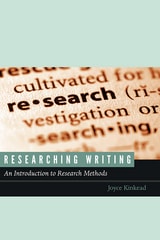
Researching Writing
An Introduction to Research MethodsJoyce Kinkead
Utah State University Press, 2016
Author Joyce Kinkead lays out the research process, including finding and defining questions, planning, and starting the research. Expository content introduces the language and methods of writing research, and specific methods are demonstrated in published examples, illustrating student work using student work and showing that it is possible for students to join the scholarly conversation in writing studies. Other features include student activities, instructor resources, student resources, and links to external content on journal websites, digital publications, YouTube, and similar work.
The first-ever textbook for research methods in writing studies for undergraduates, Researching Writing takes a hands-on approach that excites and engages students in the depth and complexities of research and will influence the creation of courses in new writing majors as the field continues to grow.

Responding to Writing
A Practical Sourcebook for InstructorsDana R. Ferris, Grant Eckstein, and Betsy Gilliland
University of Michigan Press, 2027
Responding to Writing brings together practical, cutting-edge ideas from teachers who spend their days working with student writers and trying to make feedback genuinely useful. The book shares classroom approaches that have been tested in real courses, from high school settings to college and graduate programs. It shows how teachers, peers, and students themselves can make feedback a more collaborative and manageable part of writing instruction.
Each chapter presents a student‑centered approach that helps writers feel supported and more in control of their own writing and revision process. In addition to a summary of the approach with light background and context, readers will find straightforward examples, tools, and routines they can adapt to their own classrooms, including ways to use technology, build reflection into assignments, and support writers with varied backgrounds and needs. This book offers working instructors a set of dependable methods for helping students improve as writers while keeping feedback purposeful and humane.
Response to Reform
Composition and the Professionalization of TeachingMargaret J. Marshall
Southern Illinois University Press, 2003
Response to Reform: Composition and the Professionalization of Teaching critiques the politics of labor and gender biases inherent in the composition workplace that prevent literacy teachers from attaining professional status and respect. Scrutinizing the relationship between scholarship and teaching, Margaret J. Marshall calls for a reconceptualization of what it means to prepare for and enter the field of composition instruction.
Interrogating the approach the education system takes to certify teachers without actually “professionalizing” their careers, Marshall contends that these programs rely on outdated rhetorics of labor that only widen the gap between teaching and other professional jobs. Such attempts to re-educate literacy teachers exploit and marginalize their work, and thus prevent them from claiming the status of academic professionals. In providing an overview of the history of and language used to literacy instruction, she also points out that while women are overrepresented in composition instruction, they are underrepresented in tenure track and administrative positions.
To correct and combat these inequities, Marshall advocates an alternate alignment of power structures and rhetorical choices. In a wide-ranging survey that sheds new light on the composition workplace as well as higher education at large, Response to Reform: Composition and the Professionalization of Teaching boldly asks us to do away with the reductive language we inherit from the past that characterize teaching and professionalization, as well as our customary responses to public criticism of education. The result is a new articulation of composition as a meritorious profession.
Retention and Resistance
Writing Instruction and Students Who LeavePegeen Reichert Powell
Utah State University Press, 2014
Retention is a vital issue for institutions, but as these students’ stories show, leaving college is often the result of complex and idiosyncratic individual situations that make institutional efforts difficult and ultimately ineffective. An adjustment of institutional and pedagogical objectives is needed to refocus on educating as many students as possible, including those who might leave before graduation.
Much of the pedagogy, curricula, and methodologies of composition studies assume students are preparing for further academic study. Retention and Resistance argues for a new kairotic pedagogy that moves toward an emphasis on the present classroom experience and takes students’ varied experiences into account. Infusing the discourse of retention with three individual student voices, Powell explores the obligation of faculty to participate in designing an institution that educates all students, no matter where they are in their educational journey or how far that journey will go.
Retention, Persistence, and Writing Programs
Todd Ruecker
Utah State University Press, 2017
From scholars working in a variety of institutional and geographic contexts and with a wide range of student populations, Retention, Persistence, and Writing Programs offers perspectives on how writing programs can support or hinder students’ transitions to college. The contributors present individual and program case studies, student surveys, a wealth of institutional retention data, and critical policy analysis.
Rates of student retention in higher education are a widely acknowledged problem: although approximately 66 percent of high school graduates begin college, of those who attend public four-year institutions, only about 80 percent return the following year, with 58 percent graduating within six years. At public two-year institutions, only 60 percent of students return, and fewer than a third graduate within three years. Less commonly known is the crucial effect of writing courses on these statistics.
First-year writing is a course that virtually all students have to take; thus, writing programs are well-positioned to contribute to larger institutional conversations regarding retention and persistence and should offer themselves as much-needed sites for advocacy, research, and curricular innovation. Retention, Persistence, and Writing Programs is a timely resource for writing program administrators as well as for new writing teachers, advisors, administrators, and state boards of education.
Contributors: Matthew Bridgewater, Cristine Busser, Beth Buyserie, Polina Chemishanova, Michael Day, Bruce Feinstein, Patricia Freitag Ericsson, Nathan Garrett, Joanne Baird Giordano, Tawanda Gipson, Sarah E. Harris, Mark Hartlaub, Holly Hassel, Jennifer Heinert, Ashley J. Holmes, Rita Malenczyk, Christopher P. Parker, Cassandra Phillips, Anna Plemons, Pegeen Reichert Powell, Marc Scott, Robin Snead, Sarah Elizabeth Snyder, Sara Webb-Sunderhaus, Susan Wolff Murphy
Rethinking Peer Review
Critical Reflections on a Pedagogical PracticePhoebe Jackson
University Press of Colorado, 2024
Rethinking Racism
Emotion, Persuasion, and Literacy Education in an All-White High SchoolJennifer Seibel Trainor
Southern Illinois University Press, 2008
In Rethinking Racism: Emotion, Persuasion, and Literacy Education in an All-White High School, Jennifer Seibel Trainor proposes a new understanding of the roots of racism, one that is based on attention to the role of emotion and the dynamics of persuasion. This one-year ethnographic study argues against previous assumptions about racism, demonstrating instead how rhetoric and emotion, as well as the processes and culture of schools, are involved in the formation of racist beliefs.
Telling the story of a year spent in an all-white high school, Trainor suggests that contrary to prevailing opinion, racism often does not stem from ignorance, a lack of exposure to other cultures, or the desire to protect white privilege. Rather, the causes of racism are frequently found in the realms of emotion and language, as opposed to rational calculations of privilege or political ideologies. Trainor maintains that racist assertions often originate not from prejudiced attitudes or beliefs but from metaphorical connections between racist ideas and nonracist values. These values are reinforced, even promoted by schooling via "emotioned rules" in place in classrooms: in tacit, unexamined lessons, rituals, and practices that exert a powerful—though largely unacknowledged—persuasive force on student feelings and beliefs about race.
Through in-depth analysis of established anti-racist pedagogies, student behavior, and racial discourses, Trainor illustrates the manner in which racist ideas are subtly upheld through social and literacy education in the classroom—and are thus embedded in the infrastructures of schools themselves. It is the emotional and rhetorical framework of the classroom that lends racism its compelling power in the minds of students, even as teachers endeavor to address the issue of cultural discrimination. This effort is continually hindered by an incomplete understanding of the function of emotions in relation to antiracist persuasion and cannot be remedied until the root of the problem is addressed.
Rethinking Racism calls for a fresh approach to understanding racism and its causes, offering crucial insight into the formative role of schooling in the perpetuation of discriminatory beliefs. In addition, this highly readable narrative draws from white students' own stories about the meanings of race in their learning and their lives. It thus provides new ways of thinking about how researchers and teachers rep- resent whiteness. Blending narrative with more traditional forms of ethnographic analysis, Rethinking Racism uncovers the ways in which constructions of racism originate in literacy research and in our classrooms—and how these constructions themselves can limit the rhetorical positions students enact.
Rethinking Your Writing
Rhetoric for Reflective WritersE. Shelley Reid
University Press of Colorado, 2025
Created from the start as an online book, Rethinking also helps support instructors as they engage students with many kinds of writing tasks, from typical first-year assignments like narratives and research-based arguments to writing that happens in response to more complex rhetorical situations, such as community-based writing, writing in multiple genres, and writing across disciplines:
- The modular, cross-linked design helps faculty assign and students locate information needed for any writing situation.
- In-depth, student-friendly sections guide students’ thinking on vital but less visible elements of writing, such as threshold concepts, rhetorical analysis, reflective practice, peer review, writers’ dispositions, critical reading, research processes, and questions of equity.
- A book-wide focus on how writers choose their approaches based on their goals, resources, and constraints supports learners who are exploring new genres and audiences, and lays the groundwork for discussion of how writers use tools like Generative AI.
- More than 70 innovative writing exercises help writers explore and practice relevant strategies.
In Rethinking Your Writing, E. Shelley Reid provides a versatile guide that can be tailored to the needs of almost any course or classroom. Whether you select a single module to supplement your current resources or use the text throughout your course, this book is designed to help you engage your students and deepen their understanding of how writers learn and succeed in school, their careers, and beyond.
Rethinking Zapotec Time
Cosmology, Ritual, and Resistance in Colonial MexicoDavid Tavárez
University of Texas Press, 2022
2024 — Best Book in Colonial Latin American Studies — Colonial Section, Latin American Studies Association
2023 — Best Subsequent Book — Native American and Indigenous Studies Association
2023 — Honorable Mention, Best Book in the Social Sciences — Latin American Studies Association, Mexico Section
2022 — Marysa Navarro Best Book Prize — New England Council of Latin American Studies
As the first exhaustive translation and analysis of an extraordinary Zapotec calendar and ritual song corpus, seized in New Spain in 1704, this book expands our understanding of Mesoamerican history, cosmology, and culture.
In 1702, after the brutal suppression of a Zapotec revolt, the bishop of Oaxaca proclaimed an amnesty for idolatry in exchange for collective confessions. To evade conflict, Northern Zapotec communities denounced ritual specialists and surrendered sacred songs and 102 divinatory manuals, which preserve cosmological accounts, exchanges with divine beings, and protocols of pre-Columbian origin that strongly resemble sections of the Codex Borgia. These texts were sent to Spain as evidence of failed Dominican evangelization efforts, and there they remained, in oblivion, until the 1960s.
In this book, David Tavárez dives deep into this formidable archive of ritual and divinatory manuals, the largest calendar corpus in the colonial Americas, and emerges with a rich understanding of Indigenous social and cultural history, Mesoamerican theories of cosmos and time, and Zapotec ancestor worship. Drawing on his knowledge of Zapotec and Nahuatl, two decades of archival research, and a decade of fieldwork, Tavárez dissects Mesoamerican calendars as well as Native resistance and accommodation to the colonial conquest of time, while also addressing entangled transatlantic histories and shining new light on texts still connected to contemporary observances in Zapotec communities.
Revising Moves
Writing Stories of (Re)MakingChristina LaVecchia
Utah State University Press, 2024
In these narrative-driven essays written by a wide range of writing professionals, Revising Moves describes revision as a messy, generative, and often collaborative act. These meditations reveal how revision is both a micro practice tracked by textual change and a macro phenomenon rooted in family life, institutional culture, identity commitments, and political and social upheaval. Contributors depict revision as a holistic undertaking and a radically contextualized, distributed practice that showcases its relationality to everything else. Authors share their revision processes when creating scholarly works, institutional and self-promoting documents, and creative projects. Through narrative the volume opens a window to what is often unseen in a finished text: months or years of work, life events that disrupt or alter writing plans, multiple draft changes, questions about writerly identity and positionality, layers of (sometimes contradictory) feedback, and much more.
Revisionary Rhetoric, Feminist Pedagogy, and Multigenre Texts
Julie Jung
Southern Illinois University Press, 2005
In this precise and provocative treatise, Julie Jung augments the understanding and teaching of revision by arguing that the process should entail changing attitudes rather than simply changing texts. Revisionary Rhetoric, Feminist Pedagogy, and Multigenre Texts proposes and demonstrates alternative ways of reading, writing, and teaching that hear silences in such a way as to generate personal, pedagogical, and professional revisions. As both a challenge to prevailing revision pedagogies and an elaboration of contemporary feminist rhetorics, the volume encourages students and instructors to examine their identities as scholars of rhetoric and composition and to question how and why revision is taught.
Jung analyzes feminist texts to identify a revisionary rhetoric that is, at its core, most concerned with creating a space in which to engage productively with issues of difference. This synthesis of feminist theory and revision studies yields a pedagogically useful definition of feminist rhetoric, through which Jung examines the insights afforded by multigenre texts in various related contexts: the academic essay, the discipline of rhetoric and composition studies, feminist composition, and the subfields of English studies including rhetoric and composition, literature, and creative writing. Jung illustrates how multigenre texts demand innovative methods of inquiry because they do not fit the conventions of any single genre. Because genre is inextricably tied to the construction of social identity, she explains, multigenre texts also offer a means for understanding and revising disciplinary identity.
Boldly making a case for the revisionary power of multigenre texts, Jung retheorizes revision as a process of disrupting textual clarity so that differences can be identified, contended with, and perhaps understood. Revisionary Rhetoric, Feminist Pedagogy, and Multigenre Texts makes great strides towards defining feminist rhetoric and ascertaining how revision can be theorized, not just practiced. Jung also provides a multigenre epilogue that explores the usefulness of reconceiving revision as a progression towards wholeness rather than perfection.
Reworking English in Rhetoric and Composition
Global Interrogations, Local InterventionsEdited by Bruce Horner and Karen Kopelson
Southern Illinois University Press, 2014
In Reworking English in Rhetoric and Composition, editors Bruce Horner and Karen Kopelson gather leading scholars and new voices in the field of rhetoric and composition to offer a dynamic new perspective on English as it is used today. This provocative volume explores the myriad ways in which English is constantly redefined, revised, and redirected through specific, located acts of writing, rhetoric, teaching, and learning. Contributors provide insightful contributions to the study of English from both national and international perspectives, revealing the language as a fluid and constantly changing manner of expression that challenges established notions.
In part one, “Reworking Language,” writers call into question the idea of language as a static, stable entity. In part two, “Locations and Migrations: Global/Local Interrogations,” contributors explore the impact of writing and teaching English in both in the United States and abroad, from Arkansas and Oklahoma to China, Jamaica, and Lebanon. Part three, “Pedagogical/Institutional Interventions,” addresses English in institutional settings and the implications for future pedagogical work. Each essay in this revolutionary volume substantiates two key premises for the rethinking of English: first, that languages are susceptible to constant change through the very acts of writing, teaching, and learning, and second, that this reworking occurs as it moves between various temporal and spatial locations.
Throughout the volume, the variety and flexibility of English across the globe are both advocated and revealed, rejecting dominant Anglophone perspectives and instead placing language in cross-cultural contexts. Brimming with informative and thought-provoking insights, Reworking English in Rhetoric and Composition breathes new life into the field and provides direction for scholars and teachers looking to the future of English.
Rewriting Composition
Terms of ExchangeBruce Horner
Southern Illinois University Press, 2016
Each chapter of Rewriting Composition focuses on one key term, discussing how limitations set by dominant definitions shape and direct what compositionists do and how they think about their work. The first chapter, “Composition,” critiques a discourse of composition as lacking and therefore as in need of being either put to an end, renamed, aligned with other fields, or supplemented with work in other disciplines or other forms of composition. Rather than seeing composition as something to be abandoned, replaced, or supplemented, Horner suggests ways of productively engaging with the ordinary work of composition whose ostensible lack is assumed in the dominant discourse. Subsequent chapters apply this reconsideration to other key terms, critiquing dominant conceptions of “language” and English as stable; examining how “labor” in composition is divorced from the productive force of social relations to which language work contributes; rethinking the terms of value by which the labor of composition teachers, administrators, and students is measured; and questioning the application of conventional definitions of professional academic disciplinarity to composition. By exposing limitations in dominant conceptions of the work of composition and by modeling and opening up space for new conceptions of key terms, Rewriting Composition offers teachers of composition and rhetoric, writing scholars, and writing program administrators the critical tools necessary for charting the future of composition studies.
Rewriting Partnerships
Community Perspectives on Community-Based LearningRachael W. Shah
Utah State University Press, 2020
Winner of the IARSLCE 2021 Publication of the Year Award and the Coalition for Community Writing Outstanding Book Award.
Community members are rarely tapped for their insights on engaged teaching and research, but without these perspectives, it is difficult to create ethical and effective practices. Rewriting Partnerships calls for a radical reorientation to the knowledges of community partners. Emphasizing the voices of community members themselves—the adult literacy learners, secondary students, and youth activists who work with college students—the book introduces Critical Community-Based Epistemologies, a deeply practical approach to knowledge construction that centers the perspectives of marginalized participants.
Drawing on interviews with over eighty community members, Rewriting Partnerships features community knowledges in three common types of community-engaged learning: youth working with college students in a writing exchange program, nonprofit staff who serve as clients for student projects, and community members who work with graduate students. Interviewees from each type of partnership offer practical strategies for creating more ethical collaborations, including how programs are built, how projects are introduced to partners, and how graduate students are educated. The book also explores three approaches to partnership design that create space for community voices at the structural level: advisory boards, participatory evaluation, and community grading.
Immediately applicable to teachers, researchers, community partners, and administrators involved in community engagement, Rewriting Partnerships offers concrete strategies for creating more community-responsive partnerships at the classroom level as well as at the level of program and research design. But most provocatively, the book challenges common assumptions about who can create knowledge about community-based learning, demonstrating that community partners have the potential to contribute significantly to community engagement scholarship and program decision-making.
Rewriting Work
Lora Anderson
University Press of Colorado, 2024