Results by title
28167 books match the query 'History' and 1206 start with r
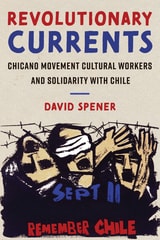
Revolutionary Currents
Chicano Movement Cultural Workers and Solidarity with ChileDavid Spener
University of Arizona Press, 2027
On September 11, 1973, General Augusto Pinochet led a bloody military coup in Chile that overthrew Salvador Allende’s democratically elected socialist government. The coup ushered in a cruelly repressive dictatorship that would govern the country for the next seventeen years, constituting a watershed moment in Cold War history.
This book recounts the untold story of how Chicano Movement poets, artists, musicians, and theater groups in the United States used their work to express solidarity with the international campaign to restore democracy in Chile. Such expressions of solidarity were especially prominent in the San Francisco Bay Area, where hundreds of Chilean exiles settled following the coup. Upon arrival, they joined a diverse Latinx population that was home to a Chicanx arts community whose members’ political orientations primed them to lend their talents to anti-imperialist causes. These Chicanxs were also drawn to the campaign against the dictatorship through friendship and acquaintance with members of the Chilean exile community.
David Spener shows how the Bay Area’s unique cosmopolitan social context offered Chicanxs and Chileans meaningful opportunities for dialogue and collaboration with each other as well as with Latinxs of other national origins. Chicanxs often adopted a pan-ethnic raza identity that they could share with Chilean, Nicaraguan, Puerto Rican, Salvadoran, and other Latinx activists. This did not mean, however, that they abandoned the political identities that they had gained from the Chicano Movement. Instead, many came to see themselves as uniting with other Latinxs, first Chileans and then Nicaraguans and Salvadorans, in a struggle against U.S. imperialism throughout the Americas.
Revolutionary Feminists
The Women's Liberation Movement in SeattleBarbara Winslow
Duke University Press, 2023
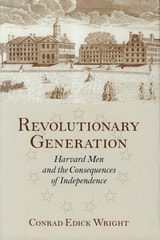
Revolutionary Generation
Harvard Men and the Consequences of IndependenceConrad Edick Wright
University of Massachusetts Press, 2005
Conrad Edick Wright draws on extensive research on the classes that graduated from Harvard immediately before the start of the war to follow their members as they passed through life's common and predictable events from birth and childhood through youth to maturity, careers, marriage, the increasing civic and family responsibilities of midlife, old age, and death. He is also sensitive to his subjects' thoughts and feelings. Unusually articulate and frequently reflective, the men of the Harvard College classes of 1771 through 1774 often revealed their ambitions and concerns through their letters and diaries.
Revolutionary Generation provides the most sustained application of life course and life cycle analysis to be found in any study of late-eighteenth- or early-nineteenth-century America. At the same time, it shows on a personal level through the lives of its subjects many of the most important consequences of the War for Independence.

Revolutionary Lives
Anna Strunsky and William English WallingJames Boylan
University of Massachusetts Press, 0

Revolutionary Medicine
Health and the Body in Post-Soviet CubaP. Sean Brotherton
Duke University Press, 2012
Revolutionary Nativism
Fascism and Culture in China, 1925-1937Maggie Clinton
Duke University Press, 2017
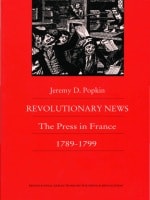
Revolutionary News
The Press in France, 1789–1799Jeremy D. Popkin
Duke University Press, 1990
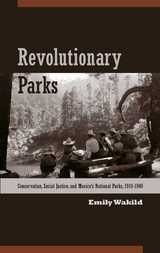
Revolutionary Parks
Conservation, Social Justice, and Mexico’s National Parks, 1910–1940Emily Wakild
University of Arizona Press, 2011
Revolutionary Parks tells the surprising story of how forty national parks were created in Mexico during the latter stages of the first social revolution of the twentieth century. By 1940 Mexico had more national parks than any other country. Together they protected more than two million acres of land in fourteen states. Even more remarkable, Lázaro Cárdenas, president of Mexico in the 1930s, began to promote concepts akin to sustainable development and ecotourism.
Conventional wisdom indicates that tropical and post-colonial countries, especially in the early twentieth century, have seldom had the ability or the ambition to protect nature on a national scale. It is also unusual for any country to make conservation a political priority in the middle of major reforms after a revolution. What emerges in Emily Wakild’s deft inquiry is the story of a nature protection program that takes into account the history, society, and culture of the times. Wakild employs case studies of four parks to show how the revolutionary momentum coalesced to create early environmentalism in Mexico.
According to Wakild, Mexico’s national parks were the outgrowth of revolutionary affinities for both rational science and social justice. Yet, rather than reserves set aside solely for ecology or politics, rural people continued to inhabit these landscapes and use them for a range of activities, from growing crops to producing charcoal. Sympathy for rural people tempered the radicalism of scientific conservationists. This fine balance between recognizing the morally valuable, if not always economically profitable, work of rural people and designing a revolutionary state that respected ecological limits proved to be a radical episode of government foresight.
Revolutionary Positions
Sexuality and Gender in Cuba and BeyondMichelle Chase, Isabella Close, Melina Pappademos, and Heidi Tinsman, special issue editors
Duke University Press, 0
Contributors. Lorraine Bayard de Volo, Marcelo Casals, Michelle Chase, Aviva Chomsky, Isabella Cosse, Ximena Espeche, Robert Franco, Paula Halperin, Lani Hanna, Elizabeth Quay Hutchison, Melina Pappademos, Jennifer L. Lambe, Diosnara Ortega González, Gregory Randall, Margaret Randall, Chelsea Schields, Sarah Seidman, Emily Snyder, Heidi Tinsman, Ailynn Torres Santana
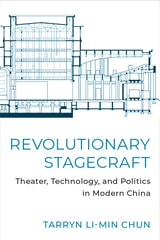
Revolutionary Stagecraft
Theater, Technology, and Politics in Modern ChinaTarryn Li-Min Chun
University of Michigan Press, 2024
2026 NYU Joe Callaway Prize Winner
- 2025 Association for Theatre in Higher Education Outstanding Book Award in Innovative Achievement Winner
- 2024 Theatre Library Association George Freedley Memorial Award Co-Winner
- American Society for Theatre Research Barnard Hewitt Award for Outstanding Research in Theatre History Finalist
Revolutionary Stagecraft draws on a rich corpus of literary, historical, and technical materials to reveal a deep entanglement among technological modernization, political agendas, and the performing arts in modern China. This unique approach to Chinese theater history combines a close look at plays themselves, performance practices, technical theater details, and behind-the-scenes debates over “how to” make theater amid the political upheavals of China’s 20th century. The book begins at a pivotal moment in the 1920s—when Chinese theater artists began to import, use, and write about modern stage equipment—and ends in the 1980s when China's scientific and technological boom began. By examining iconic plays and performances from the perspective of the stage technologies involved, Tarryn Li-Min Chun provides a fresh perspective on their composition and staging. The chapters include stories on the challenges of creating imitation neon, rigging up a makeshift revolving stage, and representing a nuclear bomb detonating onstage.
In thinking about theater through technicity, the author mines well-studied materials such as dramatic texts and performance reviews for hidden technical details and brings to light a number of previously untapped sources such as technical journals and manuals; set design renderings, lighting plots, and prop schematics; and stage technology how-to guides for amateur thespians. This approach focuses on material stage technologies, situating these objects equally in relation to their technical potential, their human use, and the social, political, economic, and cultural forces that influence them. In each of its case studies, Revolutionary Stagecraft reveals the complex and at times surprising ways in which Chinese theater artists and technicians of the 20th century envisioned and enacted their own revolutions through the materiality of the theater apparatus.
Revolutionary Women in Postrevolutionary Mexico
Jocelyn Olcott
Duke University Press, 2005
Olcott demonstrates an extraordinary grasp of the complexity of postrevolutionary Mexican politics, exploring the goals and outcomes of women’s organizing in Mexico City and the port city of Acapulco as well as in three rural locations: the southeastern state of Yucatán, the central state of Michoacán, and the northern region of the Comarca Lagunera. Combining the strengths of national and regional approaches, this comparative perspective sets in relief the specificities of citizenship as a lived experience.
Revolutionary Worlds
Local Perspectives and Dynamics during the Indonesian Independence War, 1945-1949Bambang Purwanto
Amsterdam University Press, 2023
Bringing together two national historiographical traditions which have long remained largely separate, Revolutionary Worlds is the result of a collaboration between the Indonesian research project Proklamasi Kemerdekaan, Revolusi dan Perang di Indonesia ('Proclamation of Independence, Revolution and War in Indonesia', Universitas Gadjah Mada, Yogyakarta) and the Dutch research group of the Regional Studies project, under the umbrella of the research programme Independence, Decolonization, Violence and War in Indonesia, 1945-1950.
The authors of this book – Taufik Ahmad, Galuh Ambar Sasi, Maarten van der Bent, Martijn Eickhoff, Farabi Fakih, Roel Frakking, Apriani Harahap, Anne-Lot Hoek, Sarkawi B. Husain, Julianto Ibrahim, Gerry van Klinken, Erniwati, Mawardi Umar, Anne van der Veer, Abdul Wahid, Tri Wahyuning M. Irsyam, and Muhammad Yuanda Zara – work with various universities and research institutes in Indonesia and the Netherlands.
Revolutionizing Repertoires
The Rise of Populist Mobilization in PeruRobert S. Jansen
University of Chicago Press, 2017
Drawing on pragmatist theories of social action, Revolutionizing Repertoires sets out to examine what happens when the repertoire of practices available to political actors is dramatically reconfigured. Taking as his case study the development of a distinctively Latin American style of populist mobilization, Robert S. Jansen analyzes the Peruvian presidential election of 1931. He finds that, ultimately, populist mobilization emerged in the country at this time because newly empowered outsiders recognized the limitations of routine political practice and understood how to modify, transpose, invent, and recombine practices in a whole new way. Suggesting striking parallels to the recent populist turn in global politics, Revolutionizing Repertoires offers new insights not only to historians of Peru but also to scholars of historical sociology and comparative politics, and to anyone interested in the social and political origins of populism.
Revolutionizing Women's Healthcare
The Feminist Self-Help Movement in AmericaHannah Dudley-Shotwell
Rutgers University Press, 2020
Revolutionizing Women’s Healthcare is the story of a feminist experiment: the self-help movement. This movement arose out of women’s frustration, anger, and fear for their health. Tired of visiting doctors who saw them as silly little girls, suffering shame when they asked for birth control, seeking abortions in back alleys, and holding little control over their own reproductive lives, women took action. Feminists created “self-help groups” where they examined each other’s bodies and read medical literature. They founded and ran clinics, wrote books, made movies, undertook nationwide tours, and raided and picketed offending medical institutions. Some performed their own abortions. Others swore off pharmaceuticals during menopause. Lesbian women found “at home” ways to get pregnant. Black women used self-help to talk about how systemic racism affected their health. Hannah Dudley-Shotwell engagingly chronicles these stories and more to showcase the creative ways women came together to do for themselves what the mainstream healthcare system refused to do.
Revolutionizing a World
From Small States to Universalism in the Pre-Islamic Near EastMark Altaweel and Andrea Squitieri
University College London, 2018
The authors argue that the persistence of large states and empires starting in the eighth/seventh centuries BCE, which continued for many centuries, led to new sociopolitical structures and institutions emerging in the Near East. The primary processes that enabled this emergence were large-scale and long-distance movements, or population migrations. These patterns of social developments are analyzed under different aspects: settlement patterns, urban structure, material culture, trade, governance, language spread, and religion, all pointing at movement as the main catalyst for social change. This book’s argument is framed within a larger theoretical framework termed as "universalism," a theory that explains many of the social transformations that happened to societies in the Near East, starting from the Neo-Assyrian period and continuing for centuries. Among other influences, the effects of these transformations are today manifested in modern languages, concepts of government, universal religions and monetized and globalized economies.
Revolutions and Counter-Revolutions
1917 and Its Aftermath from a Global PerspectiveEdited by Stefan Rinke and Michael Wildt
Campus Verlag, 2017
Revolutions at Home
The Origin of Modern Childhood and the German Middle ClassEmily C. Bruce
University of Massachusetts Press, 2021
Revolutions at Home analyzes a rich set of documents created for and by young Germans to show that children were central to reinventing their own education between 1770 and 1850. Through their reading and writing, they helped construct the modern child subject. The active child who emerged at this time was not simply a consequence of expanding literacy but, in fact, a key participant in defining modern life.
Revolutions in Mexican Catholicism
Reform and Revelation in Oaxaca, 1887–1934Edward Wright-Rios
Duke University Press, 2009
Wright-Rios demonstrates that pastors, peasants, and laywomen sought to enliven and shape popular religion in Oaxaca. The clergy tried to adapt the Vatican’s blueprint for Catholic revival to Oaxaca through institutional reforms and attempts to alter the nature and feel of lay religious practice in what amounted to a religious modernization program. Yet some devout women had their own plans. They proclaimed their personal experiences of miraculous revelation, pressured priests to recognize those experiences, marshaled their supporters, and even created new local institutions to advance their causes and sustain the new practices they created. By describing female-led visionary movements and the ideas, traditions, and startling innovations that emerged from Oaxaca’s indigenous laity, Wright-Rios adds a rarely documented perspective to Mexican cultural history. He reveals a remarkable dynamic of interaction and negotiation in which priests and parishioners as well as prelates and local seers sometimes clashed and sometimes cooperated but remained engaged with one another in the process of making their faith meaningful in tumultuous times.
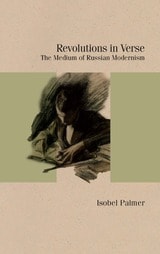
Revolutions in Verse
The Medium of Russian ModernismIsobel Palmer
Northwestern University Press, 2025
How modernist interartistic experimentation and the proliferation of new media technologies inspired fresh insights into poetry
Isobel Palmer spotlights Russian modernist poets’ and formalist theorists’ conscious engagement with formal convention, showing how their efforts were tied up with broader attempts in the early Soviet era to understand and articulate the nature of poetry and its most characteristic devices. Returning to critical debates around poetic encounters with three key aesthetic categories—rhythm, image, and voice—Palmer unpacks the period’s deeper interest in the material bases of poetic speech itself. Through fresh, incisive readings of canonical poets and theorists, from Andrei Bely and Vladimir Mayakovsky to Yury Tynianov and Viktor Shklovsky, Revolutions in Verse: The Medium of Russian Modernism explores the proliferation of interartistic experiments and the emergence of new media technologies that made poetry visible as a medium in its own right.
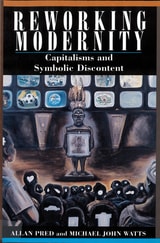
Reworking Modernity
Capitalisms and Symbolic DiscontentPred, Allan
Rutgers University Press, 1992
Using both grand conceptualizations and grounded case studies, Allan Pred and Michael Watts look at how people cope with and give meaning to capitalism and modernity in different times and places. As capital accumulation has grown and taken new forms, it has affected technology and labor relations which in turn have affected people's daily lives. These changes have not always been either welcome or easy. Pred and Watts focus on the symbolic discontent and cultural confrontations that accompany capitalism. They depict people struggling over the meaning of change in their lives and over new relations of power.
Modernity is experienced differently in different times and places. To illustrate this point, Pred and Watts offer four case studies that range across time and space. These studies remind us that there are multiple capitalisms and mutiple reactions to capitalisms. Watts begins with a study of a Muslim millenarian movement that arose alongside the Nigerian oil boom of the 1970s. When a Muslim prophet and disenfranchised followers tried to create a distinctive community and identity, they came into brutal conflict with state authorities. Thousands died in the resulting oppression. Watts's next case is less bloody, at least in the short run. He tell us what happened when technological change was introduced in rice production in West African peasant society. Peasants were drawn into the world economy as contract farmers. This changed work relations and affected everyday life in peasant households. Families began to fight over who would work and under what conditions. They struggled over gender indentity and property rights. We move back in time and across space for ther third case study. Pred discusses changes in the daily life of the Stockholm working class at the end of the nineteenth century. He writes of the various forms their discontent took as they struggled with economic restructuring. Even conflict over street names took on special meaning. For the last case Pred takes us to a steel mill in California. When a South Korean company became half owner of the mill, there was money for modernization and the threat of layoffs was reduced. But the workers remained unhappy. They protested low wages, unsafe conditions, and unfair recruitment practices. Their labor issues turned into issues of nationalism, morality and identity. All four case studies demonstrate the shock of modernity and how the resulting struggles affect daily life.
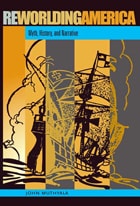
Reworlding America
Myth, History, and NarrativeJohn Muthyala
Ohio University Press, 2006
John Muthyala's Reworlding America moves beyond the U.S.-centered approach of traditional American literary criticism. In this groundbreaking book, Muthyala argues for a transgeographical perspective from which to study the literary and cultural histories of the Americas.
By emphasizing transnational migration, border crossing, and colonial modernity, Reworlding America exposes how national, ethnic, linguistic, religious, and cultural boundaries have been continually created and transgressed—with profound consequences for the peoples of the Americas.
Drawing from cultural studies, anthropology, literature, and history, Muthyala examines the literatures of the Americas in terms of their intimate relationship to questions of cultural survival, identity formation, and social power. He goes beyond nationalist, ethnocentric, and religious frameworks used to conceptualize American literary history and examines the connection between modernity and colonialism.
Reworlding America's significance extends into the realm of education, history, ethnography, and literary and cultural studies and contributes to the larger project of refashioning the role of English and American studies in a transborder, postnational global culture.
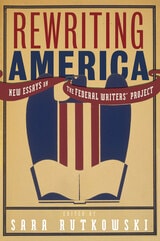
Rewriting America
New Essays on the Federal Writers' ProjectEdited by Sara Rutkowski
University of Massachusetts Press, 2022
Established in 1935, the Federal Writers’ Project (FWP) sent over 6,500 unemployed historians, teachers, writers, and librarians out to document America’s past and present in the midst of the Great Depression. The English poet W. H. Auden referred to this New Deal program as “one of the noblest and most absurd undertakings ever attempted by any state.”
Featuring original work by scholars from a range of disciplinary perspectives, this edited collection provides fresh insights into how this extraordinary program helped transform American culture. In addition to examining some of the major twentieth-century writers whose careers the FWP helped to launch—including Ralph Ellison, Richard Wright, and Margaret Walker—Rewriting America presents new perspectives on the role of African Americans, Mexican Americans, Asian Americans, and women on the project. Essays also address how the project’s goals continue to resonate with contemporary realities in the midst of major economic and cultural upheaval.
Along with the volume editor, contributors include Adam Arenson, Sue Rubenstein DeMasi, Racheal Harris, Jerrold Hirsch, Kathi King, Maiko Mine, Deborah Mutnick, Diane Noreen Rivera, Greg Robinson, Robert Singer, James Sun, and David A. Taylor.
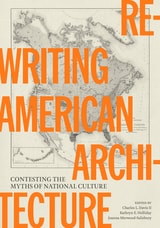
Rewriting American Architecture
Contesting the Myths of National CultureEdited by Charles L. Davis II, Kathryn E. Holliday, and Joanna Merwood-Salisbury
University of Texas Press, 2026
A critical reassessment of nineteenth‑century American architecture that uncovers how race, settler colonialism, and contested national identities shaped the built environment and its historiography.
Rewriting American Architecture offers a revisionist riposte to the canonical story of nineteenth-century American architecture. Drawing on new archival research and revisionist historiography, the essays in this volume reveal how American architecture was shaped not by inevitable progress toward a unified national culture but by the turbulent realities of race, labor, settler colonialism, and territorial expansion. Rather than treating architecture as an apolitical aesthetic expression, the contributors expose it as an active arena in which the meanings of nationhood were constructed, contested, and often violently enforced. From Indigenous spatial practices and Black institutional building to transnational exchanges and the racial politics embedded in professionalization, this collection reframes the built environment as central to the competing cultural, political, and geographic claims that defined the United States during this period.
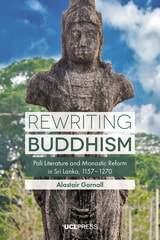
Rewriting Buddhism
Pali Literature and Monastic Reform in Sri Lanka, 1157–1270Alastair Gornall
University College London, 2020

Rewriting Exodus
American Futures from Du Bois to ObamaAnna Hartnell
Pluto Press, 2011
Exodus, as a powerful narrative of liberation, has been a central imaginative touchstone in the black American struggle against US racism. This book traces the concept in a number of pivotal black thinkers, and explores its signficance for contemporary America.
The exodus story is a fitting allegory for the painful experience of exile that disproportionately afflicted African Americans in the aftermath of Hurricane Katrina, and it also provides compelling imagery for the triumphant election of Barack Obama in 2008. Building around these themes, Anna Hartnell traces the intellectual development of one of the defining narratives of black American thinking on social justice in the United States.
In placing black America at the centre of the study of US culture, Rewriting Exodus suggests new ways of thinking about America's relationship with the Middle East and the wider postcolonial world. Hartnell's groundbreaking contribution marks a vital new chapter in American cultural and political history.
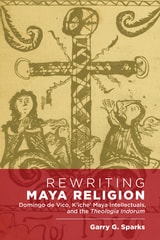
Rewriting Maya Religion
Domingo de Vico, K’iche’ Maya Intellectuals, and the Theologia IndorumGarry G. Sparks
University Press of Colorado, 2019
Centered on the specific work of Dominicans among the Highland Maya of Guatemala in the decades prior to the arrival of the Catholic Reformation in the late sixteenth century, the book focuses on the various understandings of religious analyses—Hispano-Catholic and Maya—and their strategic exchanges, reconfigurations, and resistance through competing efforts of religious translation. Sparks historically contextualizes Vico’s theological treatise within both the wider set of early literature in K’iche’an languages and the intellectual shifts between late medieval thought and early modernity, especially the competing theories of language, ethnography, and semiotics in the humanism of Spain and Mesoamerica at the time.
Thorough and original, Rewriting Maya Religion serves as an ethnohistorical frame for continued studies on Highland Maya religious symbols, discourse, practices, and logic dating back to the earliest documented evidence. It will be of great significance to scholars of religion, ethnohistory, linguistics, anthropology, and Latin American history.
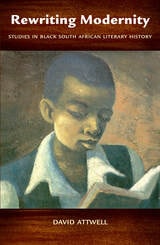
Rewriting Modernity
Studies in Black South African Literary HistoryDavid Attwell
Ohio University Press, 2006
Rewriting Modernity: Studies in Black South African Literary History connects the black literary archive in South Africa—from the nineteenth-century writing of Tiyo Soga to Zakes Mda in the twenty-first century—to international postcolonial studies via the theory of transculturation, a position adapted from the Cuban anthropologist Fernando Ortiz.
David Attwell provides a welcome complication of the linear black literary history—literature as a reflection of the process of political emancipation—that is so often presented. He focuses on cultural transactions in a series of key moments and argues that black writers in South Africa have used print culture to map themselves onto modernity as contemporary subjects, to negotiate, counteract, reinvent, and recast their positioning within colonialism, apartheid, and the context of democracy.
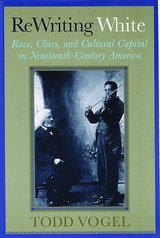
Rewriting White
Race, Class, and Cultural Capital in Nineteenth-Century AmericaTodd Vogel
Rutgers University Press, 2004
What did it mean for people of color in nineteenth-century America to speak or write "white"? More specifically, how many and what kinds of meaning could such "white" writing carry? In ReWriting White, Todd Vogel looks at how America has racialized language and aesthetic achievement. To make his point, he showcases the surprisingly complex interactions between four nineteenth-century writers of color and the "standard white English" they adapted for their own moral, political, and social ends. The African American, Native American, and Chinese American writers Vogel discusses delivered their messages in a manner that simultaneously demonstrated their command of the dominant discourse of their times-using styles and addressing forums considered above their station-and fashioned a subversive meaning in the very act of that demonstration.
The close readings and meticulous archival research in ReWriting White upend our conventional expectations, enrich our understanding of the dynamics of hegemony and cultural struggle, and contribute to the efforts of other cutting-edge contemporary scholars to chip away at the walls of racial segregation that have for too long defined and defaced the landscape of American literary and cultural studies.
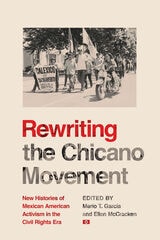
Rewriting the Chicano Movement
New Histories of Mexican American Activism in the Civil Rights EraMario T. García
University of Arizona Press, 2021
The essays in this volume broaden traditional views of the Chicano Movement that are too narrow and monolithic. Instead, the contributors to this book highlight the role of women in the movement, the regional and ideological diversification of the movement, and the various cultural fronts in which the movement was active. Rewriting the Chicano Movement stresses that there was no single Chicano Movement but instead a composite of movements committed to the same goal of Chicano self-determination. Scholars, students, and community activists interested in the history of the Chicano Movement can best start by reading this book.
Contributors: Holly Barnet-Sanchez, Tim Drescher, Jesús Jesse Esparza, Patrick Fontes, Mario T. García, Tiffany Jasmín González, Ellen McCracken, Juan Pablo Mercado, Andrea Muñoz, Michael Anthony Turcios, Omar Valerio-Jiménez
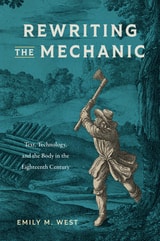
Rewriting the Mechanic
Text, Technology, and the Body in the Eighteenth CenturyEmily M. West
Bucknell University Press, 2027
In the eighteenth century, “technology” didn’t name a particular device or a process. It referred instead to written accounts of the mechanical arts, a now-obsolete category encompassing the wide range of work done by hand, from baking bread to building ships. Rewriting the Mechanic examines how these written descriptions, circulating across genres in eighteenth-century Britain, transformed certain mechanical arts by imagining them as newly innovative, authoritative, and able to make speculative possibilities real—as what we now call technological. Reversing the familiar story in which literature simply reflects technological change, West draws on the work of Robert Hooke, Aphra Behn, Daniel Defoe, Maria Edgeworth, and Jane Austen to demonstrate the influence of literary techniques on ideas about masculinity, power, and the body, and how these texts helped to bring the very idea of technological modernity into being.
Published by Bucknell University Press. Distributed worldwide by Rutgers University Press.
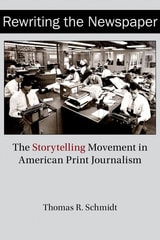
Rewriting the Newspaper
The Storytelling Movement in American Print JournalismThomas R. Schmidt
University of Missouri Press, 2020
Thomas Schmidt analyzes the expansion of narrative journalism and the corresponding institutional changes in the American newspaper industry in the last quarter of the twentieth century. In doing so, he offers the first institutionally situated history of narrative journalism’s evolution from the New Journalism of the 1960s to long-form literary journalism in the 1990s. Based on the analysis of primary sources, industry publications, and oral history interviews, this study traces how narrative techniques developed and spread through newsrooms, advanced by institutional initiatives and a growing network of practitioners, proponents, and writing coaches who mainstreamed the use of storytelling. Challenging the popular belief that it was only a few talented New York reporters (Tome Wolfe, Jimmy Breslin, Gay Talese, Joan Didion, and others) who revolutionized journalism by deciding to employ storytelling techniques in their writing, Schmidt shows that the evolution of narrative in late twentieth century American Journalism was more nuanced, more purposeful, and more institutionally based than the New Journalism myth suggests.
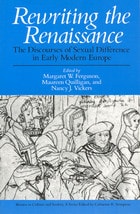
Rewriting the Renaissance
The Discourses of Sexual Difference in Early Modern EuropeEdited by Margaret W. Ferguson, Maureen Quilligan, and Nancy Vickers
University of Chicago Press, 1986
Throughout, the essays focus on the structures of Renaissance patriarchy that organized power relations both in the state and in the family. They explore the major conequences of patriarchy for women—their marginalization and lack of identity and power—and the ways in which individual women or groups of women broke, or in some cases deliberately circumvented, the rules that defined them as a secondary sex. Topics covered include representations of women in literature and art, the actual work done by women both inside and outside of the home, and the writings of women themselves. In analyzing the rhetorical strategies that "marginalized" historical and fictional women, these essays counter scholarly and critical traditions that continue to exhibit patriarchal biases.
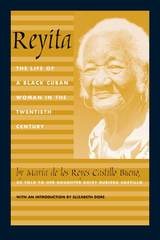
Reyita
The Life of a Black Cuban Woman in the Twentieth CenturyMaría de los Reyes Castillo Bueno
Duke University Press, 2000
Sensitive to and deeply knowledgeable of the systemic causes and consequences of poverty, Reyita’s testimony considers the impact of slavery on succeeding generations, her mother’s internalized racism, and Cuba’s residual discrimination. The humiliation and poverty inflicted on the black Cuban community as well as her decision to marry a white man to ensure a higher standard of living form the basis of other chapters. Reyita actively participated in the life of the community—often caring for the children of prostitutes along with her own eight children and giving herbal medicine and “spiritualist” guidance to ill or troubled neighbors. She describes her growing resistance, over five decades of marriage, to her husband’s sexism and negativity. Strong-willed and frank about her sexuality as well as her religious and political convictions, Reyita recounts joining the revolutionary movement in the face of her husband’s stern objections, a decision that added significant political purpose to her life. At book’s end, Reyita radiates gratification that her 118 descendants have many different hues of skin, enjoy a variety of professions, and—“most importantly”—are free of racial prejudice.
Rhetoric
Renato Barilli
University of Minnesota Press, 1989
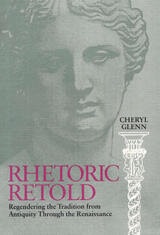
Rhetoric Retold
Regendering the Tradition from Antiquity Through the RenaissanceCheryl Glenn
Southern Illinois University Press, 1997
After explaining how and why women have been excluded from the rhetorical tradition from antiquity through the Renaissance, Cheryl Glenn provides the opportunity for Sappho, Aspasia, Diotima, Hortensia, Fulvia, Julian of Norwich, Margery Kempe, Margaret More Roper, Anne Askew, and Elizabeth I to speak with equal authority and as eloquently as Plato, Aristotle, Cicero, and Augustine. Her aim is nothing less than regendering and changing forever the history of rhetoric.
To that end, Glenn locates women’s contributions to and participation in the rhetorical tradition and writes them into an expanded, inclusive tradition. She regenders the tradition by designating those terms of identity that have promoted and supported men’s control of public, persuasive discourse—the culturally constructed social relations between, the appropriate roles for, and the subjective identities of women and men.
Glenn is the first scholar to contextualize, analyze, and follow the migration of women’s rhetorical accomplishments systematically. To locate these women, she follows the migration of the Western intellectual tradition from its inception in classical antiquity and its confrontation with and ultimate appropriation by evangelical Christianity to its force in the medieval Church and in Tudor arts and politics.
Rhetoric and Reality
Writing Instruction in American Colleges, 1900 - 1985James A. Berlin
Southern Illinois University Press, 1987
Berlin here continues his unique history of American college composition begun in his Writing Instruction in Nineteenth-Century Colleges (1984), turning now to the twentieth century.
In discussing the variety of rhetorics that have been used in writing classrooms Berlin introduces a taxonomy made up of three categories: objective rhetorics, subjective rhetorics, and transactional rhetorics, which are distinguished by the epistemology on which each is based. He makes clear that these categories are not tied to a chronology but instead are to be found in the English department in one form or another during each decade of the century.
His historical treatment includes an examination of the formation of the English department, the founding of the NCTE and its role in writing instruction, the training of teachers of writing, the effects of progressive education on writing instruction, the General Education Movement, the appearance of the CCCC, the impact of Sputnik, and today’s “literacy crisis.”
Rhetoric and Resistance
The Literary Arts of Dissent in Nineteenth-Century BritainMaeve Adams
Ohio University Press, 2025
A fresh perspective on the enduring relationship between literature, democracy, and dissent
Rhetoric and Resistance explores the transformative role of nineteenth-century literature in shaping modern concepts and practices of democratic dissent. By examining the works of Romantic and Victorian novelists, poets, and journalists, Maeve Adams identifies origins of modern theories and practices of resistance in nineteenth-century literary forms. Offering a literary history of dissent, the book recovers the intertwined development of democracy and aesthetics, revealing how narrative form became a potent tool for challenging authority.
Tracing the lineage of dissent from the radical fiction and journalism of the 1800s to contemporary movements like #MeToo, Adams offers a genealogy that highlights how literary texts experimented with political power, granting new and consequential voices to working-class individuals, women, colonized peoples, and other marginalized groups.
Adams takes an interdisciplinary approach, weaving together close readings of works by Thomas De Quincey, Walter Scott, Elizabeth Gaskell, and H. G. Wells, as well as lesser-known journalists, with insights from modern moral and political philosophy. Drawing on theories of democratic ethics and justice from scholars such as Miranda Fricker, Sharon Krause, Martha Nussbaum, and Philip Pettit, the book bridges literary history and contemporary debates about political agency and expression.
Rhetoric and Scripture
Collected Essays of Thomas H. OlbrichtThomas H. Olbricht
SBL Press, 2021
Rhetoric and Writing Studies in the New Century
Historiography, Pedagogy, and PoliticsEdited by Cheryl Glenn and Roxanne Mountford
Southern Illinois University Press, 2017
Rhetoric and the Republic
Politics, Civic Discourse, and Education in Early AmericaMark Garrett Longaker
University of Alabama Press, 2007
Rhetoric as Philosophy
The Humanist TraditionErnesto Grassi. Foreword by Timothy W. Crusius
Southern Illinois University Press, 2001
Originally published in English in 1980, Rhetoric as Philosophy has been out of print for some time. The reviews of that English edition attest to the importance of Ernesto Grassi’s work.
By going back to the Italian humanist tradition and aspects of earlier Greek and Latin thought, Ernesto Grassi develops a conception of rhetoric as the basis of philosophy. Grassi explores the sense in which the first principles of rational thought come from the metaphorical power of the word. He finds the basis for his conception in the last great thinker of the Italian humanist tradition, Giambattista Vico (1668–1744). He concentrates on Vico’s understanding of imagination and the sense of human ingenuity contained in metaphor. For Grassi, rhetorical activity is the essence and inner life of thought when connected to the metaphorical power of the word.
Rhetoric at the Margins
Revising the History of Writing Instruction in American Colleges, 1873-1947David Gold
Southern Illinois University Press, 2008
Rhetoric at the Margins: Revising the History of Writing Instruction in American Colleges, 1873-1947 examines the rhetorical education of African American, female, and working-class college students in the late nineteenth and early twentieth centuries. The rich case studies in this work encourage a reconceptualization of both the history of rhetoric and composition and the ways we make use of it.
Author David Gold uses archival materials to study three types of institutions historically underrepresented in disciplinary histories: a black liberal arts college in rural East Texas (Wiley College); a public women's college (Texas Woman's University); and an independent teacher training school (East Texas Normal College). The case studies complement and challenge previous disciplinary histories and suggest that the epistemological schema that have long applied to pedagogical practices may actually limit our understanding of those practices.
Gold argues that each of these schools championed intellectual and pedagogical traditions that differed from the Eastern liberal arts model—a model that often serves as the standard bearer for rhetorical education. He demonstrates that by emphasizing community uplift and civic participation and attending to local needs, these schools created contexts in which otherwise moribund curricular features of the era—such as strict classroom discipline and an emphasis on prescription—took on new possibilities.
Rhetoric at the Margins describes the recent revisionist turn in rhetoric and composition historiography, argues for the importance of diverse institutional microhistories, and argues that the nineteenth and early twentieth centuries offer rich lessons for contemporary classroom practice. The study brings alive the voices of black, female, rural, Southern, and first-generation college students and their instructors, effectively linking these histories to the history of rhetoric and writing. Appendices include excerpts of important and rarely seen primary source material, allowing readers to experience in fuller detail the voices captured in this work.
Rhetoric on the Margins of Modernity
Vico, Condillac, MonboddoCatherine L. Hobbs
Southern Illinois University Press, 2002
Changes in English studies today, particularly the rise of cultural studies, have forced reexaminations of historical genealogies. Three complex figures whose places are currently being reassessed include the Neapolitan Giambattista Vico (1668 –1744), the Frenchman Etienne de Condillac (1714 –1780), and the Scotsman James Burnet(t), Lord Monboddo (1714 –1799) in our histories of communication, linguistics, English studies, and now rhetoric.
In Rhetoric on the Margins of Modernity: Vico, Condillac, Monboddo, Catherine L. Hobbs focuses primarily on these three key figures in whose work rhetoric and linguistics intertwine as they respond to emerging attitudes and values of science and philosophy in the eighteenth century. Through her examination of works of Vico, Condillac, Monboddo and other marginal figures, Hobbs presents a different and more nuanced view of the transformation of rhetoric from classical to modern.
In order to redefine each figure’s position, Hobbs brings together the histories of linguistics, literature, rhetoric, and communication, rather than leaving them isolated in separate disciplines. She examines each figure’s theory of language origin and development as it has motivated their rhetorical theories. The result is Rhetoric on the Margins of Modernity: Vico, Condillac, Monboddo, an original and significant account of the formation of modern rhetoric.
Rhetoric, Independence, and Nationhood, 1760–1800, Volume II
Stephen E Lucas
Michigan State University Press, 2022
Rhetoric, Science, and Magic in Seventeenth-century England
Ryan J. Stark
Catholic University of America Press, 2009
Rhetorical Bodies
Jack Selzer
University of Wisconsin Press, 1999
What significance does the physical, material body still have in a world of virtual reality and genetic cloning? How do technology and postmodern rhetoric influence our understanding of the body? And how can our discussion of the body affect the way we handle crises in public policy—the politics of race and ethnicity; issues of "family values" that revolve around sexual and gender identities; the choices revolving around reproduction and genome projects, and the spread of disease?
Leading scholars in rhetoric and communication, as well as literary and cultural studies, address some of the most important topics currently being discussed in the human sciences. The essays collected here suggest the wide range of public arenas in which rhetoric is operative—from abortion clinics and the World Wide Web to the media's depiction of illiteracy and the Donner Party. These studies demonstrate how the discourse of AIDS prevention or Demi Moore's "beautiful pregnancy" call to mind the physical nature of being human and the ways in which language and other symbols reflect and create the physical world.
Rhetorical Delivery as Technological Discourse
A Cross-Historical StudyBen McCorkle
Southern Illinois University Press, 2012
According to Ben McCorkle, the rhetorical canon of delivery—traditionally seen as the aspect of oratory pertaining to vocal tone, inflection, and physical gesture—has undergone a period of renewal within the last few decades to include the array of typefaces, color palettes, graphics, and other design elements used to convey a message to a chosen audience. McCorkle posits that this redefinition, while a noteworthy moment of modern rhetorical theory, is just the latest instance in a historical pattern of interaction between rhetoric and technology. In Rhetorical
Delivery as Technological Discourse: A Cross-Historical Study, McCorkle explores the symbiotic relationship between delivery and technologies of writing and communication. Aiming to enhance historical understanding by demonstrating how changes in writing technology have altered our conception of delivery, McCorkle reveals the ways in which oratory and the tools of written expression have directly affected one another throughout the ages.
To make his argument, the author examines case studies from significant historical moments in the Western rhetorical tradition. Beginning with the ancient Greeks, McCorkle illustrates how the increasingly literate Greeks developed rhetorical theories intended for oratory that incorporated “writerly” tendencies, diminishing delivery’s once-prime status in the process. Also explored is the near-eradication of rhetorical delivery in the mid-fifteenth century—the period of transition from late manuscript to early print culture—and the implications of the burgeoning
print culture during the nineteenth century.
McCorkle then investigates the declining interest in delivery as technology designed to replace the human voice and gesture became prominent at the beginning of the 1900s. Situating scholarship on delivery within a broader postmodern structure, he moves on to a discussion of the characteristics of contemporary hypertextual and digital communication and its role in reviving the canon, while also anticipating the future of communication technologies, the likely shifts in attitude toward delivery, and the implications of both on the future of teaching rhetoric.
Rhetorical Delivery as Technological Discourse traces a long-view perspective of rhetorical history to present readers a productive reading of the volatile treatment of delivery alongside the parallel history of writing and communication technologies. This rereading will expand knowledge of the canon by not only offering the most thorough treatment of the history of rhetorical delivery available but also inviting conversation about the reciprocal impacts of rhetorical theory and written communication on each other throughout this history.
Rhetorical Education In America
Cheryl Jean Glenn
University of Alabama Press, 2009
A timely collection of essays by prominent scholars in the field—on the past, present, and future of rhetoric instruction.
From Isocrates and Aristotle to the present, rhetorical education has consistently been regarded as the linchpin of a participatory democracy, a tool to foster civic action and social responsibility. Yet, questions of who should receive rhetorical education, in what form, and for what purpose, continue to vex teachers and scholars.
The essays in this volume converge to explore the purposes, problems, and possibilities of rhetorical education in America on both the undergraduate and graduate levels and inside and outside the academy. William Denman examines the ancient model of the "citizen-orator" and its value to democratic life. Thomas Miller argues that English departments have embraced a literary-research paradigm and sacrificed the teaching of rhetorical skills for public participation. Susan Kates explores how rhetoric is taught at nontraditional institutions, such as Berea College in Kentucky, where Appalachian dialect is espoused. Nan Johnson looks outside the academy at the parlor movement among women in antebellum America. Michael Halloran examines the rhetorical education provided by historical landmarks, where visitors are encouraged to share a common public discourse. Laura Gurak presents the challenges posed to traditional notions of literacy by the computer, the promises and dangers of internet technology, and the necessity of a critical cyber-literacy for future rhetorical curricula.
Collectively, the essays coalesce around timely political and cross-disciplinary issues. Rhetorical Education in America serves to orient scholars and teachers in rhetoric, regardless of their disciplinary home, and help to set an agenda for future classroom practice and curriculum design.
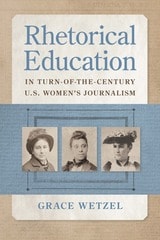
Rhetorical Education in Turn-of-the-Century U.S. Women's Journalism
Grace Wetzel, with a foreword by Shari J. Stenberg
Southern Illinois University Press, 2022
At the end of the nineteenth century, newspapers powerfully shaped the U.S. reading public, fostering widespread literacy development and facilitating rhetorical education. With new opportunities to engage audiences, female journalists repurposed the masculine tradition of journalistic writing by bringing together intimate forms of rhetoric and pedagogy to create innovative new dialogues. Rhetorical Education in Turn-of-the-Century U.S. Women’s Journalism illuminates the pedagogical contributions of three newspaperwomen to show how the field became a dynamic site of public participation, relationship building, education, and activism in the 1880s and 1890s.
Grace Wetzel introduces us to the work of Omaha correspondent Susette La Flesche Tibbles (Inshta Theamba), African American newspaper columnist Gertrude Bustill Mossell, and white middle-class reporter Winifred Black (“Annie Laurie”). Journalists by trade, these three writers made the mass-circulating newspaper their site of teaching and social action, inviting their audiences and communities—especially systematically marginalized voices—to speak, write, and teach alongside them.
Situating these journalists within their own specific writing contexts and personas, Wetzel reveals how Mossell promoted literacy learning and community investment among African American women through a reader-centered pedagogy; La Flesche modeled relational news research and reporting as a survivance practice while reporting for the Omaha Morning World-Herald at the time of the Wounded Knee Massacre; and Black inspired public writing and activism among children from different socioeconomic classes through her “Little Jim” story. The teachings of these figures serve as enduring examples of how we can engage in meaningful public literacy and ethical journalism.
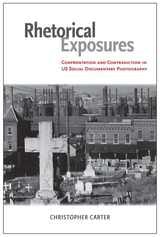
Rhetorical Exposures
Confrontation and Contradiction in US Social Documentary PhotographyChristopher Carter
University of Alabama Press, 2015
Exposing the politics of seeing: how documentary photographs confront inequality and reshape public understanding.
In Rhetorical Exposures, Christopher Carter explores social documentary photography from the nineteenth century to the present in order to illuminate the political dimensions and consequences of photographs taken and selected to highlight social injustice. Documentary photography aims to capture the material reality of life. Carter demonstrates how the creation and display of documentary photographs—often now called “imagetexts”—both invite analysis and raise persistent questions about the political and social causes for the bleak scenes of poverty and distress captured on film.
Carter’s carefully reasoned monograph examines both formal qualities of composition and the historical contexts of the production and display of documentary photographs. In Rhetorical Exposures, Carter explores Jacob Riis’s heartrending photos of Manhattan’s poor in late nineteenth-century New York, Walker Evans’s iconic images of tenant farmers in west Alabama, Ted Streshinsky’s images of 1960s social movements, Camilo José Vergara’s photographic landscapes of urban dereliction in the 1970s, and Chandra McCormick’s portraits of New Orleans’s Ninth Ward scarred by Hurricane Katrina.
While not ascribing specifically political or Marxist intentions to the photographers discussed, Carter frames his arguments in a class-based dialectic that addresses material want as an ineluctable result of social inequality. Carter argues that social documentary photography has the powerful capacity to disrupt complacent habits of viewing and to prompt viewers to confront injustice. Though photography may induce socially disruptive experiences, it remains vulnerable to the same power dynamics it subverts. Therefore, Carter offers a “rhetoric of exposure” that outlines how such social documentary images can be treated as highly tensioned rhetorical objects. His framework enables the analysis of photographs as heterogeneous records of the interaction of social classes and expressions of specific built environments. Rhetorical Exposures also discusses how photographs interact with oral and print media and relate to creations as diverse as public memorials, murals, and graphic novels.
As the creation and dissemination of new media continues to evolve in an environment of increasing anxiety about growing financial inequality, Rhetorical Exposures offers a very apt and timely discussion of the ways social documentary photography is created, employed, and understood.