Results by title
11 books match the query 'Icon'
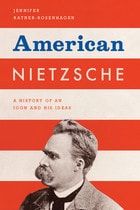
American Nietzsche
A History of an Icon and His IdeasJennifer Ratner-Rosenhagen
University of Chicago Press, 2011
If you were looking for a philosopher likely to appeal to Americans, Friedrich Nietzsche would be far from your first choice. After all, in his blazing career, Nietzsche took aim at nearly all the foundations of modern American life: Christian morality, the Enlightenment faith in reason, and the idea of human equality. Despite that, for more than a century Nietzsche has been a hugely popular—and surprisingly influential—figure in American thought and culture.
In American Nietzsche, Jennifer Ratner-Rosenhagen delves deeply into Nietzsche's philosophy, and America’s reception of it, to tell the story of his curious appeal. Beginning her account with Ralph Waldo Emerson, whom the seventeen-year-old Nietzsche read fervently, she shows how Nietzsche’s ideas first burst on American shores at the turn of the twentieth century, and how they continued alternately to invigorate and to shock Americans for the century to come. She also delineates the broader intellectual and cultural contexts within which a wide array of commentators—academic and armchair philosophers, theologians and atheists, romantic poets and hard-nosed empiricists, and political ideologues and apostates from the Left and the Right—drew insight and inspiration from Nietzsche’s claims for the death of God, his challenge to universal truth, and his insistence on the interpretive nature of all human thought and beliefs. At the same time, she explores how his image as an iconoclastic immoralist was put to work in American popular culture, making Nietzsche an unlikely posthumous celebrity capable of inspiring both teenagers and scholars alike.
A penetrating examination of a powerful but little-explored undercurrent of twentieth-century American thought and culture, American Nietzsche dramatically recasts our understanding of American intellectual life—and puts Nietzsche squarely at its heart.

Astad Deboo
An Icon of Contemporary Indian DanceKetu H. Katrak
Seagull Books, 2024
Astad Deboo (1947–2020), widely considered a pioneer of modern dance in India, was globally renowned for his distinctive style, characterized by meditative minimalism, gravity-defying backbends, and signature whirls which defined his innovative approach to form and content. In this first biography and book-length appreciation of Deboo’s work, Ketu H. Katrak unveils the remarkable life, choreography, and legacy of this groundbreaking figure in Indian modern dance. Through a comprehensive exploration, readers journey from Deboo's formative years in Jamshedpur and Bombay to his global endeavors that shaped his unique dance style.
Divided into four parts, this biography sheds light on various aspects of Deboo’s life and career: his youth, schooling, and the friendships that shaped him; his solo choreography, which boldly addressed social issues and fused modern dance with traditional elements; his humanitarian spirit, showcasing group choreography with deaf performers and Manipuri drum-dancers; and his mastery in collaborating with artists from India and abroad.
From receiving prestigious awards to transforming lives through dance, traveling around the world for over five decades yet being firmly rooted in Indian soil, Deboo left an indelible mark on contemporary Indian dance. Astad Deboo: An Icon of Contemporary Indian Dance pays homage to the dancer’s legendary status, emphasizing his unparalleled dedication and resilience—a guiding light for aspiring dancers striving to realize their artistic visions. It is a valuable addition to scholarship on dance studies, performance studies, and South Asian studies.
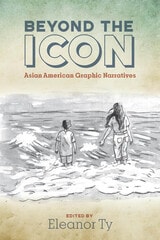
Beyond the Icon
Asian American Graphic NarrativesEdited by Eleanor Ty
The Ohio State University Press, 2022
While most US-based comics studies anthologies tend to neglect race, Beyond the Icon brings it to the foreground through an analysis of the vibrant and growing body of graphic narratives by Asian North American creators in the twenty-first century. By demonstrating how the forms and styles of the comics genre help depict Asian Americans as nuanced individuals in ways that words alone may not, Beyond the Icon makes the case for comics as a crucial artistic form in Asian American cultural production––one used to counter misrepresentations and myths, rewrite official history, and de-exoticize the Asian American experience.
An interdisciplinary team of contributors offers exciting new readings of key texts, including Ms. Marvel, George Takei’s They Called Us Enemy, Thi Bui’s The Best We Could Do, Gene Luen Yang and Sonny Liew’s The Shadow Hero, works by Adrian Tomine and Jillian Tamaki, and more, to uncover the ways in which Asian American comics authors employ graphic narratives to provide full and complex depictions of Asian diasporic subjects and intervene in the wider North American consciousness. Beyond the Icon initiates vital conversations between Asian American studies, ethnic studies, and comics.
Contributors:
Monica Chiu, Shilpa Davé, Melinda Luisa de Jesús, Lan Dong, Jin Lee, erin Khuê Ninh, Stella Oh, Jeanette Roan, Eleanor Ty
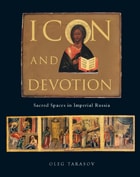
Icon and Devotion
Sacred Spaces in Imperial RussiaOleg Tarasov
Reaktion Books, 2002
By tracing the artistic vocabulary, techniques and working methods of icon painters, Tarasov shows how icons have been integral to the history of Russian art, influenced by folk and mainstream currents alike. As well as articulating the specifically Russian piety they invoke, he analyzes the significance of icons in the cultural life of modern Russia in the context of popular prints and poster design.
Icon of the Kingdom of God
An Orthodox EcclesiologyRadu Bordeianu
Catholic University of America Press, 2023
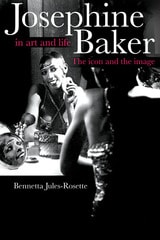
Josephine Baker in Art and Life
THE ICON AND THE IMAGEBennetta Jules-Rosette
University of Illinois Press, 2006
Josephine Baker (1906-1975) was a dancer, singer, actress, author, politician, militant, and philanthropist, whose images and cultural legacy have survived beyond the hundredth anniversary of her birth. Neither an exercise in postmodern deconstruction nor simple biography, Josephine Baker in Art and Life presents a critical cultural study of the life and art of the Franco-American performer whose appearances as the savage dancer Fatou shocked the world.
Although the study remains firmly anchored in Josephine Baker’s life and times, presenting and challenging carefully researched biographical facts, it also offers in-depth analyses of the images that she constructed and advanced. Bennetta Jules-Rosette explores Baker’s far-ranging and dynamic career from a sociological and cultural perspective, using the tools of sociosemiotics to excavate the narratives, images, and representations that trace the story of her life and fit together as a cultural production.

Leila Khaled
Icon of Palestinian LiberationSarah Irving
Pluto Press, 2012
Dubbed 'the poster girl of Palestinian militancy', Leila Khaled's image flashed across the world after she hijacked a passenger jet in 1969. The picture of a young, determined looking woman with a checkered scarf, clutching an AK-47, was as era-defining as that of Che Guevara.
In this intimate profile, based on interviews with Khaled and those who know her, Sarah Irving gives us the life-story behind the image. Key moments of Khaled's turbulent life are explored, including the dramatic events of the hijackings, her involvement in the Marxist Popular Front for the Liberation of Palestine (a radical element within the PLO), her opposition to the Oslo peace process and her activism today.
Leila Khaled's example gives unique insights into the Palestinian struggle through one remarkable life – from the tension between armed and political struggle, to the decline of the secular left and the rise of Hamas, and the role of women in a largely male movement.
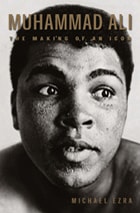
Muhammad Ali
The Making of an IconMichael Ezra
Temple University Press, 2009
Muhammad Ali (born Cassius Clay) has always engendered an emotional reaction from the public. From his appearance as an Olympic champion to his iconic status as a national hero, his carefully constructed image and controversial persona has always been intensely scrutinized. In Muhammad Ali, Michael Ezra considers the boxer who calls himself “The Greatest” from a new perspective. He writes about Ali’s pre-championship bouts, the management of his career and his current legacy, exploring the promotional aspects of Ali and how they were wrapped up in political, economic, and cultural “ownership.”
Ezra’s incisive study examines the relationships between Ali’s cultural appeal and its commercial manifestations. Citing examples of the boxer’s relationship to the Vietnam War and the Nation of Islam—which serve as barometers of his “public moral authority”—Muhammad Ali analyzes the difficulties of creating and maintaining these cultural images, as well as the impact these themes have on Ali’s meaning to the public.
Our Joyce
From Outcast to IconBy Joseph Kelly
University of Texas Press, 1997
James Joyce began his literary career as an Irishman writing to protest the deplorable conditions of his native country. Today, he is an icon in a field known as "Joyce studies." Our Joyce explores this amazing transformation of a literary reputation, offering a frank look into how and for whose benefit literary reputations are constructed.
Joseph Kelly looks at five defining moments in Joyce's reputation. Before 1914, when Joyce was most in control of his own reputation, he considered himself an Irish writer speaking to the Dublin middle classes. When T. S. Eliot and Ezra Pound began promoting Joyce in 1914, however, they initiated a cult of genius that transformed Joyce into a prototype of the "egoist," a writer talking only to other writers.
This view served the purposes of Morris Ernst in the 1930s, when he defended Ulysses against obscenity charges by arguing that geniuses were incapable of obscenity and that they wrote only for elite readers. That view of Joyce solidified in Richard Ellmann's award-winning 1950s biography, which portrayed Joyce as a self-centered genius who cared little for his readers and less for the world at war around him. The biography, in turn, led to Joyce's canonization by the academy, where a "Joyce industry" now flourishes within English departments.
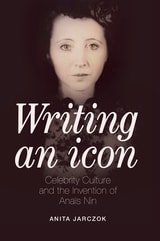
Writing an Icon
Celebrity Culture and the Invention of Anaïs NinAnita Jarczok
Ohio University Press, 2017
Anaïs Nin, the diarist, novelist, and provocateur, occupied a singular space in twentieth-century culture, not only as a literary figure and voice of female sexual liberation but as a celebrity and symbol of shifting social mores in postwar America. Before Madonna and her many imitators, there was Nin; yet, until now, there has been no major study of Nin as a celebrity figure.
In Writing an Icon, Anita Jarczok reveals how Nin carefully crafted her literary and public personae, which she rewrote and restyled to suit her needs and desires. When the first volume of her diary was published in 1966, Nin became a celebrity, notorious beyond the artistic and literary circles in which she previously had operated. Jarczok examines the ways in which the American media appropriated and deconstructed Nin and analyzes the influence of Nin’s guiding hand in their construction of her public persona.
The key to understanding Nin’s celebrity in its shifting forms, Jarczok contends, is the Diary itself, the principal vehicle through which her image has been mediated. Combining the perspectives of narrative and cultural studies, Jarczok traces the trajectory of Nin’s celebrity, the reception of her writings. The result is an innovative investigation of the dynamic relationships of Nin’s writing, identity, public image, and consumer culture.
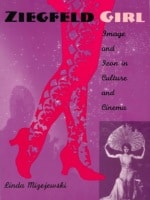
Ziegfeld Girl
Image and Icon in Culture and CinemaLinda Mizejewski
Duke University Press, 1999
Mizejewski traces the Ziegfeld Girl’s connections to turn-of-the-century celebrity culture, black Broadway, the fashion industry, and the changing sexual and gender identities evident in mainstream entertainment during the Ziegfeld years. In addition, she emphasizes how crises of immigration and integration made the identity and whiteness of the American Girl an urgent issue on Broadway’s revue stages during that era. Although her focus is on the showgirl as a “type,” the analysis is intermingled with discussions of figures like Anna Held, Fanny Brice, and Bessie McCoy, the Yama Yama girl, as well as Ziegfeld himself. Finally, Mizejewski discusses the classic American films that have most vividly kept this showgirl alive in both popular and camp culture, including The Great Ziegfeld, Ziegfeld Girl, and the Busby Berkeley musicals that cloned Ziegfeld’s showgirls for decades.
Ziegfeld Girl will appeal to scholars and students in American studies, popular culture, theater and performance studies, film history, gender studies, gay and lesbian studies, and social history.