Results by title
603 books match the query 'Discrimination (incl. Prejudice, Racism, Colorism, etc.)' and 73 start with r

Red Star Over Malaya
Resistance and Social Conflict During and After the Japanese Occupation, 1941-1946Cheah Boon Kheng
National University of Singapore Press, 2012
As Japanese forces withdrew from the countryside, the Chinese guerrillas of the communist-led resistance movement, the Malayan People's Anti-Japanese Army (MPAJA), emerged from the jungle and took control of some 70 per cent of the country's smaller towns and villages, seriously alarming the Malay population. When the British Military Administration sought to regain control of these liberated areas, the ensuing conflict set the tone for future political conflicts and marked a crucial stage in the history of Malaya. Based on extensive archival research, Red Star Over Malaya provides a riveting account of the way the Japanese occupation reshaped colonial Malaya, and of the tension-filled months that followed Japan's surrender. This book is fundamental to an understanding of social and political developments in Malaysia during the second half of the 20th century.

Red, White, Black, and Blue
A Dual Memoir of Race and Class in AppalachiaWilliam M. Drennen Jr., Kojo (William T.) Jones Jr.
Ohio University Press, 2004

Redefining Japaneseness
Japanese Americans in the Ancestral HomelandYamashiro, Jane H
Rutgers University Press, 2017
Redefining Race
Asian American Panethnicity and Shifting Ethnic BoundariesDina G. Okamoto is associate professor of sociology and director of the Center for Research on Race and Ethnicity in Society at Indiana University.
Russell Sage Foundation, 2014
Reel Inequality, Second Edition
Hollywood Actors and RacismNancy Wang Yuen
Rutgers University Press, 2027
Reel Inequality was the first book to systematically document how Hollywood's institutional racism shapes the lives and careers of actors of color. In this updated edition, Nancy Wang Yuen again translates academic research on structural racism into an engaging, accessible narrative for general readers. Connecting personal stories from actors of color, industry data and practices, and historical patterns, she reveals how racism operates both behind the scenes and on the screen. She also examines Hollywood’s retreat from diversity efforts amid the broader backlash against DEI.
Yuen draws on newly released industry data and recently published interviews with actors of color, showing how racism continues to shape who gets cast, who gets hired, and who gets to tell their own story. She looks closely at the pressures actors of color face, including typecasting, financial precarity, and racial burdens, even as many push back and forge their own paths. She also uses the lens of Hollywood to explore broader issues of race, inequality, and representation.
Reel Inequality
Hollywood Actors and RacismNancy Wang Yuen
Rutgers University Press, 2016
Reformed American Dreams
Welfare Mothers, Higher Education, and ActivismSheila M. Katz
Rutgers University Press, 2019
Regulating Difference
Religious Diversity and Nationhood in the Secular WestMarian Burchardt
Rutgers University Press, 2020
Transnational migration has contributed to the rise of religious diversity and has led to profound changes in the religious make-up of society across the Western world. As a result, societies and nation-states have faced the challenge of crafting ways to bring new religious communities into existing institutions and the legal frameworks. Regulating Difference explores how the state regulates religious diversity and examines the processes whereby religious diversity and expression becomes part of administrative landscapes of nation-states and people’s everyday lives. Arguing that concepts of nationhood are key to understanding the governance of religious diversity, Regulating Difference employs a transatlantic comparison of the Spanish region of Catalonia and the Canadian province of Quebec to show how processes of nation-building, religious heritage-making and the mobilization of divergent interpretations of secularism are co-implicated in shaping religious diversity. It argues that religious diversity has become central for governing national and urban spaces.
This book is also freely available online as an open access digital edition.

Reichsrock
The International Web of White-Power and Neo-Nazi Hate MusicDyck, Kirsten
Rutgers University Press, 2016
Reinventing the Austin City Council
Ann O'M. Bowman
Temple University Press, 2020
Reinventing the Austin City Council explores the puzzle that was Austin’s reluctance to alter its at-large system and establish a geographically-based, single-member district system. Ann Bowman chronicles the repeated attempts to change the system, the eventual decision to do so, and the consequences of that change. In the process, she explores the many twists and turns that occurred in Austin as it struggled to design a fair system of representation. Reinventing the Austin City Council assesses the impact of the new district system since its inception in 2014.
Austin’s experience ultimately offers a political lesson for creating institutional change.
Remembering the Alamo
Memory, Modernity, and the Master SymbolBy Richard R. Flores
University of Texas Press, 2002
"Remember the Alamo!" reverberates through Texas history and culture, but what exactly are we remembering? Over nearly two centuries, the Mexican victory over an outnumbered band of Alamo defenders has been transformed into an American victory for the love of liberty. Why did the historical battle of 1836 undergo this metamorphosis in memory and mythology to become such a potent master symbol in Texan and American culture?
In this probing book, Richard Flores seeks to answer that question by examining how the Alamo's transformation into an American cultural icon helped to shape social, economic, and political relations between Anglo and Mexican Texans from the late nineteenth to the mid-twentieth centuries. In the first part of the book, he looks at how the attempts of heritage society members and political leaders to define the Alamo as a place have reflected struggles within Texas society over the place and status of Anglos and Mexicans. In the second part, he explores how Alamo movies and the transformation of Davy Crockett into an Alamo hero/martyr have advanced deeply racialized, ambiguous, and even invented understandings of the past.

Repealed
Ireland’s Unfinished Fight for Reproductive RightsCamilla Fitzsimons
Pluto Press, 2021
*Winner of the James S. Donnelly, Sr. Prize 2022*
In Ireland, 2018, a constitutional ban that equated the life of a woman to the life of a fertilized embryo was overturned and abortion was finally legalized. This victory for the Irish feminist movement set the country alight with euphoria. But the celebrations were short-lived - the new legislation turned out to be one of the most conservative in Europe. This book tells the story of the ‘Repeal’ campaign through the lens of the activists.
The authors trace the shocking history of the origins of the eighth amendment, which was drawn up in fear of a tide of liberal reforms across Europe. They draw out the lessons learned through the decades and from the groundbreaking campaign in 2018, which was an inspiring example of modern grassroots activism. They also recount the tensions between a medicalized approach and reproductive justice approach to abortion, as well as the harsh effect of the campaign on the health of activists.
Grounded in a radical feminist politics, this book is an honest and inspirational account of a movement that is only just beginning.

Represent and Destroy
Rationalizing Violence in the New Racial CapitalismJodi Melamed
University of Minnesota Press, 2011
In the global convulsions in the aftermath of World War II, one dominant world racial order broke apart and a new one emerged. This is the story Jodi Melamed tells in Represent and Destroy, portraying the postwar racial break as a transition from white supremacist modernity to a formally antiracist liberal capitalist modernity in which racial violence works normatively by policing representations of difference.
Following the institutionalization of literature as a privileged domain for Americans to get to know difference—to describe, teach, and situate themselves with respect to race—Melamed focuses on literary studies as a cultural technology for transmitting liberal racial orders. She examines official antiracism in the United States and finds that these were key to ratifying the country’s global ascendancy. She shows how racial liberalism, liberal multiculturalism, and neoliberal multiculturalism made racism appear to be disappearing, even as they incorporated the assumptions of global capitalism into accepted notions of racial equality.
Yet Represent and Destroy also recovers an anticapitalist “race radical” tradition that provides a materialist opposition to official antiracisms in the postwar United States—a literature that sounds out the violence of liberal racial orders, relinks racial inequality to material conditions, and compels desire for something better than U.S. multiculturalism.
Reproducing the French Race
Immigration, Intimacy, and Embodiment in the Early Twentieth CenturyElisa Camiscioli
Duke University Press, 2009
By focusing on telling aspects of the immigration debate, Camiscioli reveals how racial hierarchies were constructed, how gender figured in their creation, and how only white Europeans were cast as assimilable. Delving into pronatalist politics, she describes how potential immigrants were ranked according to their imagined capacity to adapt to the workplace and family life in France. She traces the links between racialized categories and concerns about industrial skills and output, and she examines medico-hygienic texts on interracial sex, connecting those to the crusade against prostitution and the related campaign to abolish “white slavery,” the alleged entrapment of (white) women for sale into prostitution abroad. Camiscioli also explores the debate surrounding the 1927 law that first made it possible for French women who married foreigners to keep their French nationality. She concludes by linking the Third Republic’s impulse to create racial hierarchies to the emergence of the Vichy regime.
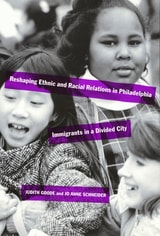
Reshaping Ethnic Relations
Immigrants in a Divided CityJudith Goode and Jo Anne Schneider
Temple University Press, 1994
What happens when people from diverse racial and ethnic backgrounds come together to live and work in the same neighborhood? Unlike other examinations of this question that focus on one group, this book looks at the interaction of both old and new immigrant populations in three Philadelphia neighborhoods.
In this ethnographic study, which is a result of the Ford Foundation-funded Changing Relations: Newcomers and Established Residents in Philadelphia Project, the authors consider five primary groups—whites, African Americans, Puerto Ricans, Koreans, and Eastern Europeans—in Olney, Kensington, and Port Richmond. Focusing on the interaction of racial, ethnic, and immigrant communities in schools, organized community celebrations and social events, the workplace, shopping areas, and neighborhood politics, the authors show that the contradictions of individual beliefs, actions, and strategies of power are not easily resolved.
By examining the local, citywide, and national economy and government, previous human relations efforts, changing immigration patterns, community-level power structures, real estate turnover, and gentrification, the authors evaluate current strategies to create harmony in communities with an ever-changing mix of established residents and newly arrived immigrants. Through their findings, Judith Goode and Jo Anne Schneider develop better alternatives that will encourage understanding and cooperation among different racial and ethnic groups sharing their lives and neighborhoods.

Resolving Racial Conflict
The Community Relations Service and Civil Rights, 1964-1989Bertram Levine
University of Missouri Press, 2005
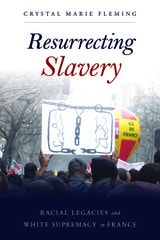
Resurrecting Slavery
Racial Legacies and White Supremacy in FranceCrystal Marie Fleming
Temple University Press, 2017
How can politicians and ordinary citizens face the racial past in a country that frames itself as colorblind? In her timely and provocative book, Resurrecting Slavery, Crystal Fleming shows how people make sense of slavery in a nation where talking about race, colonialism, and slavery remains taboo. Noting how struggles over the meaning of racial history are informed by contemporary politics of race, she asks: What kinds of group identities are at stake today for activists and French people with ties to overseas territories where slavery took place?
Fleming investigates the connections and disconnections that are made between racism, slavery, and colonialism in France. She provides historical context and examines how politicians and commemorative activists interpret the racial past and present. Resurrecting Slavery also includes in-depth interviews with French Caribbean migrants outside the commemorative movement to address the everyday racial politics of remembrance.
Bringing a critical race perspective to the study of French racism, Fleming’s groundbreaking study provides a more nuanced understanding of race in France along with new ways of thinking about the global dimensions of slavery, anti-blackness, and white supremacy.
Revisiting Childhood Resilience Through Marginalised and Displaced Voices
Perspectives from the Past and PresentWendy Sims-Schouten
University College London, 2025
Revisiting Childhood Resilience Through Marginalised and Displaced Voices resists the way we think about resilience, shifting the focus from personal perseverance to the lived realities of children and young people pushed to society’s margins. Wendy Sims-Schouten moves beyond the familiar idea of resilience as individual grit, instead exploring how defiance and even compliance emerge as survival strategies for care leavers, bullied youth, ethnic minorities, and those with histories of migration and displacement.
Spanning one hundred and fifty years of personal and collective histories, this book brings together interdisciplinary research co-produced with those too often left out of resilience studies. By centering their voices, it unveils how resilience is shaped not just by inner strength, but by systemic barriers and the availability of support. Revisiting Childhood Resilience calls on policymakers and practitioners to rethink resilience as something far more complex than an individual trait; a process deeply rooted in context and agency.
Rhetorics of Whiteness
Postracial Hauntings in Popular Culture, Social Media, and EducationEdited by Tammie M. Kennedy, Joyce Irene Middleton, Krista Ratcliffe, with a foreword by Lilia D. Monzó and Peter McLaren
Southern Illinois University Press, 2017
With the election of our first black president, many Americans began to argue that we had finally ended racism, claiming that we now live in a postracial era. Yet near-daily news reports regularly invoke white as a demographic category and recount instances of racialized violence as well as an increased sensitivity to expressions of racial unrest. Clearly, American society isn’t as color-blind as people would like to believe. In Rhetorics of Whiteness: Postracial Hauntings in Popular Culture, Social Media, and Education, contributors reveal how identifications with racialized whiteness continue to manifest themselves in American culture.
The sixteen essays that comprise this collection not only render visible how racialized whiteness infiltrates new twenty-first-century discourses and material spaces but also offer critical tactics for disrupting this normative whiteness. Specifically, contributors examine popular culture (novels, films, TV), social media (YouTube, eHarmony, Facebook), education (state law, the textbook industry, dual credit programs), pedagogy (tactics for teaching via narratives, emotional literacy, and mindfulness) as well as cultural theories (concepts of racialized space, anti-dialogicism, and color blindness). Offering new approaches to understanding racialized whiteness, this volume emphasizes the importance of a rhetorical lens for employing whiteness studies’ theories and methods to identify, analyze, interpret, and interrupt representations of whiteness.
Although whiteness studies has been waning as an active research field for the past decade, the contributors to Rhetorics of Whiteness assert that it hasn’t lost its relevancy because racialized whiteness and issues of systemic racism persist in American society and culture today. Few whiteness studies texts have been published in rhetoric and composition in the past decade, so this collection should quickly become mandatory reading. By focusing on common, yet often overlooked, contemporary examples of how racialized whiteness haunts U.S. society, Rhetorics of Whiteness serves as a valuable text for scholars in the field as well as anyone else interested in the topic.

Right Here, Right Now
Life Stories from America's Death RowLynden Harris, editor
Duke University Press, 2021
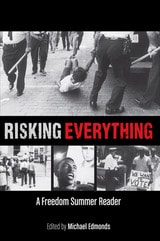
Risking Everything
A Freedom Summer ReaderMichael Edmonds
Wisconsin Historical Society Press, 2014
Risking Everything: A Freedom Summer Reader documents the 1964 Mississippi Freedom Summer Project, when SNCC and CORE workers and volunteers arrived in the Deep South to register voters and teach non-violence, and more than 60,000 black Mississippians risked everything to overturn a system that had brutally exploited them.
In the 44 original documents in this anthology, you’ll read their letters, eavesdrop on their meetings, shudder at their suffering, and admire their courage. You’ll witness the final hours of three workers murdered on the project’s first day, hear testimony by black residents who bravely stood up to police torture and Klan firebombs, and watch the liberal establishment betray them.
These vivid primary sources, collected by the Wisconsin Historical Society, provide both first-hand accounts of this astounding grassroots struggle as well as a broader understanding of the Civil Rights movement.
The selected documents are among the 25,000 pages about the Mississippi Freedom Summer Project in the archives of the Wisconsin Historical Society. The manuscripts were collected in the mid-1960s, at a time when few other institutions were interested in saving the stories of common people in McComb or Ruleville, Mississippi. Most have never been published before.
Robo Sacer
Necroliberalism and Cyborg Resistance in Mexican and Chicanx DystopiasDavid S. Dalton
Vanderbilt University Press, 2023
Harvey L. Johnson Publication Award, Southwest Council of Latin American Studies, 2026
Premio Alambique, Alambique: Revista Académica de Ciencia Ficción y Fantasía, 2025
Robo Sacer engages the digital humanities, critical race theory, border studies, biopolitical theory, and necropolitical theory to interrogate how technology has been used to oppress people of Mexican descent—both within Mexico and in the United States—since the advent of the North American Free Trade Agreement (NAFTA) in 1994. As the book argues, robo-sacer identity emerges as transnational flows of bodies, capital, and technology become an institutionalized state of exception that relegates people from marginalized communities to the periphery.
And yet the same technology can be utilized by the oppressed in the service of resistance. The texts studied here represent speculative stories about this technological empowerment. These texts theorize different means of techno-resistance to key realities that have emerged within Mexican and Chicano/a/x communities under the rise and reign of neoliberalism. The first three chapters deal with dehumanization, the trafficking of death, and unbalanced access to technology. The final two chapters deal with the major forms of violence—feminicide and drug-related violence—that have grown exponentially in Mexico with the rise of neoliberalism. These stories theorize the role of technology both in oppressing and in providing the subaltern with necessary tools for resistance.
Robo Sacer builds on the previous studies of Sayak Valencia, Irmgard Emmelhainz, Guy Emerson, Achille Mbembe, and of course Giorgio Agamben, but it differentiates itself from them through its theorization on how technology—and particularly cyborg subjectivity—can amend the reigning biopolitical and necropolitical structures of power in potentially liberatory ways. Robo Sacer shows how the cyborg can denaturalize constructs of zoē by providing an outlet through which the oppressed can tell their stories, thus imbuing the oppressed with the power to combat imperialist forces.

Room 306
The National Story of the Lorraine MotelBen Kamin
Michigan State University Press, 2012