Results by title
681 books match the query 'English language' and 67 start with r
Rewriting
How to Do Things with Texts, Second EditionJoseph Harris
Utah State University Press, 2017
“Like all writers, intellectuals need to say something new and say it well. But for intellectuals, unlike many other writers, what we have to say is bound up with the books we are reading . . . and the ideas of the people we are talking with.”
What are the moves that an academic writer makes? How does writing as an intellectual change the way we work from sources? In Rewriting, Joseph Harris draws the college writing student away from static ideas of thesis, support, and structure, and toward a more mature and dynamic understanding. Harris wants college writers to think of intellectual writing as an adaptive and social activity, and he offers them a clear set of strategies—a set of moves—for participating in it. Introducing remixing as an additional signature move and updated with new attention to digital writing, the second edition both extends and rethinks the ideas of the original.
Rhetor Response
A Theory and Practice of Literary AffordancePeter H. Khost
Utah State University Press, 2018
Bridging the disciplinary divide between writing and literature, Rhetor Response introduces the concept and pedagogical applications of “literary affordances”—the ways in which readers “use” and integrate literature into their own writing or lives. Unconcerned with authorial intent, interpretive meaning, or critical reception, “affordance” signifies a shift in focus from what literary texts mean and do to what one can do with them.
This book presents both opportunities and challenges to writing studies, a field whose burgeoning disciplinary independence ironically relies on a sizable underclass of specialists in literature rather than writing. Incorporating elements of rhetorical theory, literary criticism, pedagogical methodology, political critique, and psychological and philosophical memoir, Peter H. Khost complicates and revives the relevance of literature—from belles lettres to fanfiction—by turning from interpretation to affordance in order to identify readers’ applications of literary textual features to unrelated lived situations.
Rhetor Response theorizes and exemplifies literary affordance as a constructive step toward professional reconciliation, as well as an entry into greater textual power and pleasure for students and readers. It is a one-of-a-kind resource for college writing program administrators, faculty and scholars in English and writing studies, and graduate and advanced undergraduate students across both disciplines.
Rhetoric and Composition as Intellectual Work
Edited by Gary A. Olson
Southern Illinois University Press, 2002
In response to those who insist that rhetoric and composition should remain only a service discipline, editor Gary A. Olson’s Rhetoric and Composition as Intellectual Work demonstrates that it already is an intellectual discipline, that for at least a quarter of a century the field has developed an impressive tradition of intellectual work in a remarkable assortment of subject areas. Rhetoric and Composition as Intellectual Work suggests the diversity of intellectual projects that have and will continue to make rhetoric and composition more than a service to the university, more than a field devoted solely to improving writing pedagogy, and more than a preliminary to literary studies.
This collection of nineteen essays by some of the most distinguished scholars in the discipline illustrates that rhetoric and composition has much to contribute to the intellectual milieu of the contemporary university, as the field continues to push its disciplinary borders and discover new sites of investigation.
Rhetoric and Reality
Writing Instruction in American Colleges, 1900 - 1985James A. Berlin
Southern Illinois University Press, 1987
Berlin here continues his unique history of American college composition begun in his Writing Instruction in Nineteenth-Century Colleges (1984), turning now to the twentieth century.
In discussing the variety of rhetorics that have been used in writing classrooms Berlin introduces a taxonomy made up of three categories: objective rhetorics, subjective rhetorics, and transactional rhetorics, which are distinguished by the epistemology on which each is based. He makes clear that these categories are not tied to a chronology but instead are to be found in the English department in one form or another during each decade of the century.
His historical treatment includes an examination of the formation of the English department, the founding of the NCTE and its role in writing instruction, the training of teachers of writing, the effects of progressive education on writing instruction, the General Education Movement, the appearance of the CCCC, the impact of Sputnik, and today’s “literacy crisis.”
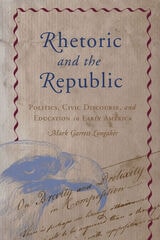
Rhetoric and the Republic
Politics, Civic Discourse, and Education in Early AmericaMark Garrett Longaker
University of Alabama Press, 2007
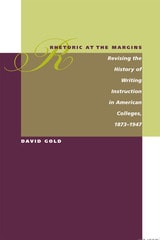
Rhetoric at the Margins
Revising the History of Writing Instruction in American Colleges, 1873-1947David Gold
Southern Illinois University Press, 2008
Rhetoric at the Margins: Revising the History of Writing Instruction in American Colleges, 1873-1947 examines the rhetorical education of African American, female, and working-class college students in the late nineteenth and early twentieth centuries. The rich case studies in this work encourage a reconceptualization of both the history of rhetoric and composition and the ways we make use of it.
Author David Gold uses archival materials to study three types of institutions historically underrepresented in disciplinary histories: a black liberal arts college in rural East Texas (Wiley College); a public women's college (Texas Woman's University); and an independent teacher training school (East Texas Normal College). The case studies complement and challenge previous disciplinary histories and suggest that the epistemological schema that have long applied to pedagogical practices may actually limit our understanding of those practices.
Gold argues that each of these schools championed intellectual and pedagogical traditions that differed from the Eastern liberal arts model—a model that often serves as the standard bearer for rhetorical education. He demonstrates that by emphasizing community uplift and civic participation and attending to local needs, these schools created contexts in which otherwise moribund curricular features of the era—such as strict classroom discipline and an emphasis on prescription—took on new possibilities.
Rhetoric at the Margins describes the recent revisionist turn in rhetoric and composition historiography, argues for the importance of diverse institutional microhistories, and argues that the nineteenth and early twentieth centuries offer rich lessons for contemporary classroom practice. The study brings alive the voices of black, female, rural, Southern, and first-generation college students and their instructors, effectively linking these histories to the history of rhetoric and writing. Appendices include excerpts of important and rarely seen primary source material, allowing readers to experience in fuller detail the voices captured in this work.
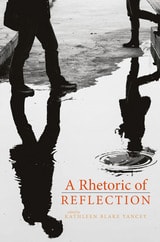
Rhetoric of Reflection
Kathleen Yancey
Utah State University Press, 2016
As mapped by the contributors to A Rhetoric of Reflection, this iteration of research and practice is taking up new questions in new sites of activity and with new theories. It comprises attention to transfer of writing knowledge and practice, teaching and assessment, portfolios, linguistic and cultural difference, and various media, including print and digital. It conceptualizes conversation as a primary reflective medium, both inside and outside the classroom and for individuals and collectives, and articulates the role that different genres play in hosting reflection. Perhaps most important in the work of this third generation is the identification and increasing appreciation of the epistemic value of reflection, of its ability to help make new meanings, and of its rhetorical power—for both scholars and students.
Contributors: Anne Beaufort, Kara Taczak, Liane Robertson, Michael Neal, Heather Ostman, Cathy Leaker, Bruce Horner, Asao B. Inoue, Tyler Richmond, J. Elizabeth Clark, Naomi Silver, Christina Russell McDonald, Pamela Flash, Kevin Roozen, Jeff Sommers, Doug Hesse
Rhetoric, Independence, and Nationhood, 1760–1800, Volume II
Stephen E Lucas
Michigan State University Press, 2022

Rhetoric, Science, and Magic in Seventeenth-century England
Ryan J. Stark
Catholic University of America Press, 2009
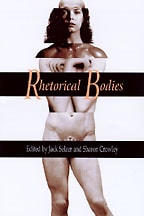
Rhetorical Bodies
Jack Selzer
University of Wisconsin Press, 1999
What significance does the physical, material body still have in a world of virtual reality and genetic cloning? How do technology and postmodern rhetoric influence our understanding of the body? And how can our discussion of the body affect the way we handle crises in public policy—the politics of race and ethnicity; issues of "family values" that revolve around sexual and gender identities; the choices revolving around reproduction and genome projects, and the spread of disease?
Leading scholars in rhetoric and communication, as well as literary and cultural studies, address some of the most important topics currently being discussed in the human sciences. The essays collected here suggest the wide range of public arenas in which rhetoric is operative—from abortion clinics and the World Wide Web to the media's depiction of illiteracy and the Donner Party. These studies demonstrate how the discourse of AIDS prevention or Demi Moore's "beautiful pregnancy" call to mind the physical nature of being human and the ways in which language and other symbols reflect and create the physical world.
Rhetorical Education In America
Cheryl Jean Glenn
University of Alabama Press, 2009
A timely collection of essays by prominent scholars in the field—on the past, present, and future of rhetoric instruction.
From Isocrates and Aristotle to the present, rhetorical education has consistently been regarded as the linchpin of a participatory democracy, a tool to foster civic action and social responsibility. Yet, questions of who should receive rhetorical education, in what form, and for what purpose, continue to vex teachers and scholars.
The essays in this volume converge to explore the purposes, problems, and possibilities of rhetorical education in America on both the undergraduate and graduate levels and inside and outside the academy. William Denman examines the ancient model of the "citizen-orator" and its value to democratic life. Thomas Miller argues that English departments have embraced a literary-research paradigm and sacrificed the teaching of rhetorical skills for public participation. Susan Kates explores how rhetoric is taught at nontraditional institutions, such as Berea College in Kentucky, where Appalachian dialect is espoused. Nan Johnson looks outside the academy at the parlor movement among women in antebellum America. Michael Halloran examines the rhetorical education provided by historical landmarks, where visitors are encouraged to share a common public discourse. Laura Gurak presents the challenges posed to traditional notions of literacy by the computer, the promises and dangers of internet technology, and the necessity of a critical cyber-literacy for future rhetorical curricula.
Collectively, the essays coalesce around timely political and cross-disciplinary issues. Rhetorical Education in America serves to orient scholars and teachers in rhetoric, regardless of their disciplinary home, and help to set an agenda for future classroom practice and curriculum design.
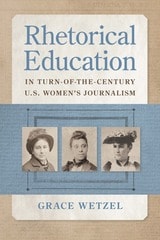
Rhetorical Education in Turn-of-the-Century U.S. Women's Journalism
Grace Wetzel, with a foreword by Shari J. Stenberg
Southern Illinois University Press, 2022
At the end of the nineteenth century, newspapers powerfully shaped the U.S. reading public, fostering widespread literacy development and facilitating rhetorical education. With new opportunities to engage audiences, female journalists repurposed the masculine tradition of journalistic writing by bringing together intimate forms of rhetoric and pedagogy to create innovative new dialogues. Rhetorical Education in Turn-of-the-Century U.S. Women’s Journalism illuminates the pedagogical contributions of three newspaperwomen to show how the field became a dynamic site of public participation, relationship building, education, and activism in the 1880s and 1890s.
Grace Wetzel introduces us to the work of Omaha correspondent Susette La Flesche Tibbles (Inshta Theamba), African American newspaper columnist Gertrude Bustill Mossell, and white middle-class reporter Winifred Black (“Annie Laurie”). Journalists by trade, these three writers made the mass-circulating newspaper their site of teaching and social action, inviting their audiences and communities—especially systematically marginalized voices—to speak, write, and teach alongside them.
Situating these journalists within their own specific writing contexts and personas, Wetzel reveals how Mossell promoted literacy learning and community investment among African American women through a reader-centered pedagogy; La Flesche modeled relational news research and reporting as a survivance practice while reporting for the Omaha Morning World-Herald at the time of the Wounded Knee Massacre; and Black inspired public writing and activism among children from different socioeconomic classes through her “Little Jim” story. The teachings of these figures serve as enduring examples of how we can engage in meaningful public literacy and ethical journalism.
Rhetorical Listening
Identification, Gender, WhitenessKrista Ratcliffe
Southern Illinois University Press, 2005
Extending the feminist rhetorical project to define and model rhetorical listening
Long-ignored within rhetoric and composition studies, listening has returned to the disciplinary radar. Rhetorical Listening: Identification, Gender, Whiteness argues that rhetorical listening facilitates conscious identifications needed for cross-cultural communication.
Krista Ratcliffe establishes eavesdropping, listening metonymically, and listening pedagogically as approaches to rhetorical listening. She defines and models rhetorical listening, addressing identifications with gender and whiteness within public debates, scholarship, and pedagogy. Offering an approach grounded in classical rhetorical theory, Heideggerian theory, feminist theory, and critical race theory, Ratcliffe presents rhetorical listening as an invention tactic that engages spoken and written texts and supplements reading, writing, speaking, and silence as a rhetorical art.
Theorizing intersections of gender and whiteness, Rhetorical Listening examines how whiteness functions as an "invisible" racial category and provides disciplinary and cultural reasons for the displacement of listening and for the use of rhetorical listening as a code of cross-cultural conduct. Ratcliffe presents rhetorical listening in terms of cultural logics, stances, and dominant interpretive tropes. She highlights the modern identification theory of Kenneth Burke and the postmodern identification and disidentification theory of Diana Fuss and presents nonidentification as a more productive site for rhetorical listening.
Rhetorical Refusals
Defying Audiences' ExpectationsJohn Schilb
Southern Illinois University Press, 2007
The first book to explore rhetorical refusals—instances in which speakers and writers deliberately flout the conventions of rhetoric and defy their audiences’ expectations— Rhetorical Refusals: Defying Audiences’ Expectations challenges the reader to view these acts of academic rebellion as worthy of deeper analysis than they are commonly accorded, as rhetorical refusals can simultaneously reveal unspoken assumptions behind the very conventions they challenge, while also presenting new rhetorical strategies.
Through a series of case studies, John Schilb demonstrates the deeper meanings contained within rhetorical refusals: when dance critic Arlene Croce refused to see a production that she wrote about; when historian Deborah Lipstadt declined to debate Holocaust deniers; when President Bill Clinton denied a grand jury answers to their questions; and when Frederick Douglass refused to praise Abraham Lincoln unequivocally. Each of these unexpected strategies revealed issues of much greater importance than the subjects at hand. By carefully laying out an underlying framework with which to evaluate these acts, Schilb shows that they can variously point to the undue privilege of authority; the ownership of truth; the illusory divide between public and private lives; and the subjectivity of honor.
According to Schilb, rhetorical refusals have the potential to help political discourse become more inventive. To demonstrate this potential, Schilb looks at some notable cases in which invitations have led to unexpected results: comedian Stephen Colbert’s brazen performance at the White House Press Association dinner; poet Sharon Olds’s refusal to attend the White House Book Fair, and activist Cindy Sheehan’s display of an anti-war message at the 2006 State of the Union Address.
Rhetorical Refusals explores rhetorical theories in accessible language without sacrificing complexity and nuance, revealing the unspoken implications of unexpected deviations from rhetorical norms for classic political concepts like free debate and national memory. With case studies taken from art, politics, literature, and history, this book will appeal to scholars and students of English, communication studies, and history.
Rhetorical Strategies and Genre Conventions in Literary Studies
Teaching and Writing in the DisciplinesLaura Wilder
Southern Illinois University Press, 2012
Laura Wilder fills a gap in the scholarship on writing in the disciplines and writing across the curriculum with this thorough study of the intersections between scholarly literary criticism and undergraduate writing in introductory literature courses. Rhetorical Strategies and Genre Conventions in Literary Studies is the first examination of rhetorical practice in the research and teaching of literary study and a detailed assessment of the ethics and efficacy of explicit instruction in the rhetorical strategies and genre conventions of the discipline.
Using rhetorical analysis, ethnographic observation, and individual interviews, Wilder demonstrates how rhetorical conventions play a central, although largely tacit, role in the teaching of literature and the evaluation of student writing. Wilder follows a group of literature majors and details their experiences. Some students received experimental, explicit instruction in the special topoi, while others received more traditional, implicit instruction.
Arguing explicit instruction in disciplinary conventions has the potential to help underprepared students, Wilder explores how this kind of instruction may be incorporated into literature courses without being overly reductive. Taking into consideration student perspectives, Wilder makes a bold case for expanding the focus of research in writing in the disciplines and writing across the curriculum in order to grasp the full complexity of disciplinary discourse.
Risky Writing
Self-Disclosure and Self-Transformation in the ClassroomJeffrey Berman
University of Massachusetts Press, 2001
This is the final volume in a trilogy of works that examine the impact of writing and reading about traumatic subjects. Diaries to an English Professor (1994) explores the ways in which undergraduate students use psychoanalytic diaries to probe conflicted issues in their lives. Surviving Literary Suicide (1999) investigates how graduate students respond to suicidal literature—novels and poems that portray and sometimes glorify self-inflicted death.
In Risky Writing, Jeffrey Berman builds on those earlier studies, describing ways teachers can encourage college students to write safely on a wide range of subjects often deemed too personal or too dangerous for the classroom: grieving the loss of a beloved relative or friend, falling into depression, coping with the breakup of one's family, confronting sexual abuse, depicting a drug or alcohol problem, encountering racial prejudice. Berman points out that nearly everyone has difficulty talking or writing about such issues because they arouse shame and tend to be enshrouded in secrecy and silence. This is especially true for college students, who are just emerging from adolescence and find themselves at institutions that rarely promote self-disclosure.
Recognizing the controversial nature of his subject, Berman confronts academic opposition to personal writing head on. He also discusses the similarities between the “writing cure” and the “talking cure,” the role of the teacher and audience in the self-disclosing classroom, and the pedagogical strategies necessary to minimize risk, including the importance of empathy and other befriending skills.
Rural Literacies
Kim Donehower, Charlotte Hogg, and Eileen Schell
Southern Illinois University Press, 2006