Results by title
3388 books match the query 'Fiction' and 77 start with r
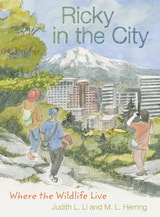
Ricky in the City
Where the Wildlife LiveJudith L. Li
Oregon State University Press, 2019
The kids find insects and reptiles moving about garden patches and bioswales, song birds and squirrels in neighborhood tree canopies, falcons and eagles crossing spacious river floodplains. As they record and map how wildlife and people are connected in these city spaces, they become community scientists, contributing to actual regional databases. After they see the young trees Marcus planted in his neighborhood, the feeders Jenny tends for hummingbirds, and the fascinating wildlife underpasses built in the wetlands, Ricky and Ellie realize there are many ways people actively care for the city’s wildlife.
In this fourth and final story of their award-winning children’s series, M. L. Herring’s vivid pen and watercolor illustrations complement the engaging storytelling of Judith Li. Readers will delight in the journal pages and maps “hand drawn” by Ricky and Ellie at the end of each chapter, while the “Dear Reader” section offers further tips for budding citizen scientists.
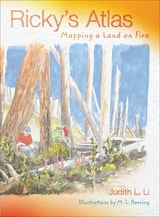
Ricky's Atlas
Mapping a Land on FireLi
Oregon State University Press, 2016
In this sequel to Ellie’s Log: Exploring the Forest Where the Great Tree Fell, Ricky Zamora brings his love of map-making and his boundless curiosity to the arid landscapes east of the Cascades Mountains. He arrives during a wild thunderstorm, and watches his family and their neighbors scramble to deal with a wildfire sparked by lightning. Joined by his friend Ellie, he sees how plants, animals, and people adjust to life with wildfires.
While hiking across a natural prairie, climbing up a fire tower, and studying historical photos and maps, Ricky and Ellie learn about the role of fire in shaping the landscape of the semi-arid plateau east of the mountains. They experience the scary days of wildfire in progress, explore a gritty site after a wildfire, and discover how some plants and animals depend on fire to survive.
Color pen-and-ink drawings accompany the text and vividly illustrate plants, animals, and events encountered in this exciting summer adventure. With his friend Ellie, Ricky creates a brightly colored diary of the fire, with maps, timelines, and sketches of what they see in this fire-prone land. Ricky’s notebook about his summer visit to his uncle’s ranch becomes an atlas of fire ecology, weather patterns, and life in the rain shadow.
Upper elementary kids will enjoy the mixture of amazing adventures with actual historical, physical, and ecological data about the region. Woven into the story are the small pleasures of ranch life, intriguing histories of Native Americans and early settlers, and almost unbelievable views of ancient fossils. Ricky and Ellie’s explorations, accompanied by their hand-written notes, introduce readers to a very special landscape and history east of the mountains.

Rift
V.Y. Mudimbe
University of Minnesota Press, 1993
Riot
Mary Casanova
University of Minnesota Press, 2014
Based on actual events from 1989 in International Falls, Minnesota, Riot tells the story of sixth-grader Bryan, whose family becomes stressed when nonunion labor “rats” are hired by the local paper mill, leaving his father, a union worker, angry and out of a job. Tension erupts into daily fights at school and nightly acts of vandalism with no solution in sight. Already torn between his parents’ opposing viewpoints on how to handle the escalating situation, Bryan’s growing feelings for the daughter of a nonunion worker only complicate matters.
Bryan tries to understand the turmoil affecting his home and his town, but it is becomes harder and harder to separate his friends from his enemies. And when he witnesses a violent act that implicates his father, he must wrestle with family loyalty and telling the truth.
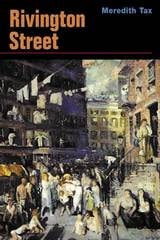
Rivington Street
A NOVELMeredith Tax
University of Illinois Press, 1982
An absorbing, epic novel, Rivington Street is also suitable for use as a classroom text.
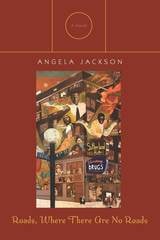
Roads, Where There Are No Roads
A NovelAngela Jackson
Northwestern University Press, 2017
In this highly anticipated sequel to her acclaimed first novel, Where I Must Go, Angela Jackson continues the remarkable story of Magdalena Grace. As a black student at the predominantly white Eden University, Maggie found herself deeply involved in conflict. Now, out in the wider world, she and her beloved Treemont Stone evolve into agents of change as they become immersed in the historical events unfolding around them—the movements advocating for civil rights, black consciousness, black feminism, the rights of the poor, and an end to the war in Vietnam. Rendered in prose so lyrical and luminous as to suggest a dream, Roads, Where There Are No Roads is a love story in the greatest sense, celebrating love between a man and a woman, between family members, and among the members of a community whose pride pushes them to rise up and resist. This gorgeously written novel will resonate with readers today as incredibly relevant, uplifting hearts and causing eyes to water with sorrow and delight.
Roast Beef, Medium
The Business Adventures of Emma McChesneyEdna Ferber
University of Illinois Press, 1913
Edna Ferber, Pulitzer Prize-winning author of Show Boat and Giant, achieved her first great success with a series of stories she published in American Magazine between 1911 and 1913. The stories featured Emma McChesney: smart, savvy, stylish, divorced mother, and Midwest traveling sales representative for T. A. Buck's Featherloom skirts and petticoats. With one hand on her sample case and the other fending off advances from salesmen, hotel clerks, and other predators, Emma holds on tightly to her reputation: honest, hardworking, and able to outsell the slickest salesman.
Like her compact bag of traveling necessities, Emma has her life boiled down to essentials: her work and her seventeen-year-old son, Jock. Her experience has taught her that it's best to stick to roast beef, medium--avoiding both physical and moral indigestion--rather than experiment with fancy sauces and exotic dishes. Yet she never shies away from a challenge, and her sharp instincts and common sense serve her well in dealing with the likes of Ed Meyer, a smooth-talking, piano-playing salesman; Blanche LeHay, prima donna of the Sam Levin Crackerjack Belles; and T. A. Buck Jr., the wet-behind-the-ears son of the founder of Featherloom.
Roast Beef, Medium is the first of three volumes chronicling the travels and trials of Emma McChesney. The illustrations by James Montgomery Flagg, one of the most highly regarded book illustrators of the period, enhance both the humor and the vivid characterization in this wise and high-spirited tale.
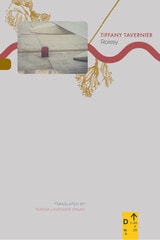
Roissy
Tiffany Tavernier
Seagull Books, 2021
Every day the narrator of this gripping novel hurries from one terminal to another in Charles de Gaulle Roissy airport, Paris, pulling her suitcase behind her, talking to people she meets—but she never boards an airplane. She becomes an “unnoticeable,” a homeless woman disguised as a passenger, protected by her anonymity. When a man who comes to the airport every day to await the Rio-to-Paris flight—the same route on which a plane crashed into the sea a few years earlier—attempts to approach her, she flees, terrified. But eventually, she accepts his kindness and understands his loss, and she gives in to the grief they share, forming a bond with him that becomes more than friendship. A magnificent portrait of a woman who rediscovers herself through a chance connection, Roissy is a powerful, polyphonic book, a glimpse at the infinite capacity of the human spirit to be reborn.
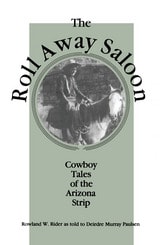
Roll Away Saloon
Rowland W. Rider as told to Deirdre M. Paulsen
Utah State University Press, 1985
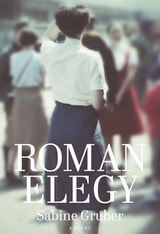
Roman Elegy
Sabine Gruber
Haus Publishing, 2013
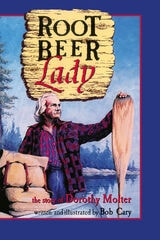
Root Beer Lady
The Story Of Dorothy MolterBob Cary
University of Minnesota Press, 2002
An ice-cold glass of root beer and a warm welcome greeted thousands of weary paddlers who stopped at the Isle of Pines to meet Dorothy Molter, the courageous, independent woman who became a North Woods legend. Bob Cary, Dorothy’s longtime friend, captures her life and spirit in Root Beer Lady.
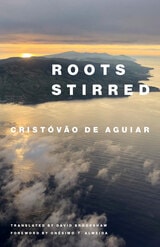
Roots Stirred
Cristóvão de Aguiar, Translated by David Brookshaw, Foreword by Onésimo T. Almeida
Tagus Press, 2026
A vibrant tale of memory, resistance, and the enduring spirit of an island community
This richly woven, multi-voiced novel transports readers to a small village on São Miguel, the largest of Portugal’s Azores islands. Through the eyes of a young boy growing up in the 1940s, and the stories shared by his beloved great-uncle, Tio Pascoal, the novel paints a vivid portrait of island life—its beauty, its hardships, and its quiet defiance.
As Tio Pascoal recounts his own youth at the start of the 20th century, we glimpse a world shaped by poverty, exploitation, and the heavy hands of church, landowners, and, later, the rise of Portugal’s authoritarian regime. Yet amid these struggles, the resilience of the islanders shines through—in their music, their feast days, their customs, and the enduring ties between those who stayed behind and those who set sail for America.
Told in a style alive with the rhythms and color of the local language—carefully rendered into English—Roots Stirred is both a coming-of-age story and a tribute to the rebellious spirit that endures across generations. By the time the young narrator prepares to leave his childhood behind, his uncle’s stories have taken root within him, carrying forward the memory of their people and the islands they call home.
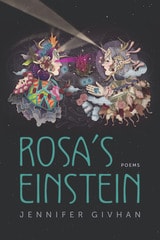
Rosa's Einstein
PoemsJennifer Givhan
University of Arizona Press, 2019
In this full-length poetry collection, the girls of Rosa’s Einstein embark on a quest to discover what is real and what is possible in the realms of imagination, spurred on by scientific curiosity and emotional resilience. Following a structural narrative arc inspired by the archetypal hero’s journey, sisters Rosa and Nieve descend into the desert borderlands of New Mexico to find resolution and healing through a bold and fearless examination of the past, meeting ghostly helpers and hinderers along the way. These metaphorical spirits take the shape of circus performers, scientists, and Lieserl, the lost daughter Albert Einstein gave away.
Poet Jennifer Givhan reimagines the life of Lieserl, weaving her search for her scientist father with Rosa and Nieve’s own search for theirs. Using details both from Einstein’s known life and from quantum physics, Givhan imagines Lieserl in a circus-like landscape of childhood trauma and survival, guided by Rosa and Nieve.
Rosie the Tarantula
A True Adventure in Chicago’s Field MuseumIllustations by Peggy Macnamara; Written by Katie Macnamara
Northwestern University Press, 2017
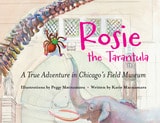
Several years ago, Rosie went on an expedition to the wonders of the Field’s soaring halls, such as Sue the Tyrannosaurus rex, as well as the secret specimens of animal fossils and human artifacts hidden away in drawers, cabinets, and bins. Renowned Field Museum artist-in-residence Peggy Macnamara brings the marvels of the museum to vivid life in a set of gorgeous and meticulously accurate watercolors. Peggy’s daughter Katie narrates the story of this restless arachnid in rhyme ideal for reading aloud to children.
A keepsake quality book that will delight budding young scientists and their families, Rosie the Tarantula provides a colorful, interactive experience with one of Chicago’s foremost cultural institutions. This one-of-a-kind book is rounded out by fascinating notes for adult readers, and other fun features for further reading.
Roundabout
An Improvisational FictionPhong Nguyen
Moon City Press, 2019
Rowdy Tales from Early Alabama
The Humor of John Gorman BarrJohn Gorman Barr
University of Alabama Press, 1989
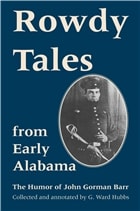
The rollicking tales of Old Southwestern humor were a distinctive contribution to American folk culture provided by the frontiersmen of the South and Southwest, a tradition brought to its highest form in the work of Mark Twain. Among the precursors of Twain was John Gorman Barr of Tuscaloosa, Alabama. Like Twain, Barr grew up in a river town, worked in a printing office, and traveled widely; and again like Twain, Barr drew upon the people and places of his home region as the primary sources for his tales.
In addition to the pure entertainment Barr’s stories provide, they also furnish a comprehensive picture of Tuscaloosa and western Alabama in the 1850s—the roaring river town coexisting uneasily with the intellectual sophistication of the recently established University of Alabama.
Roxy and Coco
A NovelTerese Svoboda
West Virginia University Press, 2024
“[A] wry and rambunctious fable….The book offers brief and staggered visions of family, in all its complex permutations. Here, flocks settle into wonderfully unlikely formations. It’s possible that the most dangerous thing for anyone, harpy or human, is the decision to fly alone.” — Hilary Leichter, New York Times Book Review
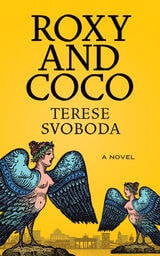
Sisters Roxy and Coco are two glamorous harpies—mythical bird women—attempting to outrun extinction and fix the planet by preventing child abuse, one child at a time.
When Roxy is suddenly attracted to her human supervisor at a social work agency a hundred years too early, Coco is very suspicious. Luring Roxy with his scent, Tim is also on the payroll of a fake conservationist intent on her less-than-legal collection. Coco swoops in to vet Tim, but Interpol is hot on her trail for a series of curious homicides. (Surveillance has a very hard time convincing his boss of what he’s monitoring.) When the sisters find themselves trapped, Chris, a bipolar skateboarding truant, tries his best to rescue them but it’s Stewie, Coco’s colleague, who turns the story inside out. Roxy and Coco climaxes at a gala of egg fanciers who scramble to escape the harpies’ talons.
Action figure–worthy, for readers of Neil Gaiman and Karen Russell, this modern take on these fabled women touches on mental illness, racism, animal rights, and the rights of children.
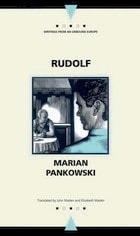
Rudolf
Marian Pankowski
Northwestern University Press, 1996
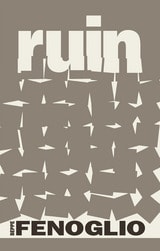
Ruin
Beppe Fenoglio
Northwestern University Press, 1992
Born into a working-class family in the town of Alba lying in that part of the Piedmont called LeLanghe, Beppe Fenoglio (1922-1963) belonged to the generation of young Italian writers whose works were molded by their World War II experience and the anti-Fascist Resistance many took part in. Fenoglio fought as a partisan against the German troops occupying Italy, and the major part of his literature is connected with the events of the time.
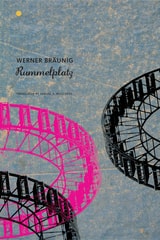
Rummelplatz
Werner Bräunig
Seagull Books, 2015
Rummelplatz, translated here by Samuel P. Willcocks, focuses on a notorious East German uranium mine, run by the Soviets and supplying the brotherland’s nuclear program. Veterans, fortune seekers, and outsiders with tenuous family ties like narrator Peter Loose flock to the well-paying mine, but soon find their new lives bleak. Safety provisions are almost nonexistent and tools are not adequately supplied. The only outlets for workers are the bars and fairgrounds where copious amounts of alcohol are consumed and brawls quickly ensue. In Rummelplatz, Bräunig paints his characters as intrinsically human and treats the death of each worker, no matter how poor, as a great tragedy. Bräunig occupies a cultlike status in Germany, and this new translation of his masterpiece is an excellent introduction for English-language readers.
Praise for the German edition
“One of the best novels of postwar Germany. . . . The narrative force and the emotional punch are sensational.”—Die Zeit
“An event in literary history and one ‘helluva’ novel.”—Der Spiegel
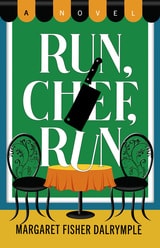
Run, Chef, Run
A NovelMargaret Fisher Dalrymple
University of Nevada Press, 2027
When restaurateur Liliane “Lili” Chabrier and her cook, Ricky, discover a crashed plane while hiking in the mountains near Lake Tahoe, they stumble into a criminal enterprise that reaches far beyond the kitchen of Lili’s upscale Reno-area restaurant, the Bistro Bellevue.
Unaware that Ricky has taken a fortune in cartel money from the wreckage, Lili returns to the restaurant and the demanding rhythms of fine dining. But someone is watching her. As suspicion, violence, and betrayal close in, Lili must navigate a dangerous world of money laundering and organized crime while trying to protect the restaurant and the people she loves. Her growing relationship with Mac, a veteran of the Middle East wars, offers an unexpected source of strength as the danger escalates.
Fast-paced and atmospheric, Run, Chef, Run offers an insider’s view of the high-pressure world of fine dining, from the controlled chaos of a professional kitchen to the intricate codes of behavior that restaurant guests rarely see. Rich descriptions of food and the daily lives of restaurant workers give the novel a vivid sense of place, while Lili’s sharp observations and resilience drive a story of crime, loyalty, and survival.
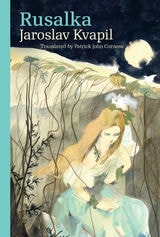
Rusalka
A Lyrical Fairy-tale in Three ActsJaroslav Kvapil
Karolinum Press, 2020
Transposed into the folkloric topos of a landlocked Bohemia, the mermaid is rendered here as a Slavic rusalka—a dangerous water nymph—who must choose between love and immortality. Thus, Rusalka, while certainly paying homage to the original story’s Scandinavian roots, is still a distinct work of modern Czech literature. Newly translated by Patrick Corness, Kvapil’s work will now find a fresh group of readers looking to get lost in one of Europe’s great lyrical fairy tale traditions.
Russia Container
Alexander Kluge
Seagull Books, 2022
Not just in light of a contested pipeline during the war in Ukraine but also after centuries of both exchange and rejection, Russia and Germany were and are as far away from each other as they are intrinsically linked. The geopolitical present seems critical, the signs pointing towards conflict and polarity.
In this hot climate, German author Alexander Kluge makes Russia the exclusive subject of his latest book, offering multiple perspectives: from that of the historical German patriots of the Napoleonic Wars of Liberation to the narrative point of view of Franz Kafka and Heiner Müller; from messianic yearning and utopian expectations of the twentieth century to the full-blown or near-miss catastrophes in the atomic age.
Composed in Kluge’s characteristic short-prose vignette style, interspersed with numerous images and often humorous asides, Russia Container is yet another brilliant and thought-provoking work from one of Europe’s most prolific and deeply intellectual literary genius. The volume includes a preface specially written to engage with the current events in Ukraine, making Kluge’s narratives even more timely and topical.
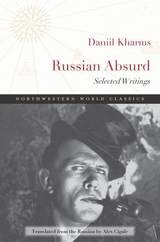
Russian Absurd
Selected WritingsDaniil Kharms, Translated from the Russian by Alex Cigale
Northwestern University Press, 2017
A writer who defies categorization, Daniil Kharms has come to be regarded as an essential artist of the modernist avant-garde. His writing, which partakes of performance, narrative, poetry, and visual elements, was largely suppressed during his lifetime, which ended in a psychiatric ward where he starved to death during the siege of Leningrad. His work, which survived mostly in notebooks, can now be seen as one of the pillars of absurdist literature, most explicitly manifested in the 1920s and ’30s Soviet Union by the OBERIU group, which inherited the mantle of Russian futurism from such poets as Vladimir Mayakovsky and Velimir Khlebnikov. This selection of prose and poetry provides the most comprehensive portrait of the writer in English translation to date, revealing the arc of his career and including a particularly generous selection of his later work.
Russian Nights
Vladimir Fedorovich Odoevsky
Northwestern University Press, 1997
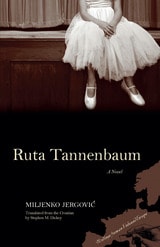
Ruta Tannenbaum
A NovelMiljenko Jergovic
Northwestern University Press, 2011
Using their shared Jewish heritage as a starting point, Jergovic constructs a fictional family history populated by historical figures with the precocious Ruta at the center. Stephen Dickey’s translation masterfully captures Jergovic´’s colloquial yet deeply observed style, which animates the tangled and troubled history of persecution and war in Croatia.
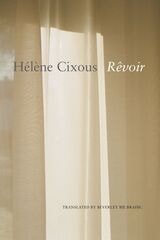
Rêvoir
Hélène Cixous
Seagull Books, 2024
As the pandemic sweeps through Paris in March 2020, the writer HC faces a choice: stay in Paris or flee to the countryside? The weight of historical responses bears down on her—those of her ancestors and Jewish writers during moments of persecution.
Still uncertain, she flees to the country at the last moment, with her cats and her daughter, with her diaries and notebooks. What will she do here? Write? What will she write about? Can she write about the experience of being confined? She will write about her cats; every day she will observe their lives and take notes about how they cope with being housebound, and later, in the spring, with the outdoors.
Thucydides, Defoe, Camus, Kafka—she will compare her experiences with those of others who have been confined by malady or persecution. She will write of her mother, who fled impending disaster on many occasions and always kept a suitcase ready.
She too will endure. The important thing is to have a good death, surrounded by those she loves, not locked down in a hospital.