Results by title
1726 books match the query 'Film' and 64 start with r
Reuse, Misuse, Abuse
The Ethics of Audiovisual Appropriation in the Digital EraJaimie Baron
Rutgers University Press, 2021
Revisiting Women's Cinema
Feminism, Socialism, and Mainstream Culture in Modern ChinaLingzhen Wang
Duke University Press, 2021
Rewrite Man
The Life and Career of Screenwriter Warren SkaarenBy Alison Macor
University of Texas Press, 2017
In Rewrite Man, Alison Macor tells an engrossing story about the challenges faced by a top screenwriter at the crossroads of mixed and conflicting agendas in Hollywood. Whether writing love scenes for Tom Cruise on the set of Top Gun, running lines with Michael Keaton on Beetlejuice, or crafting Nietzschean dialogue for Jack Nicholson on Batman, Warren Skaaren collaborated with many of New Hollywood’s most powerful stars, producers, and directors. By the time of his premature death in 1990, Skaaren was one of Hollywood’s highest-paid writers, although he rarely left Austin, where he lived and worked. Yet he had to battle for shared screenwriting credit on these films, and his struggles yield a new understanding of the secretive screen credit arbitration process—a process that has only become more intense, more litigious, and more public for screenwriters and their union, the Writers Guild of America, since Skaaren’s time. His story, told through a wealth of archival material, illuminates crucial issues of film authorship that have seldom been explored.
Richard Linklater
David T. Johnson
University of Illinois Press, 2012
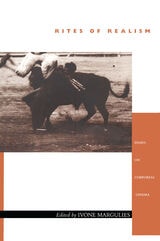
Rites of Realism
Essays on Corporeal CinemaIvone Margulies, ed.
Duke University Press, 2003
By providing close readings of classic and contemporary works, Rites of Realism signals the need to return to a focus on films as the main innovators of realist representation. The collection is inspired by André Bazin's theories on film's inherent heterogeneity and unique ability to register contingency (the singular, one-time event). This volume features two new translations: of Bazin's seminal essay "Death Every Afternoon" and Serge Daney's essay reinterpreting Bazin's defense of the long shot as a way to set the stage for a clash or risky confrontation between man and animal. These pieces evince key concerns—particularly the link between cinematic realism and contingency—that the other essays explore further.
Among the topics addressed are the provocative mimesis of Luis Buñuel's Land Without Bread; the adaptation of trial documents in Carl Dreyer's Passion of Joan of Arc; the use of the tableaux vivant by Wim Wenders and Peter Greenaway; and Pier Paolo Pasolini's strategies of analogy in his transposition of The Gospel According to St. Matthew from Palestine to southern Italy. Essays consider the work of filmmakers including Michelangelo Antonioni, Maya Deren, Mike Leigh, Cesare Zavattini, Zhang Yuan, and Abbas Kiarostami.
Contributors: Paul Arthur, André Bazin, Mark A. Cohen, Serge Daney, Mary Ann Doane, James F. Lastra, Ivone Margulies, Abé Mark Normes, Brigitte Peucker, Richard Porton, Philip Rosen, Catherine Russell, James Schamus, Noa Steimatsky, Xiaobing Tang

Ritwik Ghatak
Occasional Essays for a 100th BirthdayEdited by Gayatri Chakravorty Spivak and Surya Parekh
Seagull Books, 2025
The cinema of Ritwik Ghatak (1925–76) continues to resonate across borders and generations. His films—largely shaped by the 1947 Partition of Bengal and the experience of displacement—probe the fractured human condition through bold formal experimentation, unforgettable soundscapes, and a profound sense of myth and memory. Though his body of work was modest in size, Ghatak’s influence has steadily expanded, securing his place as a major figure in world cinema. This distinctive volume, which marks the centenary of this visionary filmmaker, gathers essays by important scholars and thinkers from around the world.
Moving beyond conventional film criticism and area studies, the collection stages new, transnational encounters with Ghatak’s films—approaching them as world texts, as sonic and visual experiments, and as meditations on migration, collectivity, and social existence.
Robert Altman’s Subliminal Reality
Robert T. Self
University of Minnesota Press, 2002
The most complete and compelling analysis available of Altman’s films
With his complex and unconventional films, Robert Altman often draws an impassioned response from critics but bafflement and indifference from the general public. Some audiences have dismissed his movies as insignificant, unsatisfying, and unreadable. Ironically, Altman might agree: he makes films in order to challenge filmgoers’s expectations of straightforward narratives and easily understood endings.
In Robert Altman’s Subliminal Reality, Robert T. Self sheds light on Altman’s work and provides the most comprehensive analysis of his films to date. With close readings of classics like MASH, McCabe and Mrs. Miller, and Nashville, as well as more recent films like The Player, Short Cuts, and Cookie’s Fortune, Self asserts the value of Altman’s work not only to film theory and the entertainment industry but to American culture itself. In his analysis, Self identifies Altman’s films particularly as they address issues of form, identity, and industry. He explains how Altman critiques moviemaking forms by using an open, fragmented mode of storytelling and by turning conventional Hollywood genres inside out. He examines Altman’s characterization of social and individual identity as fragile and fragmentary and his depiction of antiheroic characters debilitated by their socially constructed gender roles. Finally, Self shows how Altman challenges the entertainment industry itself, questioning its methods and motives and critiquing its role in our cultural alienation. Self frames his study of Altman’s work with a discussion of the director’s efforts to create a "subliminal reality" in his narratives—to touch audiences on an unconscious level and to recognize the unspoken, and unspeakable, dimensions in human interactions. According to Self, this striving for "subliminal reality" makes Altman’s films not only exemplary of the potential of art cinema narration but instrumental in keeping such narrative alive.
Robert Bresson
Cinematic Style as PhilosophyRobert B. Pippin
University of Chicago Press, 2026
Over a forty-year career, Robert Bresson developed one of the most distinctive cinematic styles in the history of filmmaking. Criticizing conventional movies as “filmed theater,” Bresson proposed instead a way of writing with images, which he called “cinematographs.” Robert B. Pippin argues here for a way of understanding how these stylistic innovations express a range of philosophical commitments, explorations of the possible sources of meaning in late modern life, and the implications of the absence of such sources.
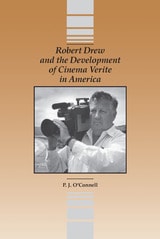
Robert Drew and the Development of Cinema Verite in America
P.J. O'Connell
Southern Illinois University Press, 1992
Author P. J. O’Connell traces Robert Drew’s influence on cinema verite through extensive interviews with Drew and with some of the founding fathers of American cinema verite filmmaking—Donn Alan Pennebaker, Gregory Shuker, and Richard Leacock.
Robert Drew’s contributions to documentary film have been both technical and conceptual. Realizing that his equipment was too heavy and intrusive, Drew persuaded Time-Life Broadcasting to sponsor the development of new, lightweight, portable synchronous sound equipment that freed documentary filmmakers from the bulky, tripod-mounted, AC-powered equipment of the past. His new technology allowed him to capture intense moments as they happened, and to make viewers feel personally involved in the events he presented. While making more than twenty documentaries in the early 1960s, Drew continued to initiate innovations that were not thought possible a generation before him.
P. J. O’Connell is the executive producer of public affairs at Penn State Television and an affiliate assistant professor in the School of Communication at Penn State University.
Robert Paul and the Origins of British Cinema
Ian Christie
University of Chicago Press, 2019
From improving upon Edison’s Kinetoscope to cocreating the first movie camera in Britain to building England’s first film studio and launching the country’s motion-picture industry, Paul played a key part in the history of cinema worldwide. It’s not only Paul’s story, however, that historian Ian Christie tells here. Robert Paul and the Origins of British Cinema also details the race among inventors to develop lucrative technologies and the jumbled culture of patent-snatching, showmanship, and music halls that prevailed in the last decade of the nineteenth century. Both an in-depth biography and a magnificent look at early cinema and fin-de-siècle Britain, Robert Paul and the Origins of British Cinema is a first-rate cultural history of a fascinating era of global invention, and the revelation of one of its undervalued contributors.
Rock 'n' Roll Movies
Sterritt, David
Rutgers University Press, 2018
Roman Polanski
James Morrison
University of Illinois Press, 2006
James Morrison's critical study offers a comprehensive and critically engaged treatment on Roman Polanski's immense body of work. Tracing the filmmaker's remarkably diverse career from its beginnings to 2007, the book provides commentary on all of Polanski's major films in their historical, cultural, social, and artistic contexts. Morrison locates Polanski's work within the genres of comedy and melodrama, arguing that he is not merely obsessed with the theme of repression, but that his true interest is in the concrete—what is out in the open—and why we so rarely see it.
The range of Polanski's filmmaking challenges traditional divisions between high and low culture. For example, The Ninth Gate is a brash pastiche of the horror genre, while The Pianist is an Academy Award-winner about the Holocaust. Dubbing Polanski a relentless critic of modernity, Morrison concludes that his career is representative of the fissures, victories, and rehabilitations of the last fifty years of international cinema.
A volume in the series Contemporary Film Directors, edited by James Naremore
Rubble Films
German Cinema In Shadow Of 3Rd ReichRobert R. Shandley
Temple University Press, 2001
Rubble Films is a close look at German cinema in the immediate postwar era, and a careful examination of its relationship to Allied occupation. Shandley reveals how German film borrowed -- both literally and figuratively -- from its Nazi past, and how the occupied powers (specifically the US) used its position as victor to open Europe to Hollywood movie products and aesthetics.
Incorporating a careful reading of several important postwar films, Shandley also discusses how the German studio system operated immediately after the war, in the east and the west, giving special focus on DEFA, the east German studio that rose during Soviet occupation.
Pathbreaking in its research, Rubble Films sheds new light on a significant moment of German cultural rebirth, and adds a new dimension to the study of the history of film.
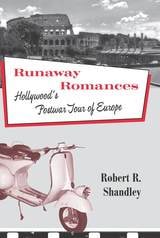
Runaway Romances
Hollywood's Postwar Tour of EuropeRobert R. Shandley
Temple University Press, 2009
In the 1950s and early 1960s, America imagined itself young and in love in Europe. And Hollywood films of the era reflected this romantic allure. From a young and naïve Audrey Hepburn falling in love with Gregory Peck inRoman Holiday to David Lean’s Summertime, featuring Katherine Hepburn’s sexual adventure in Venice, these glossy travelogue romances were shot on location, and established an exciting new genre for Hollywood.
As Robert Shandley shows in Runaway Romances, these films were not only indicative of the ideology of the American-dominated postwar world order, but they also represented a shift in Hollywood production values. Eager to capture new audiences during a period of economic crisis, Hollywood’s European output utilized the widescreen process to enhance cinematic experience. The films—To Catch a Thief, Three Coins in the Fountain, and Funny Face among them—enticed viewers to visit faraway places for romantic escapades. In the process, these runaway romances captured American fantasies for a brief, but intense, period that ended as audiences grew tired of old World splendors, and entered into a new era of sexual awakening.