Results by title
5448 books match the query 'History and criticism' and 301 start with r
Reader Of The Purple Sage
Essays On Western Writers And Environmental LiteratureAnn Ronald
University of Nevada Press, 2003
Literary scholar Ann Ronald gathers her most notable published essays about Nevada, environmental writing, and Western American literature in one volume. These essays reflect Ronald’s wide-ranging interests. Here are deeply informed, critical essays on writers as diverse as Zane Gray, Edward Abbey, Wallace Stegner, and Terry Tempest Williams, as well as the Tonopah Ladies—a group of literary women who found their voices in the unlikely setting of a mining boomtown—and on such varied topics as the image of Reno in nineteenth- and twentieth-century fiction. Included are several recent essays in which Ronald thoughtfully discusses the burgeoning field of environmental writing, some of its principal themes and concerns, and its best-known practitioners.
Reading Adoption
Family and Difference in Fiction and DramaMarianne Novy
University of Michigan Press, 2005
Marianne Novy is Professor of English and Women's Studies at the University of Pittsburgh. She is author or editor of numerous books, including Imagining Adoption: Essays on Literature and Culture.
Reading African American Autobiography
Twenty-First-Century Contexts and CriticismEdited by Eric D. Lamore
University of Wisconsin Press, 2016
The life narratives studied range from an eighteenth-century criminal narrative, a 1918 autobiography, and the works of Richard Wright to new media, graphic novels, and a celebrity memoir from Pam Grier.
Reading America
Citizenship, Democracy, and Cold War LiteratureKristin L. Matthews
University of Massachusetts Press, 2016
During the Cold War, the editor of Time magazine declared, “A good citizen is a good reader.” As postwar euphoria faded, a wide variety of Americans turned to reading to understand their place in the changing world. Yet, what did it mean to be a good reader? And how did reading make you a good citizen?
In Reading America, Kristin L. Matthews puts into conversation a range of political, educational, popular, and touchstone literary texts to demonstrate how Americans from across the political spectrum—including “great works” proponents, New Critics, civil rights leaders, postmodern theorists, neoconservatives, and multiculturalists—celebrated particular texts and advocated particular interpretive methods as they worked to make their vision of "America" a reality. She situates the fiction of J. D. Salinger, Ralph Ellison, Thomas Pynchon, John Barth, and Maxine Hong Kingston within these debates, illustrating how Cold War literature was not just an object of but also a vested participant in postwar efforts to define good reading and citizenship.
Reading Billy Budd
Hershel Parker
Northwestern University Press, 1990
Reading Capitalist Realism
Alison Shonkwiler and Leigh Claire LaBerge
University of Iowa Press, 2014
Reading Capitalist Realism presents some of the latest and most sophisticated approaches to the question of the relation between capitalism and narrative form, partly by questioning how the “realism” of austerity, privatization, and wealth protection relate to the realism of narrative and cultural production. Even as critics have sought to locate a new aesthetic mode that might consider and move beyond theorizations of the postmodern, this volume contends that narrative realism demands renewed scrutiny for its ability to represent capitalism’s latest scenes of enclosure and indebtedness.
Ranging across fiction, nonfiction, television, and film, the essays collected here explore to what extent realism is equipped to comprehend and historicize our contemporary economic moment and what might be the influence or complicity of the literary in shaping the global politics of lowered expectations. Including essays on writers such as Mohsin Hamid, Lorrie Moore, Jess Walter, J. M. Coetzee, James Kelman, Ali Smith, Russell Banks, William Vollmann, and William Gibson, as well as examinations of Hollywood film productions and The Wire television series, Reading Capitalist Realism calls attention to a resurgence of realisms across narrative genres and questions realism’s ability to interrogate the crisis-driven logic of political and economic “common sense.”
Reading Chican@ Like a Queer
The De-Mastery of DesireBy Sandra K. Soto
University of Texas Press, 2010
A race-based oppositional paradigm has informed Chicano studies since its emergence. In this work, Sandra K. Soto replaces that paradigm with a less didactic, more flexible framework geared for a queer analysis of the discursive relationship between racialization and sexuality. Through rereadings of a diverse range of widely discussed writers—from Américo Paredes to Cherríe Moraga—Soto demonstrates that representations of racialization actually depend on the sexual and that a racialized sexuality is a heretofore unrecognized organizing principle of Chican@ literature, even in the most unlikely texts. Soto gives us a broader and deeper engagement with Chican@ representations of racialization, desire, and both inter- and intracultural social relations.
While several scholars have begun to take sexuality seriously by invoking the rich terrain of contemporary Chicana feminist literature for its portrayal of culturally specific and historically laden gender and sexual frameworks, as well as for its imaginative transgressions against them, this is the first study to theorize racialized sexuality as pervasive to and enabling of the canon of Chican@ literature. Exemplifying the broad usefulness of queer theory by extending its critical tools and anti-heteronormative insights to racialization, Soto stages a crucial intervention amid a certain loss of optimism that circulates both as a fear that queer theory was a fad whose time has passed, and that queer theory is incapable of offering an incisive, politically grounded analysis in and of the current historical moment.

Reading Country Music
Steel Guitars, Opry Stars, and Honky Tonk BarsCecelia Tichi, ed.
Duke University Press, 1998
Bringing together a wide range of scholars and critics from literature, communications, history, sociology, art, and music, this anthology looks at everything from the inner workings of the country music industry to the iconography of certain stars to the development of distinctive styles within the country music genre. Essays include a look at the shift from "hard-core" to "soft-shell" country music in recent years; Johnny Cash as lesbian icon; gender, class, and region in Dolly Parton’s star image; and bluegrass’s gothic tradition. Originally published as a special issue of South Atlantic Quarterly, this expanded book edition includes new articles on the spirituality of Willie Nelson, the legacy and tradition of stringed music, and the revival of Stephen Foster’s blackface musical, among others.
Contributors. Mary A. Bufwack, Don Cusic, Curtis W. Ellison, Mark Fenster, Vivien Green Fryd, Teresa Goddu, T. Walter Herbert, Christine Kreyling, Michael Kurek, Amy Schrager Lang, Charmaine Lanham, Bill Malone, Christopher Metress, Jocelyn Neal, Teresa Ortega, Richard A. Peterson, Ronnie Pugh, John W. Rumble, David Sanjek, Cecelia Tichi, Pamela Wilson, Charles K. Wolfe
Reading Death in Ancient Rome
Mario Erasmo
The Ohio State University Press, 2008
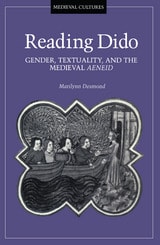
Reading Dido
Gender, Textuality, and the Medieval AeneidMarilynn Desmond
University of Minnesota Press, 1994
Describes the variations in the figure of Dido as she emerges from ancient literary texts.
If we view the Aeneid—the poem of empire, conquest, and male hierarchy-as the West's quintessential canonical text and Latin primer, then the history of Virgil readership should tell us much about the concept of education in the West. In this book, Marilynn Desmond reveals how a constructed and mediated tradition of reading Virgil has conditioned various interpretations among readers responding to medieval cultural and literary texts. In particular, she shows how the story of Dido has been marginalized within canonical readings of the Aeneid. Reaching back to the Middle Ages and vernacular poetic readings of Dido, Desmond recovers an alternative Virgil from historical tradition and provides another paradigm for reading the Aeneid.
Desmond follows the figure of Dido as she emerges from ancient historical and literary texts (from Timaeus and Justin to Virgil and Ovid) and circulates in medieval textual cultures. Her study ranges from the pedagogical discourses of Latin textual traditions (including Servius, Augustine, Bernard Silvestris, and John of Salisbury) to the French and English vernacular cultures inscribed in the Roman d'Eneas, the Histoire ancienne jusqu'à César, and the work of Dante, Chaucer, Gavin Douglas, Caxton, and Christine de Pizan. The positions of all these readers point to the cultural specificity and historical contingency of all traditions of reading; thus, this book demonstrates how medieval traditions of reading Dido offer the modern reader a series of countertraditions that support feminist, antihomophobic, and postcolonial interpretive gestures.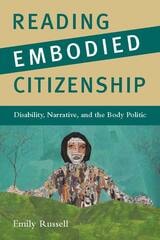
Reading Embodied Citizenship
Disability, Narrative, and the Body PoliticRussell, Emily
Rutgers University Press, 2011
Liberal individualism, a foundational concept of American politics, assumes an essentially homogeneous population of independent citizens. When confronted with physical disability and the contradiction of seemingly unruly bodies, however, the public searches for a story that can make sense of the difference. The narrative that ensues makes "abnormality" an important part of the dialogue about what a genuine citizen is, though its role is concealed as an exception to the rule of individuality rather than a defining difference. Reading Embodied Citizenship brings disability to the forefront, illuminating its role in constituting what counts as U.S. citizenship.
Drawing from major figures in American literature, including Mark Twain, Flannery O'Connor, Carson McCullers, and David Foster Wallace, as well as introducing texts from the emerging canon of disability studies, Emily Russell demonstrates the place of disability at the core of American ideals. The narratives prompted by the encounter between physical difference and the body politic require a new understanding of embodiment as a necessary conjunction of physical, textual, and social bodies. Russell examines literature to explore and unsettle long-held assumptions about American citizenship.
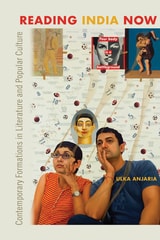
Reading India Now
Contemporary Formations in Literature and Popular CultureUlka Anjaria
Temple University Press, 2019
In an age of social media and reality television, reading and consumption habits in India now demand homegrown pulp fictions. Ulka Anjaria categorizes post-2000 Indian literature and popular culture as constituting “the contemporary,” a movement defined by new and experimental forms—where high- and low-brow meet, and genres break down.
Reading India Now studies the implications of this developing trend as both the right-wing resurges and marginalized voices find expression. Anjaria explores the fiction of Chetan Bhagat and Anuja Chauhan as well as Aamir Khan’s television talk show, Satyamev Jayate, plus the work of documentarian Paromita Vohra, to argue how different kinds of texts are involved in imagining new political futures for an India in transition. Contemporary literature and popular culture in India might seem artless and capitalistic, but it is precisely its openness to the world outside that allows these new works to offer significant insight into the experiences and sensibilities of contemporary India.
Reading Nature
The Evolution of American Nature WritingJohn Seibert Farnsworth
Michigan State University Press, 2025
Reading Network Fiction
David Ciccoricco
University of Alabama Press, 2007
A theoretical framework for understanding fiction built on nodes, links, and distributed narrative systems.
The marriage of narrative and the computer dates back to the 1980s, with the hypertext experiments of luminaries such as Judy Malloy and Michael Joyce. What has been variously called "hypertext fiction," "literary hypertext," and "hyperfiction" has surely surrendered any claim to newness in the 21st century.
David Ciccoricco establishes the category of "network fiction" as distinguishable from other forms of hypertext and cybertext: network fictions are narrative texts in digitally networked environments that make use of hypertext technology in order to create emergent and recombinant narratives. Though they both pre-date and post-date the World Wide Web, they share with it an aesthetic drive that exploits the networking potential of digital composition and foregrounds notions of narrative recurrence and return.
Ciccoricco analyzes innovative developments in network fiction from first-generation writers Michael Joyce (Twilight, a symphony, 1997) and Stuart Moulthrop (Victory Garden, 1991) through Judd Morrissey’s The Jew's Daughter (2000), an acclaimed example of digital literature in its latter instantiations on the Web. Each investigation demonstrates not only what the digital environment might mean for narrative theory but also the ability of network fictions to sustain a mode of reading that might, arguably, be called "literary." The movement in the arts away from representation and toward simulation, away from the dynamics of reading and interpretation and toward the dynamics of interaction and play, has indeed led to exaggerated or alarmist claims of the endangerment of the literary arts. At the same time, some have simply doubted that the conceptual and discursive intricacy of print fiction can migrate to new media. Against these claims, Reading Network Fiction attests to the verbal complexity and conceptual depth of a body of writing created for the surface of the screen.

Reading North by South
On Latin American Literature, Culture, and PoliticsNeil Larsen
University of Minnesota Press, 1995
Reading North by South was first published in 1995. Minnesota Archive Editions uses digital technology to make long-unavailable books once again accessible, and are published unaltered from the original University of Minnesota Press editions.
Neil Larsen is concerned with misleading interpretations of literature and culture that dominate Latin American studies in North America. In Reading North by South he attempts to correct the distorted views that have prevailed by proposing the need for a freshly conceived historical materialist approach to Latin American texts and cultural practices.
Reading North by South opens with reflections on how North America has read Latin America since the advent of popular fiction from authors like Cortázar and García Márquez. Larsen argues that the North American academy tends to interpret Latin American texts through a postmodern lens of cultural politics that ignores historical realism, and he contends that more attention needs to be paid to historical and class issues. He provides insightful commentaries on political discourses, cultural events, films, and literary texts, and maintains that the canonization of the modernist aesthetic in the United States has resulted in a marginalization of writers and writing that reflect the historical realities of Latin American politics.
As it analyzes important points of debate within and outside of Latin American studies, Reading North by South draws upon a wide diversity of texts written in Portuguese, Spanish and English. Of particular interest is Larsen's discussion of writings from the Caribbean, an area that is not frequently included in Latin American studies. Reading North by South will lead readers to question the expectations and preconceptions that inform their readings of Latin American literature.
Neil Larsen is associate professor of Spanish and Latin American literature at Northeastern University. He is the author of Modernism and Hegemony: A Materialist Critique of Aesthetic Agencies (Minnesota, 1990), and editor of The Discourse of Power: Culture, Hegemony, and the Authoritarian State in Latin America (1983).
Reading Ovid in Medieval Wales
Paul Russell
The Ohio State University Press, 2017
Russell argues that this annotated version of the Ars amatoria arose out of the teaching traditions of the Carolingian world and that the annotation, as we have it, was the product of a cumulative process of glossing and commenting on the text. He then surveys other glossed Ovid manuscripts to demonstrate how that accumulation was built up. Russell also explores the fascinating issue of why Ovid’s love poetry should be used to teach Latin verse in monastic contexts. Finally, he discusses the connection between this manuscript and the numerous references to Ovid in later Welsh poetry, suggesting that the Ovidian references should perhaps be taken to refer to love poetry more generically.
Reading Patristic Texts on Social Ethics
Issues and Challenges for the Twenty-First CenturyJohan Leemans
Catholic University of America Press, 2011

Reading Piers Plowman and the Pilgrim's Progress
Reception and the Protestant ReaderBarbara A. Johnson
Southern Illinois University Press, 1992
Centering her discussion on two historical "ways of reading"—which she calls the Protestant and the lettered—Barbara A. Johnson traces the development of a Protestant readership as it is reflected in the reception of Langland’s Piers Plowman and Bunyan’s Pilgrim’s Progress.
Informed by reader-response and reception theory and literacy and cultural studies, Johnson’s ambitious examination of these two ostensibly literary texts charts the cultural roles they played in the centuries following their composition, roles far more important than their modern critical reputations can explain.
Johnson argues that much more evidence exists about how earlier readers read than has hitherto been acknowledged. The reception of Piers Plowman, for example, can be inferred from references to the work, the apparatus its Renaissance printer inserted in his editions, the marginal comments readers inscribed both in printed editions and in manuscripts, and the apocryphal "plowman" texts that constitute interpretations of Langland’s poem. She demonstrates by example that what is culturally transmitted has not been just the work itself; it includes vestiges of past readers’ encounters with the text that are traceable both in the way a text is presented as well as in the way that presentation is received.
Conditioned more by religious, historical, and economic forces than by literary concerns, Langland’s poem became a part of the reformist tradition that culminated in Bunyan’s Pilgrim’s Progress. By understanding this tradition, Bunyan’s place in it, and the way the reception of The Pilgrim’s Progress illustrates the beginning of a new, more realistic fictional tradition, Johnson concludes, we can begin to delineate a more accurate history of the ways literature and society intersect, a history of readers reading.
Reading Popol Wuj
A Decolonial GuideNathan C. Henne
University of Arizona Press, 2020
Popol Wujis considered one of the oldest books in the Americas. Various elements of Popol Wuj have appeared in different written forms over the last two millennia and several parts of Popol Wuj likely coalesced in hieroglyphic book form a few centuries before contact with Europeans. Popol Wuj offers a unique interpretation of the Maya world and ways of being from a Maya perspective. However, that perspective is often occluded since the extant Popol Wuj is likely a copy of a copy of a precontact Indigenous text that has been translated many times since the fifteenth century.
Reading Popol Wujoffers readers a path to look beyond Western constructions of literature to engage with this text through the philosophical foundation of Maya thought and culture. This guide deconstructs various translations to ask readers to break out of the colonial mold in approaching this seminal Maya text.
Popol Wuj, or Popol Vuh, in its modern form, can be divided thematically into three parts: cosmogony (the formation of the world), tales of the beings who inhabited the Earth before the coming of people, and chronicles of different ethnic Maya groups in the Guatemala area. Examining thirteen translations of the K’iche’ text, Henne offers a decolonial framework to read between what translations offer via specific practice exercises for reading, studying, and teaching. Each chapter provides a close reading and analysis of a different critical scene based on a comparison of several translations (English and Spanish) of a key K’iche’ word or phrase in order to uncover important philosophical elements of Maya worldviews that resist precise expression in Indo-European languages.
Charts and passages are frontloaded in each chapter so the reader engages in the comparative process before reading any leading arguments. This approach challenges traditional Western reading practices and enables scholars and students to read Popol Wuj—and other Indigenous texts—from within the worldview that created them.
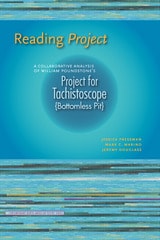
Reading Project
A Collaborative Analysis of William Poundstone's Project for Tachistoscope {Bottomless Pit}Jessica Pressman, Mark C. Marino, and Jeremy Douglass
University of Iowa Press, 2015
Project for the Tachistoscope {Bottomless Pit} is a work of electronic literature that presents a high-speed, one-word-at-a-time animation synchronized to visual and aural effects. It tells the tale of a mysterious pit and its impact on the surrounding community. Programmed in Flash and published online, its fast-flashing aesthetic of information overload bombards the reader with images, text, and sound in ways that challenge the ability to read carefully, closely, and analytically in traditional ways. The work’s multiple layers of poetics and programming can be most effectively read and analyzed through collaborative efforts at computational criticism such as is modeled in this book. The result is a unique and trailblazing book that presents the authors’ collaborative efforts and interpretations as a case study for performing digital humanities literary criticism of born-digital poetics.

Reading Relations
How Authors Enter Our LivesDixon, Dan
University of Iowa Press, 2026
Drawing on the ordinary language philosophy of Toril Moi and Stanley Cavell, Dan Dixon argues that the act of reading shares emotional ground with our social lives. It prompts us to attend to the kinds of affective attachments that frequently resist description, as well as the attachments that encourage debate among scholars of literature.
Dixon posits that the interpretation of a text is significantly shaped by our impression of the writer. Through the lens of persona, this book examines the work of influential and iconic post-1945 American essayists, such as Joan Didion, Maggie Nelson, James Baldwin, Janet Malcolm, Teju Cole, David Foster Wallace, and Ben Lerner. The attachments we form might facilitate insight, consolation, distrust, or vanity. But whatever their effects, they can’t be ignored.
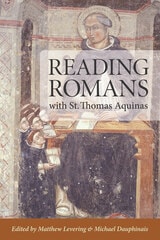
Reading Romans with St. Thomas Aquinas
Matthew Levering
Catholic University of America Press, 2012
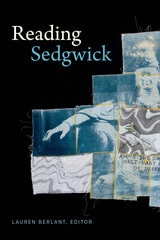
Reading Sedgwick
Lauren Berlant, editor
Duke University Press, 2019
Contributors. Lauren Berlant, Kathryn Bond Stockton, Judith Butler, Lee Edelman, Jason Edwards, Ramzi Fawaz, Denis Flannery, Jane Gallop, Jonathan Goldberg, Meridith Kruse, Michael Moon, José Esteban Muñoz, Chris Nealon, Andrew Parker, H. A. Sedgwick, Karin Sellberg, Michael D. Snediker, Melissa Solomon, Robyn Wiegman
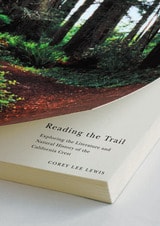
Reading The Trail
Exploring The Literature And Natural History Of The California CrestCorey Lee Lewis
University of Nevada Press, 2005
A provocative new way to read and interpret the classic works of John Muir, Mary Austin, and Gary Snyder, and to bring their ideas into the discussion of ecological values and the current environmental crisis. Lewis combines a perceptive discussion of their work and ideas with an engaging account of his own trail experiences as hiker/backpacker and volunteer trail builder, proposing that such a field-based, interdisciplinary approach to literary study and outdoors experience can enrich our appreciation for the work of nature writers.
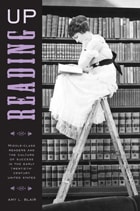
Reading Up
Middle-Class Readers and the Culture of Success in the Early Twentieth-Century United StatesAmy Blair
Temple University Press, 2011
A person who reads a book for self-improvement rather than aesthetic pleasure is “reading up.” Reading Up is Amy Blair's engaging study of popular literary critics who promoted reading generally and specific books as vehicles for acquiring cultural competence and economic mobility. Combining methodologies from the history of the book and the history of reading, to mass-cultural studies, reader-response criticism, reception studies, and formalist literary analysis, Blair shows how such critics influenced the choices of striving readers and popularized some elite writers.
Framed by an analysis of Hamilton Wright Mabie's role promoting the concept of “reading up” during his ten-year stint as the cultivator of literary taste for the highly popular Ladies' Home Journal, Reading Up reveals how readers flocked to literary works that they would be expected to dislike. Blair shows that while readers could be led to certain books by a trusted adviser, they frequently followed their own path in interpreting them in unexpected ways.
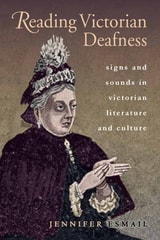
Reading Victorian Deafness
Signs and Sounds in Victorian Literature and CultureJennifer Esmail
Ohio University Press, 2013
Winner of the 2013 Sonya Rudikoff Award for best first book in Victorian Studies
Short-listed for the 2013 British Society for Literature and Science Book Prize.
Reading Victorian Deafness is the first book to address the crucial role that deaf people, and their unique language of signs, played in Victorian culture. Drawing on a range of works, from fiction by Charles Dickens and Wilkie Collins, to poetry by deaf poets and life writing by deaf memoirists Harriet Martineau and John Kitto, to scientific treatises by Alexander Graham Bell and Francis Galton, Reading Victorian Deafness argues that deaf people’s language use was a public, influential, and contentious issue in Victorian Britain.
The Victorians understood signed languages in multiple, and often contradictory, ways: they were objects of fascination and revulsion, were of scientific import and literary interest, and were considered both a unique mode of human communication and a vestige of a bestial heritage. Over the course of the nineteenth century, deaf people were increasingly stripped of their linguistic and cultural rights by a widespread pedagogical and cultural movement known as “oralism,” comprising mainly hearing educators, physicians, and parents.
Engaging with a group of human beings who used signs instead of speech challenged the Victorian understanding of humans as “the speaking animal” and the widespread understanding of “language” as a product of the voice. It is here that Reading Victorian Deafness offers substantial contributions to the fields of Victorian studies and disability studies. This book expands current scholarly conversations around orality, textuality, and sound while demonstrating how understandings of disability contributed to Victorian constructions of normalcy. Reading Victorian Deafness argues that deaf people were used as material test subjects for the Victorian process of understanding human language and, by extension, the definition of the human.
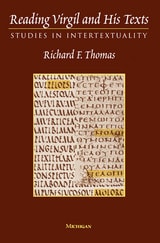
Reading Virgil and His Texts
Studies in IntertextualityRichard F. Thomas
University of Michigan Press, 2000
The articles and notes included in this volume have been selected for their diachronic aspect in addition to the synchronic status they had in their original context. Dealing with the intricate ways in which Virgil, and in the introductory chapter his predecessor Catullus, manipulated and appropriated their inherited Greek and Roman literary tradition, this book presents a coherent profile, through these detailed studies, of the mechanics of one of the most dynamic periods in the literary history of any culture.
Richard Thomas--one of the most important voices in Latin literary studies today--shows little anxiety about objections to authorial intentionality. Throughout there is a working assumption that intertextual connections can be established and, further, that functions and purposes, even intended ones, may be inferred from those connections.
This book will be of interest to scholars and students of Greek and Latin literature but will also be of great value to students of medieval, Renaissance, and early modern vernacular literatures, most of whose poets see themselves as closely connected to Virgil.
Richard F. Thomas is Professor of Greek and Latin, Harvard University.
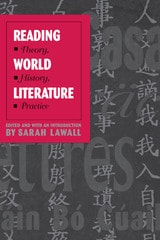
Reading World Literature
Theory, History, PracticeEdited by Sarah Lawall
University of Texas Press, 1994
As teachers and readers expand the canon of world literature to include writers whose voices traditionally have been silenced by the dominant culture, fundamental questions arise. What do we mean by "world"? What constitutes "literature"? Who should decide?
Reading World Literature is a cumulative study of the concept and evolving practices of "world literature." Sarah Lawall opens the book with a substantial introduction to the overall topic. Twelve original essays by distinguished specialists run the gamut from close readings of specific texts to problems of translation theory and reader response. The sequence of essays develops from re-examinations of traditional canonical pieces through explorations of less familiar works to discussions of reading itself as a "literacy" dependent on worldview.
Reading World Literature will open challenging new vistas for a wide audience in the humanities, from traditionalists to avant-garde specialists in literary theory, cultural studies, and area studies.
Reading across Borders
Afghans, Iranians, and Literary NationalismAria Fani
University of Texas Press, 2024
2025 René Wellek Prize, Monograph, American Comparative Literature Association
The dynamic and interconnected ways Afghans and Iranians invented their modern selves through literature.
Contrary to the presumption that literary nationalism in the Global South emerged through contact with Europe alone, Reading across Borders demonstrates how the cultural forms of Iran and Afghanistan as nation-states arose from their shared Persian heritage and cross-cultural exchange in the twentieth century. In this book, Aria Fani charts the individuals, institutions, and conversations that made this exchange possible, detailing the dynamic and interconnected ways Afghans and Iranians invented their modern selves through new ideas about literature.
Fani illustrates how voluntary and state-funded associations of readers helped formulate and propagate "literature" as a recognizable notion, adapting and changing Persian concepts to fit this modern idea. Focusing on early twentieth-century periodicals with readers in Afghan and Iranian cities and their diaspora, Fani exposes how nationalism intensified—rather than severed—cultural contact among two Persian-speaking societies amidst the diverging and competing demands of their respective nation-states. This interconnected history was ultimately forgotten, shaping many of the cultural disputes between Iran and Afghanistan today.
Reading after Actium
Vergil's Georgics, Octavian, and RomeChristopher Nappa
University of Michigan Press, 2005
Reading after Actium is a study of Vergil's Georgics, a didactic poem ostensibly about farming but in fact a brilliant exercise challenging readers to develop a broader perspective on the basic problems and the dangers of human life. Octavian is treated as one of the poet's students and given the opportunity to learn lessons in handling power, in controlling Rome's vast resources, and in preventing the bloody cycle of civil war from beginning again. Most of all the Georgics asks Octavian to consider what is involved in assuming godlike power over his fellow citizens.
Reading after Actium provides an introduction to the history of scholarship surrounding the Georgics and the political questions surrounding Octavian and his career. Nappa gives a book by book analysis of the entire poem, and a conclusion that draws together the themes of the whole. Reading after Actium will appeal to students and critics of Vergil and other Augustan Literature as well as those of didactic poetry and its traditions. Students of Roman history and politics should read this as well.
Christopher Nappa is Assistant Professor of Classics at the University of Minnesota.
Reading and Teaching Ancient Fiction
Jewish, Christian, and Greco-Roman NarrativesSara R. Johnson
SBL Press, 2018
The third volume of research on ancient fiction
This volume includes essays presented in the Ancient Fiction and Early Christian and Jewish Narrative section of the Society of Biblical Literature. Contributors explore facets of ongoing research into the interplay of history, fiction, and narrative in ancient Greco-Roman, Jewish, and Christian texts. The essays examine the ways in which ancient authors in a variety of genre and cultural settings employed a range of narrative strategies to reflect on pressing contemporary issues, to shape community identity, or to provide moral and educational guidance for their readers. Not content merely to offer new insights, this volume also highlights strategies for integrating the fruits of this research into the university classroom and beyond.
Features
- Insight into the latest developments in ancient Mediterranean narrative
- Exploration of how to use ancient texts to encourage students to examine assumptions about ancient gender and sexuality or to view familiar texts from a new perspective
- Close readings of classical authors as well as canonical and noncanonical Jewish and Christian texts
Reading and Writing the Ambiente
Queer Sexualities in Latino, Latin American, and Spanish CultureSusana Chávez-Silverman
University of Wisconsin Press, 2000
In this dynamic collection of essays, many leading literary scholars trace gay and lesbian themes in Latin American, Hispanic, and U.S. Latino literary and cultural texts. Reading and Writing the Ambiente is consciously ambitious and far-ranging, historically as well as geographically. It includes discussions of texts from as early as the seventeenth century to writings of the late twentieth century.
Reading and Writing the Ambiente also underscores the ways in which lesbian and gay self-representation in Hispanic texts differs from representations in Anglo-American texts. The contributors demonstrate that—unlike the emphasis on the individual in Anglo- American sexual identity—Latino, Spanish, and Latin American sexual identity is produced in the surrounding culture and community, in the ambiente. As one of the first collections of its kind, Reading and Writing the Ambiente is expressive of the next wave of gay Hispanic and Latin scholarship.
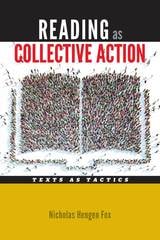
Reading as Collective Action
Text as TacticsNicholas Hengen Fox
University of Iowa Press, 2017
Reading as Collective Action shifts our focus outward, to another of literature’s powers: the power to reshape our world in very public, very active ways. In this book, you will encounter readers who criticized the Bush administration’s war on terror by republishing poems by writers ranging from Shakespeare to Amiri Baraka everywhere from lampposts to the New York Times. You will read about people in Michigan and Tennessee, who leveraged a community reading program on John Steinbeck’s The Grapes of Wrath to organize support for those in need during the Great Recession and to engage with their neighbors about immigration. You will meet a pair of students who took to public transit to talk with strangers about working-class literature and a trio who created a literary website that reclaimed the working-class history of the Pacific Northwest.
This book challenges dominant academic modes of reading. For adherents of the “civic turn,” it suggests how we can create more politically effective forms of service learning and community engagement grounded in a commitment to tactical, grassroots actions. Whether you’re a social worker or a student, a zine-maker, a librarian, a professor, or just a passionate reader with a desire to better your community, this book shows that when we read texts as tactics, “that book changed my life” can become “that book changed our lives.”
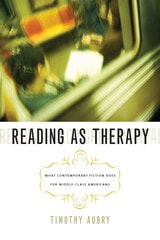
Reading as Therapy
What Contemporary Fiction Does for Middle-Class AmericansTimothy Aubry
University of Iowa Press, 2011
@font-face { font-family: "Myriad Pro";}p.MsoNormal, li.MsoNormal, div.MsoNormal { margin: 0in 0in 0.0001pt; font-size: 12pt; font-family: "Times New Roman"; }div.Section1 { page: Section1; }Why do Americans read contemporary fiction? This question seems simple, but is it? Do Americans read for the purpose of aesthetic appreciation? To satisfy their own insatiable intellectual curiosities? While other forms of media have come to monopolize consumers’ leisure time, in the past two decades book clubs have proliferated, Amazon has sponsored thriving online discussions, Oprah Winfrey has inspired millions of viewers to read both contemporary works and classics, and novels have retained their devoted following within middlebrow communities.
In Reading as Therapy, Timothy Aubry argues that contemporary fiction serves primarily as a therapeutic tool for lonely, dissatisfied middle-class American readers, one that validates their own private dysfunctions while supporting elusive communities of strangers unified by shared feelings. Aubry persuasively makes the case that contemporary literature’s persistent appeal depends upon its capacity to perform a therapeutic function.
Reading as Therapy traces the growth and proliferation of psychological concepts focused on the subjective interior within mainstream, middle-class society and the impact this has had on contemporary fiction. The prevailing tendency among academic critics has been to decry the personal emphasis of contemporary fiction as complicit with the rise of a narcissistic culture, the ascendency of liberal individualism, and the breakdown of public life. Reading as Therapy, by contrast, underscores the varied ideological effects that therapeutic culture can foster.
To uncover the many unpredictable ways in which contemporary literature answers the psychological needs of its readers, Aubry considers several different venues of reader-response—including Oprah’s Book Club and Amazon customer reviews—the promotional strategies of publishing houses, and a variety of contemporary texts, ranging from Khaled Hosseini’s The Kite Runner to Anita Shreve’s The Pilot’s Wife to David Foster Wallace’s Infinite Jest. He concludes that, in the face of an atomistic social landscape, contemporary fiction gives readers a therapeutic vocabulary that both reinforces the private sphere and creates surprising forms of sympathy and solidarity among strangers.
Reading at the Limits of Poetic Form
Dematerialization in Adorno, Blanchot, and CelanJacob McGuinn
Northwestern University Press, 2024
How does literary objecthood contend with the challenge of writing objects that emerge at an extreme limit of material presence? Jacob McGuinn delves into the ways literature writes this indeterminate presence in the context of pre- and post-’68 Paris, a vital moment in the history of criticism. The works of poet Paul Celan, philosopher Theodor Adorno, and writer Maurice Blanchot highlight how the complexities of reading such a dematerialized object are part of the indeterminacy of material itself. Indeterminate objects—glass, snow, walls, screens—are subjects Celan describes as existing in “meridian” space, while for Adorno and Blanchot, criticism not only responds to this indeterminacy but also takes it as its condition. Reading at the Limits of Poetic Form: Dematerialization in Adorno, Blanchot, and Celan shows how these readings simultaneously limit the object of criticism and outline alternative ways of thinking that lie between the models of critical formalism and historicism, ultimately revealing the possible materiality of literature in unrealized history, incomplete politics, and nondetermining thinking.
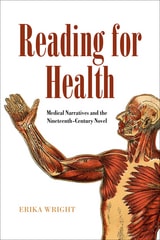
Reading for Health
Medical Narratives and the Nineteenth-Century NovelErika Wright
Ohio University Press, 2016
In Reading for Health: Medical Narratives and the Nineteenth-Century Novel, Erika Wright argues that the emphasis in Victorian Studies on disease as the primary source of narrative conflict that must be resolved has obscured the complex reading practices that emerge around the concept of health. By shifting attention to the ways that prevention of illness and the preservation of well-being operate in fiction, both thematically and structurally, Wright offers a new approach to reading character and voice, order and temporality, setting and metaphor. As Wright reveals, while canonical works by Austen, Brontë, Dickens, Martineau, and Gaskell register the pervasiveness of a conventional “therapeutic” form of action and mode of reading, they demonstrate as well an equally powerful investment in the achievement and maintenance of “health”—what Wright refers to as a “hygienic” narrative—both in personal and domestic conduct and in social interaction of the individual within the community.
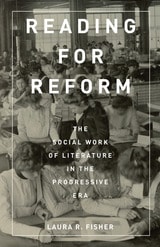
Reading for Reform
The Social Work of Literature in the Progressive EraLaura R. Fisher
University of Minnesota Press, 2019
An unprecedented examination of class-bridging reform and U.S. literary history at the turn of the twentieth century
Reading for Reform rewrites the literary history of late nineteenth and early twentieth century America by putting social reform institutions at the center of literary and cultural analysis. Examining the vibrant, often fractious literary cultures that developed as part of the Progressive mandate to uplift the socially disadvantaged, it shows that in these years reformers saw literature as a way to combat the myriad social problems that plagued modern U.S. society. As they developed distinctly literary methods for Americanizing immigrants, uplifting and refining wage-earning women, and educating black students, their institutions gave rise to a new social purpose for literature.
Class-bridging reform institutions—the urban settlement house, working girls’ club, and African American college—are rarely addressed in literary history. Yet, Laura R. Fisher argues, they engendered important experiments in the form and social utility of American literature, from minor texts of Yiddish drama and little-known periodical and reform writers to the fiction of Edith Wharton and Nella Larsen. Fisher delves into reform’s vast and largely unexplored institutional archives to show how dynamic sites of modern literary culture developed at the margins of social power.
Fisher reveals how reformist approaches to race, class, religion, and gender formation shaped American literature between the 1880s and the 1920s. In doing so, she tells a new story about the fate of literary practice, and the idea of literature’s practical value, during the very years that modernist authors were proclaiming art’s autonomy from concepts of social utility.
Reading for the Planet
Toward a GeomethodologyChristian Moraru
University of Michigan Press, 2015
Reading in the Postgenomic Age
Race, Discipline, and Bionarrativity in Contemporary North American LiteratureLesley Larkin
The Ohio State University Press, 2025
Reading the Difficulties
Dialogues with Contemporary American Innovative PoetryThomas Fink
University of Alabama Press, 2013
New Strategies for Reading the Most Innovative Poetry of Our Time.
Definitions of what constitutes innovative poetry are innumerable and are offered from every quarter. Some critics and poets argue that innovative poetry concerns free association (John Ashbery), others that experimental poetry is a “re-staging” of language (Bruce Andrews) or a syntactic and cognitive break with the past (Ron Silliman and Lyn Hejinian). The tenets of new poetry abound.
But what of the new reading that such poetry demands? Essays in Reading the Difficulties ask what kinds of stances allow readers to interact with verse that deliberately removes many of the comfortable cues to comprehension—poetry that is frequently nonnarrative, nonrepresentational, and indeterminate in subject, theme, or message.
Some essays in Thomas Fink and Judith Halden-Sullivan’s collection address issues of reader reception and the way specific stances toward reading support or complement the aesthetic of each poet. Others suggest how we can be open readers, how innovative poetic texts change the very nature of reader and reading, and how critical language can capture this metamorphosis. Some contributors consider how the reader changes innovative poetry, what language reveals about this interaction, which new reading strategies unfold for the audiences of innovative verse, and what questions readers should ask of innovative verse and of events and experiences that we might bring to reading it.
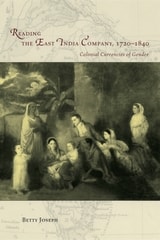
Reading the East India Company 1720-1840
Colonial Currencies of GenderBetty Joseph
University of Chicago Press, 2003
Drawing on the British East India Company's records as well as novels, memoirs, portraiture and guidebooks, Joseph shows how the company's economic and archival practices intersected to produce colonial "fictions" or "truth-effects" that strictly governed class and gender roles—in effect creating a "grammar of power" that kept the far-flung empire intact. And while women were often excluded from this archive, Joseph finds that we can still hear their voices at certain key historical junctures. Attending to these voices, Joseph illustrates how the writing of history belongs not only to the colonial project set forth by British men, but also to the agendas and mechanisms of agency—of colonized Indian, as well as European women. In the process, she makes a valuable and lasting contribution to gender studies, postcolonial theory, and the history of South Asia.
Reading the Literatures of Asian America
Shirley Geok-lin Lim
Temple University Press, 1992
Reading the Middle Generation Anew
Culture, Community, and Form in Twentieth-Century American PoetryEric Haralson
University of Iowa Press, 2006
In addition to having worked during the broad middle of the last century, these poets constitute the center of twentieth-century American poetry in the larger sense, refuting invidious connotations of “middle” as coming after the great moderns and being superseded by a proliferating postmodern experimentation. This middle generation mediates the so-called American century and its prodigious body of poetry, even as it complicates historical and aesthetic categorizations.
Taking diverse formal and thematic angles on these poets—deconstructionist, biographical-historical, and more formalist accounts—this book re-examines their between-ness and ambivalence: their various positionings and repositionings in aesthetic, political, and personal matters. The essays study the interplay between these writers and such shifting formations as religious discourse, consumerism, militarism and war, the ideology of America as “nature’s nation,” and U.S. race relations and ethnic conflicts. Reading the Middle Generation Anew also shows the legacy of the middle generation, the ways in which their lives and writings continue to be a shaping force in American poetry. This fresh and invigorating collection will be of great interest to literary scholars and poets.
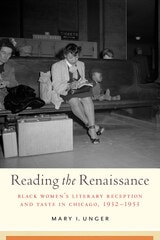
Reading the Renaissance
Black Women's Literary Reception and Taste in Chicago, 1932-1953Mary I. Unger
University of Massachusetts Press, 2025
From 1932 to 1953, during the Black Chicago Renaissance, numerous literary events were held within and for the city’s Black community. In book clubs, public forums, print reviews, little magazines, local programming, and other public venues, Black women in particular debated the role of literature in racial uplift efforts, set literary standards, and acted as community gatekeepers for cultural production during a time known as the Black Chicago Renaissance. Through these inspiring efforts, a mix of publishers, well-known authors, and everyday readers significantly fostered a robust literary culture in the Windy City.
Reading the Renaissance constructs a reception history of the Black women who read and reviewed, published and promoted, and collected and curated literature of the era. Mary Unger interprets how local figures such as Vivian G. Harsh, Ora Morrow, Gwendolyn Brooks, Alice Browning, Fern Gayden, and Margaret Walker cultivated particular literary tastes through collective acts of reading and reception. She does so by recovering a network of readers, book clubs, literary magazines, civic programs, and book businesses that Black women created, led, and transformed during the early 1930s through the early 1950s in Bronzeville, Chicago’s predominantly Black South Side neighborhood.
This illuminating work includes close readings of texts alongside letters, scrapbooks, meeting minutes, reviews, and other ephemera of local reading practices to show how Black women facilitated diverse strategies of reading while instructing community members how to engage a variety of print cultures at the time. Unger demonstrates how Black women readers influenced individual authors as well as the norms and expectations of African American literature more broadly, becoming important (yet too often overlooked) players in American literary history.
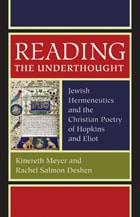
Reading the Underthought
Jewish Hermeneutics and the Christian Poetry of Hopkins and EliotKinereth Meyer
Catholic University of America Press, 2010
Reading the Wind
The Literature of the Vietnam WarTimothy J. Lomperis
Duke University Press, 1987
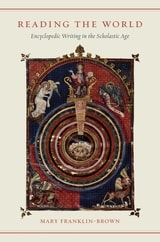
Reading the World
Encyclopedic Writing in the Scholastic AgeMary Franklin-Brown
University of Chicago Press, 2012

Readings at the Edge of Literature
Myra Jehlen
University of Chicago Press, 2002
Throughout these essays Jehlen demonstrates the crucial role that the process of writing itself plays in unfolding these paradoxes, whether in the form of novels by Harriet Beecher Stowe and Virginia Woolf; the histories of Captain John Smith; or even a work of architecture, such as the Guggenheim museum in Bilbao.
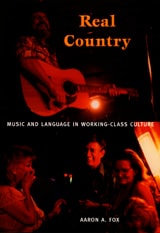
Real Country
Music and Language in Working-Class CultureAaron A. Fox
Duke University Press, 2004
Fox spent hundreds of hours observing, recording, and participating in talk and music-making in homes, beer joints, and garage jam sessions. He renders the everyday life of Lockhart’s working-class community in detail, right down to the ice cold beer, the battered guitars, and the technical skills of such local musical legends as Randy Meyer and Larry “Hoppy” Hopkins. Throughout, Fox focuses on the human voice. His analyses of conversations, interviews, songs, and vocal techniques show how feeling and experience are expressed, and how local understandings of place, memory, musical aesthetics, working-class social history, race, and gender are shared. In Real Country, working-class Texans re-imagine their past and give voice to the struggles and satisfactions of their lives in the present through music.
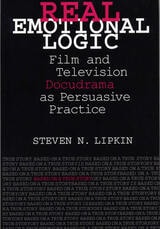
Real Emotional Logic
Film and Television Docudrama as Persuasive PracticeSteven N. Lipkin
Southern Illinois University Press, 2002
Analyzing docudrama as a mode of argument, Steven N. Lipkin explores the ethical, historical, and ideological functions of docudrama to discover why these films based on true stories offer such appealing story lines. That appeal, Lipkin discovers, is rooted in docudrama’s representation of actual people and events by means of melodramatic narrative structures that play on the emotions of the viewer.
The dual nature of docudramas—blending narrative and documentary style— argues for a moral view of reality-based subject matter. The ethics, the ideology, the very presence of docudrama on television and the range of topics and problems that appear in contemporary feature film docudramas indicate how this form of presentation appeals to its audience. Docudrama offers a warranted, rational view of what the story material might suggest initially to be an irrational world. Through its moral agenda, docudrama ultimately allows the possibilities of understanding, optimism, and hope to emerge from “real stories.”
Real Emotional Logic traces the development of docudramas into contemporary movies of the week and feature films, including Schindler’s List, Amistad, JFK, The Killing Fields, Quiz Show, A League of Their Own, In the Name of the Father, Call Northside 777, 13 Rue Madeleine, Cheerleader Mom, Shine, Rosewood, A Civil Action, and October Sky.
Lipkin provides further insight into the genre by identifying and describing the commonalities connecting ostensibly different docudramas through their shared themes and narrative techniques. In doing so, he exposes the persuasive rhetorical strategies at the heart of docudramas and reveals the constructed emotional appeal inherent in films “based on a true story.”