Results by title
1917 books match the query 'Law' and 81 start with r
Reinterpreting Property
Margaret Jane Radin
University of Chicago Press, 1994
Departing from traditional libertarian and economic theories of property, Margaret Jane Radin argues that the law should take into account nonmonetary personal value attached to property—and that some things, such as bodily integrity, are so personal they should not be considered property at all. Gathered here are pieces ranging from Radin's classic early essay on property and personhood to her recent works on governmental "taking" of private property.
Margaret Jane Radin is professor of law at Stanford University. She is the author of over twenty-five articles on legal and political theory.
Religion, Order, and Law
David Little
University of Chicago Press, 1984
Religious Freedom after the Sexual Revolution
A Catholic GuideHelen Alvare
Catholic University of America Press, 2022
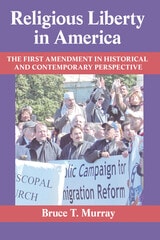
Religious Liberty in America
The First Amendment in Historical and Contemporary PerspectiveBruce T. Murray
University of Massachusetts Press, 2008
A nation founded on church-state separation is still debating where the line is drawn
In recent years a series of highly publicized controversies has focused attention on what are arguably the sixteen most important words in the U.S. Constitution: “Congress shall make no law respecting an establishment of religion, or prohibiting the free exercise thereof.” The ongoing court battles over the inclusion of the words “under God” in the Pledge of Allegiance, the now annual cultural quarrel over “Merry Christmas” vs. “Happy Holidays,” and the political promotion of “faith-based initiatives” to address social problems—all reflect competing views of the meaning of the religious liberty clauses of the First Amendment.
Such disputes, as Bruce T. Murray shows, are nothing new. For more than two hundred years Americans have disagreed about the proper role of religion in public life and where to draw the line between church and state. In this book, he reexamines these debates and distills the volumes of commentary and case law they have generated. He analyzes not only the changing contours of religious freedom but also the phenomenon of American civil religion, grounded in the notion that the nation's purpose is sanctified by a higher authority—an idea that can be traced back to the earliest New England colonists and remains deeply ingrained in the American psyche.
Throughout the book, Murray connects past and present, tracing the historical roots of contemporary controversies. He considers why it is that a country founded on the separation of church and state remains singularly religious among nations, and concludes by showing how the Supreme Court's thinking about the religious liberty clauses has evolved since the late eighteenth century.
Remaking Appalachia
Ecosocialism, Ecofeminism, and LawNicholas F. Stump
West Virginia University Press, 2021
Environmental law has failed spectacularly to protect Appalachia from the ravages of liberal capitalism, and from extractive industries in particular. Remaking Appalachia chronicles such failures, but also puts forth hopeful paths for truly radical change.
Remaking Appalachia begins with an account of how, over a century ago, laws governing environmental and related issues proved fruitless against the rising power of coal and other industries. Key legal regimes were, in fact, explicitly developed to support favored industrial growth. Aided by law, industry succeeded in maximizing profits not just through profound exploitation of Appalachia’s environment but also through subordination along lines of class, gender, and race. After chronicling such failures and those of liberal development strategies in the region, Stump explores true system change beyond law “reform.” Ecofeminism and ecosocialism undergird this discussion, which involves bottom-up approaches to transcending capitalism that are coordinated from local to global scales.
Rendition to Torture
Clarke, Alan W
Rutgers University Press, 2012
In Rendition to Torture, Alan W. Clarke explains how the United States adopted torture as a matter of official policy; how and why it turned to extraordinary rendition as a way to outsource more extreme, mutilating forms of torture; and outlines the steps the United States took to hide its abuses. Many adverse consequences attended American use of torture. False information gleaned from torture was used to justify the Iraq war, adding potency to the charge that the war was illegal under international law. Moreover, European nations and Canada aided, abetted, and became thoroughly enmeshed in U.S.-led torture and renditions, thereby spreading both the problem and the blame for this practice. Clarke offers an extended critique of these activities, placing them in historical and legal context as well as in transnational and comparative perspective.
Representation Rights and the Burger Years
Nancy Maveety
University of Michigan Press, 1991
Representing Women
Law, Literature, and FeminismSusan Sage Heinzelman and Zipporah Batshaw Wiseman, eds.
Duke University Press, 1994
Beginning with an exploration of the ways in which women are represented—how they either tell or have their stories told in literature, in the law, in a courtroom—this collection demonstrates the interrelatedness of the legal and the literary. Whether considering the status of medieval women readers or assessing the effectiveness and extent of contemporary rape law reform, the essays show that power first comes with telling one’s own story, and that the degree and effect of that power are determined by the cultural significance of the forum in which the story is presented. But telling the story is not enough. One must also be aware of how the story is contained within traditional constructs or boundaries and is thus limited in its effects, as Carol Sanger’s essay on mothers and legal/sexual identity makes clear. One must also recognize how a story might perpetuate an ideological agenda that is not in the best interests of the storyteller, as Elizabeth Butler Cullingford shows in her reading of Yeats’s "Leda and the Swan" and one must know the historical context of a story and of its telling, as Anne B. Goldstein’s essay on lesbian narratives discloses.
Breaking down the boundaries between law and literature, this anthology makes evident the ways in which the effect of women’s stories has been constrained and expands the range of possibilities for those who represent women, tell women’s stories, or present women’s issues. Representing Women makes the retelling of old stories about women compelling and the telling of new ones both necessary and possible.
Contributors. Kathryn Abrams, Linda Brodkey, Rita Copeland, Elizabeth Butler Cullingford, Margaret Anne Doody, Susan B. Estrich, Michelle Fine, Anne B. Goldstein, Angela P. Harris, Susan Sage Heinzelman, Christine L. Krueger, Martha Minow, Carol Sanger, Judy Scales-Trent
Reproducing Jews
A Cultural Account of Assisted Conception in IsraelSusan Martha Kahn
Duke University Press, 2000
In this ethnographic study of the new reproductive technologies in Israel, Susan Martha Kahn explores the cultural meanings and contemporary rabbinic responses to artificial insemination, in-vitro fertilization, egg donation, and surrogacy. Kahn draws on fieldwork with unmarried Israeli women who are using state-subsidized artificial insemination to get pregnant and on participant-observation in Israeli fertility clinics. Through close readings of traditional Jewish texts and careful analysis of Israeli public discourse, she explains how the Israeli embrace of new reproductive technologies has made Jewish beliefs about kinship startlingly literal. Kahn also reveals how a wide range of contemporary Israelis are using new reproductive technologies to realize their reproductive futures, from ultraorthodox infertile married couples to secular unmarried women.
As the first scholarly account of assisted conception in Israel, this multisited ethnography will contribute to current anthropological debates on kinship studies. It will also interest those involved with Jewish studies.
Reproducing Rape
Domination through Talk in the CourtroomGregory M. Matoesian
University of Chicago Press, 1993
Matoesian examines the language of the courtroom, focusing on how defense lawyers interpret and classify rape in a way that makes the victim's experience appear as a normal sexual encounter. He analyzes the language that defense attorneys use in cross-examination to argue that courtroom talk can shape the victim's testimony to fit male standards of legitimate sexual practice. On this view, cross-examination is an adversarial war of words through which lawyers manipulate reality and perpetuate the patriarchal domination of women.
Reproducing Rape will interest students and professionals in law, criminology, sociology, feminist theory, linguistics, and anthropology.
Resolving International Conflicts
Peter Hay
Central European University Press, 2009
Restitution
Civil Liability for Unjust EnrichmentWard Farnsworth
University of Chicago Press, 2014
In Restitution, Ward Farnsworth presents a guide to this body of law that is compact, lively, and insightful—the first treatment of its kind that the American law of restitution has received. The book explains restitution doctrines, remedies, and defenses with unprecedented clarity and illustrates them with vivid examples. Farnsworth demonstrates that the law of restitution is guided by a manageable and coherent set of principles that have remarkable versatility and power. Restitution makes a complex and important area of law accessible, understandable, and interesting to any reader.
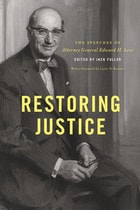
Restoring Justice
The Speeches of Attorney General Edward H. LeviEdward H. Levi
University of Chicago Press, 2013
Serving at an almost unprecedentedly difficult time, Levi was among the most admired attorney generals of the modern era. Published here for the first time, the speeches in Restoring Justice offer a superb sense of the man and his work.
Rethinking Evidence
Exploratory EssaysWilliam Twining
Northwestern University Press, 1994
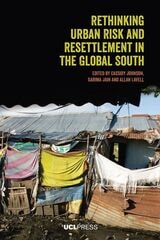
Rethinking Urban Risk and Resettlement in the Global South
Edited by Cassidy Johnson, Garima Jain, and Allan Lavell
University College London, 2021
Environmental changes impact everyone, but the burden is especially heavy upon the lives and livelihoods of the urban poor and those living in informal settlements. In an effort to reduce urban residents’ exposure to climate change and natural disasters, resettlement programs are becoming widespread across the Global South. Yet, while resettlement may reduce a region’s future climate-related disaster risk, it can also often increase poverty and vulnerability. This volume collates the findings from a research project that examined urban areas across the globe, including case studies from India, Uganda, Peru, Colombia, Mexico, Cambodia, and the Philippines. The book offers a unique approach to resettlement, providing an opportunity for urban planners to re-think how disaster risk management can better address the accumulation of urban risks in the era of climate change.
Rethinking the Rule of Law after Communism
Wojciech Sadurski
Central European University Press, 2005
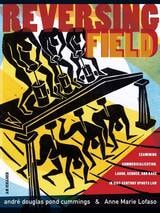
Reversing Field
Examining Commercialization, Labor, Gender, and Race in 21st Century Sports Lawedited by andré douglas pond cummings and Anne Marie Lofaso
West Virginia University Press, 2010
Reversing Field invites students, professionals, and enthusiasts of sport—whether law, management and marketing, or the game itself—to explore the legal issues and regulations surrounding collegiate and professional athletics in the United States. This theoretical and methodological interrogation of sports law openly addresses race, labor, gender, and the commercialization of sports, while offering solutions to the disruptions that threaten its very foundation during an era of increased media scrutiny and consumerism. In over thirty chapters, academics, practitioners, and critics vigorously confront and debate matters such as the Arms Race, gender bias, racism, the Rooney Rule, and steroid use, offering new thought and resolution to the vexing legal issues that confront sports in the 21st century.
Rhetorical Knowledge in Legal Practice and Critical Legal Theory
Francis J. Mootz III
University of Alabama Press, 2006
A clear summary of contemporary rhetorical philosophy and its intersections with hermeneutics and critical theory
This book describes the significance of rhetorical knowledge for law through detailed discussions of some of the most difficult legal issues facing courts today, including affirmative action, gay rights, and assisted suicide.
Francis J. Mootz responds to both extremes, those who argue that law is merely a rhetorical mask for the exercise of power and those who demonstrate an ideological faith in law’s autonomy, and he breaks new ground by returning to modern classics in the fields of rhetoric and hermeneutics. Drawing from Chaim Perelman's "new rhetoric" and Hans-Georg Gadamer's "philosophical hermeneutics," Mootz argues that justice is a product of rhetorical knowledge. Drawing from Nietzsche, Mootz’s conception of rhetorical knowledge opens up the dynamic possibilities of critical legal theory.
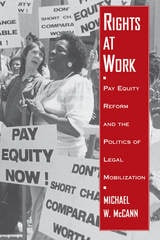
Rights at Work
Pay Equity Reform and the Politics of Legal MobilizationMichael W. McCann
University of Chicago Press, 1994
Rights at Work explores the political strategies in more than a dozen pay equity struggles since the late 1970s, including battles of state employees in Washington and Connecticut, as well as city employees in San Jose and Los Angeles. Relying on interviews with over 140 union and feminist activists, McCann shows that, even when the courts failed to correct wage discrimination, litigation and other forms of legal advocacy provided reformers with the legal discourse—the understanding of legal rights and their constraints—for defining and advancing their cause.
Rights at Work offers new insight into the relation between law and social change—the ways in which grass roots social movements work within legal rights traditions to promote progressive reform.
Rights of Inclusion
Law and Identity in the Life Stories of Americans with DisabilitiesDavid M. Engel and Frank W. Munger
University of Chicago Press, 2003
Although all sixty interviewees had experienced discrimination, none had filed a formal protest or lawsuit. Nevertheless, civil rights played a crucial role in their lives. Rights improved their self-image, enhanced their career aspirations, and altered the perceptions and assumptions of their employers and coworkers-in effect producing more inclusive institutional arrangements. Focusing on these long-term life histories, Engel and Munger incisively show how rights and identity affect one another over time and how that interaction ultimately determines the success of laws such as the ADA.
Rights on Trial
How Workplace Discrimination Law Perpetuates InequalityEllen Berrey, Robert L. Nelson, and Laura Beth Nielsen
University of Chicago Press, 2017
On the surface, America’s commitment to equal opportunity in the workplace has never been clearer. Virtually every company has antidiscrimination policies in place, and there are laws designed to protect these rights across a range of marginalized groups. But, as Ellen Berrey, Robert L. Nelson, and Laura Beth Nielsen compellingly show, this progressive vision of the law falls far short in practice. When aggrieved individuals turn to the law, the adversarial character of litigation imposes considerable personal and financial costs that make plaintiffs feel like they’ve lost regardless of the outcome of the case. Employer defendants also are dissatisfied with the system, often feeling “held up” by what they see as frivolous cases. And even when the case is resolved in the plaintiff’s favor, the conditions that gave rise to the lawsuit rarely change. In fact, the contemporary approach to workplace discrimination law perversely comes to reinforce the very hierarchies that antidiscrimination laws were created to redress.
Based on rich interviews with plaintiffs, attorneys, and representatives of defendants and an original national dataset on case outcomes, Rights on Trial reveals the fundamental flaws of workplace discrimination law and offers practical recommendations for how we might better respond to persistent patterns of discrimination.
Rivers on Fire and Corporate Liars
The Monitoring and Sanctioning of U.S. Water Pollution CrimesJoshua Ozymy
Rutgers University Press, 2026
For over four decades, the US federal government has undertaken efforts to police and prosecute environmental crimes to protect public health and the natural environment. Yet, we still know very little about how US federal agencies have monitored and sanctioned water pollution violations and if these actions actually deter crime. In Rivers on Fire and Corporate Liars, Joshua Ozymy and Melissa Jarrell Ozymy examined over one thousand federal water pollution investigations and prosecutions undertaken by the US EPA and Department of Justice from 1983 to 2023 to answer these questions. Their analysis provides the most comprehensive empirical examination to date of how the criminal enforcement of water pollution has evolved over time, patterns in prosecutions, and how criminals were sanctioned.
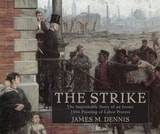
Robert Koehler’s The Strike
The Improbable Story of an Iconic 1886 Painting of Labor ProtestJames M. Dennis
University of Wisconsin Press, 2011
Every work of art has a story behind it. In 1886 the German American artist Robert Koehler painted a dramatic wide-angle depiction of an imagined confrontation between factory workers and their employer. He called this oil painting The Strike. It has had a long and tumultuous international history as a symbol of class struggle and the cause of workers’ rights. First exhibited just days before the tragic Chicago Haymarket riot, The Strike became an inspiration for the labor movement. In the midst of the campaign for an eight-hour workday, it gained international attention at expositions in Paris, Munich, and the 1893 Chicago World’s Fair. Though the painting fell into obscurity for decades in the early twentieth century, The Strike lived on in wood-engraved reproductions in labor publications. Its purchase, restoration, and exhibition by New Left activist Lee Baxandall in the early 1970s launched it to international fame once more, and collectors and galleries around the world scrambled to acquire it. It is now housed in the Deutsches Historisches Museum in Berlin, Germany.
Rock This Way
Cultural Constructions of Musical LegitimacyMel Stanfill
University of Michigan Press, 2023
Any and all songs are capable of being remixed. But not all remixes are treated equally. Rock This Way examines transformative musical works—cover songs, remixes, mash-ups, parodies, and soundalike songs—to discover what contemporary American culture sees as legitimate when it comes to making music that builds upon other songs. Through examples of how popular discussion talked about such songs between 2009 and 2018, Mel Stanfill uses a combination of discourse analysis and digital humanities methods to interrogate our broader understanding of transformative works and where they converge at the legal, economic, and cultural ownership levels.
Rock This Way provides a new way of thinking about what it means to re-create and borrow music, how the racial identity of both the reusing artist and the reused artist matters, and the ways in which the law polices artists and their works. Ultimately, Stanfill demonstrates that the extent to which a work is seen as having new expression or meaning is contingent upon notions of creativity, legitimacy, and law, all of which are shaped by white supremacy.
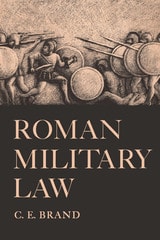
Roman Military Law
By C. E. Brand
University of Texas Press, 1968
Rome was the law-giver for much of the modern world. She was also the greatest military power of antiquity, operating her military organization with remarkable efficiency and effectiveness throughout most of the then-known world. In view of the importance of both the legal and military aspects of the Roman Empire, an account of their combination in a system of disciplinary control for the Roman armies is of considerable significance to historians in both fields—and, in fact, to scholars in general. In Roman Military Law, C. E. Brand describes this system of control.
Since a characterization of such a system can be made most meaningful only against a background of Roman constitutional government and in the light of ideologies current at the time, Brand follows his initial “Note on Sources” with a sketch of the contemporary Roman scene. This first section includes a discussion of the Roman constitution and an examination of Roman criminal law.
The history of Rome, as a republic, principate, and empire, extended over a period of a thousand years, so any attempt to represent a generalized picture must be essentially a matter of extraction and condensation from the voluminous literature of the whole era. Nevertheless, from the fantastic evolution that is the history of Rome, Brand has been able to construct a more or less static historical mosaic that may be considered typically “Roman.” This comes into sharpest focus during the period of the Punic Wars, when the city and its people were most intensely Roman. The picture of the Roman armies is set into this basic framework, in chapters dealing with military organization, disciplinary organization, religion and discipline, and offenses and punishments.
The final section of the book considers briefly the vast changes in Roman institutions that came about under the armies of the Empire, and then concludes with the Latin text and an English translation of the only known code of Roman military justice, promulgated sometime during the later Empire, preserved in Byzantine literature, and handed down to medieval times in Latin translations of Byzantine Greek law, which it has heretofore been confused.
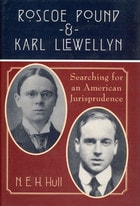
Roscoe Pound and Karl Llewellyn
Searching for an American JurisprudenceN. E. H. Hull
University of Chicago Press, 1997
Through meticulous archival research, Hull shows how the intellectual battles of the day took place against a network of private and public relationships and demonstrates how Pound's and Llewellyn's ideas of jurisprudence sprang from a kind of intellectual bricolage, the pragmatic assemblage of parts rather than the development of a unified whole, that is peculiarly American. Humorous, engaging, and provocative, Roscoe Pound and Karl Llewellyn uncovers the roots of American jurisprudence in the lives of two of its most compelling figures.
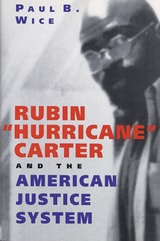
Rubin ' Hurricane' Carter and the American Justice System
Wice, Paul B
Rutgers University Press, 2000
Winner of the 2001 New Jersey Author's Award by the New Jersey Academic Alliance
Paul Wice takes the famous case of Rubin “Hurricane” Carter to another level of scrutiny as he puts the criminal justice system itself on trial. The case illustrates many of the strengths and weaknesses of our nation’s much maligned criminal justice system while affirming the power and resoluteness of the human spirit.
Early on the morning of June 17, 1966, the sound of gunfire echoed through the quite streets of Paterson, New Jersey, as four people were shot, three fatally, inside the Lafayette Bar and Grill. Twenty-nine-year-old Rubin “Hurricane” Carter, a prominent professional boxer, along with his companion, John Artis, were arrested and charged with committing this brutal crime. Prosecutors would later theorize that the murders were racially motivated — Carter and Artis are black, the victims white — to avenge the killing of a black Paterson tavern owner. Despite barely credible and oft-times contradictory evidence presented by both sides, a year after the killings Carter and Artis were convicted of murder and sentenced to life in prison. A second jury upheld the previous convictions in 1976. Artis was imprisoned until 1981, when he was released on parole. Carter remained in jail until 1988, when acting prosecutor John Goceljak elected not to pursue a third trial following the reversal of the 1976 retrial by the Federal District Court, a decision ultimately affirmed by the Circuit Court of Appeals and the U.S. Supreme Court. With the release of the widely discussed movie on Carter starring Denzel Washington, the case has again become visible and controversial.
Wice follows the torturous legal path of this case as it wound its way through first the New Jersey then the federal justice system for the next twenty-two years. His interpretations are informed by interviews with key members of both the prosecution and defense as well as previously unused court documents and transcripts. Wice evaluates the Carter case within a larger theoretical framework to illustrate many of the critical weaknesses of the adversary system and appeals process that is so basic to the American judicial system. Here is what can happen when police and prosecutors act unprofessionally, when critical witnesses lie, and when the justice system itself is unwilling to correct its errors or admit its mistakes.

Rules of Origin in International Trade
A Comparative StudyEdwin Vermulst, Jacques Bourgeois, and Paul Waer, Editors
University of Michigan Press, 1994
Rules versus Relationships
The Ethnography of Legal DiscourseJohn M. Conley and William M. O'Barr
University of Chicago Press, 1990
Russia's Legal Fictions
Harriet Murav
University of Michigan Press, 1998
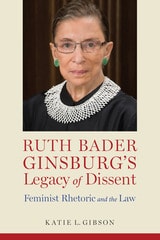
Ruth Bader Ginsburg’s Legacy of Dissent
Feminist Rhetoric and the LawKatie L. Gibson
University of Alabama Press, 2018
A rhetorical analysis of Justice Ruth Bader Ginsburg’s feminist jurisprudence.
Ruth Bader Ginsburg’s lifelong effort to reshape the language of American law has had profound consequences: she has shifted the rhetorical boundaries of jurisprudence on a wide range of fundamental issues from equal protection to reproductive rights. Beginning in the early 1970s, Ginsburg led a consequential attack on sexist law in the United States. By directly confronting the patriarchal voice of the law, she pointedly challenged an entrenched genre of legal language that silenced the voices and experiences of American women and undermined their status as equal citizens. On the United States Supreme Court, Justice Ginsburg continues to challenge the traditional scripts of legal discourse to insist on a progressive vision of the Constitution and to demand a more inclusive and democratic body of law.
This illuminating work examines Justice Ruth Bader Ginsburg’s contributions in reshaping the rhetoric of the law (specifically through the lens of watershed cases in women’s rights) and describes her rhetorical contributions—beginning with her work in the 1970s as a lawyer and an advocate for the ACLU’s Women’s Rights Project through her tenure as a Supreme Court justice. Katie L. Gibson examines Ginsburg’s rhetoric to argue that she has dramatically shifted the boundaries of legal language. Gibson draws from rhetorical theory, critical legal theory, and feminist theory to describe the law as a rhetorical genre, arguing that Ginsburg’s jurisprudence can appropriately be understood as a direct challenge to the traditional rhetoric of the law.
Ruth Bader Ginsburg stands as an incredibly important figure in late twentieth- and early twenty-first-century feminism. While a growing number of admirers celebrate Justice Ginsburg’s voice of dissent today, Ginsburg’s rhetorical legacy reveals that she has long articulated a sharp and strategic voice of judicial dissent. This study contributes to a more complete understanding of her feminist legacy by detailing the unique contributions of her legal rhetoric.