Results by title
2817 books match the query 'Nature' and 107 start with r
Renewable Civic Energy
Community Engagement and Policy Design for a Climate Resilient AmericaCarmen Sirianni
Temple University Press, 2027
Although both our climate and democracy are in crisis, there is hope. Creative engagement has been taking place at the community level as environmental activists, grassroots movements, and place-based collaborative efforts have partnered with institutions to create effective sustainability initiatives.
Renewable Civic Energy provides an analytic framework and case studies that show how innovative practitioners from civic and professional associations, educational institutions, and youth organizations, as well as local, state, and federal agencies, have collaborated to “design for democracy.” These include watershed associations to restore rivers and address sea level rise, as well as collaborative community conservation and tribal partnerships on Western lands. Sirianni also analyzes collaborative environmental justice and university partnerships that promote engagement and democratic professionalism.
Sirianni closes Renewable Civic Energy by proposing several transformative, yet thoroughly pragmatic, institutional reform strategies. Ordinary people can help solve complex public problems—and they can enable government to work with them to improve both the climate and democracy.
Renewing Our Rivers
Stream Corridor Restoration in Dryland RegionsEdited by Mark K. Briggs and W. R. Osterkamp
University of Arizona Press, 2020
Our rivers are in crisis and the need for river restoration has never been more urgent. Water security and biodiversity indices for all of the world’s major rivers have declined due to pollution, diversions, impoundments, fragmented flows, introduced and invasive species, and many other abuses.
Developing successful restoration responses are essential. Renewing Our Rivers addresses this need head on with examples of how to design and implement stream-corridor restoration projects. Based on the experiences of seasoned professionals, Renewing Our Rivers provides stream restoration practitioners the main steps to develop successful and viable stream restoration projects that last. Ecologists, geomorphologists, and hydrologists from dryland regions of Australia, Mexico, and the United States share case studies and key lessons learned for successful restoration and renewal of our most vital resource.
The aim of this guidebook is to offer essential restoration guidance that allows a start-to-finish overview of what it takes to bring back a damaged stream corridor. Chapters cover planning, such emerging themes as climate change and environmental flow, the nuances of implementing restoration tactics, and monitoring restoration results. Renewing Our Rivers provides community members, educators, students, natural resource practitioners, experts, and scientists broader perspectives on how to move the science of restoration to practical success.
Reopening the American West
Edited by Hal K. Rothman
University of Arizona Press, 1998
In this book Mike Davis, Stephen Pyne, William deBuys, Donald Worster, Dan Flores, and others re-examine the relationship between people and the environment in the American West over five hundred years, from the legacy of Coronado's search for the Cities of Gold to the social costs of tourism and gaming inflicted by modern adventurers. By exploring places in the West, aspects of the region's past, and ways of understanding some of its pressing issues, the authors foster a better understanding of how people interact and perceive land.
Reopening the American West takes a fresh approach to the history of the region, examining the premises of earlier scholars as well as those who have redefined the study of the West over the past two decades. It combines provocative essays with insightful analyses to address issues that are representative of the West in the twentieth century—multiculturalism, water issues, resource exploitation—and to reopen the West for all readers interested in new ways of looking at its wide-open spaces.
Contents:
Places
Dreams of Earth, William deBuys
Environmentalism and Multiculturalism, Dan L. Flores
Pyre on the Mountain, Stephen J. Pyne
Las Vegas Versus Nature, Mike Davis
Pasts
The Legacy of John Wesley Powell, Donald Worster
Pokey’s Paradox: Tourism and Transformation on the Western Navajo Reservation, Hal K. Rothman
Negotiating National Identity: Western Tourism and "See American First," Marguerite Schaffer
Understanding
Place Humanists at the Headgates, Helen Ingram
Tapping the Rockies: Resource Exploitation and Conservation in the Intermountain West, Char Miller
The Meaning of Place: Reimagining Community in a Changing West, Robert Gottlieb

Reptiles and Amphibians of Minnesota
W.J. Breckenridge
University of Minnesota Press, 1944
Requiem for the Santa Cruz
An Environmental History of an Arizona RiverRobert H. Webb, Julio L. Betancourt, R. Roy Johnson, and Raymond M. Turner; Foreword by Bernard L. Fontana
University of Arizona Press, 2014
Authored by an esteemed group of scientists, Requiem for the Santa Cruz thoroughly documents this river—the premier example of historic arroyo cutting during the late nineteenth and early twentieth centuries, when large floodflows cut down through unconsolidated valley fill to form deep channels in the major valleys of the American Southwest. Each chapter provides a unique opportunity to chronicle the arroyo legacy, evaluate its causes, and consider its aftermath. Using more than a collective century of observations and collections, the authors reconstruct the circumstances of the river’s entrenchment and the groundwater mining that ultimately killed the marshlands, a veritable mesquite forest, and a birdwatcher's paradise.
Today, communities everywhere face this conundrum: do we manage ephemeral rivers through urban areas for flood control, or do we attempt to restore them to some previous state of perennial naturalness? Requiem for the Santa Cruz carefully explores the legacies of channel change, groundwater depletion, flood control, and nascent attempts at river restoration to give a long-term perspective on management of rivers in arid lands. Tied together by authors who have committed their life’s work to the study of aridland rivers, this book offers a touching and scientifically grounded requiem for the Santa Cruz and every southwestern river.
Rereading the Machine in the Garden
Nature and Technology in American CultureEdited by Eric C. Erbacher, Nicole Maruo-Schröder, and Florian Sedlmeier
Campus Verlag, 2014
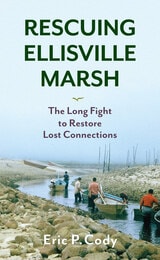
Rescuing Ellisville Marsh
The Long Fight to Restore Lost ConnectionsEric P. Cody
University of Massachusetts Press, 2023
For hundreds of years, farmers and fishing communities maintained the inlet to Ellisville Marsh, a picturesque piece of coastline ten miles south of Plymouth, Massachusetts. Recognized as one of the most environmentally sensitive and ecologically valuable places in the state, the salt marsh and estuary are home to a diverse array of wildlife and a range of habitats, including low-tide mudflats, a saltwater pond, intertidal zone, and fields of tall marsh grass.
After agricultural and fishing activities faded away in the late twentieth century, it soon became apparent that protecting the marsh and its surroundings from development would not be enough to restore the natural equilibrium that had been lost when the inlet became blocked. Having witnessed government inaction over the years, Eric P. Cody and four other locals founded the Friends of Ellisville Marsh in 2007 to address erosion, revive tidal flows, and revitalize fisheries and wildlife in the face of climate change. Rescuing Ellisville Marsh presents the powerful case study of backyard activism, telling the story of a community that bonded with a natural place and decided to fight for it.
Residual Governance
How South Africa Foretells Planetary FuturesGabrielle Hecht
Duke University Press, 2023
Resisting Extractivism
Peruvian Gold, Everyday Violence, and the Politics of AttentionMichael Wilson Becerril
Vanderbilt University Press, 2021
Peru is classified as one of the deadliest countries in the world for environmental defenders, where activists face many forms of violence. Through an ethnographic and systematic comparison of four gold-mining conflicts in Peru, Resisting Extractivism presents a vivid account of subtle and routine forms of violence, analyzing how meaning-making practices render certain types of damage and suffering noticeable while occluding others. The book thus builds a theory of violence from the ground up—how it is framed, how it impacts people’s lived experiences, and how it can be confronted. By excavating how the everyday interactions that underlie conflicts are discursively concealed and highlighted, this study assists in the prevention and transformation of violence over resource extraction in Latin America.
The book draws on a controlled, qualitative comparison of four case studies, extensive ethnographic research conducted over fourteen months of fieldwork, analysis of over nine hundred archives and documents, and unprecedented access to more than 250 semi-structured interviews with key actors across industry, the state, civil society, and the media. Michael Wilson Becerril identifies, traces, and compares these dynamics to explain how similar cases can lead to contrasting outcomes—insights that may be usefully applied in other contexts to save lives and build better futures.
Resourceful Kingdoms
Customary Institutions, Contested Ownership, and Community Development in AfricaShingirai Taodzera
Ohio University Press, 0
Resourceful Kingdoms investigates the struggle for control over Uganda’s emerging oil sector, centering on the Bunyoro Kingdom’s unsuccessful effort to secure ownership of resources discovered on its ancestral lands. Drawing on extensive fieldwork, the book shows how the military-backed National Resistance Movement government consolidated authority over an estimated two billion barrels of oil, while Bunyoro communities experienced displacement, land loss, political tension, and significant environmental harm even before production began. The Bunyoro case reflects a wider pattern in which rural, resource-rich populations across Africa are marginalized as governments and multinational corporations convert natural resources into state-centered revenues.
The book further explores how indigenous kingdoms might come to own resources and channel revenues toward sustainable, culturally grounded development. Through comparative case studies of Uganda’s powerful Buganda Kingdom and South Africa’s Bafokeng Kingdom—widely recognized for community-based mineral ownership and effective wealth management—Resourceful Kingdoms illustrates how traditional institutions can pair with corporate structures, private land ownership, and diversified investment strategies to strengthen community prosperity.
From this analysis emerges strategic coexistence, a new framework that outlines how kingdoms can secure resource rights independent of shifting state policies or corporate social-responsibility initiatives. Presented as both a philosophy and a set of practical steps, strategic coexistence urges kingdoms to formalize land ownership, build strong indigenous governance systems, create community-owned corporations, reinvest resource revenues in long-term development, and transition away from dependence on extractive industries. Resourceful Kingdoms ultimately repositions African kingdoms as dynamic, contemporary governance institutions with significant potential to influence natural resource administration and advance community well-being.
Restless Ecologies
Climate Change and Socioecological Futures in the Peruvian HighlandsAllison Caine
University of Arizona Press, 2025
Drawing on the Quechua concept of k’ita, or restlessness, Allison Caine explores how herders in the community of Chillca in the Cordillera Vilcanota mountain range of the southeastern Peruvian Andes sense and make sense of changing conditions. Capricious mountains, distracted alpacas, and wayward children deviate from their expected spatial and temporal trajectories. When practices of sociality start to fall apart—when animals no longer listen to herders’ whistles, children no longer visit their parents, and humans no longer communicate with mountains—these failures signal a broader ecological instability that threatens the viability of the herder’s world.
For more than two years, the author herded alongside the women of the Cordillera Vilcanota, observing them and talking with them about their interactions with their animals, landscapes, and neighbors. Emphasizing the importance of Indigenous knowledge and traditional ecological practices, Caine argues that Quechua understandings of restlessness align with and challenge broader theoretical understandings of what it is to be vulnerable in a time of planetary crisis.
Restoring Tropical Forests
A Practical GuideStephen Elliott, David Blakesley, and Kate Hardwick
Royal Botanic Gardens, Kew, 2013
The book is based on the innovative techniques developed at Chiang Mai University’s Forest Restoration Research Unit, Thailand. It takes a threepart approach, first looking at effective general concepts of tropical forest dynamics and regeneration, then at specific proven restoration techniques, and finally at how to use research methods to refine and adapt the techniques to local ecological and socioeconomic conditions. In addition, illustrations and case studies of successful applications help to make this a global, user-friendly guide. Whether for developing new techniques or improving old ones, Restoring Tropical Forests is a valuable tool for effective, ecologically sound change.
Restoring the Pitchfork Ranch
How Healing a Southwest Oasis Holds Promise for Our Endangered LandA. Thomas Cole
University of Arizona Press, 2024
Restoring the Pitchfork Ranch tells the story of a decades-long habitat restoration project in southwestern New Mexico. A. Thomas Cole explains what inspired him and his wife, Lucinda, to turn their retirement into years dedicated to hard work and renewal. The book shares the past and present history of a very special ranch south of Silver City, which is home to a rare type of regional wetland, a fragile desert grassland ecosystem, archaeological sites, and a critical wildlife corridor in a drought-stricken landscape.
Today the 11,300 acres that make up the Pitchfork Ranch provide an important setting for carbon sequestration, wildlife habitats, and space for the reintroduction of endangered or threatened species. Restoring the Pitchfork Ranch weaves together stories of mine strikers, cattle ranching, and the climate crisis into an important and inspiring call to action. For anyone who has wondered how they can help, the Pitchfork Ranch provides an inspiring way forward.
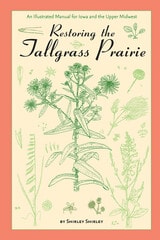
Restoring the Tallgrass Prairie
An Illustrated Manual for Iowa and the Upper MidwestShirley Shirley
University of Iowa Press, 1994
Iowa is the only state that lies entirely within the natural region of the tallgrass prairie. Early documents indicate that 95 percent of the state—close to 30 million acres—was covered by prairie vegetation at the time of Euro-American settlement. By 1930 the prairie sod had been almost totally converted to cropland; only about 30,000 acres of the original “great green sea” remained. Now, in this gracefully illustrated manual, Shirley Shirley has created a step-by-step guide to reconstructing the natural landscape of Iowa and the Upper Midwest.
Chapters on planning, obtaining and selecting plants and seeds, starting seeds indoors, preparing the site, planting, and maintenance set the stage for comprehensive species accounts. Shirley gives firsthand information on soil, moisture, sun, and pH requirements; location, size, and structure; blooming time and color; and propagation, germination, and harvesting for more than a hundred wildflowers and grasses.
Shirley's sketches—all drawn from native plants and from seedlings that she grew herself—will be valuable for even the most experienced gardener. While other books typically feature only the flowering plant, her careful drawings show the three stages of the seedlings, the flower, and the seedhead with seeds as well as the entire plant. This practical and attractive volume will help anyone dedicated to reconstructing the lost “emerald growth” of the historic tallgrass prairie.
Resurrection of the Animals
Anita Skeen
Michigan State University Press, 2002
Rethinking Reality
Lucretius and the Textualization of NatureDuncan F. Kennedy
University of Michigan Press, 2002
The book engages in a sustained argument about realist assumptions in scientific and other discourses through detailed analysis and discussion of some of the most important recent contributions to this debate. Engaging sympathetically but not uncritically with constructivist accounts of scientific knowledge, the book takes up a sustained critique of recent contributions to that debate, including those of Ian Hacking, Evelyn Fox Keller, Bruno Latour, and Hans-Jörg Rheinberger. What are the implications of regarding such knowledge as "discovered" or "invented"? How is the rhetoric of such claims to be identified and the pretentions of those claims assessed?In what ways can realist and constructivist approaches be reconciled? How do these considerations affect the way we read scientific texts from the past and regard them historically?
What emerges is a fresh and challenging assessment of the role of time and temporal perspective in assessing claims to knowledge in scientific thought and of the importance of textuality to the history of knowledge. A wide variety of readers, from classicists and intellectual historians to epistemologists of science, will enjoy and learn from Rethinking Reality.
Duncan Kennedy is Reader in Latin Literature and the Theory of Criticism, University of Bristol. He is also the author of The Arts of Love: Five Studies in the Discourse of Roman Love Elegy.
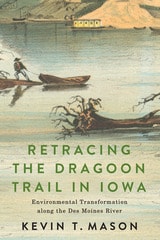
Retracing the Dragoon Trail in Iowa
Environmental Transformation along the Des Moines RiverKevin T. Mason
Michigan State University Press, 2026
In Retracing the Dragoon Trail in Iowa, historian Kevin T. Mason presents a vivid and deeply researched account of Iowa’s evolving landscape, beginning with the 1835 expedition of the First U.S. Dragoons. Drawing from archival records, maps, government surveys, Indigenous histories, and ecological data, Mason explores how Iowa’s prairies and wetlands gave way to farms, towns, and transportation networks. He situates these environmental shifts within the broader forces of Manifest Destiny, military expansion, and settler colonialism, while amplifying the voices of the Sauk, Meskwaki, Dakota, and other Indigenous nations whose histories are often marginalized.
But Mason doesn’t just write about history—he walks it. His 371-mile journey retracing the original dragoon route across Iowa blends scholarship with storytelling, captured through video essays, photography, and writing. This modern-day trek, featured on Iowa PBS’s Iowa Life and Iowa Public Radio’s Talk of Iowa, brings the past into the present, offering a compelling look at how landscapes remember. The result is a powerful contribution to environmental history, regional studies, and Indigenous scholarship—one that reveals the layered interactions between land use, policy, and historical change.
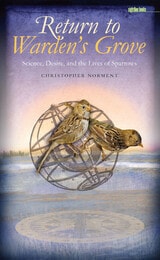
Return to Warden's Grove
Science, Desire, and the Lives of SparrowsChristopher Norment
University of Iowa Press, 2008
Based on three seasons of field research in the Canadian Arctic, Christopher Norment's exquisitely crafted meditation on science and nature, wildness and civilization, is marked by bottomless prose, reflection on timeless questions, and keen observations of the world and our place in it. In an era increasingly marked by cutting-edge research at the cellular and molecular level, what is the role for scientists of sympathetic observation? What can patient waiting tell us about ourselves and our place in the world?
His family at home in the American Midwest, Norment spends months on end living in isolation in the Northwest Territories, studying the ecology of the Harris's Sparrow. Although the fourteenth-century German mystic Meister Eckhardt wrote, "God is at home, we are in the far country," Norment argues that an intellectual, emotional, and spiritual "far country" can be found in the lives of animals and arctic wilderness. For Norment, "doing science" can lead to an enriched aesthetic and emotional connection to something beyond the self and a way to develop a sacred sense of place in a world that feels increasingly less welcoming, certain, and familiar.
Revenant Ecologies
Defying the Violence of Extinction and ConservationAudra Mitchell
University of Minnesota Press, 2024
Engaging a broad spectrum of ecological thought to articulate the ethical scale of global extinction
As global rates of plant and animal extinctions mount, anxieties about the future of the earth’s ecosystems are fueling ever more ambitious efforts at conservation, which draw on Western scientific principles to manage species and biodiversity. In Revenant Ecologies, Audra Mitchell argues that these responses not only ignore but also magnify powerful forms of structural violence like colonialism, racism, genocide, extractivism, ableism, and heteronormativity, ultimately contributing to the destruction of unique life forms and ecosystems.
Critiquing the Western discourse of global extinction and biodiversity through the lens of diverse Indigenous philosophies and other marginalized knowledge systems, Revenant Ecologies promotes new ways of articulating the ethical enormity of global extinction. Mitchell offers an ambitious framework—(bio)plurality—that focuses on nurturing unique, irreplaceable worlds, relations, and ecosystems, aiming to transform global ecological–political relations, including through processes of land return and critically confronting discourses on “human extinction.”
Highlighting the deep violence that underpins ideas of “extinction,” “conservation,” and “biodiversity,” Revenant Ecologies fuses political ecology, global ethics, and violence studies to offer concrete, practical alternatives. It also foregrounds the ways that multi-life-form worlds are actively defying the forms of violence that drive extinction—and that shape global efforts to manage it.
Retail e-book files for this title are screen-reader friendly with images accompanied by short alt text and/or extended descriptions.
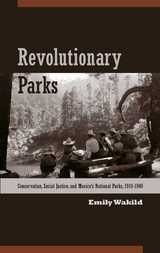
Revolutionary Parks
Conservation, Social Justice, and Mexico’s National Parks, 1910–1940Emily Wakild
University of Arizona Press, 2011
Revolutionary Parks tells the surprising story of how forty national parks were created in Mexico during the latter stages of the first social revolution of the twentieth century. By 1940 Mexico had more national parks than any other country. Together they protected more than two million acres of land in fourteen states. Even more remarkable, Lázaro Cárdenas, president of Mexico in the 1930s, began to promote concepts akin to sustainable development and ecotourism.
Conventional wisdom indicates that tropical and post-colonial countries, especially in the early twentieth century, have seldom had the ability or the ambition to protect nature on a national scale. It is also unusual for any country to make conservation a political priority in the middle of major reforms after a revolution. What emerges in Emily Wakild’s deft inquiry is the story of a nature protection program that takes into account the history, society, and culture of the times. Wakild employs case studies of four parks to show how the revolutionary momentum coalesced to create early environmentalism in Mexico.
According to Wakild, Mexico’s national parks were the outgrowth of revolutionary affinities for both rational science and social justice. Yet, rather than reserves set aside solely for ecology or politics, rural people continued to inhabit these landscapes and use them for a range of activities, from growing crops to producing charcoal. Sympathy for rural people tempered the radicalism of scientific conservationists. This fine balance between recognizing the morally valuable, if not always economically profitable, work of rural people and designing a revolutionary state that respected ecological limits proved to be a radical episode of government foresight.
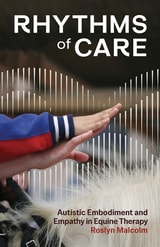
Rhythms of Care
Autistic Embodiment and Empathy in Equine TherapyRoslyn Malcolm
University of Minnesota Press, 2027
A thoughtful exploration of autism, offering a new understanding of social relations through a sensory-perceptual approach
Sensitive and flighty, horses require carefully designed environments to help them feel calm and soothed—precisely the sort of places that are understood to help some autistic youth to flourish. In Rhythms of Care, Roslyn Malcolm changes the conversation around autism, detailing shifting understandings of the condition from neurological misfiring to a whole-body condition of sensory-perceptual difference.
Malcolm chronicles the experiences of several autistic youth and their families at two UK equestrian riding centers, developing new language to elaborate on an advancing sense of autistic embodiment and sociality emerging through equine-assisted therapy. Her inquiry turns away from a focus on autistic brains and toward cultivating ecologies where autistic people's ways of being and embodiments can be accepted and supported.
Tracing the role of sensory and endocrinological knowledge in our formulations of bodies, empathy, and personhood, Rhythms of Care explores more-than-human sociality, multispecies distributions of care, and the anthropology of the body. In our chronically stressful and overstimulating era of late capitalism and inequality, Malcolm envisions a sensory environment for all beings.
Retail e-book files for this title are screen-reader friendly with images accompanied by short alt text and/or extended descriptions.
Ripple Effects
How We're Loving Our Lakes to DeathTed J. Rulseh
University of Wisconsin Press, 2022
In his engaging and conversational style, Ted Rulseh details each of these challenges and proposes achievable solutions. He draws on personal experience, interviews, academic research, and government reports to describe the state of the lakes, the stresses they are under, and avenues to successful lakeside living for a sustainable future. Ripple Effects will be a go-to source for all who love lakes and who advocate for their protection; its driving question is summed up by one of Rulseh’s interviewees: “We love this lake. What can we do to keep it healthy?”
Rise of the Dragon
Readings from Nature on the Chinese Fossil RecordEdited by Henry Gee
University of Chicago Press, 2002
Perhaps the best known of these new Chinese fossils are the famous feathered dinosaurs from Liaoning Province, which may help end one of the most intense debates in paleontology—whether birds evolved from dinosaurs. But other finds have been just as spectacular, such as the minutely preserved (to the cellular level) animal embryos of the 670 million-year-old Duoshantuo phosphorites, or the world's oldest known fish, from the Chengjiang formation in southwestern Yunnan Province.
Rise of the Dragon makes descriptions and detailed discussions of these important finds available in one convenient volume for paleontologists and serious fossil fans.
Rising Ground
A Search for the Spirit of PlacePhilip Marsden
University of Chicago Press, 2016
Rising Ground is a record of that journey, but it is also so much more: a beautifully written meditation on place, nature, and human life that encompasses history, archaeology, geography, and the love of place that suffuses us when we finally find home. Firmly in a storied tradition of English nature writing that stretches from Gilbert White to Helen MacDonald, Rising Ground reveals the ways that places and peoples have interacted over time, from standing stones to footpaths, ancient habitations to modern highways. What does it mean to truly live in a place, and what does it take to understand, and honor, those who lived and died there long before we arrived?
Like the best travel and nature writing, Rising Ground is written with the pace of a contemplative walk, and is rich with insight and a powerful sense of the long skein of years that links us to our ancestors. Marsden’s close, loving look at the small patch of earth around him is sure to help you see your own place—and your own home—anew.
Risk Criticism
Precautionary Reading in an Age of Environmental UncertaintyMolly Wallace
University of Michigan Press, 2016
Taking inspiration from the questions raised by the Bulletin’s synecdochical “nuclear,” Risk Criticism aims to generate a hybrid form of critical practice that brings “nuclear criticism” into conversation with ecocriticism. Through readings of novels, films, theater, poetry, visual art, websites, news reports, and essays, Risk Criticism tracks the diverse ways in which environmental risks are understood and represented today.
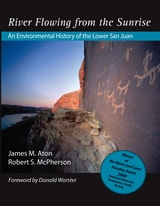
River Flowing From The Sunrise
An Environmental History of the Lower San JuanJames M. Aton and Robert S. McPherson
Utah State University Press, 2000
River Life and the Upspring of Nature
Naveeda Khan
Duke University Press, 2023

River Life and the Upspring of Nature
Naveeda Khan
Duke University Press, 2023
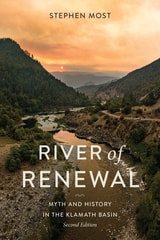
River of Renewal
Myth and History in the Klamath BasinStephen Most
Oregon State University Press, 2024
The only history of the entire Klamath Basin, River of Renewal tells the stories of the region’s diverse communities and stakeholders, including the government agencies that manage most of its land. Based on author Stephen Most’s original research and interviews with tribal leaders, ranchers, farmers, fishermen, forest managers, and others, River of Renewal is a political as well as an environmental history, one that underscores the power of commitment to a place and the vital importance of traditional knowledge in ecological stewardship. It offers an indispensable resource for anyone who wishes to better understand the peoples of the Klamath Basin and their extraordinary accomplishment of bringing about the removal of the four hydroelectric dams that harmed their cultures, economies, and environment for a century.
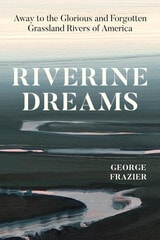
Riverine Dreams
Away to the Glorious and Forgotten Grassland Rivers of AmericaGeorge Frazier
University of Chicago Press, 2025
The North American grasslands that once covered vast areas of the central United States are now our most endangered ecosystems. But not far from any spot in the grasslands is a river. Grassland rivers are as central to the story of prairies as bison and bluestem. Defined as rivers that drain prairie watersheds, these waterways are crucial to plains ecosystems and no less endangered than the grasslands surrounding them. They are also enigmatic: some are restricted by local access laws and others have simply been forgotten. In any given year, fewer than a dozen people might lay eyes on tens of thousands of miles of America’s grassland rivers. But, as environmental writer George Frazier shows, following their twists and turns is one of the best ways to experience the wild essence of the prairies.
Riverine Dreams invites us on a trip along eight grassland rivers—including the Missouri, the Niobrara, and Purgatoire—traversing their environmental and cultural histories and introducing us to the people who study, paddle, and conserve them. This journey takes Frazier across the North American interior—from Montana and Colorado to Nebraska and Missouri—where he uncovers a remarkable movement to celebrate and preserve these natural treasures: nothing less than a grassland river revival.
The first accessible introduction to these waters, Riverine Dreams is a personal exploration of the rivers that are so vital to the health of the prairies.
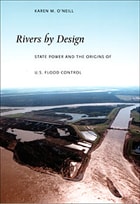
Rivers by Design
State Power and the Origins of U.S. Flood ControlKaren M. O Neill
Duke University Press, 2006
O’Neill focuses on the creation of flood control programs along the lower Mississippi River and the Sacramento River, the first two rivers to receive federal flood control aid. She describes how, in the early to mid-nineteenth century, planters, shippers, and merchants from both regions campaigned for federal assistance with flood control efforts. She explains how the federal government was slowly and reluctantly drawn into water management to the extent that, over time, nearly every river in the United States was reengineered. Her narrative culminates in the passage of the national Flood Control Act of 1936, which empowered the Army Corps of Engineers to build projects for all navigable rivers in conjunction with local authorities, effectively ending nationwide, comprehensive planning for the protection of water resources.
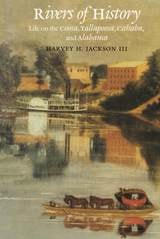
Rivers of History
Life on the Coosa, Tallapoosa, Cahaba, and AlabamaHarvey H. Jackson, III
University of Alabama Press, 1995
An illuminating study of how rivers shaped the history, culture, and environment of Alabama and the American South.
In Rivers of History, acclaimed historian Harvey H. Jackson III blends environmental history with compelling storytelling and traces the evolving relationship between people and rivers—from Indigenous communities who first depended on these waterways, to European settlers, to the development of modern towns and industries. Along the way, readers encounter stories of transportation and trade, conflict and cooperation, ecological change and conservation, all tied to the flow of these essential rivers.
Far more than a geographical study, Rivers of History demonstrates how waterways act as lifelines of human experience. Rivers shaped patterns of settlement, enabled agricultural and economic growth, and served as critical channels for communication across the American South. At the same time, they created challenges—flooding, environmental degradation, and competing demands for natural resources—that continue to influence life in the region today.
Jackson shows how the history of Alabama cannot be understood apart from its rivers. The Coosa, Tallapoosa, Cahaba, and Alabama rivers emerge not simply as physical features on a map, but as powerful forces that connect past and present, nature and society. His interdisciplinary approach—bringing together history, geography, and environmental studies—makes this work especially valuable for students, scholars, and general readers alike.
Accessible yet authoritative, Rivers of History is essential reading for anyone interested in Southern history, environmental change, or the enduring relationship between landscapes and human communities. It offers a compelling reminder that the story of a place is often written in the movement of its waters.
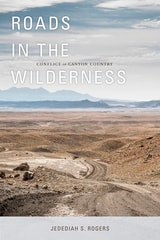
Roads in the Wilderness
Conflict in Canyon CountryJedediah S. Rogers
University of Utah Press, 2013
Winner of the Wallace Stegner Prize in American Environmental or Western History
The canyon country of southern Utah and northern Arizona—a celebrated desert of rock and sand punctuated by gorges and mesas—is a region hotly contested among vying and disparate interests, from industrial developers to wilderness preservation advocates. Roads are central to the conflicts raging in an area perceived as one of the last large roadless places in the continental United States. The canyon country in fact contains an extensive network of dirt trails and roads, many originally constructed under the authority of a one-sentence statute in an 1866 mining law, later known as R.S. 2477. While well-groomed and paved roads came to signify the industrialization of the modern age, twentiethcentury conservationists have regarded roads as intrusive human imprints on the nation’s wild lands. Roads connect rural communities, spur economic growth, and in some cases blend harmoniously into the landscape, but they also fracture and divide, disturb wildlife and habitat, facilitate industrial development, and spoil wilderness.
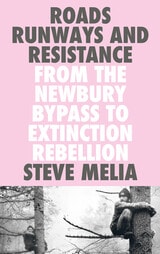
Roads, Runways and Resistance
From the Newbury Bypass to Extinction RebellionSteve Melia
Pluto Press, 2021
'As a movement for social change it is important that we understand our own history. This is a compelling read.'
From the anti-roads protests of the 1990s to HS2 and Extinction Rebellion, conflict and protest have shaped the politics of transport. In 1989, Margaret Thatcher's government announced 'the biggest road-building programme since the Romans.' This is the inside story of the thirty tumultuous years that have followed.
Roads, Runways and Resistance draws on over 50 interviews with government ministers, advisors and protestors - many of whom, including 'Swampy', speak here for the first time about the events they describe. It is a story of transport ministers undermined by their own Prime Ministers, protestors attacked or quietly supported by the police, and smartly-dressed protestors who found a way onto the roof of the Houses of Parliament.
Today, as a new wave of road building and airport expansion threatens to bust Britain's carbon budgets, climate change protestors find themselves on a collision course with the government. Melia asks, what difference did the protests of the past make? And what impacts might today's protest movements have on the transport of the future?

Robert Francis
Collected ProseEdited by Matthew James Babcock
University of Massachusetts Press, 2026
Rediscovering the quietly radical writing of a poet who chose simplicity, solitude, and contemplation over modern haste
American author Robert Francis, whom Robert Frost called “the best neglected poet,” lived in Amherst, Massachusetts from the 1920s to the 1980s. As an underappreciated but prolific poet, Francis authored eight poetry collections and received a number of prestigious prizes. Still, like many poets committed to their craft, he lived most of his quiet life at or well below the poverty level. To sustain himself financially, Francis turned to essay writing in popular magazines, such as the Christian Science Monitor and Forum. From 1938 to 1953, as America and the world experienced a period of intense modernization, he produced an invigorating, challenging, and enlightening quantity of prose whose quality should rank him alongside writers such as Emerson, Thoreau, Wendell Berry, and Annie Dillard.
Published in one volume for the first time, Robert Francis: Collected Prose invites readers to a retrospective retreat into the solitude and serenity of Francis’s cabin, Fort Juniper, where he ardently and artfully dueled the most psychologically, socially, and economically destructive aspects of industrialized America. These essays, together with selections from Francis’s previously unpublished nature treatise, Traveling in Concord, offer an avenue toward an enhanced understanding of many commonly overlooked aspects of the natural world, offering 21st-century readers a refreshing reorientation of worldviews, advocating life principles of simplicity over unnecessary technological complexity, and conservation over consumerism. Vibrant, jubilant, at times sardonic and brooding but always absorbing, Francis’s essays draw readers into the meditative mood of his woodland walks, apple harvests, and autumn landscapes to discover, as he writes, “the importance of the unimportant, the virtue of the small, the rewards of intense cultivation.”
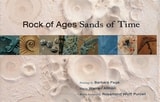
Rock of Ages, Sands of Time
Paintings by Barbara Page, Text by Warren AllmonBarbara Page and Warren D. Allmon
University of Chicago Press, 2001
These are just a few scenes from the magnificent drama that unfolds in glorious full color and three-dimensional texture in Rock of Ages, Sands of Time. Each of Barbara Page's 544 contiguous painted panels represents a million years of the history of life on earth, with fossil plants and animals depicted at the same scale and in association with each other just as they might be found by a paleontologist in the field. A muted rainbow of background colors evoke the rocks in which the fossils were found—the Texas Red Beds, for instance, or the yellow Solnhofen limestone—and keystone events are shown metaphorically, with fat rolls of paint marking major extinctions or continental drift.
To fully experience the awesome impact of an eon's worth of time spread across 500 feet of bas-relief panels, you'd have to visit the Museum of the Earth in Ithaca, New York, where Page's specially commissioned work will be installed when the museum opens in 2002. But this book is the next best thing. Not only does it contain crisp color reproductions of each painting, but it also includes an accessible essay from paleontologist Warren Allmon giving the scientific context behind the art.
For fossil lovers of all ages, and anyone interested in the merging of art and science, Rock of Ages, Sands of Time will be the find of a lifetime.
Rock | Water | Life
Ecology and Humanities for a Decolonial South AfricaLesley Green
Duke University Press, 2020
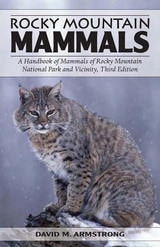
Rocky Mountain Mammals
A Handbook of Mammals of Rocky Mountain National Park and Vicinity, Third EditionDavid M. Armstrong
University Press of Colorado, 2008
Designed for quick reference and enjoyable reading, Rocky Mountain Mammals offers what most field guides don't - a wealth of fascinating information about each species. In seventy-two species accounts, David M. Armstrong describes each animal and its signs, habits, habitat, and natural history, noting times when seasonal events such as elk sparring occur.
Introductory materials and appendices offer rich context and wildlife-watching support, including a checklist with page numbers for quick field reference, an identification key, a glossary, derivations of scientific names, and advice on how, when, and where to watch mammals. Armstrong introduces mammalian evolution, anatomy, and distribution and offers perspective on how the local fauna fits into its geographical setting and into past and potential future faunas of the region.
This lavishly illustrated new edition will delight those who live in and visit the high country and foothills of the Southern Rockies and want to identify mammals and learn about their lives. Published in association with the Rocky Mountain Nature Association.
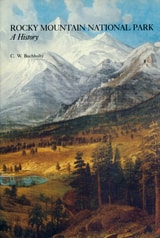
Rocky Mountain National Park
A HistoryC. W. Buchholtz
University Press of Colorado, 1983
Rod Penner
Paintings, 1987–2022Rod Penner
The Artist Book Foundation, 2022
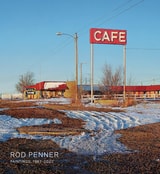
Rod Penner infuses his photorealistic paintings of the American southwest with a cinematic quality in the first major monograph on this contemporary realist artist.
The abandoned and forgotten landscapes of rural southwestern towns are the favored subjects of Rod Penner's paintings. His deft use of contrasts in his images—despondency and hope, isolation and nostalgia—evokes memories of The Last Picture Show and elicits complex responses from viewers. "I'm interested in the look of things and the quality of being there," he says. "A moment that is completely frozen with all the variety of textures; rust on poles, crumbling asphalt, light hitting the grass."
Penner's works are based on his photographs, digital video stills, and his experience of the rural landscapes of Texas and New Mexico. He depicts desolate, often deserted locations, the character of old houses and abandoned buildings, weather, and unique geography. His chosen scenes are infused with a cinematic quality that is the result of the exquisite light that he captures with his meticulous process. "The finished paintings should evoke contrasting responses of melancholy and warmth, desolation and serenity," he says.
Penner's hyperrealistic technique meticulously records both the iconic imagery and the beauty in the ashes of these once-prosperous streets and nighborhoods that still endure. The incredible poignant scenes evoke a universalism, a collective experience seen through the lens of Americana. "You won't find any hidden or overt socio-political meaning in my work and at the same time I hope that by utilizing what I find in the American landscape I'm able to connect to viewers on a deeper psychological level."
Roger Tory Peterson
A BiographyBy Douglas Carlson
University of Texas Press, 2007
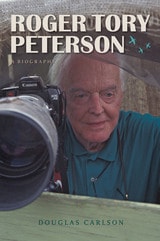
Beginning with his 1934 Field Guide to the Birds, Roger Tory Peterson introduced literally millions of people to the pleasures of observing birds in the wild. His field guide, which has gone through five editions and sold more than four million copies, fostered an appreciation for the natural world that set the stage for the contemporary environmental movement. When Rachel Carson's Silent Spring sounded a warning about the threat to birds and their habitats in the 1960s, the Peterson field guides had already prepared the public and the scientific community to heed the warning and fight to save habitat and protect endangered species—a result that Peterson wholeheartedly approved.
In this authoritative, highly readable biography of Roger Tory Peterson (1908-1996), Douglas Carlson creates a fascinating portrait of the complex, often conflicted man behind the brand name. He describes how Peterson's obsession with birds began in boyhood and continued throughout a multifaceted career as a painter, writer, educator, environmentalist, and photographer. Carlson traces Peterson's long struggle to become both an accomplished bird artist and a scientific naturalist—competing goals that drove Peterson to work to the point of exhaustion and that also deprived him of many aspects of a normal personal life. Carlson also records Peterson's many lasting achievements, from the phenomenal success of the field guides, to the bird paintings that brought him renown as "the twentieth century's Audubon," to the establishment of the Roger Tory Peterson Institute to carry on his work in conservation and education.
Rogues in the Postcolony
Narrating Extraction and Itinerancy in IndiaStacey Balkan
West Virginia University Press, 2022
Rogues in the Postcolony is a study of Anglophone Indian picaresque novels that dramatize the impacts of extractive capitalism and colonial occupation on local communities in several Indian states. In this materialist history of development on the subcontinent, Stacey Balkan considers works by Amitav Ghosh, Indra Sinha, and Aravind Adiga that critique violent campaigns of enclosure and dispossession at the hands of corporate entities like the English East India Company and its many legatees. By foregrounding the intersections among landscape ideology, agricultural improvement, extractive capitalism, and aesthetic expression, Rogues in the Postcolony also attends to the complicity of popular aesthetic forms with political and economic policy, as well as the colonial and extractivist logics that often frame discussions around the so-called Anthropocene epoch.
Bringing together questions about settler-colonial practices and environmental injustice, Rogues in the Postcolony concludes with an investigation of new extractivist frontiers, including solar capitalism, and considers the possibility of imagining life after extraction on the Indian subcontinent and beyond.
Romancing the Wild
Cultural Dimensions of EcotourismRobert Fletcher
Duke University Press, 2014
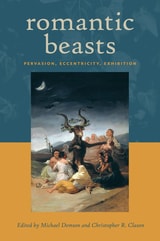
Romantic Beasts
Pervasion, Eccentricity, ExhibitionMichael Demson
Bucknell University Press, 2025
Published by Bucknell University Press. Distributed worldwide by Rutgers University Press.
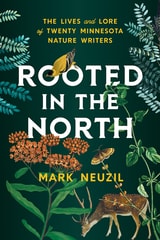
Rooted in the North
The Lives and Lore of Twenty Minnesota Nature WritersMark Neuzil
University of Minnesota Press, 2026
Discover unforgettable writers who taught Minnesota how to see its wild heart
In this engaging collection, environmental journalist Mark Neuzil revives the voices that showed generations how to appreciate Minnesota’s wild places. Comprising twenty vivid biographical essays, Rooted in the North traces the lives and lore of writers who shaped our understanding of this great state, from Minnesota’s northwoods to its tallgrass prairies to the storied landscape of the Boundary Waters Canoe Area Wilderness.
Readers will encounter towering figures of conservation such as Sigurd F. Olson, whose spiritual vision of wilderness helped define the modern environmental movement, alongside beloved chroniclers like Florence Page Jaques and Helen Hoover, whose intimate portraits of wildlife still resonate decades later. Neuzil also highlights writers Charles Eastman and Maude Kegg, who share insights into their Indigenous childhoods, and once-popular authors like Charles Hallock and George Leonard Herter, restoring them to their rightful place in the state’s literary heritage. Rooted in the North broadens our definition of “nature writer” to include novelists whose fiction grew from close observation of the land. Writers such as Martha Ostenso, Frederick Manfred, and Gary Paulsen appear here not just as storytellers but as keen interpreters of Minnesota’s natural world.
In what began as a popular series for the Minnesota Star Tribune, these essays explore the philosophy, science, adventure, faith, and everyday oddities that enlivened their subjects. The result is the only book of its kind—an illuminating portrait of the voices that helped us define and fall in love with Minnesota’s natural landscapes.
Retail e-book files for this title are screen-reader friendly with images accompanied by short alt text and/or extended descriptions.
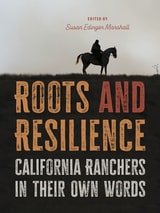
Roots and Resilience
California Ranchers in Their Own WordsSusan Edinger Marshall
University of Nevada Press, 2024
The editors have drawn together these stories, poems, and musings from ranchers across the state, calling upon real people to share their experiences, and beckoning readers to find a shared understanding concerning often divisive land-use topics. Many perspectives are considered, including those of transplanted suburbanites to seventh-generation heirs. Notably, many women’s writings are including in the book, offering unique and valuable perspectives on ranching culture.
Roots and Resilience gives voice to California’s Indigenous, Mexican American, Basque and other European American ranchers, asking the reader to find common ground in the name of land stewardship and conservation.
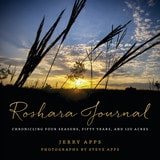
Roshara Journal
Chronicling Four Seasons, Fifty Years, and 120 AcresJerry Apps
Wisconsin Historical Society Press, 2016
A photographic diary of a small Midwestern farm and the family who’ve made it their home
In Roshara Journal, father-and-son team Jerry and Steve Apps share the monthly happenings at their family’s farm in central Wisconsin. Featuring Steve’s stunning photos and fifty years of Jerry’s journal entries, Roshara Journal captures the changes—both from month to month and over the decades—on the landscape and farmstead.
The Apps family has owned Roshara since 1966. There they nurture a prairie restoration and pine plantation, maintain a large garden that feeds three generations, observe wildlife species by the dozens, and support a population of endangered butterflies. In documenting life on this piece of land, Jerry and Steve remind us how, despite the pace and challenges of modern life, the seasons continue to influence our lives in ways large and small. Jerry explains that his journal entries become much more than mere observations: "It seems that when I write about something—a bur oak tree, for example—that old tree becomes a part of me. . . . Writing takes me to a place that goes beyond observation and understanding, a place filled with feeling and meaning."
In the tradition of Bernd Heinrich in Maine, Barry Lopez in the Canadian Arctic, and Aldo Leopold just an hour down the road in Baraboo, Jerry and Steve Apps combine observation, experience, and reflection to tell a profound story about one place in the world.
Rouge River Revived
How People Are Bringing Their River Back to LifeJohn H. Hartig and Jim Graham, Editors
University of Michigan Press, 2022
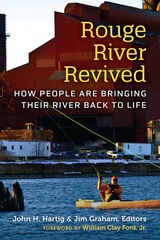
Rouge River Revived describes the river’s history from pre-European times into the 21st century. Chapters cover topics such as Native American life on the Rouge; indigenous flora and fauna over time; the river’s role in the founding of local cities; its key involvement in Detroit’s urban development and intensive industrialization; and the dramatic clean-up arising from citizen concern and activism. This book is not only a history of the environment of the Rouge River, but also of the complex and evolving relationship between humans and natural spaces.
Rough-Water Man
Elwyn Blake'S Colorado River ExpeditionsRichard E. Westwood
University of Nevada Press, 2013
Row by Row
Talking with Kentucky GardenersKatherine J. Black
Ohio University Press, 2015
For two and a half years, Katherine J. Black crisscrossed Kentucky, interviewing home vegetable gardeners from a rich variety of backgrounds. Row by Row: Talking with Kentucky Gardeners is the result, a powerful compilation of testimonies on the connections between land, people, culture, and home.
The people profiled here share a Kentucky backdrop, but their life stories, as well as their gardens, have as many colors, shapes, and tastes as heirloom tomatoes do. Black interviewed those who grow in city backyards, who carve out gardens from farmland, and who have sprawling plots in creek bottoms and former pastures. Many of the gardeners in Row by Row speak eloquently about our industrialized food system’s injuries to the land, water, and health of people. But more often they talk about what they are doing in their gardens to reverse this course.
Row by Row is as sure to appeal to historians, food studies scholars, and sustainability advocates as it is to gardeners and local food enthusiasts. These eloquent portraits, drawn from oral histories and supplemented by Deirdre Scaggs’ color photographs, form a meditation on how gardeners make sense of their lives through what they grow and how they grow it.