Results by title
93 books match the query 'Historians' and 6 start with a
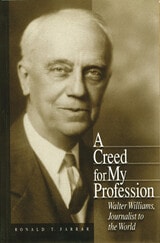
A Creed for My Profession
Walter Williams, Journalist to the WorldRonald T. Farrar
University of Missouri Press, 1998
This superb biography provides for the first time a candid look at the remarkable life of Walter Williams, the man who founded the world's first school of journalism and perhaps contributed more toward the promotion of professional journalism than any other person of his time.
Williams, the youngest of six children, was born in Boonville, Missouri, in 1864. Never an athletic child, he always had a love of books and of learning; yet, he scarcely had a high school education. He began his journalistic career as a printer's devil at seventy cents per week and eventually became editor and part- owner of a weekly in Columbia, Missouri. During his time as an editor, Williams became convinced that journalism would never reach its potential until its practitioners had the opportunity for university training in their field. After years of crusading, he established the first journalism school, on the University of Missouri campus. Later, he was chosen president of the University of Missouri, which he led with distinction during the Great Depression.
Williams was an unwavering advocate of high professional standards. His Journalist's Creed became one of the most widely circulated codes of professional ethics. Williams inspired the confidence of his fellow journalists, and he carried his message to nearly every country in which newspapers were published. Not only did he invent journalism education, he also created global organizations of journalists and spread the gospel of professionalism throughout the world. His death, in 1935, was mourned throughout the United States, and editorial tributes came from around the world. As one British editor succinctly put it, "Williams was not born to greatness. Neither was it thrust upon him. Literally, he achieved greatness."

A Historian and His World
A Life of Christopher Dawson, 1889-1970Christina Scott
Catholic University of America Press, 2023
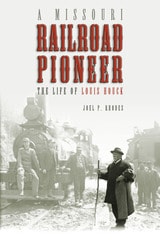
A Missouri Railroad Pioneer
The Life of Louis HouckJoel P. Rhodes
University of Missouri Press, 2013
Lawyer and journalist, entrepreneur and philanthropist, Louis Houck is often called the “Father of Southeast Missouri” because he brought the railroad to the region and opened this backwater area to industrialization and modernization. Although Houck’s name is little known today outside Missouri, Joel Rhodes shows how his story has relevance for both the state and the nation.
Rhodes presents a more complete picture of Houck than has ever been available: reviewing his life from his German immigrant roots, considering his career from both social and political perspectives, and grounding the story in both state and national history. He especially tells how, from 1880 to the 1920s, this self-taught railroader constructed a network of five hundred miles of track through the wilderness of wetlands known as “Swampeast Missouri”—and how these “Houck Roads” provided a boost for population, agriculture, lumbering, and commerce that transformed Cape Girardeau and the surrounding area.
Rhodes discusses how Houck fits into the era of economic individualism—a time when men with little formal training shaped modern industry—and also gives voice to Houck’s critics and shows that he was not always an easy man to work with. In telling the story of his railroading enterprise, Rhodes chronicles Houck’s battle with the Jay Gould railroad empire and offers key insight into the development of America’s railway system, from the cutthroat practices of ruthless entrepreneurs to the often-comic ineptness of start-up rail lines.
More than simply a biography of a business entrepreneur, the book tells how Houck not only developed the region economically but also followed the lead of Andrew Carnegie by making art, culture, and formal education available to all social classes. Houck also served for thirty-six years as president of the Board of Regents of Southeast Missouri State Teacher’s College, and as a self-taught historian he wrote the first comprehensive accounts of Missouri’s territorial period.
A Missouri Railroad Pioneer chronicles a multifaceted career that transformed a region. Solidly researched, this lively narrative also offers an entertaining read for anyone interested in Missouri history.
A Passion for Freedom
The Life of Sharlot HallMargaret F. Maxwell
University of Arizona Press, 1982
Alice Morse Earle and the Domestic History of Early America
Susan Reynolds Williams
University of Massachusetts Press, 2013
Author, collector, and historian Alice Morse Earle (1851–1911) was among the most important and prolific writers of her day. Between 1890 and 1904, she produced seventeen books as well as numerous articles, pamphlets, and speeches about the life, manners, customs, and material culture of colonial New England. Earle's work coincided with a surge of interest in early American history, genealogy, and antique collecting, and more than a century after the publication of her first book, her contributions still resonate with readers interested in the nation's colonial past.
An intensely private woman, Earle lived in Brooklyn, New York, with her husband and four children and conducted much of her research either by mail or at the newly established Long Island Historical Society. She began writing on the eve of her fortieth birthday, and the impressive body of scholarship she generated over the next fifteen years stimulated new interest in early American social customs, domestic routines, foodways, clothing, and childrearing patterns.
Written in a style calculated to appeal to a wide readership, Earle's richly illustrated books recorded the intimate details of what she described as colonial “home life.” These works reflected her belief that women had played a key historical role, helping to nurture communities by constructing households that both served and shaped their families. It was a vision that spoke eloquently to her contemporaries, who were busily creating exhibitions of early American life in museums, staging historical pageants and other forms of patriotic celebration, and furnishing their own domestic interiors.
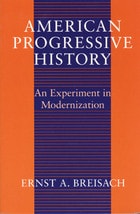
American Progressive History
An Experiment in ModernizationErnst Breisach
University of Chicago Press, 1993
Focusing his account on the work of the movement's most important representatives—including Charles Beard, James Harvey Robinson, and Carl Becker—Ernst Breisach demonstrates that Progressive history is distinguished by its unique combination of beliefs in the objective reality of historical facts and its faith in the inevitability of the progress of the human race. And though he discusses at length Frederick Jackson Turner's contributions to the creation of a modern American historiography, Breisach sets him apart from the scholars who shaped Progressive history.
While Progressive history is usually treated in isolation from simultanieous movements in European historiography, Breisach shows how it was formulated in the face of the same cultural pressures confronting European historians. Indeed, it becomes clear that until the 1930s the Progressive historians' confidence in the validity of historical investigation and the progress of civilization shielded American historians from the skepticism and cultural pessimism which characterized many of their European contempories.
Breisach's exceptionally broad and subtle analysis reveals American Progressive history to be an important and innovative experiment in the international quest for a New History, as well as a coherent school of thought in its own right.