Results by title
1441 books match the query 'World' and 67 start with r
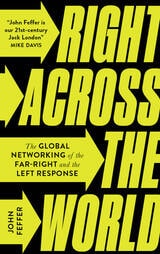
Right Across the World
The Global Networking of the Far-Right and the Left ResponseJohn Feffer
Pluto Press, 2021
'John Feffer is our 21st-century Jack London' - Mike Davis
In a post-Trump world, the right is still very much in power. Significantly more than half the world’s population currently lives under some form of right-wing populist or authoritarian rule. Today’s autocrats are, at first glance, a diverse band of brothers. But religious, economic, social and environmental differences aside, there is one thing that unites them - their hatred of the liberal, globalized world. This unity is their strength, and through control of government, civil society and the digital world they are working together across borders to stamp out the left.
In comparison, the liberal left commands only a few disconnected islands - Iceland, Mexico, New Zealand, South Korea, Spain and Uruguay. So far they have been on the defensive, campaigning on local issues in their own countries. This narrow focus underestimates the resilience and global connectivity of the right. In this book, John Feffer speaks to the world’s leading activists to show how international leftist campaigns must come together if they are to combat the rising tide of the right.
A global Green New Deal, progressive trans-European movements, grassroots campaigning on international issues with new and improved language and storytelling are all needed if we are to pull the planet back from the edge of catastrophe. This book is both a warning and an inspiration to activists terrified by the strengthening wall of far-right power.

Ripple Effects
The Work That Music Festivals Do in the WorldEdited by Eric Fillion and Ajay Heble
Temple University Press, 2027
What is the work that music festivals do in the world? In asking this question, Ripple Effects explores the varied ways in which festivals can act as spaces where new social relations are cultivated, as places for envisioning and enacting repertories of embodied memory and care, as alternatives to fragmented private consumption of culture, as sites for unexpected conversations.
While some case studies discuss structures of dominance inside mammoth corporate-sponsored festivals, other chapters find insubordinate spaces in festivals designed to honor traditional folk musics, to protest the proliferation of nuclear weapons, to deploy cultural exchanges in defiance of Cold War politics, to build pan-African unity, and to embrace the links between humans and the more-than-human world.
Ripple Effects brings together leading and emerging scholars, artists, and arts presenters to consider the challenges, rewards, and responsibilities associated with the improvisational culture and ethos of music festivals as alternative public spheres.
Contributors: Amina Boubia, Jody H. Cripps, Chris Dodd, Ben Finley, Simon Frith, Maria Giaever Lopez, Chris Greencorn, Jo Haynes, Michael J. Kramer, David A. McDonald, Patricia Nicholson, Melissa Noventa, William Parker, Jeremy Reed, Andrew Snyder, Cheryl Thompson, Steve Waksman, Katharine White, Deborah Wong, and the editors.
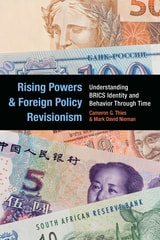
Rising Powers and Foreign Policy Revisionism
Understanding BRICS Identity and Behavior Through TimeCameron G. Thies and Mark David Nieman
University of Michigan Press, 2017
State identity is investigated qualitatively through the use of role theory and the identification of national role conceptions. Both economic and militarized conflict behavior are examined using Bayesian change-point modeling, which identifies structural breaks in time series data, revealing potential wholesale revision of foreign policy. Using this innovative approach to show that the behavior of rising powers is governed not simply by the structural dynamics of power but also by the roles that these rising powers define for themselves, they assert that this process will likely lead to a much more evolutionary approach to foreign policy and will not necessarily generate international conflict.
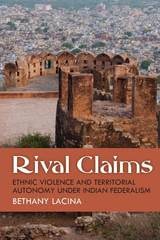
Rival Claims
Ethnic Violence and Territorial Autonomy under Indian FederalismBethany Lacina
University of Michigan Press, 2017
Using new data on ethnicity and sub-national discrimination in India, national and state archives, parliamentary records, cross-national analysis and her original fieldwork, Lacina explains ethnoterritorial politics as a three-sided interaction of the center and rival interests in the periphery. Ethnic entrepreneurs use militancy to create national political pressure in favor of their goals when the prime minister lacks clear electoral reasons to court one regional group over another. Second, ethnic groups rarely win autonomy or mobilize for violence in regions home to electorally influential anti-autonomy interests. Third, when a regional ethnic majority is politically important to the prime minister, its leaders can deter autonomy demands within their borders, while actively discriminating against minorities.
Rival Claims challenges the conventional beliefs that territorial autonomy demands are a reaction to centralized power and that governments resist autonomy to preserve central prerogatives. The center has allegiances in regional politics, and ethnoterritorial violence reflects the center’s entanglement with rival interests in the periphery.

Rogues, Widows and Orphans
Mischief and Misadventures in the World of BooksRebecca Lee
Brandeis University Press, 2026
A publishing industry insider reveals the hilarious and fascinating mishaps, hoaxes, and gaffes behind your favorite books.
It’s a long journey from a writer’s mind to a finished book, and a lot needs to go right along the way. But isn’t it more interesting when things go wrong?
Rebecca Lee, a senior editorial manager at Penguin Random House, guides readers through the secrets of the book industry, a world fizzing with scandals, rivalries, catastrophes, and con jobs. Lee demonstrates how the tiniest of typos can have oversized consequences, unearths horrifying examples of bad taste and worse style, and peeks into tales of forgeries and feuds as dramatic as any thriller. She unredacts the most egregious cases of censorship, exposes hoarders and thieves, and asks whether AI is really an existential threat to the literary universe—or if we are our own worst enemies.
An irresistible tour of mistakes and misbehavior, Rogues, Widows and Orphans will make you cringe, crack you up, and renew your appreciation for the hard work of making books—and all the ways it can go sidewise.
Rolling Transition and the Role of Intellectuals
The Case of HungaryAndrás Bozóki
Central European University Press, 2022
Utilizing a new and original framework for examining the role of intellectuals in countries transitioning to democracy, Bozóki analyses the rise and fall of dissident intellectuals in Hungary in the late 20th century. He shows how that framework is applicable to other countries too as he forensically examines their activities.
Bozóki argues that the Hungarian intellectuals did not become a ‘New Class’. By rolling transition, he means an incremental, non-violent, elite driven political transformation which is based on the rotation of agency, and it results in a new regime. This is led mainly by different groups of intellectuals who do not construct a vanguard movement but create an open network which might transform itself into different political parties. Their roles changed from dissidents to reformers, to movement organizers and negotiators through the periods of dissidence, open network building, roundtable negotiations, parliamentary activities, and new movement politics.
Through the prism of political sociology, the author focuses on the following questions: Who were the dissident intellectuals and what did they want? Under what conditions do intellectuals rebel and what are the patterns of their protest? This book will be of interest to students, researchers, and public intellectuals around the world aiming to promote human rights and democracy.

Romanticism Against the Tide of Modernity
Michael Löwy and Robert Sayre
Duke University Press, 2001
After critiquing previous conceptions of romanticism and discussing its first European manifestations, Löwy and Sayre propose a typology of the sociopolitical positions held by romantic writers-from “restitutionist” to various revolutionary/utopian forms. In subsequent chapters, they give extended treatment to writers as diverse as Coleridge and Ruskin, Charles Peguy, Ernst Bloch and Christa Wolf. Among other topics, they discuss the complex relationship between Marxism and romanticism before closing with a reflection on more contemporary manifestations of romanticism (for example, surrealism, the events of May 1968, and the ecological movement) as well as its future.
Students and scholars of literature, humanities, social sciences, and cultural studies will be interested in this elegant and thoroughly original book.
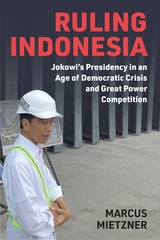
Ruling Indonesia
Jokowi's Presidency in an Age of Democratic Crisis and Great Power CompetitionMarcus Mietzner
University of Michigan Press, 2026
Joko Widodo—popularly called Jokowi—ruled Indonesia for a decade, from 2014 to 2024. The world’s fourth-largest nation and third-largest democracy, Indonesia had embarked on a messy democratic transition in the late 1990s, with the country’s ethnic and religious heterogeneity posing significant challenges to governance. Initially seen as a reformer who might challenge oligarchic structures, Jokowi was slowly but steadily seen as himself being a threat to democracy. By the time Jokowi wrapped up his presidency, he had achieved the highest approval ratings among Indonesia’s post-authoritarian presidents—and became the president with the tightest grip over Indonesia’s political elite.
Based on exclusive interviews with Jokowi and many of Indonesia’s top leaders, Ruling Indonesia shows Jokowi as a president obsessively preoccupied with his economic development agenda, subordinating all other aspects of governance to this goal. His focused approach delivered economic successes and unprecedented popularity, but also seriously undermined the health of Indonesia’s democratic institutions. Offering a holistic appraisal of his decade in office, Marcus Mietzner analyzes Jokowi’s domestic record in the context of his attempts to position Indonesia more favorably in the international competition for power and resources. Crucially, his obsession to push Indonesia closer to industrialized status while neglecting democratic development represented the ambitions and trials of many Global South leaders who are trying to juggle economic development, growing Sino-American tensions around the world, and concerns for democratic rights. As such, this book provides valuable insights into how the great power rivalry of the 21st century and the global recession of democracy are playing out in central arenas of the Global South.
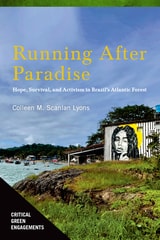
Running After Paradise
Hope, Survival, and Activism in Brazil's Atlantic ForestColleen M. Scanlan Lyons
University of Arizona Press, 2022
The pressures on this tropical forest are palpable. So are people’s responses to these pressures. What was once the state’s economic mainstay, cacao production, is only now beginning to make a comeback after a disease decimated the crops of large and small farmers alike. Tourism, another economic hope, is susceptible to economic crises and pandemics. And the threat of a massive state-led infrastructure project involving mining, a railroad, and an international port has loomed over the region for well over a decade.
Southern Bahia is at a crossroads: develop a sustainable, forest-based economy or run the risk of losing the identity and soul of this place forevermore. Through the lives of environmentalists, farmers, quilombolas, and nativos—people who are in and of this place—this book brings alive the people who are grappling with this dilemma.
Anthropologist Colleen M. Scanlan Lyons brings the eye of a storyteller to present this complex struggle, weaving in her own challenges of balancing family and fieldwork alongside the stories of the people who live in this dynamic region. Intertwined tales, friendships, and hope emerge as people both struggle to sustain their lives in a biodiversity hotspot and strive to create their paradise.
Rural Politics in Nasser's Egypt
A Quest for LegitimacyBy James B. Mayfield
University of Texas Press, 1971

Russia Under Yeltsin and Putin
Neo-Liberal AutocracyBoris Kagarlitsky
Pluto Press, 2002
Kagarlitsky shows how to understand these changes, and how to characterise the complex process of reform, revolution and counter revolution.
Looking in detail at the nature of Russian society and politics since 1990, Kagarlitsky offers an introductory political analysis of the major political and economic developments that have taken place under President Yeltsin, and the legacy he bequeathed so unexpectedly to his successor Putin. He focuses on the role of the media in post-Soviet Russia, corporate structures and their influence on social conflict, the formation of the oligarchy and the role of the left in modern Russia.
Russia and the Media
The Makings of a New Cold WarGreg McLaughlin
Pluto Press, 2020
But recent propaganda images that define public debate around growing tensions with Russia are not new or arbitrary. Russia and the Media asks, what is the role of Western journalism in constructing a new kind of Cold War with Russia? Focusing on British and US media coverage of moments of crisis and of co-operation between the West and Russia, McLaughlin exposes how such a Cold War framework shapes public perceptions of a major, hostile power reasserting itself on the world stage.
Scrutinizing events such as the Ukraine/Crimea crisis, the Skripal Poisoning and Russia's military intervention in Syria - as well as analyzing media coverage of the 2018 Russian presidential election and build up to the 2018 World Cup - Russia and the Media makes a landmark intervention at the intersection of media studies and international relations.

Russia's American Colony
S. Frederick Starr, ed.
Duke University Press, 1986
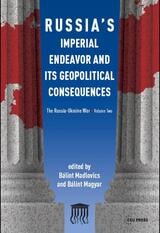
Russia's Imperial Endeavor and Its Geopolitical Consequences
The Russia-Ukraine War, Volume TwoBálint Madlovics
Central European University Press, 2024
Aside from the near-complete devastation of a sovereign state and reversal of the global balance of power, the Russian invasion of Ukraine in 2022 is leading to a radical transformation in the Eastern European and Eurasian regions – including Russia itself.
The 13 chapters in this volume examine the main geopolitical consequences of the resurgent imperialist aspirations of the Russian Federation. They examine the ideological tools of history falsification as an integral part of hybrid warfare. Turning to the economy, the book discusses how the war and economic sanctions imposed on Russia are redrawing the geopolitical map and how economic relations would change following a regime transformation. The book discusses the reactions of members of the international community to the invasion, whether threatened or neutral parties or allies. The collection therefore offers a comprehensive picture of the main consequences of the resurgent imperialist aspirations of the Russian Federation. Equipped with the conceptual tools of the analysis with a focus on the patronal features of the political-economic system, the book considers the aftermath of the war. This collection complements the book entitled Ukraine. Patronal Democracy and the Russian Invasion.
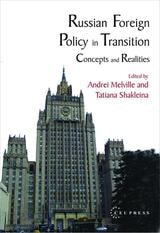
Russian Foreign Policy in Transition
Concepts and RealitiesAndrew Melville
Central European University Press, 2005
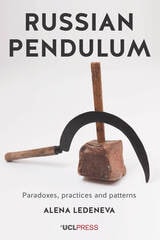
Russian Pendulum
Paradoxes, Practices and PatternsAlena Ledeneva
University College London, 2026
An unorthodox portrait of modern-day Russia, including its paradoxes, practices, and patterns.
Russian Pendulum takes readers on a compelling journey through Russia in which tradition, modernity, power, and informality collide. Linking local knowledge and insider expertise with global trends and international perspectives, the book reveals the patterns that have defined Russia’s destiny for centuries. At its core lies an intricate system of informal networks that are held together by cooptation, control, and camouflage practices.
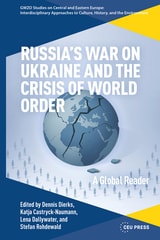
Russia’s War on Ukraine and the Crisis of World Order
A Global ReaderDennis Dierks
Central European University Press, 2026