Results by title
3703 books match the query '19th Century' and 171 start with r
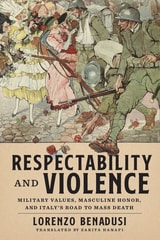
Respectability and Violence
Military Values, Masculine Honor, and Italy’s Road to Mass DeathLorenzo Benadusi
University of Wisconsin Press, 2021
In the aftermath of national unification in the 1860s, the Italian army was tasked with molding generations of men from warring regions and different social strata into obedient citizens of a centralized state. Integrating large numbers of the educated middle classes into the young kingdom’s armed forces proved decisive in establishing the army as the “main school” and backbone for mass nationalization. Lorenzo Benadusi examines the intersection of Italian military and civil society over the last century as they coalesced in the figure of the gentleman-officer—an idealized image of an altruistic, charming, and competent ruling class that could influence the choices, values, and behavior of the “new Italians.”
Respectability and Violence traces the relationship between civic virtues and military values from the post-Risorgimento period through the end of World War I, when the trauma of trench warfare made it necessary to again redefine ideas of chivalry and manliness and to accept violence as a necessary tool in defense of society and state. The language of conflict and attitudes about war forged in these decades—characterized by patriotism, heroism, and sacrifice—shaped the cultured bourgeoise into loyalists who ushered in Italy’s transition to a powerful Fascist political system. This unique study of the officer is crucial for understanding the military, social, and political history of Italy.
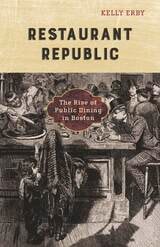
Restaurant Republic
The Rise of Public Dining in BostonKelly Erby
University of Minnesota Press, 2016
Before the 1820s, the vast majority of Americans ate only at home. As the nation began to urbanize and industrialize, home and work became increasingly divided, resulting in new forms of commercial dining.
In this fascinating book, Kelly Erby explores the evolution of such eating alternatives in Boston during the nineteenth century. Why Boston? Its more modest assortment of restaurants, its less impressive—but still significant—expansion in commerce and population, and its growing diversity made it more typical of the nation’s other urban centers than New York. Restaurants, clearly segmented along class, gender, race, ethnic, and other lines, helped Bostonians become more comfortable with deepening social stratification in their city and young republic even as the experience of eating out contributed to an emerging public consumer culture.
Restaurant Republic sheds light on how commercial dining both reflected and helped shape growing fragmentation along lines of race, class, and gender—from the elite Tremont House, which served fashionable French cuisine, to such plebeian and ethnic venues as oyster saloons and Chinese chop suey houses. The epilogue takes us to the opening, in 1929 near Boston, of the nation’s first Howard Johnson’s and that restaurant’s establishment as a franchise in the next decade. The result is a compelling story that continues to shape America.

Retelling / Rereading
The Fate of Storytelling in Modern TimesKroeber, Karl
Rutgers University Press, 1992
In this highly readable and thoroughly original book, Karl Kroeber questions the assumptions about storytelling we have inherited from the exponents of modernism and postmodernism. These assumptions have led to overly formalistic and universalizing conceptions of narrative that mystify the social functions of storytelling. Even "politically correct" critics have Eurocentrically defined story as too "primitive" to be taken seriously as art. Kroeber reminds us that the fundamental value of storytelling lies in retelling, this paradoxical remaking anew that constitutes story's role as one of the essential modes of discourse. His work develops some recent anthropological and feminist criticism to delineate the participative function of audience in narrative performances.
In depicting how audiences contribute to storytelling transactions, Kroeber carries us into a surprising array of examples, ranging from a Mesopotamian sculpture to Derek Walcott's Omeros; startling juxtapositions, such as Cervantes to Vermeer; and innovative readings of familiar novels and paintings. Tom Wolfe's comparison of his Bonfire of the Vanities to Vanity Fair is critically analyzed, as are the differences between Thackeray's novel and Joyce's Ulysses and Flaubert's Madame Bovary. Other discussions focus on traditional Native American stories, Henry James's The Ambassadors, Calvino's If on a winter's night a traveler, and narrative paintings of Giotto, Holman Hunt, and Roy Lichtenstein. Kroeber deploys the ideas of Ricoeur and Bakhtin to reassess dramatically the field of narrative theory, demonstrating why contemporary narratologists overrate plot and undervalue story's capacity to give meaning to the contingencies of real experience. Retelling/Rereading provides solid theoretical grounding for a new understanding of storytelling's strange role in twentieth-century art and of our need to develop a truly multicultural narrative criticism.
Return to the City of Joseph
Modern Mormonism's Contest for the Soul of NauvooScott C. Esplin
University of Illinois Press, 2018
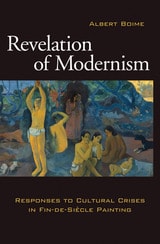
Revelation of Modernism
Response to Cultural Crises in Fin-de-Siécle PaintingAlbert Boime
University of Missouri Press, 2008
Among postimpressionist painters, Van Gogh, Seurat, Cézanne, and Gauguin produced a remarkable body of work that responded to a cultural and spiritual crisis in the avant-garde world—influences that pushed them toward an increasing reliance on science, literature, and occultism. In Revelation of Modernism, renowned art historian Albert Boime reappraises specific works by these masters from a perspective more appreciative of the individuals’ inner conflicts, offering the art world a new understanding of a period fraught with apocalyptic fears and existential anxieties.
Building on the seminal observations of Sven Lövgren from a half-century ago, Boime rejects popular notions of “art for art’s sake” and rethinks an entire movement to suggest that history, rather than expressive urge, is the driving force that shapes art. He reconsiders familiar masterpieces from a fresh perspective, situating the art in the contexts of history both real and speculative, of contemporary philosophy, and of science to depict modernism as a development that ultimately failed.
Boime expands on what we think we know about these figures and produces startling new revelations about their work. From the political history of Seurat’s Parade de cirque to the astronomical foundations of Van Gogh’s Starry Night, he draws analogies between literary sources and social, personal, and political strategies that have eluded most art historians. He offers a richer and more complex vision of Cézanne, considering the artist as an Old Testament figure in search of the Promised Landscape. And he provides a particularly detailed look at Gauguin—on whom Boime has never previously published—that takes a closer look at the artist’s The Vision after the Sermon and its allusions to Eliphas Lévi’s writings, sheds light on the sources for From whence do we come? and offers new thoughts about Gauguin’s various self-portraits.
Boime’s latest contribution further testifies to his status as one of our most important living art historians. As entertaining as it is eloquent, Revelation of Modernism is a bold and groundbreaking work that should be required reading for all who wish to understand the contradictory origins and development of modernism and its role in history.
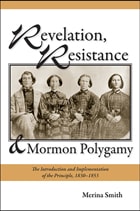
Revelation, Resistance, and Mormon Polygamy
The Introduction and Implementation of the Principle, 1830–1853Merina Smith
Utah State University Press, 2013
When Joseph Smith began to reveal and teach the doctrine of plural marriage in 1841, even stalwart members like Brigham Young were shocked and confused. In this thoughtful study, Smith argues that the secret introduction of plural marriage among the leadership coincided with an evolving public theology that provided a contextualizing religious narrative that persuaded believers to accept the principle.
This fresh interpretation draws from diaries, letters, newspapers, and other primary sources and is especially effective in its use of family narratives. It will be of great interest not only to scholars and the general public interested in Mormon history but in American history, religion, gender and sexuality, and the history of marriage and families.
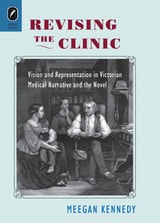
Revising the Clinic
Vision and Representation in Victorian Medical Narrative and the NovelMeegan Kennedy
The Ohio State University Press, 2010
Critics have examined how novelists borrow from other genres—newspapers, legal cases, autobiographies. Medical writing likewise enriches the novel’s uniquely flexible and wide-ranging presentation of Victorian culture. In turn, the novel shapes medical narrative even as clinical science idealizes methodological rigor. Revising the Clinic shows how the wealth of scientific material in mainstream Victorian periodicals creates a productive literary “commons” where novelists and physicians can encounter each others’ strategies for seeing and stating. Novelists adapt physicians’ techniques to nonmedical scenes, and physicians echo the sentimental or sensational novel to gain sympathy or rhetorical force when medical knowledge falters.
Kennedy traces the development of the Victorian novel and the case history from eighteenth-century curious observation and curious sights through nineteenth-century clinical observation, mechanical observation, and speculation, to Freud’s labyrinthine mapping and speculative insight. These make new sense, read within the literary tradition of the case history. The lens of Kennedy’s argument clarifies and illuminates the preoccupation with genre and visuality that is common to Victorian medicine and the novel.
Revisionary Interventions into the Americanist Canon
Donald E. Pease
Duke University Press, 1994
Originally published as a special issue of boundary 2, the essays gathered here discuss writers as diverse as Kate Chopin, Frederick Douglass, Emerson, Melville, W. D. Howells, Henry James, W. E. B. DuBois, and Mark Twain, plus the historical figure John Brown. Two major sections devoted to the theory of romance and to cultural-historical analyses emphasize the political perspective of "New Americanist" literary and cultural study.
Contributors. William E. Cain, Wai-chee Dimock, Howard Horwitz, Gregory S. Jay, Steven Mailloux, John McWilliams, Susan Mizruchi, Donald E. Pease, Ivy Schweitzer, Priscilla Wald, Michael Warner, Robert Weimann
Revival and Awakening
American Evangelical Missionaries in Iran and the Origins of Assyrian NationalismAdam H. Becker
University of Chicago Press, 2015
American evangelicals arrived in Iran in the 1830s. Becker examines how these missionaries, working with the “Nestorian” Church of the East—an Aramaic-speaking Christian community in the borderlands between Qajar Iran and the Ottoman Empire—catalyzed, over the span of sixty years, a new national identity. Instructed at missionary schools in both Protestant piety and Western science, this indigenous group eventually used its newfound scriptural and archaeological knowledge to link itself to the history of the ancient Assyrians, which in time led to demands for national autonomy. Exploring the unintended results of this American attempt to reform the Orient, Becker paints a larger picture of religion, nationalism, and ethnic identity in the modern era.
Revivalism and Cultural Change
Christianity, Nation Building, and the Market in the Nineteenth-Century United StatesGeorge M. Thomas
University of Chicago Press, 1989
"Subtle and complex. . . . Fascinating."—Randolph Roth, Pennsylvania History
"[Revivalism and Cultural Change] should be read with interest by those interested in religious movements as well as the connections among religion, economics, and politics."—Charles L. Harper, Contemporary Sociology
"Readers old and new stand to gain much from Thomas's sophisticated study of the macrosociology of religion in the United States during the nineteenth century. . . . He has given the sociology of religion its best quantitative study of revivalism since the close of the 1970s."—Journal for the Scientific Study of Religion
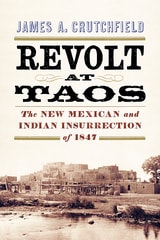
Revolt at Taos
The New Mexican and Indian Insurrection of 1847James A. Crutchfield
Westholme Publishing, 2025
On the morning of January 19, 1847, Charles Bent, the newly appointed governor of the American-claimed territory of New Mexico, was savagely killed at his home in Don Fernando de Taos, a small, remote town located north of Santa Fe. Those responsible for Bent’s murder were New Mexican settlers and Indians from nearby Taos Pueblo who refused to recognize the United States occupation. With emotions rubbed raw, the natives continued their bloodbath until five more leading citizens were massacred in Taos. During the ensuing months, American civilians and soldiers, along with scores of New Mexicans and Taos Indians, were killed and wounded throughout the region. Less than a month following Bent’s murder, in a two-day battle, volunteer and regular elements of an American army under the command of Colonel Sterling Price emerged victorious after bombarding the insurrectionists at their refuge in the church at Taos Pueblo. Surviving participants in the earlier Taos murders were arrested, tried in American-dominated courts, and, within weeks, hanged for their actions. The murder of Bent and the others at Taos and the subsequent trials and executions brought with them misunderstanding, controversy, mistrust, and recrimination on both sides of the issue. The events also subjected President James K. Polk’s administration to censure over what some critics believed was an overextension of presidential authority in claiming New Mexico as a territory.
In Revolt at Taos: The New Mexican and Indian Insurrection of 1847, writer and historian James A. Crutchfield explores the fast-moving events surrounding the bloody revolt which left native inhabitants of New Mexico wondering how their neighbors and kinsmen could be legally tried, found guilty, and executed for acts they considered to have been honorable ones committed in defense of their country. These concerns have never been adequately addressed and their struggle has been all but scrubbed from the history of American expansion.
Revolution
Modern Uprisings in Ancient TimeMiriam Leonard
University of Chicago Press, 2025
Despite its Latin etymology, “revolution” in its modern understanding arguably did not exist in antiquity, and revolution as we know it today is considered by many theorists to be a term born in modernity. While they certainly had times of momentous political upheaval, the Greeks and Romans tended to understand such events as part of a narrative of political continuity rather than novelty or rupture. Nevertheless, modern revolutions have repeatedly appropriated tropes of classical discourse, such as freedom, tyranny, tragedy, and fraternity.
With this book, Miriam Leonard offers a conceptual history of revolution, unraveling modernity’s yearning for the new and questioning why ancient concepts continue to play such an important role in political uprisings. Leonard looks at examples of appeals to antiquity during the French and Haitian Revolutions, in anticolonial struggles, and feminist and queer movements and considers works of theorists such as Karl Marx, Hannah Arendt, and Sigmund Freud that foreground an engagement with antiquity.
Revolutions at Home
The Origin of Modern Childhood and the German Middle ClassEmily C. Bruce
University of Massachusetts Press, 2021
Revolutions at Home analyzes a rich set of documents created for and by young Germans to show that children were central to reinventing their own education between 1770 and 1850. Through their reading and writing, they helped construct the modern child subject. The active child who emerged at this time was not simply a consequence of expanding literacy but, in fact, a key participant in defining modern life.
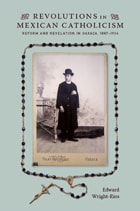
Revolutions in Mexican Catholicism
Reform and Revelation in Oaxaca, 1887–1934Edward Wright-Rios
Duke University Press, 2009
Wright-Rios demonstrates that pastors, peasants, and laywomen sought to enliven and shape popular religion in Oaxaca. The clergy tried to adapt the Vatican’s blueprint for Catholic revival to Oaxaca through institutional reforms and attempts to alter the nature and feel of lay religious practice in what amounted to a religious modernization program. Yet some devout women had their own plans. They proclaimed their personal experiences of miraculous revelation, pressured priests to recognize those experiences, marshaled their supporters, and even created new local institutions to advance their causes and sustain the new practices they created. By describing female-led visionary movements and the ideas, traditions, and startling innovations that emerged from Oaxaca’s indigenous laity, Wright-Rios adds a rarely documented perspective to Mexican cultural history. He reveals a remarkable dynamic of interaction and negotiation in which priests and parishioners as well as prelates and local seers sometimes clashed and sometimes cooperated but remained engaged with one another in the process of making their faith meaningful in tumultuous times.
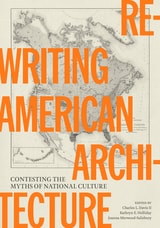
Rewriting American Architecture
Contesting the Myths of National CultureEdited by Charles L. Davis II, Kathryn E. Holliday, and Joanna Merwood-Salisbury
University of Texas Press, 2026
A critical reassessment of nineteenth‑century American architecture that uncovers how race, settler colonialism, and contested national identities shaped the built environment and its historiography.
Rewriting American Architecture offers a revisionist riposte to the canonical story of nineteenth-century American architecture. Drawing on new archival research and revisionist historiography, the essays in this volume reveal how American architecture was shaped not by inevitable progress toward a unified national culture but by the turbulent realities of race, labor, settler colonialism, and territorial expansion. Rather than treating architecture as an apolitical aesthetic expression, the contributors expose it as an active arena in which the meanings of nationhood were constructed, contested, and often violently enforced. From Indigenous spatial practices and Black institutional building to transnational exchanges and the racial politics embedded in professionalization, this collection reframes the built environment as central to the competing cultural, political, and geographic claims that defined the United States during this period.
Rewriting Crusoe
The Robinsonade across Languages, Cultures, and MediaJakub Lipski
Bucknell University Press, 2020
Published by Bucknell University Press. Distributed worldwide by Rutgers University Press.
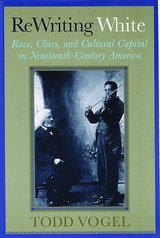
Rewriting White
Race, Class, and Cultural Capital in Nineteenth-Century AmericaTodd Vogel
Rutgers University Press, 2004
What did it mean for people of color in nineteenth-century America to speak or write "white"? More specifically, how many and what kinds of meaning could such "white" writing carry? In ReWriting White, Todd Vogel looks at how America has racialized language and aesthetic achievement. To make his point, he showcases the surprisingly complex interactions between four nineteenth-century writers of color and the "standard white English" they adapted for their own moral, political, and social ends. The African American, Native American, and Chinese American writers Vogel discusses delivered their messages in a manner that simultaneously demonstrated their command of the dominant discourse of their times-using styles and addressing forums considered above their station-and fashioned a subversive meaning in the very act of that demonstration.
The close readings and meticulous archival research in ReWriting White upend our conventional expectations, enrich our understanding of the dynamics of hegemony and cultural struggle, and contribute to the efforts of other cutting-edge contemporary scholars to chip away at the walls of racial segregation that have for too long defined and defaced the landscape of American literary and cultural studies.
Rhetoric and Resistance
The Literary Arts of Dissent in Nineteenth-Century BritainMaeve Adams
Ohio University Press, 2025
A fresh perspective on the enduring relationship between literature, democracy, and dissent
Rhetoric and Resistance explores the transformative role of nineteenth-century literature in shaping modern concepts and practices of democratic dissent. By examining the works of Romantic and Victorian novelists, poets, and journalists, Maeve Adams identifies origins of modern theories and practices of resistance in nineteenth-century literary forms. Offering a literary history of dissent, the book recovers the intertwined development of democracy and aesthetics, revealing how narrative form became a potent tool for challenging authority.
Tracing the lineage of dissent from the radical fiction and journalism of the 1800s to contemporary movements like #MeToo, Adams offers a genealogy that highlights how literary texts experimented with political power, granting new and consequential voices to working-class individuals, women, colonized peoples, and other marginalized groups.
Adams takes an interdisciplinary approach, weaving together close readings of works by Thomas De Quincey, Walter Scott, Elizabeth Gaskell, and H. G. Wells, as well as lesser-known journalists, with insights from modern moral and political philosophy. Drawing on theories of democratic ethics and justice from scholars such as Miranda Fricker, Sharon Krause, Martha Nussbaum, and Philip Pettit, the book bridges literary history and contemporary debates about political agency and expression.
Rhetoric at the Margins
Revising the History of Writing Instruction in American Colleges, 1873-1947David Gold
Southern Illinois University Press, 2008
Rhetoric at the Margins: Revising the History of Writing Instruction in American Colleges, 1873-1947 examines the rhetorical education of African American, female, and working-class college students in the late nineteenth and early twentieth centuries. The rich case studies in this work encourage a reconceptualization of both the history of rhetoric and composition and the ways we make use of it.
Author David Gold uses archival materials to study three types of institutions historically underrepresented in disciplinary histories: a black liberal arts college in rural East Texas (Wiley College); a public women's college (Texas Woman's University); and an independent teacher training school (East Texas Normal College). The case studies complement and challenge previous disciplinary histories and suggest that the epistemological schema that have long applied to pedagogical practices may actually limit our understanding of those practices.
Gold argues that each of these schools championed intellectual and pedagogical traditions that differed from the Eastern liberal arts model—a model that often serves as the standard bearer for rhetorical education. He demonstrates that by emphasizing community uplift and civic participation and attending to local needs, these schools created contexts in which otherwise moribund curricular features of the era—such as strict classroom discipline and an emphasis on prescription—took on new possibilities.
Rhetoric at the Margins describes the recent revisionist turn in rhetoric and composition historiography, argues for the importance of diverse institutional microhistories, and argues that the nineteenth and early twentieth centuries offer rich lessons for contemporary classroom practice. The study brings alive the voices of black, female, rural, Southern, and first-generation college students and their instructors, effectively linking these histories to the history of rhetoric and writing. Appendices include excerpts of important and rarely seen primary source material, allowing readers to experience in fuller detail the voices captured in this work.
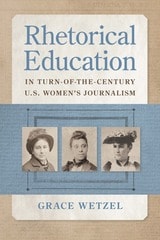
Rhetorical Education in Turn-of-the-Century U.S. Women's Journalism
Grace Wetzel, with a foreword by Shari J. Stenberg
Southern Illinois University Press, 2022
At the end of the nineteenth century, newspapers powerfully shaped the U.S. reading public, fostering widespread literacy development and facilitating rhetorical education. With new opportunities to engage audiences, female journalists repurposed the masculine tradition of journalistic writing by bringing together intimate forms of rhetoric and pedagogy to create innovative new dialogues. Rhetorical Education in Turn-of-the-Century U.S. Women’s Journalism illuminates the pedagogical contributions of three newspaperwomen to show how the field became a dynamic site of public participation, relationship building, education, and activism in the 1880s and 1890s.
Grace Wetzel introduces us to the work of Omaha correspondent Susette La Flesche Tibbles (Inshta Theamba), African American newspaper columnist Gertrude Bustill Mossell, and white middle-class reporter Winifred Black (“Annie Laurie”). Journalists by trade, these three writers made the mass-circulating newspaper their site of teaching and social action, inviting their audiences and communities—especially systematically marginalized voices—to speak, write, and teach alongside them.
Situating these journalists within their own specific writing contexts and personas, Wetzel reveals how Mossell promoted literacy learning and community investment among African American women through a reader-centered pedagogy; La Flesche modeled relational news research and reporting as a survivance practice while reporting for the Omaha Morning World-Herald at the time of the Wounded Knee Massacre; and Black inspired public writing and activism among children from different socioeconomic classes through her “Little Jim” story. The teachings of these figures serve as enduring examples of how we can engage in meaningful public literacy and ethical journalism.
Rhetorics of Literacy
The Cultivation of American Dialect PoetryNadia Nurhussein
The Ohio State University Press, 2013
Rice and Slaves
Ethnicity and the Slave Trade in Colonial South CarolinaDaniel C. Littlefield
University of Illinois Press, 1991
Riding Lucifer's Line
Ranger Deaths along the Texas-Mexico BorderBob Alexander
University of North Texas Press, 2013

Riding for the Lone Star
Frontier Cavalry and the Texas Way of War, 1822-1865Nathan A. Jennings
University of North Texas Press, 2016
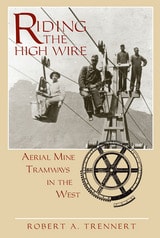
Riding the High Wire
Aerial Mine Tramways in the WestRobert A. Trennert
University Press of Colorado, 2001
Aerial mine tramways proved to have a special fascination; people often rode them for a thrill, sometimes with disastrous results. They were also very temperamental, needed constant attention, and were prone to accidents. The years between 1900 and 1920 saw the operation of some of the west's most spectacular tramways, but the decline in high-country mining beginning in the 1920s--coupled with the development of more efficient means of transportation--made this technology all but obsolete by the end of the Second World War.
Historians and the general reader will be equally enthralled by Trennert's fascinating story of the rise and fall of aerial mine tramways.
"Professor Trennert has explored a new area of mining history, and is to be commended for his pioneering work." --Liston Leyendecker, author of The Griffith Family and the Founding of Georgetown.
Right Here I See My Own Books
The Woman's Building Library at the World's Columbian ExpositionSarah Wadsworth
University of Massachusetts Press, 2012
By weaving together the behind-the-scenes story of the library's formation and the stories between the covers of books on display, Wadsworth and Wiegand firmly situate the Woman's Building Library within the historical context of the 1890s. Interdisciplinary in approach, their book demonstrates how this landmark collection helped consolidate and institutionalize women's writing in conjunction with the burgeoning women's movement and the professionalization of librarianship in late nineteenth-century America.
Americans in this period debated a wide range of topics, including women's rights, gender identity, racial politics, nationalism, regionalism, imperialism, and modernity. These debates permeated the cultural climate of the Columbian Exposition. Wadsworth and Wiegand's book illuminates the range and complexity of American women's responses to these issues within a public sphere to which the Woman's Building provided unprecedented access.

Right or Wrong, God Judge Me
THE WRITINGS OF JOHN WILKES BOOTHJohn W. Booth
University of Illinois Press, 1997
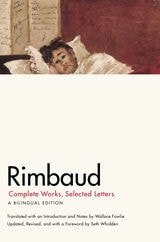
Rimbaud
Complete Works, Selected Letters, a Bilingual EditionJean Nicholas Arthur Rimbaud
University of Chicago Press, 2005
The first translation of the poet's complete works when it was published in 1966, Rimbaud: Complete Works, Selected Letters introduced a new generation of Americans to the alienated genius—among them the Doors's lead singer Jim Morrison, who wrote to translator Wallace Fowlie to thank him for rendering the poems accessible to those who "don't read French that easily." Forty years later, the book remains the only side-by-side bilingual edition of Rimbaud's complete poetic works.
Thoroughly revising Fowlie's edition, Seth Whidden has made changes on virtually every page, correcting errors, reordering poems, adding previously omitted versions of poems and some letters, and updating the text to reflect current scholarship; left in place are Fowlie's literal and respectful translations of Rimbaud's complex and nontraditional verse. Whidden also provides a foreword that considers the heritage of Fowlie's edition and adds a bibliography that acknowledges relevant books that have appeared since the original publication. On its fortieth anniversary, Rimbaud remains the most authoritative—and now, completely up-to-date—edition of the young master's entire poetic ouvre.
Rimsky-Korsakov's Harmonic Theory
Practical Manual of Harmony, Its Sources, History, and TraditionsLarisa P. Jackson
University of North Texas Press, 2022
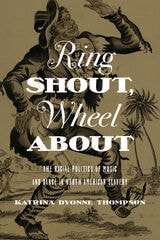
Ring Shout, Wheel About
The Racial Politics of Music and Dance in North American SlaveryKatrina D. Thompson
University of Illinois Press, 2014
In this ambitious project, historian Katrina Thompson examines the conceptualization and staging of race through the performance, sometimes coerced, of black dance from the slave ship to the minstrel stage. Drawing on a rich variety of sources, Thompson explicates how black musical performance was used by white Europeans and Americans to justify enslavement, perpetuate the existing racial hierarchy, and mask the brutality of the domestic slave trade. Whether on slave ships, at the auction block, or on plantations, whites often used coerced performances to oppress and demean the enslaved.
As Thompson shows, however, blacks' "backstage" use of musical performance often served quite a different purpose. Through creolization and other means, enslaved people preserved some native musical and dance traditions and invented or adopted new traditions that built community and even aided rebellion.
Thompson shows how these traditions evolved into nineteenth-century minstrelsy and, ultimately, raises the question of whether today's mass media performances and depictions of African Americans are so very far removed from their troublesome roots.

Ringlingville USA
The Stupendous Story of Seven Siblings and Their Stunning Circus SuccessJerry Apps
Wisconsin Historical Society Press, 2004
The Ringling Brothers began their business under the most modest of circumstances and through hard work, business savvy, and some luck created the largest, most famous circus in the world. They became wealthy men, one 50 cent admission ticket at a time.
Ringlingville USA chronicles the brothers' journey from immigrant poverty to enduring glory as the kings of the circus world. The Ringlings and their circus were last studied in depth over four decades ago. Now, for the first time, the brothers' detailed financial records and personal correspondence are available to researchers. Jerry Apps weaves together that information with newspaper accounts, oral histories, colorful anecdotes, and stunning circus ephemera and photos, many never before been published, to illuminate the importance of the Ringlings' accomplishments. He describes how the Ringling Brothers confronted the challenges of taxation, war, economic pressure, changing technology, and personal sorrows to find their place in history. The brothers emerge as complex characters whose ambition, imagination, and pure hucksterism fueled the phenomenon that was the Ringling Brothers' Circus.
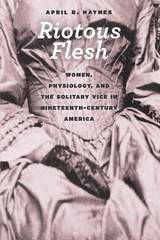
Riotous Flesh
Women, Physiology, and the Solitary Vice in Nineteenth-Century AmericaApril R. Haynes
University of Chicago Press, 2015
As April R. Haynes shows, the crusade against female masturbation was rooted in a generally shared agreement on some major points: that girls and women were as susceptible to masturbation as boys and men; that “self-abuse” was rooted in a lack of sexual information; and that sex education could empower women and girls to master their own bodies. Yet the groups who made this education their goal ranged widely, from “ultra” utopians and nascent feminists to black abolitionists. Riotous Flesh explains how and why diverse women came together to popularize, then institutionalize, the condemnation of masturbation, well before the advent of sexology or the professionalization of medicine.

Rise Of The Silver Queen
Liston E. Leyendecke
University Press of Colorado, 2005
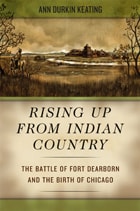
Rising Up from Indian Country
The Battle of Fort Dearborn and the Birth of ChicagoAnn Durkin Keating
University of Chicago Press, 2012
In August 1812, under threat from the Potawatomi, Captain Nathan Heald began the evacuation of ninety-four people from the isolated outpost of Fort Dearborn to Fort Wayne. The group included several dozen soldiers, as well as nine women and eighteen children. After traveling only a mile and a half, they were attacked by five hundred Potawatomi warriors. In under an hour, fifty-two members of Heald’s party were killed, and the rest were taken prisoner; the Potawatomi then burned Fort Dearborn before returning to their villages.

Ritual Medical Lore of Sephardic Women
Sweetening the Spirits, Healing the SickIsaac Jack Lévy and Rosemary Lévy Zumwalt
University of Illinois Press, 2002
Winner of the Ellii Kongas-Maranda Prize from the Women's Section of the American Folklore Society, 2003.
Ritual Medical Lore of Sephardic Women preserves the precious remnants of a rich culture on the verge of extinction while affirming women's pivotal role in the health of their communities. Centered around extensive interviews with elders of the Sephardic communities of the former Ottoman Empire, this volume illuminates a fascinating complex of preventive and curative rituals conducted by women at home--rituals that ensured the physical and spiritual well-being of the community and functioned as a vital counterpart to the public rites conducted by men in the synagogues.
Isaac Jack Lévy and Rosemary Lévy Zumwalt take us into the homes and families of Sephardim in Turkey, Israel, Greece, the former Yugoslavia, and the United States to unravel the ancient practices of domestic healing: the network of blessings and curses tailored to every occasion of daily life; the beliefs and customs surrounding mal ojo (evil eye), espanto (fright), and echizo (witchcraft); and cures involving everything from herbs, oil, and sugar to the powerful mumia (mummy) made from dried bones of corpses.
For the Sephardim, curing an illness required discovering its spiritual cause, which might be unintentional thought or speech, accident, or magical incantation. The healing rituals of domesticated medicine provided a way of making sense of illness and a way of shaping behavior to fit the narrow constraints of a tightly structured community. Tapping a rich and irreplaceable vein of oral testimony, Ritual Medical Lore of Sephardic Women offers fascinating insight into a culture where profound spirituality permeated every aspect of daily life.

Rivers in Russian Literature
Margaret Ziolkowski
University of Delaware Press, 2011
Published by University of Delaware Press. Distributed worldwide by Rutgers University Press.
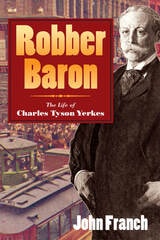
Robber Baron
The Life of Charles Tyson YerkesJohn Franch
University of Illinois Press, 2006
Robbers Roost Recollections
Pearl Baker
Utah State University Press, 1991
Roman Holidays
American Writers and Artists in Nineteenth-Century ItalyRobert K. Martin
University of Iowa Press, 2001
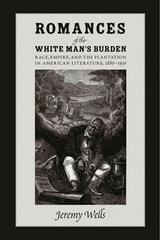
Romances of the White Man's Burden
Race, Empire, and the Plantation in American Literature, 1880-1936Jeremy Wells
Vanderbilt University Press, 2011
Romances of the White Man's Burden takes on works in American literature in which the proverbial "old plantation" is made to seem not a relic but a harbinger, a sign that the South had arrived at a multiracial modernity and harmony before the rest of the United States. Focusing on writers such as Joel Chandler Harris, Thomas Nelson Page, Henry W. Grady, Thomas Dixon, and William Faulkner, Jeremy Wells reveals their shared fixation on the figure of the white southern man as specially burdened by history. Each of these writers, in his own way, presented the plantation South as an emblem, not an aberration, of America.
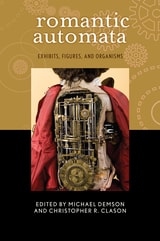
Romantic Automata
Exhibitions, Figures, OrganismsMichael Demson
Bucknell University Press, 2020
Recent scholarship in post-humanism, post-colonialism, disability studies, post-modern feminism, eco-criticism, and radical Orientalism has significantly affected the critical discourse on this topic. In engaging with the work and thought of Coleridge, Poe, Hoffmann, Mary Shelley, and other Romantic luminaries, the contributors to this collection open new methodological approaches to understanding human interaction with technology that strives to simulate, supplement, or supplant organic life.
Published by Bucknell University Press. Distributed worldwide by Rutgers University Press.
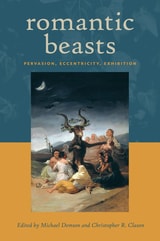
Romantic Beasts
Pervasion, Eccentricity, ExhibitionMichael Demson
Bucknell University Press, 2025
Published by Bucknell University Press. Distributed worldwide by Rutgers University Press.
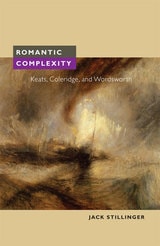
Romantic Complexity
Keats, Coleridge, and WordsworthJack Stillinger
University of Illinois Press, 2005
In Romantic Complexity, Jack Stillinger examines three of the most admired poets of English Romanticism--Keats, Coleridge, and Wordsworth--with a focus on the complexity that results from the multiple authorship, the multiple textual representation, and the multiple reading and interpretation of their best works.
Specific topics include the joint authorship of Wordsworth and Coleridge in the Lyrical Ballads, an experiment of 1798 that established the most essential characteristics of modern poetry; Coleridge's creation of eighteen or more different versions of The Ancient Mariner and how this textual multiplicity affects interpretation; the historical collaboration between Keats and his readers to produce fifty-nine separate but entirely legitimate readings of The Eve of St. Agnes; and a number of practical and theoretical matters bearing on the relationships among these writers and their influences on one another.
Stillinger shows his deep understanding of the poets' lives, works, and the history of their reception, in chapters rich with intriguing questions and answers sure to engage students and teachers of the world's greatest poetry.
Romantic Poetry
Recent Revisionary CriticismKroeber, Karl
Rutgers University Press, 1993
Romantic Women Writers
Voices and CountervoicesPaula R. Feldman and Theresa M. Kelley
Brandeis University Press, 1995
Romanticism and Anthony Trollope
A Study in the Continuities of Nineteenth-Century Literary ThoughtL. J. Swingle
University of Michigan Press, 1990
Romanticism and Transcendence
Wordsworth, Coleridge, and the Religious ImaginationJ. Robert Barth, S.J.
University of Missouri Press, 2003
Romanticism’s Other Minds
Poetry, Cognition, and the Science of SociabilityJohn Savarese
The Ohio State University Press, 2020
Rooms with a View
The Stages of Community in the Modern TheaterRichard L. Barr
University of Michigan Press, 1998
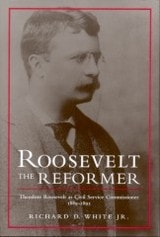
Roosevelt the Reformer
Theodore Roosevelt as Civil Service Commissioner, 1889-1895Richard D. White Jr
University of Alabama Press, 2003
Discover the overlooked years that forged Theodore Roosevelt’s reforming spirit, revealing how bureaucratic battles shaped a future president and transformed American government forever
Roosevelt the Reformer is a compelling scholarly biography that uncovers a neglected chapter of Theodore Roosevelt’s life: his six-year tenure as U.S. Civil Service Commissioner from 1889 to 1895. Rather than focusing on his presidency or battlefield exploits, the book reveals how Roosevelt’s administrative work shaped his reformist zeal, political skills, and enduring impact on American governance. Through vivid narrative and careful analysis, it shows how this “quiet” period contributed directly to the modernization of the federal government and the emergence of the merit-based civil service.
Structured chronologically, the book traces each year of Roosevelt’s commissionership while weaving together political events, personal life, and broader social context. It draws on rich primary sources—letters, speeches, and contemporary accounts—and includes scholarly features such as notes, bibliography, and index. Richard D. White Jr., a historian of American political development, combines narrative storytelling with rigorous research to illuminate Roosevelt’s battles with patronage politics, his reform strategies, and his growing administrative expertise.
This book will appeal to historians, political scientists, and general readers interested in the Gilded Age, the Progressive Era, and the origins of modern government. It is especially valuable for readers seeking fresh perspectives on Theodore Roosevelt, public administration, or reform movements, offering both an engaging biography and a nuanced study of how institutions and leaders are transformed.