Results by title
59 books match the query 'Diary' and 8 start with a
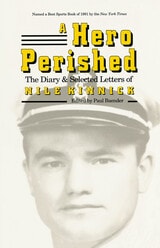
A Hero Perished
The Diary and Selected Letters of Nile KinnickPaul Baender
University of Iowa Press, 1992
A Hero Perished tells Nile Kinnick's story. This grandson of an Iowa governor, the son of parents who disciplined him to strive for his measure of greatness, became a Heisman Trophy winner and national celebrity through a combination of talent and circumstance. Following his college successes, Kinnick began legal study to prepare for a political career, but with the approach of war he entered the Navy Air Corps to refashion himself as a fighter pilot. Assigned to the carrier USS Lexington on its premier cruise, he took off in a defective plane—and his death shocked a nation grown almost used to tragic loss.
For the first time, Kinnick tells his own tale through his engaging letters—all but one previously unpublished—and his diary, printed in its entirety for the first time. The result is a human, intimate look at the true person behind the myth, revealing both his foibles and his essential principles. A Hero Perished also includes a definitive text of Kinnick's moving Heisman Award acceptance speech and his impassioned commencement supper address, calling on the new Iowa graduates to achieve moral courage in a time of depression and war.
An illuminating comment on a time and attitude that have passed, A Hero Perished is of and about a football player, but it is not a football book—it is far more. This volume displays Kinnick—who was, despite his great gifts and achievements, a vulnerable and decent young man—in a time of great change and peril when a phase of our culture was passing away.
A Month at the Front
The Diary of an Unknown SoldierEdited by the Bodleian Library
Bodleian Library Publishing, 2006
A Month at the Front chronicles one month in the life of a soldier from the 12th East Surrey regiment, and the economical yet powerful narrative vividly brings to life the sights, sounds, and horrors of war. “The first night passed uneventfully, except that we were shelled”—so begins the young man in spare prose, and the quiet drama unfolds from there. Constant bombings and the sobering landscape of war—“It was nothing unusual to come across . . . a dead comrade lying waiting for burial”—are occasionally relieved by humorous events such as the discovery that a troop of advancing Germans was “nothing more than few short willow shrubs waving about in the breeze.” The young soldier describes how his comrades gradually fall one by one, until he and three remaining fellow soldiers are captured by the enemy, an event that abruptly ends the narrative.
A Month at the Front is not penned by a famous author, nor does it claim to offer any broad perspective. Rather, it is the lone voice of an unknown young man thrust into fatal circumstances.
A Month at the Front
The Diary of an Unknown SoldierUnknown Soldier
Bodleian Library Publishing, 2014
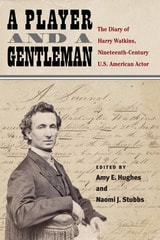
A Player and a Gentleman
The Diary of Harry Watkins, Nineteenth-Century U.S. American ActorEdited by Amy E. Hughes and Naomi J. Stubbs
University of Michigan Press, 2018
Hardworking actor, playwright, and stage manager Harry Watkins (1825–94) was also a prolific diarist. For fifteen years Watkins regularly recorded the plays he saw, the roles he performed, the books he read, and his impressions of current events. Performing across the U.S., Watkins collaborated with preeminent performers and producers, recording his successes and failures as well as his encounters with celebrities such as P. T. Barnum, Junius Brutus Booth, Edwin Forrest, Anna Cora Mowatt, and Lucy Stone. His is the only known diary of substantial length and scope written by a U.S. actor before the Civil War—making Watkins, essentially, the antebellum equivalent of Samuel Pepys. Theater historians Amy E. Hughes and Naomi J. Stubbs have selected, edited, and annotated excerpts from the diary in an edition that offers a vivid glimpse of how ordinary people like Watkins lived, loved, struggled, and triumphed during one of the most tumultuous periods in U.S. history. The selections in A Player and a Gentleman are drawn from a more expansive digital archive of the complete diary. The book, like its digital counterpart, will richly enhance our knowledge of antebellum theater culture and daily life in the U.S. during this period.
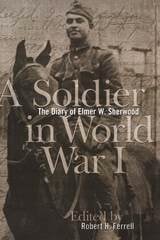
A Soldier in World War I
The Diary of Elmer W. SherwoodRobert H. Ferrell
Indiana Historical Society Press, 2004
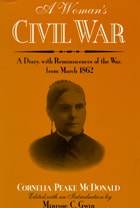
A Woman's Civil War
A Diary with Reminiscences of the War, from March 1862Cornelia Peake McDonald; Edited, with an Introduction by Minrose C. Gwin
University of Wisconsin Press, 1992
McDonald’s story of the Civil War records a personal and distinctly female battle of her own—a southern woman’s lonely struggle in the midst of chaos to provide safety and shelter for herself and her children. For McDonald, history is what happens “inside the house.” She relates the trauma that occurs when the safety of the home is disrupted and destroyed by the forces of war—when women and children are put out of their houses and have nowhere to go.
Whether she is describing a Union soldier’s theft of her Christmas cakes, the discovery of a human foot in her garden, or the death of her baby daughter, McDonald’s story of the Civil War at home is compelling and disturbing. Her tremendous determination and unyielding spirit in the face of the final collapse of her world is testimony to a woman’s will to preserve her family and her own sense of purpose as a “rebel” against all that she regarded as tyrannical and brutal in war itself.
After-Dinner Conversation
The Diary of a DecadentBy José Asunción Silva
University of Texas Press, 2005
Lost in a shipwreck in 1895, rewritten before the author's suicide in 1896, and not published until 1925, José Asunción Silva's After-Dinner Conversation (De sobremesa) is one of Latin America's finest fin de siècle novels and the first one to be translated into English. Perhaps the single best work for understanding turn-of-the-twentieth-century writing in South America, After-Dinner Conversation is also cited as the continent's first psychological novel and an outstanding example of modernista fiction and the Decadent sensibility.
Semi-autobiographical and more important for style than plot, After-Dinner Conversation is the diary of a Decadent sensation-collector in exile in Paris who undertakes a quest to find his beloved Helen, a vision whom his fevered imagination sees as his salvation. Along the way, he struggles with irreconcilable urges and temptations that pull him in every direction while he endures an environment indifferent or hostile to spiritual and intellectual pursuits, as did the modernista writers themselves. Kelly Washbourne's excellent translation preserves Silva's lush prose and experimental style. In the introduction, one of the most wide-ranging in Silva criticism, Washbourne places the life and work of Silva in their literary and historical contexts, including an extended discussion of how After-Dinner Conversation fits within Spanish American modernismo and the Decadent movement. Washbourne's perceptive comments and notes also make the novel accessible to general readers, who will find the work surprisingly fresh more than a century after its composition.
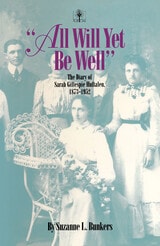
All Will Yet Be Well
The Diary of Sarah Gillespie Huftalen, 1873-1952Suzanne L. Bunkers
University of Iowa Press, 1993
Sarah Gillespie Huftalen led an unconventional life for a rural midwestern woman of her time. Born in 1865 near Manchester, Iowa, she was a farm girl who became a highly regarded country school and college teacher; she married a man older than either of her parents, received a college degree later in life, and was committed to both family and career. A gifted writer, she crafted essays, teacher-training guides, and poetry while continuing to write lengthy, introspective entries in her diary, which spans the years from 1873 to 1952. In addition, she gathered extensive information about the quietly tragic life of her mother, Emily, and worked to preserve Emily's own detailed diary.
In more than 3,500 pages, Sarah writes about her multiple roles as daughter, sister, wife, teacher, family historian, and public figure. Her diary reflects the process by which she was socialized into these roles and her growing consciousness of the ways in which these roles intersected. Not only does her diary embody the diverse strategies used by one woman to chart her life's course and to preserve her life's story for future generations, it also offers ample evidence of the diary as a primary form of private autobiography for individuals whose lives do not lend themselves to traditional definitions of autobiography.
Taken together, Emily's and Sarah's extraordinary diaries span nearly a century and thus form a unique mother/daughter chronicle of daily work and thoughts, interactions with neighbors and friends and colleagues, and the destructive family dynamics that dominated the Gillespies. Sarah's consciousness of the abusive relationship between her mother and father haunts her diary, and this dramatic relationship is duplicated in Sarah's relationship with her brother, Henry, Suzanne Bunkers' skillful editing and analysis of Sarah's diary reveal the legacy of a caring, loving mother reflected in her daughter's work as family member, teacher, and citizen.
The rich entries in Sarah Gillespie Huftalen's diary offer us brilliant insights into the importance of female kinship networks in American life, the valued status of many women as family chroniclers, and the fine art of selecting, piecing, stitching, and quilting that characterizes the many shapes of women's autobiographies. Read Sarah's dairy to discover why "all will yet be well."