3071 books match the query 'Business & Economics' and 135 start with r
cover of Review of Environmental Economics and Policy, volume 16 number 1 (Winter 2022)

Review of Environmental Economics and Policy, volume 16 number 1 (Winter 2022)

The University of Chicago Press

University of Chicago Press Journals, 2022
This is volume 16 issue 1 of Review of Environmental Economics and Policy. The Review of Environmental Economics and Policy (REEP) is an official journal of the Association of Environmental and Resource Economists and the European Association of Environmental and Resource Economists. REEP publishes symposia, articles, and regular features that contribute to one or more of the following goals: to identify and synthesize lessons learned from recent and ongoing environmental economics research; to provide economic analysis of environmental policy issues; to promote the sharing of ideas and perspectives among the various sub-fields of environmental economics; to strengthen the linkages between environmental economics research and environmental policy; to encourage communication and connections between academics and the wider policy community; to offer suggestions for future research; to provide insights and readings for use in the classroom; to address issues of interest to the environmental economics profession.
[more]
cover of Review of Environmental Economics and Policy, volume 16 number 2 (Summer 2022)

Review of Environmental Economics and Policy, volume 16 number 2 (Summer 2022)

The University of Chicago Press

University of Chicago Press Journals, 2022
This is volume 16 issue 2 of Review of Environmental Economics and Policy. The Review of Environmental Economics and Policy (REEP) is an official journal of the Association of Environmental and Resource Economists and the European Association of Environmental and Resource Economists. REEP publishes symposia, articles, and regular features that contribute to one or more of the following goals: to identify and synthesize lessons learned from recent and ongoing environmental economics research; to provide economic analysis of environmental policy issues; to promote the sharing of ideas and perspectives among the various sub-fields of environmental economics; to strengthen the linkages between environmental economics research and environmental policy; to encourage communication and connections between academics and the wider policy community; to offer suggestions for future research; to provide insights and readings for use in the classroom; to address issues of interest to the environmental economics profession.
[more]
cover of Review of Environmental Economics and Policy, volume 17 number 1 (Winter 2023)

Review of Environmental Economics and Policy, volume 17 number 1 (Winter 2023)

The University of Chicago Press

University of Chicago Press Journals, 2023
This is volume 17 issue 1 of Review of Environmental Economics and Policy. The Review of Environmental Economics and Policy (REEP) is an official journal of the Association of Environmental and Resource Economists and the European Association of Environmental and Resource Economists. REEP publishes symposia, articles, and regular features that contribute to one or more of the following goals: to identify and synthesize lessons learned from recent and ongoing environmental economics research; to provide economic analysis of environmental policy issues; to promote the sharing of ideas and perspectives among the various sub-fields of environmental economics; to strengthen the linkages between environmental economics research and environmental policy; to encourage communication and connections between academics and the wider policy community; to offer suggestions for future research; to provide insights and readings for use in the classroom; to address issues of interest to the environmental economics profession.
[more]
cover of Review of Environmental Economics and Policy, volume 17 number 2 (Summer 2023)

Review of Environmental Economics and Policy, volume 17 number 2 (Summer 2023)

The University of Chicago Press

University of Chicago Press Journals, 2023
This is volume 17 issue 2 of Review of Environmental Economics and Policy. The Review of Environmental Economics and Policy (REEP) is an official journal of the Association of Environmental and Resource Economists and the European Association of Environmental and Resource Economists. REEP publishes symposia, articles, and regular features that contribute to one or more of the following goals: to identify and synthesize lessons learned from recent and ongoing environmental economics research; to provide economic analysis of environmental policy issues; to promote the sharing of ideas and perspectives among the various sub-fields of environmental economics; to strengthen the linkages between environmental economics research and environmental policy; to encourage communication and connections between academics and the wider policy community; to offer suggestions for future research; to provide insights and readings for use in the classroom; to address issues of interest to the environmental economics profession.
[more]
cover of Review of Environmental Economics and Policy, volume 18 number 1 (Winter 2024)

Review of Environmental Economics and Policy, volume 18 number 1 (Winter 2024)

The University of Chicago Press

University of Chicago Press Journals, 2024
This is volume 18 issue 1 of Review of Environmental Economics and Policy. The Review of Environmental Economics and Policy (REEP) is an official journal of the Association of Environmental and Resource Economists and the European Association of Environmental and Resource Economists. REEP publishes symposia, articles, and regular features that contribute to one or more of the following goals: to identify and synthesize lessons learned from recent and ongoing environmental economics research; to provide economic analysis of environmental policy issues; to promote the sharing of ideas and perspectives among the various sub-fields of environmental economics; to strengthen the linkages between environmental economics research and environmental policy; to encourage communication and connections between academics and the wider policy community; to offer suggestions for future research; to provide insights and readings for use in the classroom; to address issues of interest to the environmental economics profession.
[more]
cover of Review of Environmental Economics and Policy, volume 18 number 2 (Summer 2024)

Review of Environmental Economics and Policy, volume 18 number 2 (Summer 2024)

The University of Chicago Press

University of Chicago Press Journals, 2024
This is volume 18 issue 2 of Review of Environmental Economics and Policy. The Review of Environmental Economics and Policy (REEP) is an official journal of the Association of Environmental and Resource Economists and the European Association of Environmental and Resource Economists. REEP publishes symposia, articles, and regular features that contribute to one or more of the following goals: to identify and synthesize lessons learned from recent and ongoing environmental economics research; to provide economic analysis of environmental policy issues; to promote the sharing of ideas and perspectives among the various sub-fields of environmental economics; to strengthen the linkages between environmental economics research and environmental policy; to encourage communication and connections between academics and the wider policy community; to offer suggestions for future research; to provide insights and readings for use in the classroom; to address issues of interest to the environmental economics profession.
[more]
cover of Review of Environmental Economics and Policy, volume 19 number 1 (Winter 2025)

Review of Environmental Economics and Policy, volume 19 number 1 (Winter 2025)

The University of Chicago Press

University of Chicago Press Journals, 2025
This is volume 19 issue 1 of Review of Environmental Economics and Policy. The Review of Environmental Economics and Policy (REEP) is an official journal of the Association of Environmental and Resource Economists and the European Association of Environmental and Resource Economists. REEP publishes symposia, articles, and regular features that contribute to one or more of the following goals: to identify and synthesize lessons learned from recent and ongoing environmental economics research; to provide economic analysis of environmental policy issues; to promote the sharing of ideas and perspectives among the various sub-fields of environmental economics; to strengthen the linkages between environmental economics research and environmental policy; to encourage communication and connections between academics and the wider policy community; to offer suggestions for future research; to provide insights and readings for use in the classroom; to address issues of interest to the environmental economics profession.
[more]
cover of Review of Environmental Economics and Policy, volume 19 number 2 (Summer 2025)

Review of Environmental Economics and Policy, volume 19 number 2 (Summer 2025)

The University of Chicago Press

University of Chicago Press Journals, 2025
This is volume 19 issue 2 of Review of Environmental Economics and Policy. The Review of Environmental Economics and Policy (REEP) is an official journal of the Association of Environmental and Resource Economists and the European Association of Environmental and Resource Economists. REEP publishes symposia, articles, and regular features that contribute to one or more of the following goals: to identify and synthesize lessons learned from recent and ongoing environmental economics research; to provide economic analysis of environmental policy issues; to promote the sharing of ideas and perspectives among the various sub-fields of environmental economics; to strengthen the linkages between environmental economics research and environmental policy; to encourage communication and connections between academics and the wider policy community; to offer suggestions for future research; to provide insights and readings for use in the classroom; to address issues of interest to the environmental economics profession.
[more]
cover of Review of Environmental Economics and Policy, volume 20 number 1 (Winter 2026)

Review of Environmental Economics and Policy, volume 20 number 1 (Winter 2026)

The University of Chicago Press

University of Chicago Press Journals, 2026
This is volume 20 issue 1 of Review of Environmental Economics and Policy. The Review of Environmental Economics and Policy (REEP) is an official journal of the Association of Environmental and Resource Economists and the European Association of Environmental and Resource Economists. REEP publishes symposia, articles, and regular features that contribute to one or more of the following goals: to identify and synthesize lessons learned from recent and ongoing environmental economics research; to provide economic analysis of environmental policy issues; to promote the sharing of ideas and perspectives among the various sub-fields of environmental economics; to strengthen the linkages between environmental economics research and environmental policy; to encourage communication and connections between academics and the wider policy community; to offer suggestions for future research; to provide insights and readings for use in the classroom; to address issues of interest to the environmental economics profession.
[more]
cover of Review of Environmental Economics and Policy, volume 20 number 2 (Summer 2026)

Review of Environmental Economics and Policy, volume 20 number 2 (Summer 2026)

The University of Chicago Press

University of Chicago Press Journals, 2026
This is volume 20 issue 2 of Review of Environmental Economics and Policy. The Review of Environmental Economics and Policy (REEP) is an official journal of the Association of Environmental and Resource Economists and the European Association of Environmental and Resource Economists. REEP publishes symposia, articles, and regular features that contribute to one or more of the following goals: to identify and synthesize lessons learned from recent and ongoing environmental economics research; to provide economic analysis of environmental policy issues; to promote the sharing of ideas and perspectives among the various sub-fields of environmental economics; to strengthen the linkages between environmental economics research and environmental policy; to encourage communication and connections between academics and the wider policy community; to offer suggestions for future research; to provide insights and readings for use in the classroom; to address issues of interest to the environmental economics profession.
[more]
cover of Revisiting U.S. Trade Policy: Decisions in Perspective

Revisiting U.S. Trade Policy

Decisions in Perspective

Alfred E. Eckes Jr.

Ohio University Press, 2000

In trade policy, as in many other areas of public policy, decision makers often confront present and future problems with little understanding of how similar disputes were resolved in the past. Too often, busy public officials had no time to write or record negotiating histories. Revisiting U.S. Trade Policy, which is certain to become a classic in the literature of trade negotiations, is just such a record.

Built on the oral histories of thirty-five former U.S. trade policymakers—including Michael Blumenthal, Alonzo McDonald, William Roth, and Robert S. Strauss—this unique record, prepared for publication by Alfred E. Eckes, revisits some of the most important moments of America’s trade liberalization program in the years after World War II.

From GATT to the World Trade Organization, these major players look back in candid hindsight at their decisions concerning trade policy and the effects that those decisions had on shaping the new international economic order.
[more]
cover of Revitalizing Federal Education Research and Development: Improving the R&D Centers, Regional Educational Laboratories, and the "New" OERI

Revitalizing Federal Education Research and Development

Improving the R&D Centers, Regional Educational Laboratories, and the "New" OERI

Maris A. Vinovskis

University of Michigan Press, 2001

Over the past thirty years, the government has spent approximately $1.5 billion on the Regional Educational Laboratories and $1.1 billion on the Research and Development Centers. After this large investment, these two research facilities still have been unable to find the best way to effectively help at-risk children thrive in school. Many people are slowly realizing that, unfortunately, our sizable investment in educational research and development has not been sufficient to produce the kind of information that policymakers and educators must have if they hope to meet the needs of these at-risk children.
Maris A. Vinovskis uses the research he has done over the past decade, along with the findings of other policymakers, to argue that the American public school system needs to gain functional reform if research institutions are to conduct more effective studies for policymakers. He examines here both recent reform policies as well as the history behind educational reform.
Vinovskis's vigorous investigation of the process of educational research and development in the United States will be of particular interest to individuals whose careers depend on continued federal funding. This book will also appeal to educators, policymakers, and public policy analysts and will be of unequaled value in understanding the formulation of new educational policies in the twenty-first century.
Maris A. Vinovskis is active on Capitol Hill and lectures throughout the country at such prestigious institutions as the American Academy of Arts and Sciences, the Brookings Institution, and the John F. Kennedy School of Government at Harvard. He is Professor of History, University of Michigan.
[more]
cover of Revolution From Without: Yucatan, Mexico, and the United States, 1880–1924

Revolution From Without

Yucatan, Mexico, and the United States, 1880–1924

Gilbert M. Joseph

Duke University Press, 1988
"In addition to the relevance provided by contemporary events, the republication of Revolution from Without comes at a particularly effervescent moment in Latin American revolutionary studies. An ongoing discourse among political sociologists, anthropologists and historians has greatly enriched our understanding of the political economy and social history of revolutions and popular insurgencies."—from the preface to the paperback edition
[more]
cover of Rhetorical Memory: A Study of Technical Communication and Information Management

Rhetorical Memory

A Study of Technical Communication and Information Management

Stewart Whittemore

University of Chicago Press, 2015

Institutions have regimes—policies that typically come from the top down and are meant to align the efforts of workers with the goals and mission of an institution. Institutions also have practices—day-to-day behaviors performed by individual workers attempting to interpret the institution’s missives. Taken as a whole, these form a company’s memory regime, and they have a significant effect on how employees analyze, mix, translate, sort, filter, and repurpose everyday information in order to meet the demands of their jobs, their customers, their colleagues, and themselves.

In Rhetorical Memory, Stewart Whittemore demonstrates that strategies we use to manage information—techniques often acquired through trial and error, rarely studied, and generally invisible to us—are as important to our success as the end products of our work. First, he situates information management within the larger field of rhetoric, showing that both are tied to purpose, audience, and situation. He then dives into an engaging and tightly focused workplace study, presenting three cases from a team of technical communicators making use of organizational memory during their everyday work. By examining which techniques succeed and which fail, Whittemore illuminates the challenges faced by technical communicators. He concludes with a number of practical strategies to better organize information, that will help employees, managers, and anyone else suffering from information overload.
[more]
cover of Right Across the World: The Global Networking of the Far-Right and the Left Response

Right Across the World

The Global Networking of the Far-Right and the Left Response

John Feffer

Pluto Press, 2021

'John Feffer is our 21st-century Jack London' - Mike Davis

In a post-Trump world, the right is still very much in power. Significantly more than half the world’s population currently lives under some form of right-wing populist or authoritarian rule. Today’s autocrats are, at first glance, a diverse band of brothers. But religious, economic, social and environmental differences aside, there is one thing that unites them - their hatred of the liberal, globalized world. This unity is their strength, and through control of government, civil society and the digital world they are working together across borders to stamp out the left.

In comparison, the liberal left commands only a few disconnected islands - Iceland, Mexico, New Zealand, South Korea, Spain and Uruguay. So far they have been on the defensive, campaigning on local issues in their own countries. This narrow focus underestimates the resilience and global connectivity of the right. In this book, John Feffer speaks to the world’s leading activists to show how international leftist campaigns must come together if they are to combat the rising tide of the right.

A global Green New Deal, progressive trans-European movements, grassroots campaigning on international issues with new and improved language and storytelling are all needed if we are to pull the planet back from the edge of catastrophe. This book is both a warning and an inspiration to activists terrified by the strengthening wall of far-right power.
[more]
cover of Risk Acceptability According to the Social Sciences

Risk Acceptability According to the Social Sciences

Mary Douglas

Russell Sage Foundation, 1985
Every day, it seems, we become aware of some new technological or chemical hazard. Yet it is also possible that this very awareness is new, or at least newly heightened. Why are certain kinds of risks suddenly so salient? Are public perceptions of risk simply the sum of individual reactions to individual events, or do social and cultural influences play a role in shaping our definitions of safety, acceptable risk, and danger? Prompted by public outcries and by the confusion and uncertainty surrounding risk management policy, social scientists have begun to address themselves to the issue of risk perception. But as anthropologist Mary Douglas points out, they have been singularly reluctant to examine the cultural bases of risk perception, preferring to concentrate on the individual perceiver making individual choices. This approach leaves unexamined a number of crucial social factors—our concepts of what is "natural" or "artificial," for example; our beliefs about fairness, and our moral judgements about the kind of society in which we want to live. This provocative and path-breaking report seeks to open a sociological approach to risk perception that has so far been systematically neglected. Describing first some exceptions to the general neglect of culture, Douglas builds on these clues and on her own broad anthropological perspective to make a compelling case for focusing on social factors in risk perception. She offers a challenge and a promising new agenda to all who study perceptions of risk and, by extension, to those who study human cognition and choice as well. "An altogether brilliant piece of writing—far-reaching and a joy to read." —Amartya Sen, Oxford University A Volume in the Russell Sage Foundation's Social Science Frontiers Series
[more]
cover of Risk Management and Political Culture

Risk Management and Political Culture

Sheila Jasanoff

Russell Sage Foundation, 1986
This unique comparative study looks at efforts to regulate carcinogenic chemicals in several Western democracies, including the United States, and finds marked national differences in how conflicting scientific interpretations and competing political interests are resolved. Whether risk issues are referred to expert committees without public debate or debated openly in a variety of forums, patterns of interaction among experts, policy makers, and the public reflect fundamental features of each country's political culture. "A provocative argument....Poses interesting questions for the sociology of science, especially science produced for public debate."—Contemporary Sociology A Volume in the Russell Sage Foundation's Social Science Frontiers Series
[more]
cover of Risk Principles for Public Utility Regulators

Risk Principles for Public Utility Regulators

Janice A. Beecher

Michigan State University Press, 2016

Risk and risk allocation have always been central issues in public utility regulation. Unfortunately, the term “risk” can easily be misrepresented and misinterpreted, especially when disconnected from long-standing principles of corporate finance.
This book provides those in the regulatory policy community with a basic theoretical and practical grounding in risk as it relates specifically to economic regulation in order to focus and elevate discourse about risk in the utility sector in the contemporary context of economic, technological, and regulatory change. This is not a “how-to” book with regard to calculating risks and returns but rather a resource that aims to improve understanding of the nature of risk. It draws from the fields of corporate finance, behavioral finance, and decision theory as well as the broader legal and economic theories that undergird institutional economics and the economic regulatory paradigm.
We exist in a world of scarce resources and abundant uncertainties, the combination of which can exacerbate and distort our sense of risk. Although there is understandable impulse to reduce risk, attempts to mitigate may be as likely to shift risk, and some measures might actually increase risk exposure. Many of the concepts explored here apply not just to financial decisions, such as those by utility investors, but also to regulatory and utility decision-making in general.
[more]
cover of Risk Taking: A Managerial Perspective

Risk Taking

A Managerial Perspective

Zur Shapira

Russell Sage Foundation, 1995

Classical economic theory assumes that people in risk situations follow a course of action based on a rational, consistent assessment of likely outcomes. But as Zur Shapira demonstrates in Risk Taking, corporate managers consistently stray from the prescribed path into far more subjective territory. Risk Taking offers a critical assessment of the relationship between theory and action in managerial decision making. Shapira offers a definitive account of the classical conception of risky decision making, which derives behavioral prescriptions from a calculation of both the value and the likelihood of possible outcomes. He then demonstrates how theories in this vein have been historically at odds with empirical observations. Risk Taking reports the results of an extensive survey of seven hundred managers that probed their attitudes and beliefs about risk and examined how they had actually made decisions in the face of uncertainty. The picture that emerges is of a dynamic, flexible process in which each manager's personal expertise and perceptions play profound roles. Managerial strategies are continually modified to suit changing circumstances. Rather than formulating probability estimates, executives create potential scenarios based not only on the possible outcomes but also on the many arbitrary factors inherent in their own situations. As Shapira notes, risk taking propensities vary among managers, and the need to maintain control and avoid particularly dangerous results exercises a powerful influence. Shapira also examines the impact of organizational structure, long-term management objectives, and incentives on decision making. With perceptive observations of the cognitive, emotional, and organizational dimensions of corporate decision making, Risk Taking propels the study of managerial risk behavior into new directions. This volume signals the way toward improving managerial decision making by revealing the need for more inclusive choice models that augment classical theory with vital behavioral observations.
[more]
cover of Risk Topography: Systemic Risk and Macro Modeling

Risk Topography

Systemic Risk and Macro Modeling

Edited by Markus Brunnermeier and Arvind Krishnamurthy

University of Chicago Press, 2014

The recent financial crisis and the difficulty of using mainstream macroeconomic models to accurately monitor and assess systemic risk have stimulated new analyses of how we measure economic activity and the development of more sophisticated models in which the financial sector plays a greater role.

Markus Brunnermeier and Arvind Krishnamurthy have assembled contributions from leading academic researchers, central bankers, and other financial-market experts to explore the possibilities for advancing macroeconomic modeling in order to achieve more accurate economic measurement. Essays in this volume focus on the development of models capable of highlighting the vulnerabilities that leave the economy susceptible to adverse feedback loops and liquidity spirals. While these types of vulnerabilities have often been identified, they have not been consistently measured. In a financial world of increasing complexity and uncertainty, this volume is an invaluable resource for policymakers working to improve current measurement systems and for academics concerned with conceptualizing effective measurement.

[more]
cover of Risk and Risk Management in the Agricultural Economy

Risk and Risk Management in the Agricultural Economy

Edited by Tatyana Deryugina and Barry K. Goodwin

University of Chicago Press, 0

A wide-ranging examination of the risks agricultural producers face and how risk management policies respond to an uncertain economy.

Agricultural producers face greater risk and uncertainty than those in many other sectors of the economy. Sources of risk include weather shocks, disease, and volatile prices that can upend a season's returns. A wide array of federal policies, including crop and livestock insurance programs, are designed to help producers manage these risks, often at substantial cost to taxpayers. This volume examines how producers respond to and manage various risks across multiple dimensions. Contributors investigate the potential for "subsidy harvesting" in livestock insurance markets, the effects of climate change on insurance participation and crop choice, the relationship between the structure of insurance contracts and diversification incentives, and the role of conservation practices in risk mitigation. The research studies present new evidence on the design and consequences of agricultural risk management policies.

[more]
cover of Risks in Agricultural Supply Chains

Risks in Agricultural Supply Chains

Edited by Pol Antràs and David Zilberman

University of Chicago Press, 2023

An essential guide to the role of microeconomic incentives, macro policies, and technological change in enhancing agriculture resilience.

Climate change and the recent COVID-19 pandemic have exposed the vulnerability of global agricultural supply and value chains. There is a growing awareness of the importance of interactions within and between these supply chains for understanding the performance of agricultural markets. This book presents a collection of research studies that develop conceptual models and empirical analyses of risk resilience and vulnerability in supply chains. The chapters emphasize the roles played by microeconomic incentives, macroeconomic policies, and technological change in contributing to supply chain performance. The studies range widely, considering for example how agent-based modeling and remote sensing data can be used to assess the impact of shocks, and how recent shocks such as the COVID-19 pandemic and the African Swine fever in China affected agricultural labor markets, the supply chain for meat products, and the food retailing sector. A recurring theme is the transformation of agricultural supply chains and the volatility of food systems in response to microeconomic shocks. The chapters not only present new findings but also point to important directions for future research.
[more]
cover of Risky Behavior among Youths: An Economic Analysis

Risky Behavior among Youths

An Economic Analysis

Edited by Jonathan Gruber

University of Chicago Press, 2001

Every day young people engage in risky behaviors that affect not only their immediate well-being but their long-term health and safety. These well-honed essays apply diverse economic analyses to a wide range of unsafe activities, including teen drinking and driving, smoking, drug use, unprotected sex, and criminal activity. Economic principles are further applied to mental health and performance issues such as teenage depression, suicide, nutritional disorders, and high school dropout rates. Together, the essays yield notable findings: price and regulatory incentives are critical determinants of high-risk behavior, suggesting that youths do apply some sort of cost/benefit calculation when making decisions; the macroeconomic environment in which those decisions are made matters greatly; and youths who pursue high-risk behaviors are significantly more likely to engage in similar behaviors as adults.

This important volume provides both a key data source for public policy makers and a clear affirmation of the usefulness of economic analysis to our understanding of risky behavior.

[more]
cover of Roads, Runways and Resistance: From the Newbury Bypass to Extinction Rebellion

Roads, Runways and Resistance

From the Newbury Bypass to Extinction Rebellion

Steve Melia

Pluto Press, 2021

'As a movement for social change it is important that we understand our own history. This is a compelling read.'

From the anti-roads protests of the 1990s to HS2 and Extinction Rebellion, conflict and protest have shaped the politics of transport. In 1989, Margaret Thatcher's government announced 'the biggest road-building programme since the Romans.' This is the inside story of the thirty tumultuous years that have followed.

Roads, Runways and Resistance draws on over 50 interviews with government ministers, advisors and protestors - many of whom, including 'Swampy', speak here for the first time about the events they describe. It is a story of transport ministers undermined by their own Prime Ministers, protestors attacked or quietly supported by the police, and smartly-dressed protestors who found a way onto the roof of the Houses of Parliament.

Today, as a new wave of road building and airport expansion threatens to bust Britain's carbon budgets, climate change protestors find themselves on a collision course with the government. Melia asks, what difference did the protests of the past make? And what impacts might today's protest movements have on the transport of the future?

[more]
cover of Rock Climbing in Kentucky's Red River Gorge: An Oral History of Community, Resources, and Tourism

Rock Climbing in Kentucky's Red River Gorge

An Oral History of Community, Resources, and Tourism

James N. Maples

West Virginia University Press, 2021

Rock Climbing in Kentucky’s Red River Gorge documents, for the first time, fifty years of oral history from this famous climbing community. Through extensive interviews, Maples reconstructs the growth of rock climbing in the region—including a twice-failed dam project, mysterious first routes, unauthorized sport-route growth on public lands, and a controversial archaeological dig. The book details five decades of collaborations to secure ongoing access to some of the world’s most beautiful and technically demanding routes and the challenges along the way.

More than a recounting of the past, however, Rock Climbing in Kentucky’s Red River Gorge uses the region’s extraordinary history to argue that climbing has the potential to be a valuable source of sustainable economic activity in rural areas throughout Appalachia today and in the years to come. The book concludes by offering policy recommendations and lessons learned about building beneficial partnerships among climbers, local communities, and public land managers to encourage community development and ecotourism alongside preservation.
[more]
cover of Rocking the Boat: Union Women's Voices, 1915-1975

Rocking the Boat

Union Women's Voices, 1915-1975

O'Farrell, Brigid

Rutgers University Press, 1996

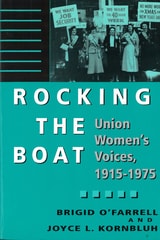
Rocking the Boat is a celebration of strong, committed women who helped to build the American labor movement. Through the stories of eleven women from a wide range of backgrounds, we experience the turmoil, hardships, and accomplishments of thousands of other union women activists through the period spanning the Great Depression, the New Deal, World War II, the McCarthy era, the civil rights movement, and the women's movement. These women tell powerful stories that highlight and detail women's many roles as workers, trade unionists, and family members. They all faced difficulties in their personal lives, overcame challenges in their unions, and individually and collectively helped improve women's everyday working lives.

Maida Springer-Kemp came from New York City's Harlem, Local 22 of the International Ladies' Garment Workers' Union, to represent the AFL-CIO in Africa. In Chicago, Alice Peurala fought for her job in the steel mill and her place in the steel workers' union. Jessie De La Cruz organized farm workers in California. Esther Peterson, organizer, educator, and lobbyist, became an advisor to four U.S. presidents. In chapters based on oral history interviews, these women and others provide new perspectives and practical advice for today's working women. They share an idealistic and practical commitment to the labor movement. As Dorothy Haener of the United Auto Workers and a founding member of the National Organization of Women said, "You have to take a look at how to rock the boat. You don't want to spill yourself out if you can avoid it, but sometimes you have to rock the boat." From these women we, too, learn how to rock the boat.

[more]
cover of Roughnecks, Drillers, and Tool Pushers: Thirty-three Years in the Oil Fields

Roughnecks, Drillers, and Tool Pushers

Thirty-three Years in the Oil Fields

By Gerald Lynch

University of Texas Press, 1991

Oil, the black gold of Texas, has given rise to many a myth. Oil could turn a man overnight into a millionaire—and did, for some. But these myths have obscured what life was really like in the oil patch, a place that was neither the El Dorado of legend nor quite the unredeemed den of sin and iniquity that some feared.

In Roughnecks, Drillers, and Tool Pushers, Gerald Lynch provides a much-needed insider's view of the oil industry, describing life in various oil fields in and around Texas. He also chronicles changes in drilling methods and oil-field technology and how these changes affected him and his fellow oil-field workers. No one else has written a working-class history of the oil fields as colorful and articulate as this one.
[more]
cover of Routine Crisis: An Ethnography of Disillusion

Routine Crisis

An Ethnography of Disillusion

Sarah Muir

University of Chicago Press, 2021

Argentina, once heralded as the future of capitalist progress, has a long history of economic volatility. In 2001–2002, a financial crisis led to its worst economic collapse, precipitating a dramatic currency devaluation, the largest sovereign default in world history, and the flight of foreign capital. Protests and street blockades punctuated a moment of profound political uncertainty, epitomized by the rapid succession of five presidents in four months. Since then, Argentina has fought economic fires on every front, from inflation to the cost of utilities and depressed industrial output. When things clearly aren't working, when the constant churning of booms and busts makes life almost unlivable, how does our deeply compromised order come to seem so inescapable? How does critique come to seem so blunt, even as crisis after crisis appears on the horizon? What are the lived effects of that sense of inescapability?

Anthropologist Sarah Muir offers a cogent meditation on the limits of critique at this historical moment, drawing on deep experience in Argentina but reflecting on a truly global condition. If we feel things are being upended in a manner that is ongoing, tumultuous, and harmful, what would we need to do—and what would we need to give up—to usher in a revitalized critique for today's world? Routine Crisis is an original provocation and a challenge to think beyond the limits of exhaustion and reimagine a form of criticism for the twenty-first century.
[more]
cover of Rubbish Theory: The Creation and Destruction of Value - New Edition

Rubbish Theory

The Creation and Destruction of Value - New Edition

Michael Thompson

Pluto Press, 2017

How do objects that are worth little to nothing become valuable? Who is behind the creation of value, and which types of people find value and comfort in transient, durable, and rubbish objects?
 
When his highly influential Rubbish Theory, first published in 1979, Michael Thompson launched the discipline of waste studies. It remains the most comprehensive analysis on the culture of waste to date. Thompson argues that there are two mutually exclusive cultural categories that are socially imposed on the world of objects: a transient category and a durable category. However, he identifies a region of flexibility, wherein a transient object that declines in value and life span can linger in a valueless and timeless limbo of rubbish, until it is discovered by a creative individual and transferred into something deemed durable. He links stability and change on one hand, with materiality on the other, providing a rich analysis of social and cultural dynamics. His instrumental theory of rubbish draws on case studies and anthropological fieldwork to highlight the ever-changing subtleties of object value and our complex relationship to waste.
 
Bringing Rubbish Theory back into print, this updated edition includes a new introduction, preface, foreword, and afterword, thoroughly exploring how Thompson’s key theories have affected our world in the four decades since it was first published and placing it in a contemporary context that shines light on the continued relevance of the book today. 
 
[more]
cover of Rulers and Capital in Historical Perspective: State Formation and Financial Development in India and the United States

Rulers and Capital in Historical Perspective

State Formation and Financial Development in India and the United States

Abhishek Chatterjee

Temple University Press, 2017

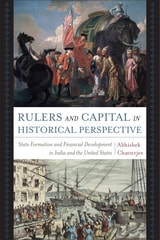
Rulers and Capital in Historical Perspective explains why modern banking and credit systems emerged in the nineteenth century only in certain countries that then subsequently industrialized and became developed.

Tracing the contemporaneous cases of India and the United States over time, Abhishek Chatterjee identifies the factors that were crucial to the development and regulation of a modern banking and credit system in the United States during the first third of the nineteenth century. He contrasts this situation with India’s, where the state never formally incorporated a sophisticated private credit system, and thus relegated it to the sphere of the informal economy.

Chatterjee identifies certain features in both societies, often—though not always—associated with colonialism, that tended to restrict the formation of modern institutionalized money and credit markets. Rulers and Capital in Historical Perspective demonstrates thatnotwithstanding the many other differences between the North American colonies (prior to independence), and India, the same facets of their relationships with Great Britain prevented the emergence of a modern banking system in the two respective societies.
[more]
cover of Rules and Restraint: Government Spending and the Design of Institutions

Rules and Restraint

Government Spending and the Design of Institutions

David M. Primo

University of Chicago Press, 2007

Government spending has increased dramatically in the United States since World War II despite the many rules intended to rein in the insatiable appetite for tax revenue most politicians seem to share. Drawing on examples from the federal and state governments, Rules and Restraint explains in lucid, nontechnical prose why these budget rules tend to fail, and proposes original alternatives for imposing much-needed fiscal discipline on our legislators.

One reason budget rules are ineffective, David Primo shows, is that politicians often create and preserve loopholes to protect programs that benefit their constituents. Another reason is that legislators must enforce their own provisions, an arrangement that is seriously compromised by their unwillingness to abide by rules that demand short-term sacrifices for the sake of long-term gain. Convinced that budget rules enacted through such a flawed legislative process are unlikely to work, Primo ultimately calls for a careful debate over the advantages and drawbacks of a constitutional convention initiated by the states—a radical step that would bypass Congress to create a path toward change. Rules and Restraint will be required reading for anyone interested in institutional design, legislatures, and policymaking.

[more]
cover of Rules of Origin in International Trade: A Comparative Study

Rules of Origin in International Trade

A Comparative Study

Edwin Vermulst, Jacques Bourgeois, and Paul Waer, Editors

University of Michigan Press, 1994
This title was formally part of the Studies in International Trade Policy Series, now called Studies in International Economics.
[more]
cover of Rules, Games, and Common-Pool Resources

Rules, Games, and Common-Pool Resources

Elinor Ostrom, Roy Gardner, and James Walker

University of Michigan Press, 1994

Explores ways that the tragedy of the commons can be avoided by people who use common-property resources

[more]
cover of Russell Sage Foundation 1907-1946: volumes 1 and 2

Russell Sage Foundation 1907-1946

volumes 1 and 2

John Glenn

Russell Sage Foundation, 1947
This history covers the first forty years of Russell Sage Foundation's efforts toward "the improvement of social and living conditions in the United States of America." It records the things that were done, both as direct work and through grants, with considerable attention to the social situation which made them seen necessary or desirable. It is of value not only to those interested in the operation of the Russell Sage Foundation or other foundatons, but for the light it throws upon the origins and development of a wide variety of movements in the borad field of social science.
[more]
cover of Russian Economic History: The Nineteenth Century

Russian Economic History

The Nineteenth Century

Arcadius Kahan

University of Chicago Press, 1989

Upon the foundation of his unique experience and education, the late Arcadius Kahan (1920-1982) built a substantial body of scholarship on all aspects of the tsarist economy. Yet some of his important contribution might well have been dissipated were it not for this collection, since many of these essays were often available only in isolated, obscure sources. This posthumous volume makes readily available for the first time ten of Kahan's essays, nine previously published in English and one in German, which serve to integrate his carefully developed picture of nineteenth-century Russian economic history. Kahan's remarkable vision forms a complement to the thought of Gerschenkron, and this volume is certain to become a valuable source for scholars and students of Russian and European economic and social history.
[more]