2706 books match the query 'European' and 107 start with r

cover of Roy Pascal and Georg Lukács: Towards a Re-Evaluation of the History of Marxist Literary Criticism in Britain?

Roy Pascal and Georg Lukács

Towards a Re-Evaluation of the History of Marxist Literary Criticism in Britain?

Helmut Peitsch

University of London Press, 2018

[more]
cover of Rubble Flora: Selected Poems

Rubble Flora

Selected Poems

Volker Braun

Seagull Books, 2019

Rubble Flora is a selection of poems from the distinguished, half-century-long career of German poet Volker Braun. Born in the former East Germany, Braun is a humane, witty, brave, and disappointed poet. In the East, his poetry upheld the voice of the individual imagination and identified with a utopian possibility that never became reality. He might be said to have found a truly singular voice amid the colossal upheavals of 1989—exploring the triumph of capitalism and the languages of advertising, terror, politics, and war. At the same time, Braun is a sensual poet in tune with the natural landscape. He has his own touchstones in world literature, and many of his poems set quotations from Rimbaud, Shakespeare, and Brecht into his own context, where they work as ironic illuminations of a present plight. The literary principle of his work lies in the friction of these different voices, whether cast into free form, collage, or classical verse. Cumulatively, Rubble Flora offers a searing vision of these transformative decades.
[more]
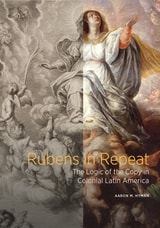
cover of Rubens in Repeat: The Logic of the Copy in Colonial Latin America

Rubens in Repeat

The Logic of the Copy in Colonial Latin America

Aaron M. Hyman

J. Paul Getty Trust, The, 2021

Winner of the Latin American Studies Association's 2022 Best Book in Colonial Latin American Studies.

This book examines the reception in Latin America of prints designed by the Flemish artist Peter Paul Rubens, showing how colonial artists used such designs to create all manner of artworks and, in the process, forged new frameworks for artistic creativity.

Peter Paul Rubens (1577–1640) never crossed the Atlantic himself, but his impact in colonial Latin America was profound. Prints made after the Flemish artist’s designs were routinely sent from Europe to the Spanish Americas, where artists used them to make all manner of objects.

Rubens in Repeat is the first comprehensive study of this transatlantic phenomenon, despite broad recognition that it was one of the most important forces to shape the artistic landscapes of the region. Copying, particularly in colonial contexts, has traditionally held negative implications that have discouraged its serious exploration. Yet analyzing the interpretation of printed sources and recontextualizing the resulting works within period discourse and their original spaces of display allow a new critical reassessment of this broad category of art produced in colonial Latin America—art that has all too easily been dismissed as derivative and thus unworthy of sustained interest and investigation. This book takes a new approach to the paradigms of artistic authorship that emerged alongside these complex creative responses, focusing on the viceroyalties of New Spain and Peru in the seventeenth and eighteenth centuries. It argues that the use of European prints was an essential component of the very framework in which colonial artists forged ideas about what it meant to be a creator.
[more]
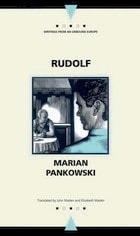
cover of Rudolf

Rudolf

Marian Pankowski

Northwestern University Press, 1996
This novel, set in the 1970s, tells the story of the "author," a middle-aged Polish professor who lives abroad but who earlier survived the Nazi concentration camps, and Rudolf, an old man. Told in stream of consciousness as well as through a triangular correspondence among Rudolf, the author, and the author's mother, the story emerges as a tale of subversion and liberation that echoes Gombrowicz in its exploration of transgressive desire. It will be of great interest to those interested in Polish literature and to readers of gay and lesbian literature.
[more]
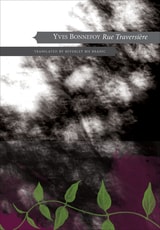
cover of Rue Traversière

Rue Traversière

Yves Bonnefoy

Seagull Books, 1972

A beautiful collection of poems from various styles and genres by France's foremost poet, Yves Bonnefoy.

Praised by Paul Auster as “one of the rare poets in the history of literature to have sustained the highest level of artistic excellence throughout an entire lifetime,” Yves Bonnefoy is widely considered the foremost French poet of his generation. Proving that his prose is just as lyrical, Rue Traversière, written in 1977, is one of his most harmonious works. Each of the fifteen discrete or linked texts, whose lengths range from brief notations to long, intense, self-questioning pages, is a work of art in its own right: brief and richly suggestive as haiku, or long and intricately wrought in syntax and thought; and all are as rewarding in their sounds and rhythms, and their lightning flashes of insight, as any sonnet. “I can write all I like; I am also the person who looks at the map of the city of his childhood and doesn’t understand,” says the section that gives the book its title, as he revisits childhood cityscapes and explores the tricks memory plays on us.

A mixture of genres—the prose poem, the personal essay, quasi-philosophical reflections on time, memory, and art—this is a book of both epigrammatic concision and dreamlike narratives that meander with the poet’s thought as he struggles to understand and express some of the undercurrents of human life. The book’s layered texts echo and elaborate on one another, as well as on aspects of Bonnefoy’s own poetics and thought.
 
[more]
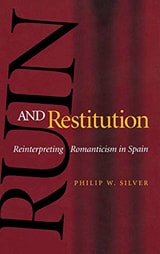
cover of Ruin and Restitution: Reinterpreting Romanticism in Spain

Ruin and Restitution

Reinterpreting Romanticism in Spain

Philip W. Silver

Vanderbilt University Press, 1997
In this highly suggestive work, Philip Silver confronts and corrects the entire critical tradition on Spanish romanticism and suggests a new "restitutional" theory of that period in Spanish cultural and political history.
[more]
cover of Russia's Legal Fictions

Russia's Legal Fictions

Harriet Murav

University of Michigan Press, 1998

Legal scholars and literary critics have shown the significance of storytelling, not only as part of the courtroom procedure, but as part of the very foundation of law. Russia's Legal Fictions examines the relationship between law, narrative and authority in nineteenth- and twentieth-century Russia.
The conflict between the Russian writer and the law is a well-known feature of Russian literary life in the past two centuries. With one exception, the authors discussed in this book--Sukhovo-Kobylin, Akhsharumov, Suvorin, and Dostoevsky in the nineteenth century and Solzhenitsyn and Siniavskii in the twentieth--were all put on trial. In Russia's Legal Fictions, Harriet Murav starts with the authors' own writings about their experience with law and explores the history of these Russian literary trials, including censorship, libel cases, and one case of murder, in their specific historical context, showing how particular aspects of the culture of the time relate to the case.
The book explores the specifically Russian literary and political conditions in which writers claim the authority not only as the authors of fiction but as lawgivers in the realm of the real, and in which the government turns to the realm of the literary to exercise its power. The author uses specific aspects of Russian culture, history and literature to consider broader theoretical questions about the relationship between law, narrative, and authority. Murav offers a history of the reception of the jury trial and the development of a professional bar in late Imperial Russia as well as an exploration of theories of criminality, sexuality, punishment, and rehabilitation in Imperial and Soviet Russia.
This book will be of interest to scholars of law and literature and Russian law, history and culture.
Harriet Murav is Associate Professor of Russian and Comparative Literature, University of California at Davis.
[more]