Results by title
14 books match the query 'Necessity'
A Defense of the Catholic Religion
The Necessity, Existence, and Limits of an Infallible ChurchBeda Mayr, OSB
Catholic University of America Press, 2023
Freedom and Necessity
St. Augustine's Teaching on Divine Power and Human FreedomGerald Bonner
Catholic University of America Press, 2007
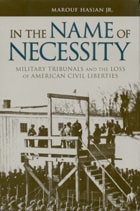
In the Name of Necessity
Military Tribunals and the Loss of American Civil LibertiesMarouf Hasian
University of Alabama Press, 2005
Examining how claims of necessity have reshaped American liberty in times of war.
Though the war on terrorism is said to have generated unprecedented military situations, arguments for the Patriot Act and military tribunals following 9/11 resemble many historical claims for restricting civil liberties, more often than not in the name of necessity.
Marouf Hasian Jr. examines the major legal cases that show how various generations have represented the need for military tribunals, and how officials historically have applied the term “necessity.” George Washington cited the necessity of martial discipline in executing the British operative Major André. Tribunals tried and convicted more than 200 Sioux warriors during the Dakota Wars. President Lincoln suspended habeas corpus for many civilian and military prisoners during the Civil War. Twentieth Century military and civilian leaders selectively drafted their own codes, leading to the execution of German saboteurs during World War II. Further, General MacArthur’s tribunal to investigate the wartime activities of Japanese General Yamashita raised the specter of “victor’s justice,” anticipating the outcry that attended the Nuremberg trials.
In those cases as in current debates about the prosecution of terrorists, Hasian argues that the past is often cited selectively, neglecting historical contexts and the controversies these cases engendered.
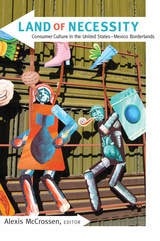
Land of Necessity
Consumer Culture in the United States–Mexico BorderlandsAlexis McCrossen, ed.
Duke University Press, 2009
In Land of Necessity, historians and anthropologists unravel the interplay of the national and transnational and of scarcity and abundance in the region split by the 1,969-mile boundary line dividing Mexico and the United States. This richly illustrated volume, with more than 100 images including maps, photographs, and advertisements, explores the convergence of broad demographic, economic, political, cultural, and transnational developments resulting in various forms of consumer culture in the borderlands. Though its importance is uncontestable, the role of necessity in consumer culture has rarely been explored. Indeed, it has been argued that where necessity reigns, consumer culture is anemic. This volume demonstrates otherwise. In doing so, it sheds new light on the history of the U.S.-Mexico borderlands, while also opening up similar terrain for scholarly inquiry into consumer culture.
The volume opens with two chapters that detail the historical trajectories of consumer culture and the borderlands. In the subsequent chapters, contributors take up subjects including smuggling, tourist districts and resorts, purchasing power, and living standards. Others address home décor, housing, urban development, and commercial real estate, while still others consider the circulation of cinematic images, contraband, used cars, and clothing. Several contributors discuss the movement of people across borders, within cities, and in retail spaces. In the two afterwords, scholars reflect on the U.S.-Mexico borderlands as a particular site of trade in labor, land, leisure, and commodities, while also musing about consumer culture as a place of complex political and economic negotiations. Through its focus on the borderlands, this volume provides valuable insight into the historical and contemporary aspects of the big “isms” shaping modern life: capitalism, nationalism, transnationalism, globalism, and, without a doubt, consumerism.
Contributors. Josef Barton, Peter S. Cahn, Howard Campbell, Lawrence Culver, Amy S. Greenberg, Josiah McC. Heyman, Sarah Hill, Alexis McCrossen, Robert Perez, Laura Isabel Serna, Rachel St. John, Mauricio Tenorio-Trillo, Evan R. Ward
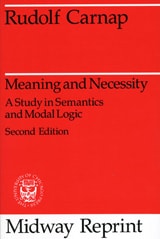
Meaning and Necessity
A Study in Semantics and Modal LogicRudolf Carnap
University of Chicago Press, 1988
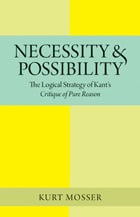
Necessity and Possibility
The Logical Strategy of Kant's Critique of Pure ReasonKurt Mosser
Catholic University of America Press, 2008
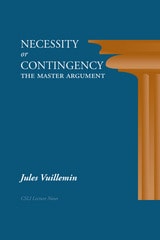
Necessity or Contingency
The Master ArgumentJules Vuillemin
CSLI, 1996
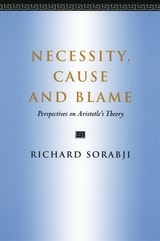
Necessity, Cause and Blame
Perspectives on Aristotle's TheoryRichard Sorabji
University of Chicago Press, 2006
“Necessity, Cause and Blame would be counted by all as one of Sorabji’s finest. The book is essential for philosophers—both specialists on the Greeks and modern thinkers about free will—and also compelling for non-specialists.”—Martha Nussbaum
“Original and important . . . The book relates Aristotle’s discussions to both the contemporary debates on determinism and causation and the ancient ones. It is especially detailed on Stoic arguments about necessity . . . and on the social and legal background to Aristotle’s thought.”—Choice
“It is difficult to convey the extraordinary richness of this book. . . . A Greekless philosopher could read it with pleasure . . . At the same time, its learning and scholarship are enormous.”—G. E. M. Anscombe, Times Literary Supplement

Possibility and Necessity
Volume 1Jean PiagetTranslated by Helga Feider
University of Minnesota Press, 1987
Possibility and Necessity was first published in 1987. Minnesota Archive Editions uses digital technology to make long-unavailable books once again accessible, and are published unaltered from the original University of Minnesota Press editions.
Jean Piaget was preoccupied, later in life, with the developing child's understanding of possibility—how the child becomes aware of the potentially unlimited scope of possible actions and learns to choose among them. Piaget's approach to this question took on a new openness to real-life situations, less deterministic than his earlier, ground-breaking work in cognitive development. The resulting two-volume work—his last—was published in France in 1981 and 1983 and is not available for the first time in English translation. Possibility and Necessity combines theoretical interpretation with detailed summaries of the experiments that Piaget and his colleagues used to test their hypotheses.
Piaget's intent, in Volume 1, is to explore the process whereby possibilities are formed. He chooses to understand "the possible" not as something predetermined by initial conditions; rather, in his use of the term, possibilities are constantly coming into being, and have no static characteristics—each arises from an event which has produced an opening onto it, and its actualization will in turn give rise to other openings. In perceiving that a possibility can be realized, and in acting upon it, the child creates something that did not exist before.
To observe this process, Piaget and his associates devised a series of thirteen problems appropriate for children ranging in age from four or five to eleven or twelve; they were asked to name all possible ways three dice might be arranged, for example, or a square of paper sectioned. The experimenters had two primary aims—to discover to what extent the child's capacity to see possibilities develops with age, and to determine the place in cognitive development of this capacity—does it precede or follow the advent of operational thought structures? In charting this process, Piaget discerns a growing interaction between possibility and necessity. How the child comes to understand necessity and achieves a dynamic synthesis—or equilibrium — between the possible and the necessary is discussed by Piaget and his colleagues in Volume 2, The Role of Necessity in Cognitive Development, also published by Minnesota.
Possibility and Necessity
Volume 2Jean PiagetTranslated by Helga Feider
University of Minnesota Press, 1987
Possibility and Necessity was first published in 1987. Minnesota Archive Editions uses digital technology to make long-unavailable books once again accessible, and are published unaltered from the original University of Minnesota Press editions.
This two-volume work—Jean Piaget's last—was published in France in 1981 and 1983 and is available now for the first time in English translation. Reflecting the preoccupations and methodologies of his later years, Possibility and Necessity combines theoretical interpretation with detailed summaries of the experiments Piaget and his colleagues used to test their hypotheses.
Volume 2 presents a series of experiments documenting the way children between the ages of four or five and eleven to thirteen come to develop a grasp of necessity and its role in understanding the world about them. The experiments show how children proceed from an initial level (at four or five years) of pseudo-necessities, where they see the world as necessarily what it appears to be without the existence of other possibilities, to an intermediate level (at six to ten years), where pseudo-necessities give way to increasingly rich arrays of possibilities, and a final stage (at eleven to thirteen years), where children are able to select among these multiple possibilities the one that fits all the data. This stage represents the optimal level of understanding reality, which is now seen by the child as infinitely variable yet coherent and lawful. Psychologically, this lawfulness corresponds to a sense of necessity, or certainty.
Volume 2 thus completes the theory presented in Volume 1 (The Role of Possibility in Cognitive Development) by showing how cognitive development is mediated on the one hand by a dialectical process of ever-expanding possibilities and, on the other, by increasingly delimiting necessities. In demonstrating how this process operates in psychological development—and in pointing out analogies in the history of science — Piaget gave his genetic epistemology its final and most accomplished form. The acquisition of knowledge is thus shown to be the result of two complementary processes: the formation of possibilities and the grasping of necessary laws and constraints in the construction of a reasoned representation of the external world.
The Necessity of Politics
Reclaiming American Public LifeChristopher Beem
University of Chicago Press, 1999
In response to this bleak assessment, advocates of "civil society" argue that rejuvenating our neighborhoods, churches, and community associations will lead to a more moral, civic-minded polity. Christopher Beem argues that while the movement's goals are laudable, simply restoring local institutions will not solve the problem; a civil society also needs politics and government to provide a sense of shared values and ideas. Tracing the concept back to Tocqueville and Hegel, Beem shows that both thinkers faced similar problems and both rejected civil society as the sole solution. He then shows how, in the case of the Civil Rights movement, both political groups and the federal government were necessary to effect a new consensus on race.
Taking up the arguments of Robert Putnam, Michael Sandel, and others, this timely book calls for a more developed sense of what the state is for and what our politics ought to be about.
"This book is bound to incite controversy and to contribute to our ongoing grappling with where our own democratic political culture is going. . . . Beem helps us to get things right by offering a corrective to any and all visions of civil society sanitized from politics."—Jean Bethke Elshtain, from the Foreword
"[Beem] makes an impressive case. At the end of the day, there really is no substitute for governmental authority in fostering the moral identity of the body politic."—Robert P. George, Times Literary Supplement

The Necessity of Pragmatism
John Dewey's Conception of PhilosophyR. W. Sleeper
University of Illinois Press, 1986
Identifying Dewey's differences with his pragmatist forerunners, Charles Sanders Peirce and William James, Sleeper elucidates Dewey's reshaping of pragmatism and the radical significance of his philosophy of culture. In this first paperback edition, a new introduction by Tom Burke establishes the ongoing importance of Sleeper's analysis of the integrity of Dewey's work and its implications for mathematics, aesthetics, and the cognitive sciences.
The Politics of Necessity
Community Organizing and Democracy in South AfricaElke Zuern
University of Wisconsin Press, 2011
The end of apartheid in South Africa broke down political barriers, extending to all races the formal rights of citizenship, including the right to participate in free elections and parliamentary democracy. But South Africa remains one of the most economically polarized nations in the world. In The Politics of Necessity Elke Zuern forcefully argues that working toward greater socio-economic equality—access to food, housing, land, jobs—is crucial to achieving a successful and sustainable democracy.
Drawing on interviews with local residents and activists in South Africa’s impoverished townships during more than a decade of dramatic political change, Zuern tracks the development of community organizing and reveals the shifting challenges faced by poor citizens. Under apartheid, township residents began organizing to press the government to address the basic material necessities of the poor and expanded their demands to include full civil and political rights. While the movement succeeded in gaining formal political rights, democratization led to a new government that instituted neo-liberal economic reforms and sought to minimize protest. In discouraging dissent and failing to reduce economic inequality, South Africa’s new democracy has continued to disempower the poor.
By comparing movements in South Africa to those in other African and Latin American states, this book identifies profound challenges to democratization. Zuern asserts the fundamental indivisibility of all human rights, showing how protest movements that call attention to socio-economic demands, though often labeled a threat to democracy, offer significant opportunities for modern democracies to evolve into systems of rule that empower all citizens.

What the Mirror Said
The Necessity of Black Women in PoetryAshley M. Jones
University of Michigan Press, 2026
Part critical essay, part personal essay collection, What the Mirror Said traces the influence of nine Black women poets in Jones’s writing and life. She brings together historical biographical information, personal reflection, and close readings as she explores personal connections to poets from Phillis Wheatley to Patricia Smith. This book is expansive in its study, from classical metrical scansion to metaphorical explication. In offering new ways to interpret poems by important contemporary poets, What the Mirror Said makes the case for the need to study and celebrate Black women poets.