Results by title
3785 books match the query 'Poetry' and 163 start with r

Rewild
Meredith Stricker
Tupelo Press, 2022
Rewriting the Word "God"
In the Arc of Converging Lines between Innovative Theory, Theology, and PoetryRomana Huk
University of Alabama Press, 2025
Innovative poetry, philosophy, theology and new sciences converge in the project of rewriting the word “God”
In Rewriting the Word “God,” Romana Huk examines the substantive connections between innovative poetry of the last century and contemporary theology and philosophy. Along the way, we encounter ten poets who have, without abandoning their inherited or chosen faith traditions, radically rethought conceptualizations of divinity, human ontology, and the real.
From the startlingly proto-phenomenological encounters with nature by Gerard Manley Hopkins to the post-deconstructive pursuit of “oracular” speech in Fanny Howe, these poets have found inspiration in a wide range of sources, from ancient religious texts to modern philosophical movements. But what unites them is their willingness to continually change, experiment and challenge the status quo, both in their religious beliefs and their poetic practice.
Huk shows how these poets have used their work to explore ultimate questions of life and death, meaning and purpose, and the relationship between humans and materiality, humans and other humans, which for these poets sheds light on humanity’s relationship with the divine. She also highlights the ways in which they have engaged with social and political issues in their poetry to speak out against injustice and oppression.
Rewriting the Word “God” is a thought-provoking and inspiring work that will challenge current perceptions of both religion and poetry from new positions at the intersection of faith, art, philosophy, science, literary theory, and culture.
Rhetorics of Literacy
The Cultivation of American Dialect PoetryNadia Nurhussein
The Ohio State University Press, 2013
Rhymes in the Flow
How Rappers Flip the BeatMacklin Smith and Aurko Joshi
University of Michigan Press, 2020
Despite its global popularity, rap has received little scholarly attention in terms of its poetic features. Rhymes in the Flow systematically analyzes the poetics (rap beats, rhythms, rhymes, verse and song structures) of many notable rap songs to provide new insights on rap artistry and performance. Defining and describing the features of what rappers commonly call flow, the authors establish a theory of the rap line as they trace rap’s deepest roots and stylistic evolution—from Anglo-Saxon poetry to Lil Wayne—and contextualize its complex poetics. Rhymes in the Flow helps explain rap’s wide appeal by focusing primarily on its rhythmic and thematic power, while also claiming its historical, cultural, musical, and poetic importance.
Rhythm & Booze
POEMSJulie Kane
University of Illinois Press, 2003
Mirroring the music of New Orleans, Kane's poems combine traditional form with improvisational flourishes. Rhythm & Booze charts her progress as she undertakes a number of journeys, from youth to experience, from blues bars to college classrooms, from city to country, from chaos to something approaching peace.
Rib Cage
Greg Miller
University of Chicago Press, 2001
Rice
PoemsNikky Finney
Northwestern University Press, 2013
In Rice, her second volume of poetry, Nikky Finney explores the complexity of rice as central to the culture, economy, and mystique of the coastal South Carolina region where she was born and raised. The prized Carolina Gold rice paradoxically made South Carolina one of the most oppressive states for slaves and also created the remarkable Gullah culture on the coastal islands. The poems in Rice compose a profound and unflinching journey connecting family and the paradoxes of American history, from the tragic times when African slaves disembarked on the South Carolina coast to the triumphant day when Judge Ernest A. Finney Jr., Nikky’s father, was sworn in as South Carolina’s first African American chief justice. Images from the Finney family archive illustrate and punctuate this collection. Rice showcases Finney’s hungry intellect, her regional awareness and pride, and her sensitivity to how cultures are built and threatened.
Rich Wife
Emily Bludworth de Barrios
University of Wisconsin Press, 2025
Richer Entanglements
Essays and Notes on Poetry and PoemsGregory Orr
University of Michigan Press, 1993
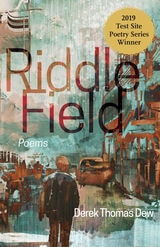
Riddle Field
PoemsDerek Thomas Dew
University of Nevada Press, 2020
"Dew is an exciting and complex new voice in contemporary poetry." —Publisher's Weekly
The beautifully crafted poems in Riddle Field explore two parallel themes, the impact of the impending destruction of a dam on a small town and the trauma of sexual abuse and eventual recovery from it. This work focuses on the environment, human and physical, in which the loss of nature and innocence is born and calls attention to the many ways we create both intimacy and distance when trauma is hidden or denied. Derek Thomas Dew’s language is harsh, honest, and sometimes heartbreaking. His poems capture the confusion and fatigue that must be navigated for a victim of abuse to piece himself back together and the internal strife that comes with carry-ing a traumatic secret that can no longer be ignored.
Rich with unforgettable images and the quiet strength of hard-won survival, Riddle Field tackles the complex process of achieving self-awareness and recovery in the wake of profound trauma.
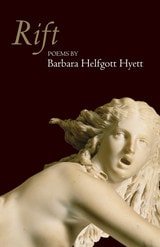
Rift
PoemsBarbara Helfgott Hyett
University of Arkansas Press, 2008
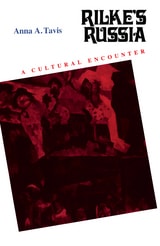
Rilke's Russia
A Cultural EncounterAnna A. Tavis
Northwestern University Press, 1996

Rimbaud and Jim Morrison
The Rebel as PoetWallace Fowlie
Duke University Press, 1994
In 1968 Jim Morrison, founder and lead singer of the rock band the Doors, wrote to Wallace Fowlie, a scholar of French literature and a professor at Duke University. Morrison thanked Fowlie for producing an English translation of the complete poems of Rimbaud. He needed the translation, he said, because, "I don’t read French that easily. . . . I am a rock singer and your book travels around with me." Fourteen years later, when Fowlie first heard the music of the Doors, he recognized the influence of Rimbaud in Morrison’s lyrics.
In Rimbaud and Jim Morrison Fowlie, a master of the form of the memoir, reconstructs the lives of the two youthful poets from a personal perspective. In their twinned stories he discovers an uncanny symmetry, a pattern far richer than the simple truth that both led lives full of adventure and both made poetry of their thirst for the liberation of the self. The result is an engaging account of the connections between an exceptional French symbolist who gave up writing poetry at the age of twenty, died young, and whose poems are still avidly read to this day, and an American rock musician whose brief career ignited an entire generation and has continued to fascinate millions around the world in the twenty years since his death in Paris. In this dual portrait, Fowlie gives us a glimpse of the affinities and resemblances between European literary traditions and American rock music and youth culture in the late twentieth century.
A personal meditation on two unusual, yet emblematic, cultural figures, this book also stands as a summary of a noted scholar’s lifelong reflections on creative artists.
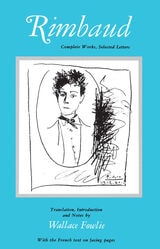
Rimbaud
COMPLETE WORKS, SELECTED LETTERSJean Nicholas Arthur Rimbaud
University of Chicago Press, 1967
"This handsome edition, which makes France's most remarkable poet readily available in the U.S., may well be a literary landmark comparable to Baudelaire's introduction of Edgar Allan Poe in France a century earlier."—Anna Balakian, New York Times Book Review
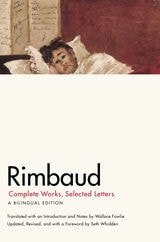
Rimbaud
Complete Works, Selected Letters, a Bilingual EditionJean Nicholas Arthur Rimbaud
University of Chicago Press, 2005
The first translation of the poet's complete works when it was published in 1966, Rimbaud: Complete Works, Selected Letters introduced a new generation of Americans to the alienated genius—among them the Doors's lead singer Jim Morrison, who wrote to translator Wallace Fowlie to thank him for rendering the poems accessible to those who "don't read French that easily." Forty years later, the book remains the only side-by-side bilingual edition of Rimbaud's complete poetic works.
Thoroughly revising Fowlie's edition, Seth Whidden has made changes on virtually every page, correcting errors, reordering poems, adding previously omitted versions of poems and some letters, and updating the text to reflect current scholarship; left in place are Fowlie's literal and respectful translations of Rimbaud's complex and nontraditional verse. Whidden also provides a foreword that considers the heritage of Fowlie's edition and adds a bibliography that acknowledges relevant books that have appeared since the original publication. On its fortieth anniversary, Rimbaud remains the most authoritative—and now, completely up-to-date—edition of the young master's entire poetic ouvre.
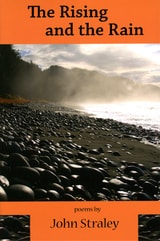
Rising and the Rain
Collected PoemsJohn Straley
University of Alaska Press, 2008
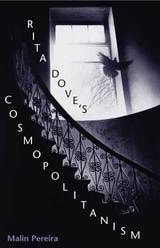
Rita Dove's Cosmopolitanism
POEMSMalin Pereira
University of Illinois Press, 2003
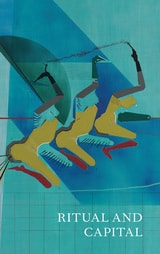
Ritual and Capital
Edited by Bard Graduate Center and Wendy's Subway
Bard Graduate Center, 2020
The publication of Ritual and Capital is the culmination of a series of public readings organized by Wendy’s Subway, a nonprofit organization in Brooklyn, as part of their Spring 2017 Reading Room residency at the Bard Graduate Center. Copublished by the Bard Graduate Center and Wendy’s Subway, Ritual and Capital is the first title in the BGCX series, a publication series designed to expand time-based programming after the events themselves have ended. Springing from the generative spontaneity of conversation, performance, and hands-on engagement as their starting points, these experimental publishing projects will provide space for continued reflection and research in a form that is inclusive of a variety of artists and makers.
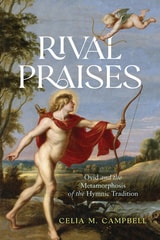
Rival Praises
Ovid and the Metamorphosis of the Hymnic TraditionCelia M. Campbell
University of Wisconsin Press, 2024

River Octopus
Paul Christiansen
University of Arkansas Press, 2027
River of Light
A Conversation with KabirJohn Morgan
University of Alaska Press, 2014
River of Light: A Conversation with Kabir is centered in one man’s meditations and revelations while traveling on a river. John Morgan spent a week traveling the Copper River in Southcentral Alaska, and the resulting encounters form the heart of this book-length poem. The river’s shifting landscape enriches the poem’s meditative mood while currents shape the poem and the pacing of its lines. The mystic poet Kabir is Morgan’s internal guide and serves as a divine foil through quiet stretches that bring to mind questions about war and human nature. Artwork by distinguished Alaska artist Kesler Woodward is a sublime companion to the text.
A combination of adventurer’s tale and spiritual quest, River of Light: A Conversation with Kabir takes the reader on a soulful journey that is both deeply personal and profoundly universal.

Road Down Troublesome
Anita Skeen
Michigan State University Press, 2027
A poetic journey through memory, loss, and the stories that define us, Road Down Troublesome blends an unmistakable Appalachian voice with fierce emotional clarity. Through a series of poems that traverse emotional and physical landscapes, Skeen maps a journey toward insight in the wake of death, loss, and grief. The collection foregrounds the shaping forces of the mother-daughter relationship, ecological fragility, and the sustaining bonds of friendship. Opening with a nod to Lisel Mueller’s invitation to give grief language, the book culminates in “After,” a poem that embodies the stillness and transformation achieved through the act of telling.
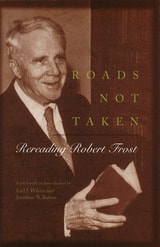
Roads Not Taken
Rereading Robert FrostEdited & Intro by Earl J. Wilcox & Jonathan N. Barron
University of Missouri Press, 2000
In Roads Not Taken, Earl J. Wilcox and Jonathan N. Barron bring a new freshness and depth to the study of one of America's greatest poets. While some critics discounted Frost as a poet without technical skill, rhetorical complexity, or intellectual depth, over the past decade scholars have begun to view Robert Frost's work from many new perspectives. Critical hermeneutics, culture studies, feminism, postmodernism, and textual editing all have had their impact on readings of the poet's life and work. This collection of essays is the first to account for the variety of these new perceptions.
Appealing to a wide literary community, and in keeping with Frost's own poetic goals, these twelve essays fall into four distinct categories: gender, biography and cultural studies, the intertext, and poetics and theory.
All the contributors, many of whom have written books on Frost, are widely recognized scholars. Their diverse viewpoints and collective expertise make this volume of essays the most significant contribution to Frost criticism to be published in over twenty years.
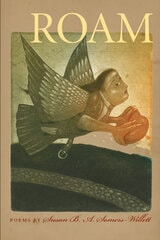
Roam
Susan B. A. Somers-Willet
Southern Illinois University Press, 2006
Roam explores the loss of a parent to cancer and the resulting uprootedness that loss can create. In searching for a sense of home and belonging, this collection of free verse looks both inward and outward, to landscapes rural and urban, and speaks in haunting and musical lyrics. Unexpected voices emerge from history and myth—those of Joan of Arc, Ophelia, Circe, Daedalus and Icarus, and Achilles’ mother, Thetis—and mingle with the author’s own voice. From the naming of the first woman, Eve, to the naming of the first European child born in the Americas, Virginia Dare, these characters seek full houses and, instead, discover empty ones. In a voice that is southern, feminist, and unflinching in its assessments of the self, Susan B. A. Somers-Willett treats personal loss without ceremony or nostalgia. The poems of Roam look homeward while acknowledging that one can never return to such elusive comforts. Her lyrics reveal the dangers and delights of an ever-changing, ever-traveling sense of self.
Robert Frost and Feminine Literary Tradition
Karen L. Kilcup
University of Michigan Press, 1998
Robert Frost and the Challenge of Darwin
Robert Faggen
University of Michigan Press, 2001
Combining both intellectual history and detailed analysis of Frost's poems, Robert Faggen shows how Frost's reading of Darwin reflected the significance of science in American culture from Emerson and Thoreau, through James and pragmatism. He provides fresh and provocative readings of many of Frost's shorter lyrics and longer pastoral narratives as they illustrate the impact of Darwinian thought on the concept of nature, with particular exploration of man's relationship to other creatures, the conditions of human equality and racial conflict, the impact of gender and sexual differences, and the survival of religion.
The book shows that Frost was neither a pessimist lamenting the uncertainties of the Darwinian worldview, nor a humanist opposing its power. Faggen draws on Frost's unpublished notebooks to reveal a complex thinker who willingly engaged with the difficult moral and epistemological implications of natural science, and showed their consonance with myths and traditions stretching back to Milton, Lucretius, and the Old Testament. Frost emerges as a thinker for whom poetry was not only artistic expression, but also a forum for the trial of ideas and their impact on humanity.
Robert Frost and the Challenge of Darwin provides a deeper understanding not only of Frost and modern poetry, but of the meaning of Darwin in the modern world, the complex interrelations of literature and science, and the history of American thought.
"A forceful, appealing study of the Frost-Darwin relation, which has gone little noted by previous scholars, and a fresh explanation of Frost's ambivalent relation to modernism, which he scorned but also influenced" --William Howarth, Princeton University
Robert Faggen is Associate Professor of Literature, Claremont McKenna College and Adjunct Associate Professor, Claremont Graduate School.
Robert Hayden in Verse
New Histories of African American Poetry and the Black Arts EraDerik Smith
University of Michigan Press, 2018
This book sheds new light on the work of Robert Hayden (1913–80) in response to changing literary scholarship. While Hayden’s poetry often reflected aspects of the African American experience, he resisted attempts to categorize his poetry in racial terms. This fresh appreciation of Hayden’s work recontextualizes his achievements against the backdrop of the Black Arts Movement and traces his influence on contemporary African American poets. Placing Hayden at the heart of a history of African American poetry and culture spanning the Harlem Renaissance to the Hip-Hop era, the book explains why Hayden is now a canonical figure in 20th-century American literature.
In deep readings that focus on Hayden’s religiousness, class consciousness, and historical vision, author Derik Smith inverts earlier scholarly accounts that figure Hayden as an outsider at odds with the militancy of the Black Arts movement. Robert Hayden in Verse offers detailed descriptions of the poet’s vigorous contributions to 1960s discourse about art, modernity, and blackness to show that the poet was, in fact, an earnest participant in Black Arts-era political and aesthetic debates.
Robert Hayden
Essays on the PoetryLaurence Goldstein and Robert Chrisman, Editors
University of Michigan Press, 2013
This collection of essays by leading critics and poets charts Robert Hayden’s growing reputation as a major writer of some of the twentieth century’s most important poems on African-American themes, including the famed “Middle Passage” and “Frederick Douglass.” The essays illuminate the themes and techniques that established Hayden as a modernist writer with affinities to T. S. Eliot, Federico Garcia Lorca, and W. B. Yeats, as well as to traditions of African-American writings that include such figures as Countee Cullen and Langston Hughes.
Robert Hayden: Essays on the Poetryis the first and only book to collect significant essays on this distinguished poet. Covering sixty years of commentary, book reviews, essays, and Hayden’s own published materials, this volume is an invaluable contribution to our understanding of the poet’s vision of experience, artistry, and influence. The book includes forty different works that examine the life and poetry of Hayden, the first African-American to serve as Consultant in Poetry to the Library of Congress (the post now called Poet Laureate) and to receive the Grand Prix de la Poesie at the First World Festival of Negro Arts, Dakar, Senegal, in 1966.
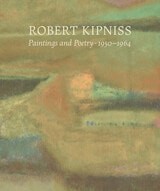
Robert Kipniss
Paintings and Poetry, 1950–1964Robert Kipniss
The Artist Book Foundation, 2013
A comprehensive look at a memorable period in the celebrated painter and printmaker's life and career, Robert Kipniss: Paintings and Poetry, 1950–1964 is the result of his many arduous months revisiting his more-than-half-a-century-ago writings and peoms that were stashed away and essentially forgotten. "Some of the poems are straightforward, some are infused with surreal irony, and some are angry," says Kipniss in his candid and honest preface. Thoughtful and articulate from conception to completion, his never-before-published poems are choreographed with his early paintings in this monograph's contemplation of these influential and foundational fourteen years. "When I stopped writing [in 1961] my vision was no longer divided between word-thinking and picture-thinking: these approaches had merged and in expressing myself I was more whole," reflects Kipniss in his retrospective musings.
This written and visual account of previously unpublished poems and critically acclaimed early paintings includes two astute and illustrative essays that further engage the reader in the evolution of the artist's prolific oeuvre. His prints, drawings, and paintings are remarkable for their eloquence and refinement, earning him international recognition for his expansive landscapes and small town vistas, as well as quiet interors and intimate still lifes.
Readers of this seminal volume are all the richer for catching a glimpse of an intensely personal segment of this accomplished artist's private history. In an unambiguous assessment, Kipniss elaborates, "The most significant insight that arose in this undertaking...came when I began to collate reproductions of my paintings of the 1950s. I could clearly see that my work in the two mediums were from very differing parts of my psyche, and that while they were both in themselves completely engaged, they were not in any way together."
Robert Lowell's Life and Work
Damaged GrandeurRichard Tillinghast, Editor
University of Michigan Press, 1995
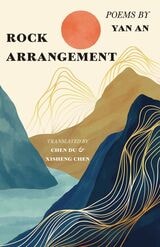
Rock Arrangement
Yan An
Carnegie Mellon University Press, 2026
An English translation of an award-winning collection by Chinese poet Yan An.
Rock Arrangement by Yan An, a prominent contemporary Chinese poet, won the Sixth Lu Xun Literary Prize, China’s highest literary honor, in 2014. Representing China’s highest poetic achievements from 2010 to 2013, this poetry collection was translated into English for the first time and was a runner-up for Carnegie Mellon University Press’s 2025 Literary Translation Prize.
Akin to eco-poetry in their core themes, characterized by surrealism, mythical elements, and high abstraction, and even abstruseness, these poems integrate regional culture, surrealist poetics, and philosophical reflection. They skillfully employ a variety of vivid rhetorical devices and create contrasts through unconventional combinations of imagery, developing a distinctive poetic and spiritual language. Rock Arrangement is a landmark work in contemporary Chinese poetry that combines intellectual depth with artistic innovation.
Rock Island Hiking Club
Ray A. Young Bear
University of Iowa Press, 2001
The narrator in this latest collection of poems by Ray Young Bear is alter ego and spiritual seeker Edgar Bearchild, who balances the hapless polarities of life in the Black Eagle Child Settlement with wry humor, a powerful intelligence, and the occasional designer drug. Bearchild is forever infused with revelations both modern and ancient, forever influenced by tribal history, animism, supernaturalism, religion, and mythology.
Whether faced with tragedy or comedy, Bearchild lives in a world replete with signs and portents, from the Lazy-Boy recliner that visually accesses a faraway crime to the child's handprint that mysteriously appears on a frosty ladder. Edgar and his wife, Selene Buffalo Husband, and the other members of the Black Eagle Child Settlement create and recreate prophecies that “quietly wait and glow” in the “mythical darkness that would follow the stories.”
Poet, novelist, and performing artist Ray Young Bear is a tribal member of the Meskwaki Nation of central Iowa. He is the author of Winter of the Salamander, The Invisible Musician, Black Eagle Child: The Facepaint Narratives (Iowa, 1992), and Remnants of the First Earth.
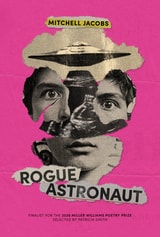
Rogue Astronaut
Mitchell Jacobs
University of Arkansas Press, 2026
At the core of Rogue Astronaut, Mitchell Jacobs’s debut poetry collection, is a mystery: Was the poet’s father abducted by aliens as a teenager? From this uncanny family lore spins a gravitational field of theory, grief, and imagination, spurring speculations about the extraterrestrial as well as the terrestrial question of familial bonds: What are the limits of understanding between two alien anatomies, between two unlike minds? Are we, after all, finally alone?
In poems that continually veer from play to reverence, from body horror to bodily delight, encounters with bed bugs and cuttlefish appear side by side with retro gaming and phantom light. A brother living with delusions turns toward the sky. The poet also peers skyward in search of connection—across family lines, across the body’s borders, across galaxies. Outer space becomes a metaphorical terrain where queer desire and spiritual longing collide. Just as Agent Mulder’s iconic X-Files poster declares “I WANT TO BELIEVE,” so do these poems ache to trust in something more—extraterrestrial life, divine presence, intimacy.
Jacobs’s electrifying collection offers readers a singular voice attuned to the strangeness of living now—where science fiction and memory, tenderness and dissociation, belief and doubt pulse in tangled orbit. With wit, vision, and formal inventiveness, Rogue Astronaut charts a course through the mysterious and the intimate, inviting us to imagine new ways of connecting across distance, time, and the alien terrain of self.
Roll Me in Your Arms
"Unprintable" Ozark Folksongs and Folklore, Volume I, Folksongs and MusicVance Randolph
University of Arkansas Press, 1992
Collected in the field from 1915 through 1955, these tales and songs were considered by the publisher at the time to be too salacious for inclusion in Vance Randolph’s Ozark Folksongs. Randolph came to doubt that they would ever appear in print, and they did not in his lifetime.
Roll Me in Your Arms, Volume I of “Unprintable” Ozark Folksongs and Folklore, includes 180 unexpurgated songs collected by Randolph with tunes transcribed from the original singers. Volume II, Blow the Candle Out, contains rhymes and songs without music as well as other unexpurgated Ozark folk materials, including children’s lore, elements in speech, graffiti, riddles, dance calls, and beliefs.
G. Legman’s painstaking and patient editing, annotating, and crossreferencing richly complement the Randolph collection. The result is a look into a previously neglected area in the study of folksong and folklore in the Ozarks and further evidence of Randolph’s preeminence in the field.
The late Vance Randolph lived in the Ozark Mountains from 1920 until his death in 1980. Although he taught folklore at the University of Arkansas in Fayetteville, he is best remembered for his many years of field research resulting in the national bestseller Pissing in the Snow & Other Ozark Folktales and more than a dozen other books on American folklore.
Roman Poetry
From the Republic to the Silver AgeTranslated and with Introduction by Dorothea Wender
Southern Illinois University Press, 1991
Meshing her own wit, verve, and gusto with that of the Roman poets she translates, Dorothea Wender strips both the cloak of awe and the dusty mantle of boredom from the classics.
Available for the first time in paper, these English verse translations of the major classical Roman poets feature hefty selections from the savage urban satire of Juvenal, the moving philosophy of Lucretius, the elegance of Horace, the grace and humor of Catullus, the grave music of Virgil, the passion of Propertius, the sexy sophistication of Ovid, and the obscenity of Martial.
Noting Wender’s “candor,” the Classical Outlook reported that in “20th-century terms, she makes the poems lively and pertinent.”
The Boston Globe said, “The conciseness is astonishing, the information [in the introductions to each poet] provocative. The freshness of the selections should do much to augment the audience for these poets and may even inspire examination of the originals.”
The best advice came from Wender herself: “Read these good poems.”
Roman Propertius and the Reinvention of Elegy
Jeri Blair DeBrohun
University of Michigan Press, 2003
DeBrohun finds the most striking element of Book 4 to be the apparent polarity of the poems, whose themes are split between new, aetiological subjects of Roman national significance and amatory affairs that evoke the themes of Propertius' first three books. In her compelling reassessment of Propertius' aspirations in Book 4, DeBrohun identifies the conflict between his new ambitions to produce Roman aetiological elegy and his traditional, exclusive devotion to erotic concerns as the central dynamic of his collection. Roman Propertius and the Reinvention of Elegy reveals how the poet came to find in the subcodes of the elegiac genre a medium of interaction between the opposing values of the two themes.
Roman Propertius will interest not only scholars and students of Greek and Roman Poetry but also students of later traditions who are interested in the questions of genre and the relationship between poetry and wider cultural discourses.
Jeri Blair DeBrohun is Associate Professor of Classics, Brown University.
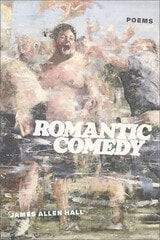
Romantic Comedy
James Allen Hall
Four Way Books, 2023
James Allen Hall returns to poetry with Romantic Comedy, a sophomore collection sounding the parameters of genre to subvert cultural notions of literary value and artistic legitimacy. What realities do stories authorize, and which remain untold? “This story,” they profess in “Biography,” “is mine: there was / a wound, then a world.” Rather than playing into the attention economy’s appetite for sensationalism, Hall’s poems resist the formulaic while paying homage to the oeuvre, a formal balancing act that celebrates queer life.The poems create liberatory narratives that break constraints or speak through them. Hall parses music from the blizzard — as when “one year / [they] watched the snow / pile to [their] door / all December, all / January,” “the year [they] wanted / to die,” and, faced with winter’s architecture, “learned / another song. Sang / another way.” Whether grieving the death of their father, documenting the survival of sexual assault, interrogating the scripts of addiction, or revisiting an ’80s crime thriller, Hall’s second collection constantly affirms the ingenuity of self-definition as a technology of survival.
Romantic Poetry
Recent Revisionary CriticismKroeber, Karl
Rutgers University Press, 1993
Romantic Vision, Ethical Context
Novalis and Artistic AutonomyGeza Molnar
University of Minnesota Press, 1987
Exploring the full range of Novalis's (the pen name of the German poet and philosopher Friedrich von Hardenberg) work, von Molnar shows how he dealt, in theory and practice, with a central issue in Romanticism-the emerging concept of the autonomous self and its relation.
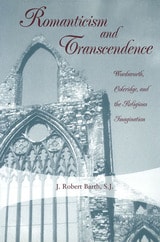
Romanticism and Transcendence
Wordsworth, Coleridge, and the Religious ImaginationJ. Robert Barth, S.J.
University of Missouri Press, 2003
Romanticism’s Other Minds
Poetry, Cognition, and the Science of SociabilityJohn Savarese
The Ohio State University Press, 2020
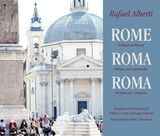
Rome
Pedestrians BewareRafael Alberti
Swan Isle Press, 2024
After his long exile in France and Argentina following the Spanish Civil War, Rafael Alberti’s final home in exile was Rome, where he wrote Roma: Peligro para caminantes (Rome: Pedestrians Beware). There, Romulus and Remus sneak down to the Tiber to suckle on feral cats, a jack of all trades pisses on the poet’s shoes, whistling as he walks away, and in the Campo de’ Fiori the poet compares sonnets with the wandering spirit of Giuseppe Gioachino Belli, all in the shadow of the glory of Rome’s imperial ruins.
Two suites of sonnets open and close the book, while in between, Alberti displays masterful poems in metered and free verse, rhyming couplets, and a numbered series of short poems. The blending of classical tradition with post-modern echoes the darkness and luminosity that exist within the poems, tinged with longing, nostalgia, love, as well as hope. In the end, the Eternal City is a refuge for Alberti:”I left for you all that I once held dear. / Oh Rome, my sorrow pleads, hold out your hands / and give me everything I left for you.”
This unique trilingual edition features exquisite and nuanced translations in English and Italian from the original Spanish by Anthony Geist and Giuseppe Leporace alongside visually evocative photographs of Rome by Adam Weintraub. Readers will want to take this poetic walk in Rome since what sometimes elicits caution, an aspect of danger, also becomes a destination for discovery.
Romey's Order
Atsuro Riley
University of Chicago Press, 2010
Romey's Order is an indelible sequence of poems voiced by an invented (and inventive) boy-speaker called Romey, set alongside a river in the South Carolina lowcountry.
As the word-furious eye and voice of these poems, Romey urgently records--and tries to order--the objects, inscape, injuries, and idiom of his "blood-home" and childhood world. Sounding out the nerves and nodes of language to transform "every burn-mark and blemish," to “bind our river-wrack and leavings," Romey seeks to forge finally (if even for a moment) a chord in which he might live. Intently visceral, aural, oral, Atsuro Riley's poems bristle with musical and imaginative pleasures, with story-telling and picture-making of a new and wholly unexpected kind.
Rookery
Traci Brimhall
Southern Illinois University Press, 2010
Traveling to the most intimate extremes of the human heart
Fraught with madness, brutality, and ecstasy, Traci Brimhall’s Rookery delves into the darkest and most remote corners of the human experience. From the graveyards and battlefields of the Civil War to the ancient forests of Brazil, from desire to despair, landscapes both literal and emotional are traversed in this unforgettable collection of poems. Brimhall guides readers through ever-winding mazes of heartbreak and treachery, and the euphoric dreams of missionaries. The end of days, the intoxication of religion that at times borders on terror, and the post-evangelical experience intertwine with the haunting redemptions and metamorphoses found in violence. These tender yet ruthless poems, brimming with danger and longing, lure readers to “a place where everyone is transformed by suffering.”
Room Where I Was Born
Brian Teare
University of Wisconsin Press, 2003
Roots and Resilience
California Ranchers in Their Own WordsSusan Edinger Marshall
University of Nevada Press, 2024
The editors have drawn together these stories, poems, and musings from ranchers across the state, calling upon real people to share their experiences, and beckoning readers to find a shared understanding concerning often divisive land-use topics. Many perspectives are considered, including those of transplanted suburbanites to seventh-generation heirs. Notably, many women’s writings are including in the book, offering unique and valuable perspectives on ranching culture.
Roots and Resilience gives voice to California’s Indigenous, Mexican American, Basque and other European American ranchers, asking the reader to find common ground in the name of land stewardship and conservation.
Rosa's Einstein
PoemsJennifer Givhan
University of Arizona Press, 2019
In this full-length poetry collection, the girls of Rosa’s Einstein embark on a quest to discover what is real and what is possible in the realms of imagination, spurred on by scientific curiosity and emotional resilience. Following a structural narrative arc inspired by the archetypal hero’s journey, sisters Rosa and Nieve descend into the desert borderlands of New Mexico to find resolution and healing through a bold and fearless examination of the past, meeting ghostly helpers and hinderers along the way. These metaphorical spirits take the shape of circus performers, scientists, and Lieserl, the lost daughter Albert Einstein gave away.
Poet Jennifer Givhan reimagines the life of Lieserl, weaving her search for her scientist father with Rosa and Nieve’s own search for theirs. Using details both from Einstein’s known life and from quantum physics, Givhan imagines Lieserl in a circus-like landscape of childhood trauma and survival, guided by Rosa and Nieve.
Rosarium
PoemsHannah Dow
Acre Books, 2018
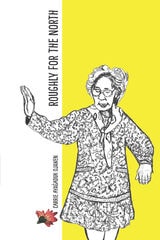
Roughly For the North
Carrie Ayagaduk Ojanen
University of Alaska Press, 2018
Roughly for the North is a tender and complex portrait of an Arctic and sub-arctic world. Full of lush language and imagery, each poem is an act of devotion and love to one’s family and land. Carrie Ayaġaduk Ojanen weaves a moving portrait of grief, of the rippling effects of historical trauma on succeeding generations, of resilience in the face of adversity, of respect for the Alaska Native traditions she grew up in. With vivid imagery, she draws the reader into Northern life, where the spiritual and industrial collide. She uses formalism and lyrical free verse to explore the natural world and to conjure a place of staggering beauty that hides death around every corner.
A member of the Ugiuvamiut tribe, Ojanen grounds her work in a web of familial relationships. Especially important is her connection with her grandparents, members of the last generation to make their home on Ugiuvak (King Island), Alaska. With heartfelt verse, her poems reflect the staggering cultural changes her grandparents faced and the way traditional art forms continue to unite her community and help them connect to the past.

Round Lake
Grace Bonner
Four Way Books, 2016