Results by title
18284 books match the query 'United States' and 833 start with r
Racing Translingualism in Composition
Toward a Race-Conscious Translingualismedited by Tom Do and Karen Rowan
Utah State University Press, 2022
This collection extends the disciplinary conversations about translingualism by foregrounding the role race and racism play in the construction and maintenance of language differences. In doing so, the contributors examine the co-naturalization of race and language in order to theorize a race-conscious translingual praxis. The book begins by offering generative critiques of translingualism, centering on the ways in which the approach’s democratic orientation to language avoids issues of race, language, and power and appeals to colorblind racist tropes of equal opportunity. Following these critiques, contributors demonstrate the important intersections of race and translingualism by drawing upon voices typically marginalized by monolingual language ideologies and pedagogies. Finally, Racing Translingualism concludes by attending to the pedagogical implications of a race-conscious translingual praxis in writing and literacy education.
Making the case for race-conscious, rather than colorblind, theories and pedagogies, Racing Translingualism offers a unique take on how translingualism is theorized and practiced and moves the field forward through its direct consideration of the links between language, race, and racism.
Contributors: Lindsey Albracht, Steven Alvarez, Bethany Davila, Tom Do, Jaclyn Hilberg, Bruce Horner, Aja Martinez, Esther Milu, Stephanie Mosher, Yasmine Romero, Karen Rowan, Rachael Shapiro, Shawanda Stewart, Brian Stone, Victor Villanueva, Missy Watson
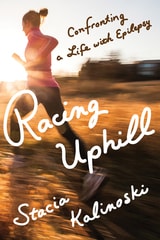
Racing Uphill
Confronting a Life with EpilepsyStacia Kalinoski
University of Minnesota Press, 2025
The candid, inspiring story of a woman’s experience with a chronic, unpredictable neurological condition
When twenty-nine-year-old reporter Stacia Kalinoski regained consciousness on a couch at the TV station where she worked, she assumed that she’d had another seizure. But the electrical storm that had just torn through her brain was more destructive than she could have imagined, and the broadcast journalism career she loved swiftly came to an end. Forced to confront the reality of her medical condition, Kalinoski made the risky decision to undergo brain surgery, targeting the epilepsy that was ravaging her life.
In Racing Uphill, Kalinoski describes the seizures that occurred while she was running, which led to her pursuit of an uncertain cure. Rallying the grit she developed as an athlete and engaging the research and reporting skills she acquired as a journalist, she gives us a rare inside look at the ways epilepsy can change a life. Moving beyond her own personal experience, Kalinoski interviews prominent epileptologists to understand how seizures can spread, steal memories, and create strange behaviors and mood disorders. She seamlessly joins what she learned from her research with her own story, offering valuable insight into the experience of grappling with a relentless neurological disease.
The vivid auras that preceded seizures and the damage that followed; the toll of her epilepsy on her family and loved ones; the extraordinary determination her reckoning required—these are all part of Kalinoski’s story of adversity, denial, acceptance, and resilience. In sharing the remarkable opportunity that epilepsy presented for her courage and growth, Stacia Kalinoski speaks to anyone facing an uphill battle and offers inspiration for taking control of one’s own health.
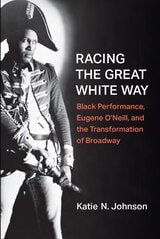
Racing the Great White Way
Black Performance, Eugene O’Neill, and the Transformation of BroadwayKatie N. Johnson
University of Michigan Press, 2023
Finalist: 2023 Theatre Library Association George Freedley Memorial Award
The early drama of Eugene O’Neill, with its emphasis on racial themes and conflicts, opened up extraordinary opportunities for Black performers to challenge racist structures in modern theater and cinema. By adapting O’Neill’s dramatic writing—changing scripts to omit offensive epithets, inserting African American music and dance, or including citations of Black internationalism--theater artists of color have used O’Neill’s texts to raze barriers in American and transatlantic theater.
Challenging the widely accepted idea that Broadway was the white-hot creative engine of U.S. theater during the early 20th century, author Katie N. Johnson reveals a far more complex system of exchanges between the Broadway establishment and a vibrant Black theater scene in New York and beyond to chart a new history of American and transnational theater. In spite of their dichotomous (and at times problematic) representation of Blackness, O’Neill’s plays such as The Emperor Jones and All God’s Chillun Got Wings make ideal case studies because of the way these works stimulated traffic between Broadway and Harlem—and between white and Black America. These investigations of O’Neill and Broadway productions are enriched by the vibrant transnational exchange found in early to mid-20th century artistic production. Anchored in archival research, Racing the Great White Way recovers not only vital lost performance histories, but also the layered contexts for performing bodies across the Black Atlantic and the Circum-Atlantic.
Racing to a Cure
A Cancer Victim Refuses Chemotherapy and Finds Tomorrow's Cures in Today's Scientific LaboratoriesNeil Ruzic
University of Illinois Press, 2003
Although chemotherapy harms the immune system and is increasingly demonstrated to be an ineffective long-term cure for the vast majority of cancers, it remains the standard treatment for most cancer patients. Ruzic, a former scientific magazine publisher and originator of a science center, refused to accept this status quo, and instead plunged into the world of cutting-edge treatments, exploring the frontiers of cancer science with revolutionary results.
Ruzic went on the offensive: visiting scores of laboratories, gathering information, talking to researchers, and effectively becoming his own patient-care advocate. This book presents his findings. A scathing critique of the chemotherapy culture as well as unscientific "alternative" therapies, the book endorses state-of-the-art molecularly based technologies, making it an illuminating and necessary read for anyone interested in cancer research, especially patients and their families and physicians.
Neil Ruzic was expected to die within two years of his initial diagnosis. Five years later he has been declared cancer-free and considers himself cured.
Racism Postrace
Roopali Mukherjee, Sarah Banet-Weiser, and Herman Gray, editors
Duke University Press, 2019
Contributors. Inna Arzumanova, Sarah Banet-Weiser, Aymer Jean Christian, Kevin Fellezs, Roderick A. Ferguson, Herman Gray, Eva C. Hageman, Daniel Martinez HoSang, Victoria E. Johnson, Joseph Lowndes, Roopali Mukherjee, Safiya Umoja Noble, Radhika Parameswaran, Sarah T. Roberts, Catherine R. Squires, Brandi Thompson Summers, Karen Tongson, Cynthia A. Young
Racism and Cultural Studies
Critiques of Multiculturalist Ideology and the Politics of DifferenceE. San Juan Jr.
Duke University Press, 2002
Individual chapters engage the themes of ethnicity versus racism, gender inequality, sexuality, and the politics of identity configured with the discourse of postcoloniality and postmodernism. Questions of institutional racism, social justice, democratization, and international power relations between the center and the periphery are explored and analyzed. San Juan fashions a critique of dominant disciplinary approaches in the humanities and social sciences and contends that “the racism question” functions as a catalyst and point of departure for cultural critiques based on a radical democratic vision. He also asks urgent questions regarding globalization and the future of socialist transformation of “third world” peoples and others who face oppression.
As one of the most notable cultural theorists in the United States today, San Juan presents a provocative challenge to the academy and other disciplinary institutions. His intervention will surely compel the attention of all engaged in intellectual exchanges where race/ethnicity serves as an urgent focus of concern.
Racism
A Critical AnalysisMike Cole
Pluto Press, 2015
Mike Cole tackles three countries in-depth: the United Kingdom, the United States and Australia. In the United Kingdom, he focuses on the effects of colonialism as well as looking at non-colour-coded racism, such as anti-Gipsy, Roma, and Traveller racism and xeno-racism directed at Eastern Europeans. Turning to the United States, Cole charts the dual legacies of indigenous genocide and slavery, as well as exploring anti-Latina/o and anti-Asian racism. Finally, in Australia, he interrogates the idea of "Terra Nullius" and its ongoing impact on the indigenous peoples, as well as other forms of racism, such as that experienced by South Sea Islanders, anti-Asian racism, and that which targets migrants. The Pauline Hanson phenomenon is also addressed. Islamophobia, antisemitism and anti-Irish racism are also dealt with in the book, as is that aimed at asylum-seekers.
Cole demonstrates that racism is both endemic and multifaceted. This book will undoubtedly establish itself as required reading for students and other critical readers looking for a comprehensive, critical overview of the study of racism in Anglophone countries.
Racist Love
Asian Abstraction and the Pleasures of FantasyLeslie Bow
Duke University Press, 2022
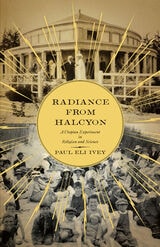
Radiance from Halcyon
A Utopian Experiment in Religion and SciencePaul Eli Ivey
University of Minnesota Press, 2013
In May 1904, the residents of Halcyon—a small utopian community on California’s central coast—invited their neighbors to attend the grand opening of the Halcyon Hotel and Sanatorium. As part of the entertainment, guests were encouraged to have their hands X-rayed. For the founders and members of Halcyon, the X-ray was a demonstration of mysterious spiritual forces made practical to human beings.
Radiance from Halcyon is the story not only of the community but also of its uniquely inventive members’ contributions to religion and science. The new synthesis of religion and science attempted by Theosophy laid the foundation for advances produced by the children of the founding members, including microwave technology and atomic spectral analysis. Paul Eli Ivey’s narrative starts in the 1890s in Syracuse, New York, with the rising of the Temple of the People, a splinter group of the theosophical movement. After developing its ideals for an agricultural and artisanal community, the Temple purchased land in California and in 1903 began to live its dream there.
In addition to an intriguing account of how a little-known utopian religious community profoundly influenced modern science, Ivey offers a wide-ranging cultural history, encompassing Theosophy, novel healing modalities, esoteric architecture, Native American concepts of community, socialist utopias, and innovative modern music.
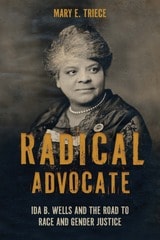
Radical Advocate
Ida B. Wells and the Road to Race and Gender JusticeMary E. Triece
University of Alabama Press, 2025
Pinpoints the persuasive strategies that typified Wells’s efforts to shape broader cultural conversations concerning the causes of racial, social, and gender inequity
Born into the brutal reality of slavery, Ida B. Wells rose to become an audacious journalist, teacher, and activist for racial and gender justice. In Radical Advocate, Mary E. Triece examines the rhetorical strategies employed by Wells to challenge deeply rooted systems of oppression, strategies that remain powerful and relevant today.
Triece introduces the concept of “radical embodied advocacy” to give an account of Wells’s unique position as a Black woman whose personal encounters with white violence were palpable, experienced physically and mentally. White men lynched Wells’s friends and threatened her own life, forcing her into exile after destroying the very press on which she wrote and edited. From this perspective, Wells understood lynching as linked to white economic and political control. Through a close analysis of Wells’s speeches, writings, and journalism, Triece reveals how Wells pioneered a form of “intersectional journalism” that centered the voices of those marginalized by race, gender, and class.
By examining Wells’s work through the lens of philosophy, rhetoric, and Black feminism, Triece underscores the epistemic challenges faced by marginalized advocates and the importance of their perspectives in shaping social change. Radical Advocate ultimately positions Wells as a prophetic figure whose insights into the systemic nature of racism remain profoundly relevant in today’s world.
Radical Aesthetics and Modern Black Nationalism
GerShun Avilez
University of Illinois Press, 2016
A bold addition to an advancing field, Radical Aesthetics and Modern Black Nationalism rewrites recent black cultural production even as it uncovers unexpected ways of locating black radicalism.
Radical American Partisanship
Mapping Violent Hostility, Its Causes, and the Consequences for DemocracyNathan P. Kalmoe and Lilliana Mason
University of Chicago Press, 2022
Political violence is rising in the United States, with Republicans and Democrats divided along racial and ethnic lines that spurred massive bloodshed and democratic collapse earlier in the nation’s history. The January 6, 2021 insurrection and the partisan responses that ensued are a vivid illustration of how deep these currents run. How did American politics become so divided that we cannot agree on how to categorize an attack on our own Capitol?
For over four years, through a series of surveys and experiments, Nathan P. Kalmoe and Lilliana Mason have been studying radicalism among ordinary American partisans. In this groundbreaking book, they draw on new evidence—as well as insights from history, psychology, and political science—to put our present partisan fractiousness in context and to explain broad patterns of political and social change. Early chapters reveal the scope of the problem, who radical partisans are, and trends over time, while later chapters identify the conditions that partisans say justify violence and test how elections, political violence, and messages from leaders enflame or pacify radical views. Kalmoe and Mason find that ordinary partisanship is far more dangerous than pundits and scholars have recognized. However, these findings are not a forecast of inevitable doom; the current climate also brings opportunities to confront democratic threats head-on and to create a more inclusive politics. Timely and thought-provoking, Radical American Partisanship is vital reading for understanding our current political landscape.
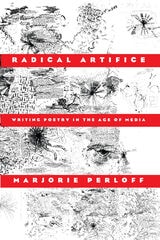
Radical Artifice
Writing Poetry in the Age of MediaMarjorie Perloff
University of Chicago Press, 1992
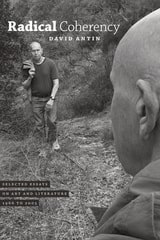
Radical Coherency
Selected Essays on Art and Literature, 1966 to 2005David Antin
University of Chicago Press, 2011
“We got to talking”—so David Antin begins the introduction to Radical Coherency, embarking on the pursuit that has marked much of his breathless, brilliantly conversational work. For the past forty years, whether spoken under the guise of performance artist or poet, cultural explorer or literary critic, Antin’s innovative observations have helped us to better understand everything from Pop to Postmodernism.
Intimately wedded to the worlds of conceptual art and poetics, Radical Coherency collects Antin’s influential critical essays and spontaneous, performed lectures (or “talk pieces”) for the very first time, capturing one of the most distinctive perspectives in contemporary literature. The essays presented here range from the first serious assessment of Andy Warhol published in a major art journal, as well as Antin’s provocative take on Clement Greenberg’s theory of Modernism, to frontline interventions in present debates on poetics and fugitive pieces from the ’60s and ’70s that still sparkle today—and represent a gold mine for art historians of the period. From John Cage to Allan Kaprow, Mark Rothko to Ludwig Wittgenstein, Antin takes the reader on an idiosyncratic, personal journey through twentieth-century culture with his trademark antiformalist panache—one thatwill be welcomed by any fan of this consummate trailblazer.
Radical Enfranchisement in the Jury Room and Public Life
Sonali Chakravarti
University of Chicago Press, 2019
With Radical Enfranchisement in the Jury Room and Public Life, Sonali Chakravarti offers a full-throated defense of juries as a democratic institution. She argues that juries provide an important site for democratic action by citizens and that their use should be revived. The jury, Chakravarti argues, could be a forward-looking institution that nurtures the best democratic instincts of citizens, but this requires a change in civic education regarding the skills that should be cultivated in jurors before and through the process of a trial. Being a juror, perhaps counterintuitively, can guide citizens in how to be thoughtful rule-breakers by changing their relationship to their own perceptions and biases and by making options for collective action salient, but they must be better prepared and instructed along the way.
Radical Family
Trailblazing Lesbian Moms Tell Their StoriesEdited by Margaret Mooney
Wisconsin Historical Society Press, 2025
A powerful collection of personal essays from lesbian moms who fought for the right to raise children
For generations, lesbians across the United States were systematically denied opportunities to raise children and build families, opportunities that were readily available to straight people. Radical Family honors the history-making struggles and triumphs of lesbian families in Madison, Wisconsin, who raised children in the 1980s, ’90s, and early 2000s—a time when lesbian motherhood was widely considered extreme and unnatural. In a collection of nine profoundly personal essays, the contributors recount their diverse paths to parenthood, as well as the hopes and challenges each family experienced. While the stories in Radical Family are unique, they all share a common thread: the mothers’ resilience and the risks they took, both small and sweeping, to defend their family’s right to exist.
For lesbians, the desire to raise children has historically been met with vilification and legal and social prejudice. Adoption agencies consistently rejected applications from out lesbians. Doctors and clinics refused to provide fertility treatments and other medical options to help them get pregnant. Lesbians who were able to raise children commonly lost custody to estranged spouses or grandparents.
Trailblazing lesbian mothers—and their children—fought to defy and, ultimately, shift this paradigm. Lesbian parents, like those in Radical Family, created informal networks in their local communities, where they could share survival strategies and find acceptance among other families that looked like theirs. With no rule book to guide them, and few laws to protect them, lesbian mothers created a new—some might even say radical—standard for what it means to be a family.
Over and over, the stories in Radical Family show how families fought back against hatred and homophobia with love, resilience, commitment, and creativity. Their stories deepen our understanding of what it means to be a mother—while showing how safety, belonging, and acceptance are universal human needs.
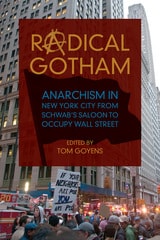
Radical Gotham
Anarchism in New York City from Schwab's Saloon to Occupy Wall StreetEdited by Tom Goyens
University of Illinois Press, 2017
Radical Health
Unwellness, Care, and Latinx Expressive CultureJulie Avril Minich
Duke University Press, 2023
Radical Hospitality
American Policy, Media, and ImmigrationNour Halabi
Rutgers University Press, 2022
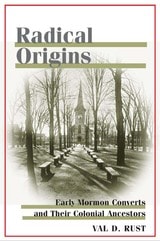
Radical Origins
Early Mormon Converts and Their Colonial AncestorsVal D. Rust
University of Illinois Press, 2004
Utilizing a unique set of meticulously compiled genealogical data, Rust uncovers the ancestors of early church members throughout what we understand as the radical segment of the Protestant Reformation. Coming from backgrounds in the Antinomians, Seekers, Anabaptists, Quakers, and the Family of Love, many colonial ancestors of the church(s early members had been ostracized from their communities. Expelled from the Massachusetts Bay Colony, some were whipped, mutilated, or even hanged for their beliefs.
Rust shows how family traditions can be passed down through the generations, and can ultimately shape the outlook of future generations. This, he argues, extends the historical role of Mormons by giving their early story significant implications for understanding the larger context of American colonial history. Featuring a provocative thesis and stunning original research, Radical Origins is a remarkable contribution to our understanding of religion in the development of American culture and the field of Mormon history.
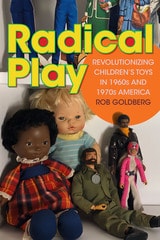
Radical Play
Revolutionizing Children’s Toys in 1960s and 1970s AmericaRob Goldberg
Duke University Press, 2023
Radical Poetics and Secular Jewish Culture
Edited by Stephen Paul Miller and Daniel Morris
University of Alabama Press, 2009
--Franz Kafka
Kafka's quip--paradoxical, self-questioning, ironic--highlights vividly some of the key issues of identity and self-representation for Jewish writers in the 20th century. No group of writers better represents the problems of Jewish identity than Jewish poets writing in the American modernist tradition--specifically secular Jews: those disdainful or suspicious of organized religion, yet forever shaped by those traditions.
This collection of essays is the first to address this often obscured dimension of modern and contemporary poetry: the secular Jewish dimension. Editors Daniel Morris and Stephen Paul Miller asked their contributors to address what constitutes radical poetry written by Jews defined as "secular," and whether or not there is a Jewish component or dimension to radical and modernist poetic practice in general. These poets and critics address these questions by exploring the legacy of those poets who preceded and influenced them--Stein, Zukofsky, Reznikoff, Oppen, and Ginsberg, among others.
While there is no easy answer for these writers about what it means to be a Jew, in their responses there is a rich sense of how being Jewish reflects on their aesthetics and practices as poets, and how the tradition of the avant-garde informs their identities as Jews. Fragmented identities, irony, skepticism, a sense of self as "other" or "outsider," distrust of the literal, and belief in a tradition that questions rather than answers--these are some of the qualities these poets see as common to themselves, the poetry they make, and the tradition they work within.
Radical Representations
Politics and Form in U.S. Proletarian Fiction, 1929–1941Barbara Foley
Duke University Press, 1994
Josephine Herbst, William Attaway, Jack Conroy, Thomas Bell and Tillie Olsen, are among the radical writers whose work Foley reexamines. Her fresh approach to the U.S. radicals' debates over experimentalism, the relation of art to propaganda, and the nature of proletarian literature recasts the relation of writers to the organized left. Her grasp of the left's positions on the "Negro question" and the "woman question" enables a nuanced analysis of the relation of class to race and gender in the proletarian novel. Moreover, examining the articulation of political doctrine in different novelistic modes, Foley develops a model for discussing the interplay between politics and literary conventions and genres.
Radical Representations recovers a literature of theoretical and artistic value meriting renewed attention form those interested in American literature, American studies, the U. S. left, and cultural studies generally.
Radical Roots
Public History and a Tradition of Social Justice ActivismDenise D. Meringolo
Amherst College Press, 2021
"This is a much-needed recalibration, as professional organizations and practitioners across genres of public history struggle to diversify their own ranks and to bring contemporary activists into the fold." — Catherine Gudis, University of California, Riverside.
"Taken all together, the articles in this volume highlight the persistent threads of justice work that has characterized the multifaceted history of public history as well as the challenges faced in doing that work."—Patricia Mooney-Melvin, The Public Historian
Radical Sensations
World Movements, Violence, and Visual CultureShelley Streeby
Duke University Press, 2013
Radical Sisters
Second-Wave Feminism and Black Liberation in Washington, D.C.Anne M. Valk
University of Illinois Press, 2010
Radical Sociologists
Martin Oppenheimer
Temple University Press, 1991

Radical Subject
Third Worldism and the Politics of Race in Asian American Studies, 1968–2000Calvin Cheung-Miaw
Duke University Press, 2027
Radical Unionism in the Midwest, 1900-1950
Rosemary Feurer
University of Illinois Press, 2006
Rosemary Feurer examines the fierce battles between these Midwestern electrical workers and the bitterly anti-union electrical and metal industry, Exploring the role of radicals in local movement formation, Feurer reveals a "civic" unionism that could connect community and union concerns to build solidarity and contest the political economy. District 8's spirited unionism included plant occupations in St. Louis and Iowa; campaigns to democratize economic planning; and strategies for national bargaining that elected officials inevitably branded as part of a communist conspiracy. Though destroyed by reactionaries and an anticommunist backlash, District 8 molded a story that tells another side of the labor movement's formation in the 1930s and 1940s, and can inform current struggles against corporate power in the modern global economy.

Radical Visions and American Dreams
Culture and Social Thought in the Depression YearsRichard H. Pells
University of Illinois Press, 1998
Pells's classic work of American intellectual history includes a new preface.
Radical Writing Center Praxis
A Paradigm for Ethical Political EngagementLaura Greenfield
Utah State University Press, 2019
Large, intersecting systems of oppression manifest in the everyday practices of institutions, classrooms, and writing centers. Local practices in turn influence the surrounding world. Radical Writing Center Praxis therefore challenges the writing center field to resist assumptions of political neutrality and instead to redefine itself in terms of more explicit ethical commitments. In this paradigm it is clear that to engage in anti-oppression work is not merely a special interest but rather a vital interest to all.
Introducing the concepts and vocabulary of radical politics, Radical Writing Center Praxis examines the tensions between the field’s professed beliefs and everyday practices and offers a process by which the writing center discipline as a whole might rebuild itself anew. It will be invaluable to writing center directors, tutors, scholars, and students as well as to administrators and compositionists.
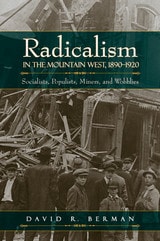
Radicalism in the Mountain West, 1890-1920
Socialists, Populists, Miners, and WobbliesDavid R. Berman
University Press of Colorado, 2013
Focusing on the populist and socialist movements, David R. Berman sheds light on American radicalism with this study of a region that epitomized its rise and fall. As the frontier industrialized, self-reliant pioneers and prospectors transformed into wage- laborers for major corporations with government, military, and church ties. Economically and politically stymied, westerners rallied around homegrown radicals such as William "Big Bill" Haywood and Vincent "the Saint" St. John and touring agitators such as Eugene Debs and Mary "Mother" Jones. Radicalism in the Mountain West tells how volleys of strikes, property damage, executions, and deportations ensued in the absence of negotiation.
Drawing on years of archival research and diverse materials such as radical newspapers, reports filed by labor spies and government agents, and records of votes, subscriptions, and memberships, Berman offers Western historians and political scientists an unprecedented view into the region's radical past.

Radicalism in the States
The Minnesota Farmer-Labor Party and the American Political EconomyRichard M. Valelly
University of Chicago Press, 1989
Richard M. Valelly treats in detail the political economy of the Minnesota Farmer-Labor Party (1918-1944), the most successful radical, state-level party in American history. With the aid of numerous interviews of surviving organizers and participants in the party's existence, Valelly recreates the party's rise to power and subsequent decline, seeking answers to some broad, developmental questions. Why did this type of politics arise, and why did it collapse when it did? What does the party's history tell us about national political change? The answers lie, Valelly argues, in America's transition from the political economy of the 1920s to the New Deal. Combining case study and comparative state politics, he reexamines America's political economy prior to the New Deal and the scope and ironies of the New Deal's reorganization of American politics. The results compellingly support his argument that the federal government's increasing intervention in the economy profoundly transformed state politics. The interplay between national economy policy-making and federalism eventually reshaped the dynamics of interest-group politics and closed off the future of "state-level radicalism." The strength of this argument is highlighted by Valelly's cross-national comparison with Canadian politics. In vivid contrast to the fate of American movements, "province level radicalism" thrived in the Canadian political environment.
In the course of analyzing one of the "supressed alternatives" of American politics, Valelly illuminates the influence of the national political economy on American political development. Radicalism in the States will interest students of economic protest, of national policy-making, of interest-group politics and party politics.
Radicalizing Men
Fascist Desires, Great Replacement Propaganda, and Political ViolenceJessica Johnson
Duke University Press, 2026
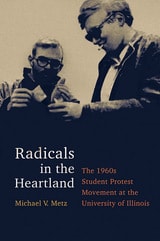
Radicals in the Heartland
The 1960s Student Protest Movement at the University of IllinoisMichael V. Metz
University of Illinois Press, 2019
Positioning the events in the context of their time, Michael V. Metz delves into the lives and actions of activists at the center of the drama. A participant himself, Metz draws on interviews, archives, and newspaper records to show a movement born in demands for free speech, inspired by a movement for civil rights, and driven to the edge by a seemingly never-ending war. If the sudden burst of irrational violence baffled parents, administrators, and legislators, it seemed inevitable to students after years of official intransigence and disregard. Metz portrays campus protesters not as angry, militant extremists but as youthful citizens deeply engaged with grave moral issues, embodying the idealism, naiveté, and courage of a minority of a generation.
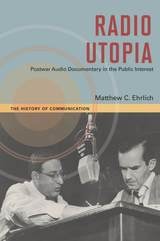
Radio Utopia
Postwar Audio Documentary in the Public InterestMatthew Ehrlich
University of Illinois Press, 2017
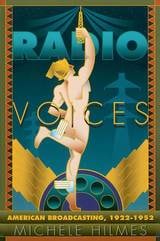
Radio Voices
American Broadcasting, 1922-1952Michele Hilmes
University of Minnesota Press, 1997
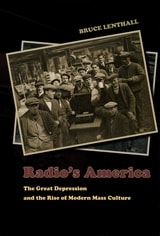
Radio's America
The Great Depression and the Rise of Modern Mass CultureBruce Lenthall
University of Chicago Press, 2007
Orson Welles’s greatest breakthrough into the popular consciousness occurred in 1938, three years before Citizen Kane, when his War of the Worlds radio broadcast succeeded so spectacularly that terrified listeners believed they were hearing a genuine report of an alien invasion—a landmark in the history of radio’s powerful relationship with its audience. In Radio’s America, Bruce Lenthall documents the enormous impact radio had on the lives of Depression-era Americans and charts the formative years of our modern mass culture.
Many Americans became alienated from their government and economy in the twentieth century, and Lenthall explains that radio’s appeal came from its capability to personalize an increasingly impersonal public arena. His depictions of such figures as proto-Fascist Charles Coughlin and medical quack John Brinkley offer penetrating insight into radio’s use as a persuasive tool, and Lenthall’s book is unique in its exploration of how ordinary Americans made radio a part of their lives. Television inherited radio’s cultural role, and as the voting tallies for American Idol attest, broadcasting continues to occupy a powerfully intimate place in American life. Radio’s America reveals how the connections between power and mass media began.
Radio, Morality, & Culture
Britain, Canada, and the United States, 1919 - 1945Robert S. Fortner
Southern Illinois University Press, 2005
Radio, Morality, and Culture: Britain, Canada, and the United States, 1919–1945 examines the moral controversies surrounding radio’s development during its formative years. In comparing the fledgling medium in Great Britain, Canada, and the United States, Robert S. Fortner documents how the church failed to participate in radio’s moral development and instead engaged in internecine warfare over issues of legitimacy and orthodoxy.
The church was arguing about theological turf and dealing with internal disputes while radio policy was being developed and communications history was being written. Fortner reveals how the church, doomed to play little more than a bit part in the future of radio, eventually lost its voice altogether in the continuing development of electronic media. Fortner effectively synthesizes cultural history and theory, communication studies, and the role religious organizations played in shaping the content and character of early radio. Geared to scholars of history, communications, and theology, Radio, Morality, and Culture provides a useful resource for research, scholarship, and public policy.
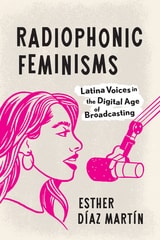
Radiophonic Feminisms
Latina Voices in the Digital Age of BroadcastingEsther Díaz Martín
University of Texas Press, 2025
2026 Gold Medal for the Best Women's Issues Book, Conference on Latin American History (CLAH)
How Latina voices in commercial radio and podcasting subvert cultural norms and bring feminism to the fore of their work.
What does Latina feminism sound like in popular culture? Drawing on case studies of commercial radio programs and podcasts hosted by Latinas and oriented toward Latinx listenership, Esther Díaz Martín explores how Latina voices create female-specific aural spaces that interrupt the misogynist status quo in US mainstream media.
Radiophonic Feminisms focuses on radio/podcasting as a medium in which women find methods for resisting oppressive gendered cultural imaginaries. Through their specific articulations—that is, the quality of their voices—their music choices, and the soundscapes they construct, Latina hosts since the early 1990s have offered feminist responses to a cultural moment marked by the demographic changes brought on by the political economy of migration and the social changes wrought by media in the digital age. Drawing attention to the invisible antisexist work of creating sound, and to its reception, Díaz Martín bridges the epistemic insights of Chicana feminist theory and sound studies, enriching and further decolonizing our thinking about auditory meaning making.
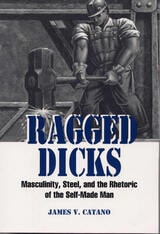
Ragged Dicks
Masculinity, Steel, and the Rhetoric of the Self-Made ManJames V. Catano
Southern Illinois University Press, 2001
Portraits of self-made men are rife in Western culture, as James V. Catano observes. Positive and negative, admittedly fictional and ostensibly factual, these portraits endure because the general rhetorical practice embodied in the myth of the self-made man enacts both the need and the very means for making oneself masculine: verbal power and prowess. The myth of the self-made man, in short, is part of ongoing rhetorical practices that constitute society, culture, and subjects.
To explain those practices and their effectiveness, Catano argues that the basic narrative achieves much of its effectiveness by engaging and enacting the traditional psychological dynamics of the family romance: preoedipal separation, oedipal conflict, and “proper” postoedipal self-definition and socialization.
To focus on the combined social, psychological, and rhetorical dynamics that constitute the ongoing activity he calls masculine self-making, Catano emphasizes a particular strand: masculinity and steelmaking. Pursuing that strand, he argues that these representations of masculine self-making are rhetorical enactments of cultural needs and desires, and that they are ongoing and formative arguments about what society and its individuals either are or should be.
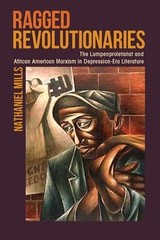
Ragged Revolutionaries
The Lumpenproletariat and African American Marxism in Depression-Era LiteratureNathaniel Mills
University of Massachusetts Press, 2017
By analyzing multiple published and unpublished works from the period, Mills shows how Richard Wright, Ralph Ellison, and Margaret Walker used the lumpenproletariat to imagine new forms of revolutionary knowledge and agency. In their writings, hobos riding the rails, criminals hustling to make ends meet, heroic black folk-outlaws, and individuals who fall out of the proletariat into the social margins all furnish material for thinking through resistance to the exploitations of capitalism, patriarchy, and Jim Crow. Ragged Revolutionaries introduces the lumpenproletariat into literary study, offers a new account of the place of Marxism in African American literature and politics, and clarifies the political and aesthetic commitments of three major modern black writers.
Railroad Labor Disputes
The Beginnings of Federal Strike PolicyGerald G. Eggert
University of Michigan Press, 1967

Railroad Postcards In Age Steam
H. Roger Grant
University of Iowa Press, 1994
Out of the tradition of those long-gone days of great, heaving steam locomotives and endless rail lines comes this remarkable selection of vintage cards, a treasure trove selected from John Vander Maas' consummate collection at the University of Iowa Libraries.
This lavish volume is the first general book-length work devoted to the once-ubiquitous railroad picture postcard. It comprises an introductory essay and an album of cards. The former fully examines the nature of the postcard craze, which reached its zenith about 1910, and discusses why images of American railroads played such an important part in the card phenomenon. The album divides an engaging assortment of more than 150 representative views into five sections: “Trains and Rolling Stock,” “Depots and Railway Structures,” “The Railroad Corridor,” “People and Railroads,” and “The Lighter Side of Railroading.”
Railroad historians, train enthusiasts, postcard collectors, and all other readers will find much to interest them in this selection of images. Not only are the cards themselves visually striking, but they convey a sense of how important railroads once were to the nation's citizenry. The sight of steaming locomotives and the hustle and bustle associated with “train time” caused hearts to quicken. These feelings made views of railroad scenes popular with buyers of postcards and now with latter-day railroad fans and card collectors.
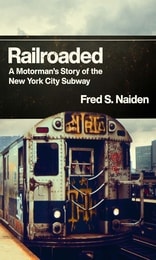
Railroaded
A Motorman's Story of the New York City SubwayFred S. Naiden
Rutgers University Press, 0
“A fascinating insider’s view of a vital and dangerous profession.” —The Wall Street Journal
“An instant classic of labor and transportation history.” —Library Journal, starred review
The New York City subway system is one of the largest and oldest in the world, still carrying traces of the transport systems that came before it. Some of its elevated tracks are remnants of steam railroads, and some tunnels run where canoes served as ferries. For passengers, riding the subway can feel like stepping into another world, dark and dank and sometimes dangerous. Now just imagine what it’s like to work there every day.
One of the few subway workers who went on to earn a PhD from Harvard, historian Fred Naiden gives readers a firsthand look at what it was like to work as a subway porter, a motorman, and a locomotive engineer during the 1980s. He recounts the labor activism of his fellow MTA employees, who advocated for better conditions, higher pay, and less institutional racism. He also shares wild stories about the riders he encountered, from a homeless former realtor who worked as a mob frontman to an angry passenger who pulled a gun on him while the train was stuck at a stop signal. Above all, Railroaded will answer many questions about the New York subway system, including how it could be improved.
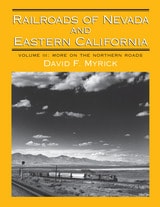
Railroads of Nevada and Eastern California
Volume 3: More on the Northern RoadsDavid F. Myrick
University of Nevada Press, 2007
The final volume in the complete history of Nevada and Eastern California railroads David Myrick's monumental railroad histories have become essential reference works for railroaders, historians, and hobbyists. Volume III contains additional information about the northern roads, including some not covered in previous volumes, and about developments since the publication of the first two volumes in the railroads of the region. It provides new facts gleaned from the correspondence of Collis P. Huntington, one of the builders of the Central Pacific and Southern Pacific railroads. It also covers roads connected with the lumber industry and the construction of electric power plants, and Southern Pacific branch lines, including some that never advanced beyond surveys.
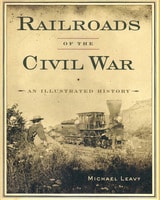
Railroads of the Civil War
An Illustrated HistoryMichael Leavy
Westholme Publishing, 2010
The Photographic Record of the First Wide-Scale Mechanization of War
Over the course of the first half of the nineteenth century, America would find itself following two increasingly divergent tracks: an industrialized North and an agricultural South. By 1860 railroads were firmly entrenched in our culture, reshaping our cities and steering us through the industrial age towards worldwide prominence. From sleepy post towns to the largest east coast cities, the distant hooting of the locomotive whistle drew ever closer and louder, filling listeners with fascination while brightening the eyes of profit-driven industrialists. But this admirable invention, lavishly adorned in brass and iron trimmings, was about to take on a new and deadly role. America’s regional differences would result in a spectacular collision over slavery, and between 1861–1865, the nation fought a savage war. The “iron horse” became a major weapon in the first war fully dependent on railroads. Moreover railroads would escalate and prolong the war, leading to its terrible carnage. Trains were used to move troops rapidly and over great distances, completely changing military strategy. Trains were also used as mobile artillery, armed with large-caliber cannons that could pound cities and fortifications. Trains were a crucial means for supplying the armies on both sides, and it was the severing of the railway lines providing food and munitions to the Army of Northern Virginia that led to Robert E. Lee’s surrender at Appomattox Court House.
In Railroads of the Civil War: An Illustrated History, Michael Leavy uses compelling period photographs and drawings and a rich narrative to reevaluate and illuminate the role of railroads in the Civil War. In addition to identifying details about the various trains and ancillary equipment and buildings in the illustrations, the author explains how trains influenced the outcome of battles and the war in general.
Rain Without Thunder
The Ideology of the Animal Rights MovementGary L. Francione
Temple University Press, 1996
Are "animal welfare" supporters indistinguishable from the animal exploiters they oppose? Do reformist measures reaffirm the underlying principles that make animal exploitation possible in the first place? In this provocative book, Gary L. Francione argues that the modern animal rights movement has become indistinguishable from a century-old concern with the welfare of animals that in no way prevents them from being exploited.
Francione maintains that advocating humane treatment of animals retains a sense of them as instrumental to human ends. When they are considered dispensable property, he says, they are left fundamentally without "rights." Until the seventies, Francione claims, this was the paradigm within which the Animal Rights Movement operated, as demonstrated by laws such as the Federal Humane Slaughter Act of 1958.
In this wide-ranging book, Francione takes the reader through the philosophical and intellectual debates surrounding animal welfare to make clear the difference between animal rights and animal welfare. Through case studies such as campaigns against animal shelters, animal laboratories, and the wearing of fur, Francione demonstrates the selectiveness and confusion inherent in reformist programs that target fur, for example, but leave wool and leather alone.
The solution to this dilemma, Francione argues, is not in a liberal position that espouses the humane treatment of animals, but in a more radical acceptance of the fundamental inalienability of animal rights.
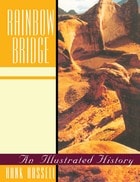
Rainbow Bridge
Hank Hassell
Utah State University Press, 1999
On the morning of August 14, 1909, a small, diverse group including Professor Byron Cummings of the University of Utah, Government Land Office surveyor William Douglass, pioneer archaeologist and trader John Weatherill, and Paiute guide Nasja Begay gazed at the largest structure of its kind in the world-Rainbow Bridge. Their presence marked the official discovery of the magnificent natural bridge, which spans 275 feet and towers 291 feet above the stream bed below it. Of the discovery party, only Nasja Begay had seen the stone arch before; he was one of a probably small number of Paiutes and Navajos, the true modern discoverers, who had visited it. In 1910, an executive order issued under the still fresh Antiquities Act created Rainbow Bridge National Monument, one of the first.
This was only the beginning of the Rainbow Bridge historical record. Its fame was soon widespread, but for many years its visitors would be few, their numbers restricted by the long arduous trail around Navajo Mountain to the site. Those few and the tour guides and businesses that emerged to serve them, especially at Rainbow Lodge, were an interesting mix though. The bridge's story included such western figures as trader Louisa Weatherill, wife of John and a Navajo speaker who was the first Anglo to hear of the bridge; Barry Goldwater, who for a time owned and operated Rainbow Lodge; Zane Grey, who wrote about the bridge; and David Brower, the Sierra Club leader who got wrapped up in the intersection of the Rainbow Bridge story with that of Glen Canyon Dam. Its construction and the filling of Lake Powell behind it made Rainbow Bridge a battleground, key territory in the larger war over water and conservation in the West. The remote, hard to reach national monument was supposed to define a limit to Colorado River reclamation but instead was inundated by Lake Powell and the tide of visitors who then could reach the foot of the bridge by boat. Though Rainbow is now easily and frequently visited and National Park Service amenities are in place, access to Rainbow Bridge is still an evolving and controversial issue.
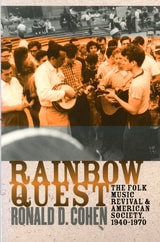
Rainbow Quest
The Folk Music Revival and American Society, 1940-1970Ronald D. Cohen
University of Massachusetts Press, 2002
For a brief period from the late 1950s to the mid-1960s, folk music captured a mass audience in the United States, as college students and others swarmed to concerts by the likes of Peter, Paul & Mary, Joan Baez, and Bob Dylan. In this comprehensive study, Ronald D. Cohen reconstructs the history of this singular cultural moment, tracing its origins to the early decades of the twentieth century. Drawing on scores of interviews and numerous manuscript collections, as well as his own extensive files, Cohen shows how a broad range of traditions—from hillbilly, gospel, blues, and sea shanties to cowboy, ethnic, and political protest music—all contributed to the genre known as folk. He documents the crucial work of John Lomax and other collectors who, with the assistance of recording companies, preserved and distributed folk music in the 1920s.
During the 1930s and 1940s, the emergence of left-wing politics and the rise of the commercial music marketplace helped to stimulate wider interest in folk music. Stars emerged, such as Woody Guthrie, Leadbelly, Pete Seeger, Burl Ives, and Josh White. With the success of the Weavers and the Kingston Trio in the 1950s, the stage was set for the full-blown “folk revival” of the early 1960s. Centered in New York's Greenwich Village and sustained by a flourishing record industry, the revival spread to college campuses and communities across the country. It included a wide array of performers and a supporting cast of journalists, club owners, record company executives, political activists, managers, and organizers. By 1965 the boom had passed its peak, as rock and roll came to dominate the marketplace, but the folk revival left an enduring musical legacy in American culture.