Results by title
4030 books match the query 'Language Arts & Disciplines' and 235 start with r
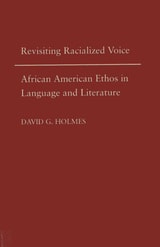
Revisiting Racialized Voice
African American Ethos in Language and LiteratureDavid G. Holmes
Southern Illinois University Press, 2004
Revisiting Racialized Voice:African American Ethos in Language and Literature argues that past misconceptions about black identity and voice, codified from the 1870s through the 1920s, inform contemporary assumptions about African American authorship and ethos. Tracing elements of racial consciousness in the works of Frederick Douglass, Charles Chesnutt, W. E. B. DuBois, Zora Neale Hurston, and others, David G. Holmes urges a revisiting of narratives from this period to strengthen and advance notions about racialized writing and to shape contemporary composition pedagogies.
Pointing to the intersection of African American identity, literature, and rhetoric, Revisiting Racialized Voice begins to construct rhetorically workable yet ideologically flexible definitions of black voice. Holmes maintains that political pressure to embrace“color blindness” endangers scholars’ ability to uncover links between racialized discourses of the past and those of the present, and he calls instead for a reassessment of the material realities and theoretical assumptions race represents and with which it has been associated.

Revisiting the Essential Indexical
John Perry
CSLI, 2020
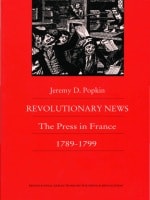
Revolutionary News
The Press in France, 1789–1799Jeremy D. Popkin
Duke University Press, 1990

Rewired
Research-Writing Partnerships Within TheRandall McClure
Assoc of College & Research Libraries, 2016
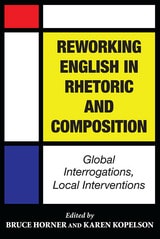
Reworking English in Rhetoric and Composition
Global Interrogations, Local InterventionsEdited by Bruce Horner and Karen Kopelson
Southern Illinois University Press, 2014
In Reworking English in Rhetoric and Composition, editors Bruce Horner and Karen Kopelson gather leading scholars and new voices in the field of rhetoric and composition to offer a dynamic new perspective on English as it is used today. This provocative volume explores the myriad ways in which English is constantly redefined, revised, and redirected through specific, located acts of writing, rhetoric, teaching, and learning. Contributors provide insightful contributions to the study of English from both national and international perspectives, revealing the language as a fluid and constantly changing manner of expression that challenges established notions.
In part one, “Reworking Language,” writers call into question the idea of language as a static, stable entity. In part two, “Locations and Migrations: Global/Local Interrogations,” contributors explore the impact of writing and teaching English in both in the United States and abroad, from Arkansas and Oklahoma to China, Jamaica, and Lebanon. Part three, “Pedagogical/Institutional Interventions,” addresses English in institutional settings and the implications for future pedagogical work. Each essay in this revolutionary volume substantiates two key premises for the rethinking of English: first, that languages are susceptible to constant change through the very acts of writing, teaching, and learning, and second, that this reworking occurs as it moves between various temporal and spatial locations.
Throughout the volume, the variety and flexibility of English across the globe are both advocated and revealed, rejecting dominant Anglophone perspectives and instead placing language in cross-cultural contexts. Brimming with informative and thought-provoking insights, Reworking English in Rhetoric and Composition breathes new life into the field and provides direction for scholars and teachers looking to the future of English.
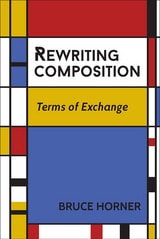
Rewriting Composition
Terms of ExchangeBruce Horner
Southern Illinois University Press, 2016
Each chapter of Rewriting Composition focuses on one key term, discussing how limitations set by dominant definitions shape and direct what compositionists do and how they think about their work. The first chapter, “Composition,” critiques a discourse of composition as lacking and therefore as in need of being either put to an end, renamed, aligned with other fields, or supplemented with work in other disciplines or other forms of composition. Rather than seeing composition as something to be abandoned, replaced, or supplemented, Horner suggests ways of productively engaging with the ordinary work of composition whose ostensible lack is assumed in the dominant discourse. Subsequent chapters apply this reconsideration to other key terms, critiquing dominant conceptions of “language” and English as stable; examining how “labor” in composition is divorced from the productive force of social relations to which language work contributes; rethinking the terms of value by which the labor of composition teachers, administrators, and students is measured; and questioning the application of conventional definitions of professional academic disciplinarity to composition. By exposing limitations in dominant conceptions of the work of composition and by modeling and opening up space for new conceptions of key terms, Rewriting Composition offers teachers of composition and rhetoric, writing scholars, and writing program administrators the critical tools necessary for charting the future of composition studies.
Rewriting Language
How Literary Texts Can Promote Inclusive Language UseChristiane Luck
University College London, 2020
By engaging readers with the issue, novels spread awareness and promote linguistic change. Novels have the power to paint the problems presented with accessibility and spark change. Analyzing five iconic literary texts, including Ursula K. Le Guin’s The Left Hand of Darkness, Verena Stefan’s Häutungen, Marge Piercy’s Woman on the Edge of Time, and June Arnold’s The Cook and the Carpenter, Luck dives into the possibilities and challenges of linguistic neutrality. Rewriting Language illustrates the link between language and imagination. As Luck concludes, novels are valuable tools to embolden inclusive language use.
Rewriting Partnerships
Community Perspectives on Community-Based LearningRachael W. Shah
Utah State University Press, 2020
Winner of the IARSLCE 2021 Publication of the Year Award and the Coalition for Community Writing Outstanding Book Award.
Community members are rarely tapped for their insights on engaged teaching and research, but without these perspectives, it is difficult to create ethical and effective practices. Rewriting Partnerships calls for a radical reorientation to the knowledges of community partners. Emphasizing the voices of community members themselves—the adult literacy learners, secondary students, and youth activists who work with college students—the book introduces Critical Community-Based Epistemologies, a deeply practical approach to knowledge construction that centers the perspectives of marginalized participants.
Drawing on interviews with over eighty community members, Rewriting Partnerships features community knowledges in three common types of community-engaged learning: youth working with college students in a writing exchange program, nonprofit staff who serve as clients for student projects, and community members who work with graduate students. Interviewees from each type of partnership offer practical strategies for creating more ethical collaborations, including how programs are built, how projects are introduced to partners, and how graduate students are educated. The book also explores three approaches to partnership design that create space for community voices at the structural level: advisory boards, participatory evaluation, and community grading.
Immediately applicable to teachers, researchers, community partners, and administrators involved in community engagement, Rewriting Partnerships offers concrete strategies for creating more community-responsive partnerships at the classroom level as well as at the level of program and research design. But most provocatively, the book challenges common assumptions about who can create knowledge about community-based learning, demonstrating that community partners have the potential to contribute significantly to community engagement scholarship and program decision-making.
Rewriting Work
Lora Anderson
University Press of Colorado, 2024
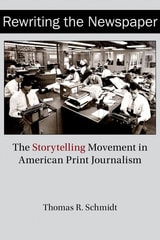
Rewriting the Newspaper
The Storytelling Movement in American Print JournalismThomas R. Schmidt
University of Missouri Press, 2020
Thomas Schmidt analyzes the expansion of narrative journalism and the corresponding institutional changes in the American newspaper industry in the last quarter of the twentieth century. In doing so, he offers the first institutionally situated history of narrative journalism’s evolution from the New Journalism of the 1960s to long-form literary journalism in the 1990s. Based on the analysis of primary sources, industry publications, and oral history interviews, this study traces how narrative techniques developed and spread through newsrooms, advanced by institutional initiatives and a growing network of practitioners, proponents, and writing coaches who mainstreamed the use of storytelling. Challenging the popular belief that it was only a few talented New York reporters (Tome Wolfe, Jimmy Breslin, Gay Talese, Joan Didion, and others) who revolutionized journalism by deciding to employ storytelling techniques in their writing, Schmidt shows that the evolution of narrative in late twentieth century American Journalism was more nuanced, more purposeful, and more institutionally based than the New Journalism myth suggests.
Rewriting
How To Do Things With TextsJoseph Harris
Utah State University Press, 2006
"Like all writers, intellectuals need to say something new and say it well. But unlike many other writers, what intellectuals have to say is bound up with the books we are reading . . . and the ideas of the people we are talking with."
What are the moves that an academic writer makes? How does writing as an intellectual change the way we work from sources? In Rewriting, a textbook for the undergraduate classroom, Joseph Harris draws the college writing student away from static ideas of thesis, support, and structure, and toward a more mature and dynamic understanding. Harris wants college writers to think of intellectual writing as an adaptive and social activity, and he offers them a clear set of strategies—a set of moves—for participating in it.
Rewriting
How to Do Things with Texts, Second EditionJoseph Harris
Utah State University Press, 2017
“Like all writers, intellectuals need to say something new and say it well. But for intellectuals, unlike many other writers, what we have to say is bound up with the books we are reading . . . and the ideas of the people we are talking with.”
What are the moves that an academic writer makes? How does writing as an intellectual change the way we work from sources? In Rewriting, Joseph Harris draws the college writing student away from static ideas of thesis, support, and structure, and toward a more mature and dynamic understanding. Harris wants college writers to think of intellectual writing as an adaptive and social activity, and he offers them a clear set of strategies—a set of moves—for participating in it. Introducing remixing as an additional signature move and updated with new attention to digital writing, the second edition both extends and rethinks the ideas of the original.
Rhetor Response
A Theory and Practice of Literary AffordancePeter H. Khost
Utah State University Press, 2018
Bridging the disciplinary divide between writing and literature, Rhetor Response introduces the concept and pedagogical applications of “literary affordances”—the ways in which readers “use” and integrate literature into their own writing or lives. Unconcerned with authorial intent, interpretive meaning, or critical reception, “affordance” signifies a shift in focus from what literary texts mean and do to what one can do with them.
This book presents both opportunities and challenges to writing studies, a field whose burgeoning disciplinary independence ironically relies on a sizable underclass of specialists in literature rather than writing. Incorporating elements of rhetorical theory, literary criticism, pedagogical methodology, political critique, and psychological and philosophical memoir, Peter H. Khost complicates and revives the relevance of literature—from belles lettres to fanfiction—by turning from interpretation to affordance in order to identify readers’ applications of literary textual features to unrelated lived situations.
Rhetor Response theorizes and exemplifies literary affordance as a constructive step toward professional reconciliation, as well as an entry into greater textual power and pleasure for students and readers. It is a one-of-a-kind resource for college writing program administrators, faculty and scholars in English and writing studies, and graduate and advanced undergraduate students across both disciplines.
Rhetoric
Renato Barilli
University of Minnesota Press, 1989
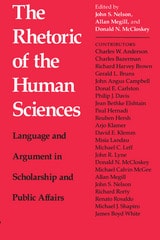
Rhetoric Of The Human Sciences
Language And Argument In Scholarship And Public AffairsJohn S. Nelson
University of Wisconsin Press, 1990
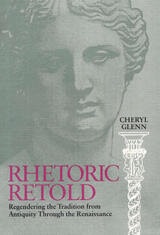
Rhetoric Retold
Regendering the Tradition from Antiquity Through the RenaissanceCheryl Glenn
Southern Illinois University Press, 1997
After explaining how and why women have been excluded from the rhetorical tradition from antiquity through the Renaissance, Cheryl Glenn provides the opportunity for Sappho, Aspasia, Diotima, Hortensia, Fulvia, Julian of Norwich, Margery Kempe, Margaret More Roper, Anne Askew, and Elizabeth I to speak with equal authority and as eloquently as Plato, Aristotle, Cicero, and Augustine. Her aim is nothing less than regendering and changing forever the history of rhetoric.
To that end, Glenn locates women’s contributions to and participation in the rhetorical tradition and writes them into an expanded, inclusive tradition. She regenders the tradition by designating those terms of identity that have promoted and supported men’s control of public, persuasive discourse—the culturally constructed social relations between, the appropriate roles for, and the subjective identities of women and men.
Glenn is the first scholar to contextualize, analyze, and follow the migration of women’s rhetorical accomplishments systematically. To locate these women, she follows the migration of the Western intellectual tradition from its inception in classical antiquity and its confrontation with and ultimate appropriation by evangelical Christianity to its force in the medieval Church and in Tudor arts and politics.
Rhetoric and Composition as Intellectual Work
Edited by Gary A. Olson
Southern Illinois University Press, 2002
In response to those who insist that rhetoric and composition should remain only a service discipline, editor Gary A. Olson’s Rhetoric and Composition as Intellectual Work demonstrates that it already is an intellectual discipline, that for at least a quarter of a century the field has developed an impressive tradition of intellectual work in a remarkable assortment of subject areas. Rhetoric and Composition as Intellectual Work suggests the diversity of intellectual projects that have and will continue to make rhetoric and composition more than a service to the university, more than a field devoted solely to improving writing pedagogy, and more than a preliminary to literary studies.
This collection of nineteen essays by some of the most distinguished scholars in the discipline illustrates that rhetoric and composition has much to contribute to the intellectual milieu of the contemporary university, as the field continues to push its disciplinary borders and discover new sites of investigation.
Rhetoric and Demagoguery
Patricia Roberts-Miller
Southern Illinois University Press, 2019
In a culture of profit-driven media, demagoguery is a savvy short-term rhetorical strategy. Once it becomes the norm, individuals are more likely to employ it and, in that way, increase its power by making it seem the only way of disagreeing with or about others. When that happens, arguments about policy are replaced by arguments about identity—and criticism is met with accusations that the critic has the wrong identity (weak, treacherous, membership in an out-group) or the wrong feelings (uncaring, heartless).
Patricia Roberts-Miller proposes a definition of demagoguery based on her study of groups and cultures that have talked themselves into disastrously bad decisions. She argues for seeing demagoguery as a way for people to participate in public discourse, and not necessarily as populist or heavily emotional. Demagoguery, she contends, depoliticizes political argument by making all issues into questions of identity. She broaches complicated questions about its effectiveness at persuasion, proposes a new set of criteria, and shows how demagoguery plays out in regard to individuals not conventionally seen as demagogues.
Roberts-Miller looks at the discursive similarities among the Holocaust in early twentieth-century Germany, the justification of slavery in the antebellum South, the internment of Japanese Americans in the United States during World War II, and the U.S.-led invasion of Iraq in 2003, among others. She examines demagoguery among powerful politicians and jurists (Earl Warren, chief justice of the U.S. Supreme Court) as well as more conventional populists (Theodore Bilbo, two-time governor of Mississippi; E. S. Cox, cofounder of the Anglo-Saxon Clubs of America). She also looks at notorious demagogues (Athenian rhetor Cleon, Ann Coulter) and lesser-known public figures (William Hak-Shing Tam, Gene Simmons).
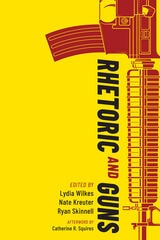
Rhetoric and Guns
Lydia Wilkes
Utah State University Press, 2021
Guns hold a complex place in American culture. Over 30,000 Americans die each year from gun violence, and guns are intimately connected to issues of public health, as is evident whenever a mass shooting occurs. But guns also play an important role in many Americans’ lives that is not reducible to violence and death—as tools, sporting equipment, and identity markers. They are also central to debates about constitutional rights, as seen in ongoing discussions about the Second Amendment, and they are a continuous source of legislative concern, as apparent in annual ratings of gun-supporting legislators.
Even as guns are wrapped up with other crucial areas of concern, they are also fundamentally a rhetorical concern. Guns and gun violence occupy a unique rhetorical space in the United States, one characterized by silent majorities, like most gun owners; vocal minorities, like the firearm industry and gun lobby; and a stalemate that fails to stem the flood of the dead. How Americans talk, deliberate, and fight about guns is vital to how guns are marketed, used, and regulated. A better understanding of the rhetorics of guns and gun violence can help Americans make better arguments about them in the world. However, where guns are concerned, rhetorical studies is not terribly different from American culture more generally. Guns are ever-present and exercise powerful effects, but they are commonly talked about in oblique, unsystematic ways.
Rhetoric and Guns advances more direct, systematic engagement in the field and beyond by analyzing rhetoric about guns, guns in rhetoric, and guns as rhetoric, particularly as they relate to specific instances of guns in culture. The authors attempt to understand rhetoric’s relationship to guns by analyzing rhetoric about guns and how they function in and as rhetoric related to specific instances—in media coverage, political speech, marketing, and advertising. Original chapters from scholars in rhetorical studies, communication, education, and related fields elucidate how rhetoric is used to maintain and challenge the deadly status quo of gun violence in the United States and extend rhetoricians’ sustained interest in the fields’ relationships to violence, brutality, and atrocity.
Contributors: Ira J. Allen, Brian Ballentine, Matthew Boedy, Peter Buck, Lisa Corrigan, Rosa Eberly, Kendall Gerdes, Ian E. J. Hill, Nathalie Kuriowa-Lewis, Patricia Roberts-Miller, Craig Rood, Bradley Serber, Catherine R. Squires, Scott Gage
Rhetoric and Reality
Writing Instruction in American Colleges, 1900 - 1985James A. Berlin
Southern Illinois University Press, 1987
Berlin here continues his unique history of American college composition begun in his Writing Instruction in Nineteenth-Century Colleges (1984), turning now to the twentieth century.
In discussing the variety of rhetorics that have been used in writing classrooms Berlin introduces a taxonomy made up of three categories: objective rhetorics, subjective rhetorics, and transactional rhetorics, which are distinguished by the epistemology on which each is based. He makes clear that these categories are not tied to a chronology but instead are to be found in the English department in one form or another during each decade of the century.
His historical treatment includes an examination of the formation of the English department, the founding of the NCTE and its role in writing instruction, the training of teachers of writing, the effects of progressive education on writing instruction, the General Education Movement, the appearance of the CCCC, the impact of Sputnik, and today’s “literacy crisis.”
Rhetoric and Religion in the Twenty-First Century
Pluralism in a Postsecular AgeEdited by Michael-John DePalma, Paul Lynch, and Jeff Ringer
Southern Illinois University Press, 2023
Expanding the scope of religious rhetoric
Over the past twenty-five years, the intersection of rhetoric and religion has become one of the most dynamic areas of inquiry in rhetoric and writing studies. One of few volumes to include multiple traditions in one conversation, Rhetoric and Religion in the Twenty-First Century engages with religious discourses and issues that continue to shape public life in the United States.
This collection of essays centralizes the study of religious persuasion and pluralism, considers religion’s place in U.S. society, and expands the study of rhetoric and religion in generative ways. The volume showcases a wide range of religious traditions and challenges the very concepts of rhetoric and religion. The book’s eight essays explore African American, Buddhist, Christian, Indigenous, Islamic, and Jewish rhetoric and discuss the intersection of religion with feminism, race, and queer rhetoric—along with offering reflections on how to approach religious traditions through research and teaching. In addition, the volume includes seven short interludes in which some of the field’s most accomplished scholars recount their experiences exploring religious rhetorics and invite readers to engage these exigent lines of inquiry.
By featuring these diverse religious perspectives, Rhetoric and Religion in the Twenty-First Century complicates the field’s emphasis on Western, Hellenistic, and Christian ideologies. The collection also offers teachers of writing and rhetoric a range of valuable approaches for preparing today’s students for public citizenship in our religiously diverse global context.
Rhetoric and Writing Studies in the New Century
Historiography, Pedagogy, and PoliticsEdited by Cheryl Glenn and Roxanne Mountford
Southern Illinois University Press, 2017
Rhetoric and the Digital Humanities
Edited by Jim Ridolfo and William Hart-Davidson
University of Chicago Press, 2015
Rhetoric and the Digital Humanities is a timely, multidisciplinary collection that is the first to bridge scholarship in rhetorical studies and the digital humanities. It offers much-needed guidance on how the theories and methodologies of rhetorical studies can enhance all work in digital humanities, and vice versa. Twenty-three essays over three sections delve into connections, research methodology, and future directions in this field. Jim Ridolfo and William Hart-Davidson have assembled a broad group of more than thirty accomplished scholars. Read together, these essays represent the cutting edge of research, offering guidance that will energize and inspire future collaborations.
Rhetoric as Philosophy
The Humanist TraditionErnesto Grassi. Foreword by Timothy W. Crusius
Southern Illinois University Press, 2001
Originally published in English in 1980, Rhetoric as Philosophy has been out of print for some time. The reviews of that English edition attest to the importance of Ernesto Grassi’s work.
By going back to the Italian humanist tradition and aspects of earlier Greek and Latin thought, Ernesto Grassi develops a conception of rhetoric as the basis of philosophy. Grassi explores the sense in which the first principles of rational thought come from the metaphorical power of the word. He finds the basis for his conception in the last great thinker of the Italian humanist tradition, Giambattista Vico (1668–1744). He concentrates on Vico’s understanding of imagination and the sense of human ingenuity contained in metaphor. For Grassi, rhetorical activity is the essence and inner life of thought when connected to the metaphorical power of the word.
Rhetoric as a Posthuman Practice
Casey Boyle
The Ohio State University Press, 2018
Through case studies of the media art of glitch, urban explorers’ use of social media, and DIY digital networks, this book then reconsiders how practice/exercise functions when the once essential bodies of the individual and a society—the two primary categories authorized by a humanist paradigm—become less reliable categories from which we might orient rhetorical action. In sum, the book argues that rhetorical practice is irreducible to the traditions and categories of humanism and must now exercise its posthuman capacities.
Rhetoric at the Margins
Revising the History of Writing Instruction in American Colleges, 1873-1947David Gold
Southern Illinois University Press, 2008
Rhetoric at the Margins: Revising the History of Writing Instruction in American Colleges, 1873-1947 examines the rhetorical education of African American, female, and working-class college students in the late nineteenth and early twentieth centuries. The rich case studies in this work encourage a reconceptualization of both the history of rhetoric and composition and the ways we make use of it.
Author David Gold uses archival materials to study three types of institutions historically underrepresented in disciplinary histories: a black liberal arts college in rural East Texas (Wiley College); a public women's college (Texas Woman's University); and an independent teacher training school (East Texas Normal College). The case studies complement and challenge previous disciplinary histories and suggest that the epistemological schema that have long applied to pedagogical practices may actually limit our understanding of those practices.
Gold argues that each of these schools championed intellectual and pedagogical traditions that differed from the Eastern liberal arts model—a model that often serves as the standard bearer for rhetorical education. He demonstrates that by emphasizing community uplift and civic participation and attending to local needs, these schools created contexts in which otherwise moribund curricular features of the era—such as strict classroom discipline and an emphasis on prescription—took on new possibilities.
Rhetoric at the Margins describes the recent revisionist turn in rhetoric and composition historiography, argues for the importance of diverse institutional microhistories, and argues that the nineteenth and early twentieth centuries offer rich lessons for contemporary classroom practice. The study brings alive the voices of black, female, rural, Southern, and first-generation college students and their instructors, effectively linking these histories to the history of rhetoric and writing. Appendices include excerpts of important and rarely seen primary source material, allowing readers to experience in fuller detail the voices captured in this work.
Rhetoric in Antiquity
Laurent Pernot
Catholic University of America Press, 2005
Rhetoric in European Culture and Beyond
Jirí Kraus
Karolinum Press, 2014
Kraus demonstrates that the reputation of rhetoric falls when it is reduced to a refined method for deceiving the public and increases when it is seen as a scientific discipline that is used throughout all of the fields of the humanities. In this sense, the author argues, rhetoric strives for universal recognition and the cultivation of rhetorical expression, spoken and written, including not only its production but also reception and interpretation.

Rhetoric in Tooth and Claw
Animals, Language, SensationDebra Hawhee
University of Chicago Press, 2017
Yet when you look at ancient and early modern treatises on rhetoric, what you find is surprising: they’re crawling with animals. With Rhetoric in Tooth and Claw, Debra Hawhee explores this unexpected aspect of early thinking about rhetoric, going on from there to examine the enduring presence of nonhuman animals in rhetorical theory and education. In doing so, she not only offers a counter-history of rhetoric but also brings rhetorical studies into dialogue with animal studies, one of the most vibrant areas of interest in humanities today. By removing humanity and human reason from the center of our study of argument, Hawhee frees up space to study and emphasize other crucial components of communication, like energy, bodies, and sensation.
Drawing on thinkers from Aristotle to Erasmus, Rhetoric in Tooth and Claw tells a new story of the discipline’s history and development, one animated by the energy, force, liveliness, and diversity of our relationships with our “partners in feeling,” other animals.
Rhetoric in the European Tradition
Thomas M. Conley
University of Chicago Press, 1993
Rhetoric of Health and Medicine As/Is
Theories and Approaches for the FieldEdited by Lisa Melonçon, S. Scott Graham, Jenell Johnson, John A. Lynch, and Cynthia Ryan
The Ohio State University Press, 2020
With a foreword by Judy Segal and in sections that address interdisciplinary perspectives, representations of health and illness in online spaces, and health activism and advocacy, this volume proceeds in a unique format: essays tackle these key topic areas through case studies ranging from food and its relation to public health, to apps that track fertility, to mental health and disability, to racial disparities that exist in public health campaigns about sudden infant death syndrome (SIDS). The essays within each section are then followed by responses from prominent scholars in the rhetoric of health and medicine—including John Lyne, J. Blake Scott, and Lisa Keränen—who take on the central theme and discuss how the theory or concept under study can and should evolve in the next stages of research. Unifying the essays is a consideration of RHM as a theoretical construct guiding research and thinking alongside the conceptual parameters that constitute what RHM is and can be in practice. In asking questions about the role of rhetoric—both as analytic and productive framework—in health and medicine, this volume engages with broader theoretical and ethical concerns about our current healthcare system and how healthcare and medical issues circulate in all the social, cultural, economic, and political aspects of our world.
Rhetoric of Reflection
Kathleen Yancey
Utah State University Press, 2016
As mapped by the contributors to A Rhetoric of Reflection, this iteration of research and practice is taking up new questions in new sites of activity and with new theories. It comprises attention to transfer of writing knowledge and practice, teaching and assessment, portfolios, linguistic and cultural difference, and various media, including print and digital. It conceptualizes conversation as a primary reflective medium, both inside and outside the classroom and for individuals and collectives, and articulates the role that different genres play in hosting reflection. Perhaps most important in the work of this third generation is the identification and increasing appreciation of the epistemic value of reflection, of its ability to help make new meanings, and of its rhetorical power—for both scholars and students.
Contributors: Anne Beaufort, Kara Taczak, Liane Robertson, Michael Neal, Heather Ostman, Cathy Leaker, Bruce Horner, Asao B. Inoue, Tyler Richmond, J. Elizabeth Clark, Naomi Silver, Christina Russell McDonald, Pamela Flash, Kevin Roozen, Jeff Sommers, Doug Hesse
Rhetoric of a Global Epidemic
Transcultural Communication about SARSHuiling Ding
Southern Illinois University Press, 2014
2016 CCCC Best Book Award in Technical and Scientific Communication
In the past ten years, we have seen great changes in the ways government organizations and media respond to and report on emerging global epidemics. The first outbreak to garner such attention was SARS (severe acute respiratory syndrome). In Rhetoric of a Global Epidemic, Huiling Ding uses SARS to explore how various cultures and communities made sense of the epidemic and communicated about it. She also investigates the way knowledge production and legitimation operate in global epidemics, the roles that professionals and professional communicators, as well as individual citizens, play in the communication process, points of contention within these processes, and possible entry points for ethical and civic intervention.
Focusing on the rhetorical interactions among the World Health Organization, the United States, China, and Canada, Rhetoric of a Global Epidemic investigates official communication and community grassroots risk tactics employed during the SARS outbreak. It consists of four historical cases, which examine the transcultural risk communication about SARS in different geopolitical regions at different stages. The first two cases deal with risk communication practices at the early stage of the SARS epidemic when it originated in southern China. The last two cases move to transcultural rhetorical networks surrounding SARS.
With such threats as SARS, avian flu, and swine flu capturing the public imagination and prompting transnational public health preparedness efforts, the need for a rhetoric of global epidemics has never been greater. Government leaders, public health officials, health care professionals, journalists, and activists can learn how to more effectively craft and manage transcultural risk communication from Ding’s examination of the complex and varied modes of communication around SARS. In addition to offering a detailed case study, Rhetoric of a Global Epidemic provides a critical methodology that professional communicators can use in their investigations of epidemics and details approaches to facilitating more open, participatory risk communication at all levels.
Rhetoric on the Margins of Modernity
Vico, Condillac, MonboddoCatherine L. Hobbs
Southern Illinois University Press, 2002
Changes in English studies today, particularly the rise of cultural studies, have forced reexaminations of historical genealogies. Three complex figures whose places are currently being reassessed include the Neapolitan Giambattista Vico (1668 –1744), the Frenchman Etienne de Condillac (1714 –1780), and the Scotsman James Burnet(t), Lord Monboddo (1714 –1799) in our histories of communication, linguistics, English studies, and now rhetoric.
In Rhetoric on the Margins of Modernity: Vico, Condillac, Monboddo, Catherine L. Hobbs focuses primarily on these three key figures in whose work rhetoric and linguistics intertwine as they respond to emerging attitudes and values of science and philosophy in the eighteenth century. Through her examination of works of Vico, Condillac, Monboddo and other marginal figures, Hobbs presents a different and more nuanced view of the transformation of rhetoric from classical to modern.
In order to redefine each figure’s position, Hobbs brings together the histories of linguistics, literature, rhetoric, and communication, rather than leaving them isolated in separate disciplines. She examines each figure’s theory of language origin and development as it has motivated their rhetorical theories. The result is Rhetoric on the Margins of Modernity: Vico, Condillac, Monboddo, an original and significant account of the formation of modern rhetoric.
Rhetoric, Independence, and Nationhood, 1760–1800, Volume II
Stephen E Lucas
Michigan State University Press, 2022
Rhetoric, Modality, Modernity
Nancy S. Struever
University of Chicago Press, 2009
Since antiquity, philosophy and rhetoric have traditionally been cast as rivals, with the former often lauded as a search for logical truth and the latter usually disparaged as empty speech. But in this erudite intellectual history, Nancy S. Struever stakes out a claim for rhetoric as the more productive form of inquiry.
Struever views rhetoric through the lens of modality, arguing that rhetoric’s guiding interest in what is possible—as opposed to philosophy’s concern with what is necessary—makes it an ideal tool for understanding politics. Innovative readings of Hobbes and Vico allow her to reexamine rhetoric’s role in the history of modernity and to make fascinating connections between thinkers from the classical, early modern, and modern periods. From there she turns to Walter Benjamin, reclaiming him as an exemplar of modernist rhetoric and a central figure in the long history of the form. Persuasive and perceptive, Rhetoric, Modality, Modernity is a novel rewriting of the history of rhetoric and a heady examination of the motives, issues, and flaws of contemporary inquiry.
Rhetoric, Technology, and the Virtues
Jared S. Colton
Utah State University Press, 2018
Rhetoric, Technology, and the Virtues argues that virtue ethics supports postmodern criticisms of rational autonomy and universalism while also enabling a discussion of the actual ethical behaviors that digital users form through their particular communicative ends and various rhetorical purposes. Authors Jared Colton and Steve Holmes extend Aristotle’s hexis framework through contemporary virtue ethicists and political theorists whose writing works from a tacit virtue ethics framework. They examine these key theorists through a range of case studies of digital habits of human users, including closed captioning, trolling, sampling, remixing, gamifying for environmental causes, and using social media, alongside a consideration of the ethical habits of nonhuman actors.
Tackling a needed topic with clarity and defined organization, Rhetoric, Technology, and the Virtues carefully synthesizes various strands of ethical thinking, convincingly argues that virtue ethics is a viable framework for digital rhetoric, and provides a practical way to assess the changing hexeis encountered across the network of ethical situations in the digital world.
Rhetoric, Through Everyday Things
Edited by Scot Barnett and Casey Boyle
University of Alabama Press, 2016
The fifteen essays in Rhetoric, Through Everyday Things persuasively overturn the stubborn assumption that objects are passive tools in the hands of objective human agents. Rhetoric has proved that forms of communication such as digital images, advertising, and political satires do much more than simply lie dormant, and Rhetoric, Through Everyday Things shows that objects themselves also move, circulate, and produce opportunities for new rhetorical publics and new rhetorical actions. Objects are not simply inert tools but are themselves vibrant agents of measurable power.
Organizing the work of leading and emerging rhetoric scholars into four broad categories, the collection explores the role of objects in rhetorical theory, histories of rhetoric, visual rhetoric, literacy studies, rhetoric of science and technology, computers and writing, and composition theory and pedagogy. A rich variety of case studies about objects such as women’s bicycles in the nineteenth century, the QWERTY keyboard, and little free libraries ground this study in fascinating, real-life examples and build on human-centered approaches to rhetoric to consider how material elements—human and nonhuman alike—interact persuasively in rhetorical situations.
Taken together, Rhetoric, Through Everyday Things argues that the field of rhetoric’s recent attention to material objects should go further than simply open a new line of inquiry. To maximize the interdisciplinary turn to things, rhetoricians must seize the opportunity to reimagine and perhaps resolve rhetoric’s historically problematic relationship to physical reality and ontology. By tapping the rich resource of inanimate agents such as "fish, political posters, plants, and dragonflies,” rhetoricians can more fully grasp the rhetorical implications at stake in such issues.
Rhetorical Action in Ancient Athens
Persuasive Artistry from Solon DemosthenesJames Fredal
Southern Illinois University Press, 2006
James Fredal’s wide-ranging survey examines the spatial and performative features of rhetorical artistry in ancient Athens from Solon to Demosthenes, demonstrating how persuasive skill depended not on written treatises, but on the reproduction of spaces and modes for masculine self-formation and displays of contests of character.
Studies of the history of rhetoric generally begin with Homer and Greek orality, then move on to fifth-century Sicily and the innovations of Corax, Tisias, and the older Sophists. While thorough and useful, these narratives privilege texts as the sole locus of proper rhetorical knowledge. Rhetorical Action in Ancient Greece:Persuasive Artistry from Solon to Demosthenes describes rhetoric as largely unwritten and rhetorical skill as closely associated with the ideologies and practices of gender formation and expression. In expanding the notion of rhetorical innovation to include mass movements, large social genres, and cultural practices—rather than the formulations of of individual thinkers and writers—Fredal offers a view of classical rhetoric as local and contingent, bound to the physical spaces, local histories, and cultural traditions of place.
Fredal argues that Greek rhetorical skill remained a function of local spaces like the Pnyx, social practices such as symposia or local meetings, cultural ideologies like those surrounding masculine friendship, and genres of performance such as how to act like a man, herald, sage, tyrant, or democrat. Citizen participation, he explains, was motivated by the desire to display masculine excellence in contests of character by overcoming fear and exerting symbolic and bodily control over self, situation, and audience. He shows how ancient Greek rhetoric employed patterns of “action” such as public oratory and performance to establish, reinforce, or challenge hierarchies and claims to political power.
Instead of examining speeches, handbooks, and theory, Rhetorical Action in Ancient Greece examines the origins of rhetoric in terms of performance. The result is a presentation of rhetorical knowledge as embodied in places and practices with spatial and practical logics that are rarely articulated in written discourse. The volume calls on archaeological, literary, and anthropological evidence about the rhetorical actions of Athens’s leading political agents—including Solon, Peisistratus, Cleisthenes, Demosthenes, and the anonymous “herm-choppers” of the Peloponnesian war—to demonstrate how each generation of political leaders adopted and transformed existing performance genres and spaces to address their own political exigency.
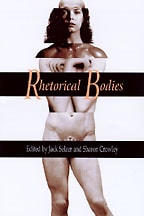
Rhetorical Bodies
Jack Selzer
University of Wisconsin Press, 1999
What significance does the physical, material body still have in a world of virtual reality and genetic cloning? How do technology and postmodern rhetoric influence our understanding of the body? And how can our discussion of the body affect the way we handle crises in public policy—the politics of race and ethnicity; issues of "family values" that revolve around sexual and gender identities; the choices revolving around reproduction and genome projects, and the spread of disease?
Leading scholars in rhetoric and communication, as well as literary and cultural studies, address some of the most important topics currently being discussed in the human sciences. The essays collected here suggest the wide range of public arenas in which rhetoric is operative—from abortion clinics and the World Wide Web to the media's depiction of illiteracy and the Donner Party. These studies demonstrate how the discourse of AIDS prevention or Demi Moore's "beautiful pregnancy" call to mind the physical nature of being human and the ways in which language and other symbols reflect and create the physical world.
Rhetorical Climatology
By A Reading GroupChris Ingraham
Michigan State University Press, 2023
Rhetorical Criticism
A Study In MethodEdwin Black
University of Wisconsin Press, 1978
This is a book that, almost singlehandedly, freed scholars from the narrow constraints of a single critical paradigm and created a new era in the study of public discourse. Its original publication in 1965 created a spirited controversy. Here Edwin Black examines the assumptions and principles underlying neo-Aristotelian theory and suggests an alternative approach to criticism, centering around the concept of the "rhetorical transaction." This new edition, containing Black's new introduction, will enable students and scholars to secure a copy of one of the most influential books ever written in the field.
Rhetorical Delivery as Technological Discourse
A Cross-Historical StudyBen McCorkle
Southern Illinois University Press, 2012
According to Ben McCorkle, the rhetorical canon of delivery—traditionally seen as the aspect of oratory pertaining to vocal tone, inflection, and physical gesture—has undergone a period of renewal within the last few decades to include the array of typefaces, color palettes, graphics, and other design elements used to convey a message to a chosen audience. McCorkle posits that this redefinition, while a noteworthy moment of modern rhetorical theory, is just the latest instance in a historical pattern of interaction between rhetoric and technology. In Rhetorical
Delivery as Technological Discourse: A Cross-Historical Study, McCorkle explores the symbiotic relationship between delivery and technologies of writing and communication. Aiming to enhance historical understanding by demonstrating how changes in writing technology have altered our conception of delivery, McCorkle reveals the ways in which oratory and the tools of written expression have directly affected one another throughout the ages.
To make his argument, the author examines case studies from significant historical moments in the Western rhetorical tradition. Beginning with the ancient Greeks, McCorkle illustrates how the increasingly literate Greeks developed rhetorical theories intended for oratory that incorporated “writerly” tendencies, diminishing delivery’s once-prime status in the process. Also explored is the near-eradication of rhetorical delivery in the mid-fifteenth century—the period of transition from late manuscript to early print culture—and the implications of the burgeoning
print culture during the nineteenth century.
McCorkle then investigates the declining interest in delivery as technology designed to replace the human voice and gesture became prominent at the beginning of the 1900s. Situating scholarship on delivery within a broader postmodern structure, he moves on to a discussion of the characteristics of contemporary hypertextual and digital communication and its role in reviving the canon, while also anticipating the future of communication technologies, the likely shifts in attitude toward delivery, and the implications of both on the future of teaching rhetoric.
Rhetorical Delivery as Technological Discourse traces a long-view perspective of rhetorical history to present readers a productive reading of the volatile treatment of delivery alongside the parallel history of writing and communication technologies. This rereading will expand knowledge of the canon by not only offering the most thorough treatment of the history of rhetorical delivery available but also inviting conversation about the reciprocal impacts of rhetorical theory and written communication on each other throughout this history.
Rhetorical Dimensions Of Popular Culture
Barry Brummett
University of Alabama Press, 1991
Supports the argument that rhetoric needs to be conceptualized as the social function that influences and manages meaning
Through history, rhetoric has been understood as the art of verbal influence. This art took various forms and was put to diverse uses. Rhetoric has usually been regarded as the kind of extended verbal discourse found in the public speech, the essay, the letter, or belles lettres, a discourse often founded on reasoned argument in support of propositions.
This conception of rhetoric as propositional, verbal text persisted through ages in which public controversy primarily took oral or written form: words spoken or committed to print. Issues were debated and decisions were formed verbally; the word was the agency for managing public business. But today the dominance of the extended text and the well-supported line of argument is fading. Public discourse may be embodied in as many words as it was in 1860, but the words take rather different forms. Presidential candidates speak more than they ever have, but campaigns depend increasingly on the twenty-second “sound bite” targeted for the evening news (Hart, 1987). A public that once read newspapers, listened to radios and to the Chautauqua speaker, or conversed on front porches is increasingly turning to various forms of video for information and entertainment.
The place and time of rhetoric are moving inexorably from specific locales in which issues are debated, into the more general context of popular culture. In other words, rhetoric as a distinct social practice carried out during concentrated periods of speaking and listening, or reading and writing, is dissipating into a noisy environment teeming with messages. Rhetorical studies as an academic discipline is responding to these changes in rhetorical practice by augmenting its traditional concerns for extended verbal texts (e.g., Medhurst & Benson, 1984). Students of rhetoric have recently examined the “rhetoric” of the streets, cartoons, and popular music. This book joins those efforts by theorists to conceptualize a kind of rhetoric that is less verbal, or “textual,” and more integrated into popular culture than is the rhetoric of Edmund Burke, Abraham Lincoln, and Franklin Roosevelt. The public as well as the academy needs a way to understand the rhetorical dimensions of popular culture.
Rhetorical Economies of Whiteness
Exploring the Intersections of Power, Privilege, and RaceEdited by Robert Asen and Casey Ryan Kelly
The Ohio State University Press, 2024
Contributors:
Godfried Asante, Robert Asen, Charles Athanasopoulos, Paulami Banerjee, Anne Bonds, Linsay M. Cramer, Derek G. Handley, V. Jo Hsu, Kelly Jensen, Casey Ryan Kelly, Kyle R. Larson, George (Guy) F. McHendry Jr., Thomas K. Nakayama, Adedoyin Ogunfeyimi, Rico Self, Stacey K. Sowards, Corinne Mitsuye Sugino
Rhetorical Education In America
Cheryl Jean Glenn
University of Alabama Press, 2009
A timely collection of essays by prominent scholars in the field—on the past, present, and future of rhetoric instruction.
From Isocrates and Aristotle to the present, rhetorical education has consistently been regarded as the linchpin of a participatory democracy, a tool to foster civic action and social responsibility. Yet, questions of who should receive rhetorical education, in what form, and for what purpose, continue to vex teachers and scholars.
The essays in this volume converge to explore the purposes, problems, and possibilities of rhetorical education in America on both the undergraduate and graduate levels and inside and outside the academy. William Denman examines the ancient model of the "citizen-orator" and its value to democratic life. Thomas Miller argues that English departments have embraced a literary-research paradigm and sacrificed the teaching of rhetorical skills for public participation. Susan Kates explores how rhetoric is taught at nontraditional institutions, such as Berea College in Kentucky, where Appalachian dialect is espoused. Nan Johnson looks outside the academy at the parlor movement among women in antebellum America. Michael Halloran examines the rhetorical education provided by historical landmarks, where visitors are encouraged to share a common public discourse. Laura Gurak presents the challenges posed to traditional notions of literacy by the computer, the promises and dangers of internet technology, and the necessity of a critical cyber-literacy for future rhetorical curricula.
Collectively, the essays coalesce around timely political and cross-disciplinary issues. Rhetorical Education in America serves to orient scholars and teachers in rhetoric, regardless of their disciplinary home, and help to set an agenda for future classroom practice and curriculum design.
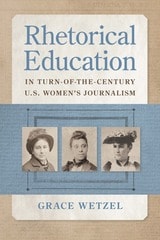
Rhetorical Education in Turn-of-the-Century U.S. Women's Journalism
Grace Wetzel, with a foreword by Shari J. Stenberg
Southern Illinois University Press, 2022
At the end of the nineteenth century, newspapers powerfully shaped the U.S. reading public, fostering widespread literacy development and facilitating rhetorical education. With new opportunities to engage audiences, female journalists repurposed the masculine tradition of journalistic writing by bringing together intimate forms of rhetoric and pedagogy to create innovative new dialogues. Rhetorical Education in Turn-of-the-Century U.S. Women’s Journalism illuminates the pedagogical contributions of three newspaperwomen to show how the field became a dynamic site of public participation, relationship building, education, and activism in the 1880s and 1890s.
Grace Wetzel introduces us to the work of Omaha correspondent Susette La Flesche Tibbles (Inshta Theamba), African American newspaper columnist Gertrude Bustill Mossell, and white middle-class reporter Winifred Black (“Annie Laurie”). Journalists by trade, these three writers made the mass-circulating newspaper their site of teaching and social action, inviting their audiences and communities—especially systematically marginalized voices—to speak, write, and teach alongside them.
Situating these journalists within their own specific writing contexts and personas, Wetzel reveals how Mossell promoted literacy learning and community investment among African American women through a reader-centered pedagogy; La Flesche modeled relational news research and reporting as a survivance practice while reporting for the Omaha Morning World-Herald at the time of the Wounded Knee Massacre; and Black inspired public writing and activism among children from different socioeconomic classes through her “Little Jim” story. The teachings of these figures serve as enduring examples of how we can engage in meaningful public literacy and ethical journalism.
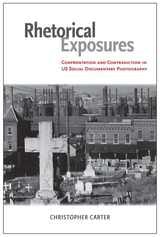
Rhetorical Exposures
Confrontation and Contradiction in US Social Documentary PhotographyChristopher Carter
University of Alabama Press, 2015
Exposing the politics of seeing: how documentary photographs confront inequality and reshape public understanding.
In Rhetorical Exposures, Christopher Carter explores social documentary photography from the nineteenth century to the present in order to illuminate the political dimensions and consequences of photographs taken and selected to highlight social injustice. Documentary photography aims to capture the material reality of life. Carter demonstrates how the creation and display of documentary photographs—often now called “imagetexts”—both invite analysis and raise persistent questions about the political and social causes for the bleak scenes of poverty and distress captured on film.
Carter’s carefully reasoned monograph examines both formal qualities of composition and the historical contexts of the production and display of documentary photographs. In Rhetorical Exposures, Carter explores Jacob Riis’s heartrending photos of Manhattan’s poor in late nineteenth-century New York, Walker Evans’s iconic images of tenant farmers in west Alabama, Ted Streshinsky’s images of 1960s social movements, Camilo José Vergara’s photographic landscapes of urban dereliction in the 1970s, and Chandra McCormick’s portraits of New Orleans’s Ninth Ward scarred by Hurricane Katrina.
While not ascribing specifically political or Marxist intentions to the photographers discussed, Carter frames his arguments in a class-based dialectic that addresses material want as an ineluctable result of social inequality. Carter argues that social documentary photography has the powerful capacity to disrupt complacent habits of viewing and to prompt viewers to confront injustice. Though photography may induce socially disruptive experiences, it remains vulnerable to the same power dynamics it subverts. Therefore, Carter offers a “rhetoric of exposure” that outlines how such social documentary images can be treated as highly tensioned rhetorical objects. His framework enables the analysis of photographs as heterogeneous records of the interaction of social classes and expressions of specific built environments. Rhetorical Exposures also discusses how photographs interact with oral and print media and relate to creations as diverse as public memorials, murals, and graphic novels.
As the creation and dissemination of new media continues to evolve in an environment of increasing anxiety about growing financial inequality, Rhetorical Exposures offers a very apt and timely discussion of the ways social documentary photography is created, employed, and understood.
Rhetorical Feminism and This Thing Called Hope
Cheryl Glenn
Southern Illinois University Press, 2018
Glenn’s rhetorical feminism offers an alternative to hegemonic rhetorical histories, theories, and practices articulated in Western culture. This alternative theory engages, addresses, and supports feminist rhetorical practices that include openness, authentic dialogue and deliberation, interrogation of the status quo, collaboration, respect, and progress. Rhetorical feminists establish greater representation and inclusivity of everyday rhetors, disidentification with traditional rhetorical practices, and greater appreciation for alternative means of delivery, including silence and listening. These tenets are supported by a cogent reconceptualization of the traditional rhetorical appeals, situating logos alongside dialogue and understanding, ethos alongside experience, and pathos alongside valued emotion.
Threaded throughout the book are discussions of the key features of rhetorical feminism that can be used to negotiate cross-boundary mis/understandings, inform rhetorical theories, advance feminist rhetorical research methods and methodologies, and energize feminist practices within the university. Glenn discusses the power of rhetorical feminism when applied in classrooms, the specific ways it inspires and sustains mentoring, and the ways it supports administrators, especially directors of writing programs. Thus, the innovative theory of rhetorical feminism—a theory rich with tactics and potentially broad applications—opens up a new field of research, theory, and practice at the intersection of rhetoric and feminism.
Rhetorical Homologies
Form, Culture, ExperienceBarry Brummett
University of Alabama Press, 2009
A highly developed study of the relationships between rhetoric and public culture.
One of the most widely used ideas in scholarship of the humanities and social sciences is that of homology: a formal pattern structuring different kinds of texts, ideas, and experiences. Rhetorical Homologies explores the central meaning of this form in a variety of discourses and also examines the kind of homologies that shape audience responses to personal, public, and political issues. Barry Brummett is most interested in homologies among very different orders of experience and texts: experiences on the battlefield that are homologous to those at a dining room table, for instance. What the common patterns that underlie such cases mean, why they are interesting, and why homology is rhetorical are the subjects of this study.
Brummett focuses on a wide range of topics, from the homologies between rhetoric and weapons throughout history to the homology of ritual injuries as manifested in representations of Christian martyrs, Laurel and Hardy films, the African-American practice of playing the dozens, and televised professional wrestling. Brummett also explores the homology of the Wise Woman, using rhetorical representations of Sojourner Truth and Oprah Winfrey. In a concluding chapter, Brummett argues that the idea of homology is important in understanding how social life is organized in general and that the centrality of discourse in organizing experience makes rhetorical homologies an important perspective for general knowledge beyond the boundaries of this study.