Results by title
28167 books match the query 'History' and 1206 start with r
Reactivations
Essays on Performance and Its DocumentationPhilip Auslander
University of Michigan Press, 2018
performance from its documentation? What is the value of performance documentation?
The book treats performance documentation as a specific discursive use of media that arose in the middle of the 20th century alongside such forms of performance as the Happening and that is different, both discursively and as a practice, from traditional theater and dance photography. Philip Auslander explores the phenomenal relationship between the spectator who experiences the performance from the document and the document itself. The document is not merely a secondary iteration of the original event but a vehicle that gives us meaningful access to the performance itself as an artistic work.
Reader Of The Purple Sage
Essays On Western Writers And Environmental LiteratureAnn Ronald
University of Nevada Press, 2003
Literary scholar Ann Ronald gathers her most notable published essays about Nevada, environmental writing, and Western American literature in one volume. These essays reflect Ronald’s wide-ranging interests. Here are deeply informed, critical essays on writers as diverse as Zane Gray, Edward Abbey, Wallace Stegner, and Terry Tempest Williams, as well as the Tonopah Ladies—a group of literary women who found their voices in the unlikely setting of a mining boomtown—and on such varied topics as the image of Reno in nineteenth- and twentieth-century fiction. Included are several recent essays in which Ronald thoughtfully discusses the burgeoning field of environmental writing, some of its principal themes and concerns, and its best-known practitioners.
Reading "The Waste Land"
Modernism and the Limits of InterpretationJewel Spears Brooker
University of Massachusetts Press, 1990
This study of T.S. Eliot's The Waste Land guides the reader through the poem line by line, taking into account a number of previous interpretations. Aims to offer a part-by-part analysis of the poem with periodic summations and a meditation on the limits of interpretation and the problematic nature of reading in the late 20th century.
Reading America
Citizenship, Democracy, and Cold War LiteratureKristin L. Matthews
University of Massachusetts Press, 2016
During the Cold War, the editor of Time magazine declared, “A good citizen is a good reader.” As postwar euphoria faded, a wide variety of Americans turned to reading to understand their place in the changing world. Yet, what did it mean to be a good reader? And how did reading make you a good citizen?
In Reading America, Kristin L. Matthews puts into conversation a range of political, educational, popular, and touchstone literary texts to demonstrate how Americans from across the political spectrum—including “great works” proponents, New Critics, civil rights leaders, postmodern theorists, neoconservatives, and multiculturalists—celebrated particular texts and advocated particular interpretive methods as they worked to make their vision of "America" a reality. She situates the fiction of J. D. Salinger, Ralph Ellison, Thomas Pynchon, John Barth, and Maxine Hong Kingston within these debates, illustrating how Cold War literature was not just an object of but also a vested participant in postwar efforts to define good reading and citizenship.
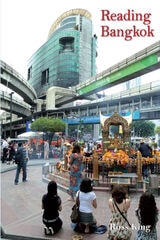
Reading Bangkok
Ross King
National University of Singapore Press, 2011
The author structures the book around external intrusions and local resistance. Geographically, this process is seen in movement from centre to periphery (Thonburi, Rattanakosin, Ratchadamnoen, Sukhumvit, Ratchadapisek, Khlong Toei, the universities). Chronologically, the city underwent various forms of colonization: incorporation of the periphery, which in turn colonized Bangkok; the economic colonization of the 19th and 20th centuries; colonization by consumption brought on in large part by globalized tourism; colonization by the "better" ideas of others (typically from the West); and finally colonization by "better" ways of thinking - notably the intrusions of the universities and of popular democracy.
This exceptionally innovative study draws on urban planning and development, history, anthropology, and political economy, and a rich body of empirical data to provide insights into the maze of power relations, inequalities and global influences that is normally hidden from view. Reading Bangkok is that rare thing, a study that genuinely changes the way its subject is seen and understood.
Reading Books
Essays on the Material Text and Literature in AmericaMichele Moylan
University of Massachusetts Press, 1996
This collection takes as its point of departure the proposition that one can, in fact, tell a book by its cover. The contributors examine the ways in which the material qualities of books—including typography, paper, bindings, layout , and promotional copy—as well as their editing, production, and distribution profoundly affect how they have been read and understood.
The volume includes essays on the publishing history of Melville's early novels, Twain's The Innocents Abroad, the Tauchnitz edition of Hawthornes's The Marble Faun, and Jackson's Romona. Other chapters examine the reception of Dante's works in America, Houghton Mifflin's biographical series, the binding styles of Ticknor and Fields, and the packaging of literature for American high schools.
Reading Boyishly
Roland Barthes, J. M. Barrie, Jacques Henri Lartigue, Marcel Proust, and D. W. WinnicottCarol Mavor
Duke University Press, 2007
To “read boyishly” is to covet the mother’s body as a home both lost and never lost, to desire her as only a son can, as only a body that longs for, but will never become Mother, can. Nostalgia (from the Greek nostos = return to native land, and algos = suffering or grief) is at the heart of the labor of boyish reading, which suffers in its love affair with the mother. The writers and the photographer that Mavor lovingly considers are boyish readers par excellence: Barrie, creator of Peter Pan, the boy who refused to grow up; Barthes, the “professor of desire” who lived with or near his mother until her death; Proust, the modernist master of nostalgia; Winnicott, therapist to “good enough” mothers; and Lartigue, the child photographer whose images invoke ghostlike memories of a past that is at once comforting and painful.
Drawing attention to the interplay between writing and vision, Reading Boyishly is stuffed full with more than 200 images. At once delicate and powerful, the book is a meditation on the threads that unite mothers and sons and on the writers and artists who create from those threads art that captures an irretrievable past.
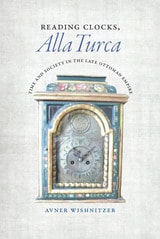
Reading Clocks, Alla Turca
Time and Society in the Late Ottoman EmpireAvner Wishnitzer
University of Chicago Press, 2015
Drawing on a wealth of archival and literary sources, Wishnitzer’s original and highly important work presents the shifting culture of time as an arena in which Ottoman social groups competed for legitimacy and a medium through which the very concept of modernity was defined. Reading Clocks, Alla Turca breaks new ground in the study of the Middle East and presents us with a new understanding of the relationship between time and modernity.
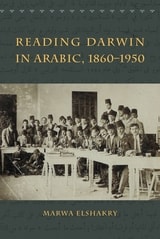
Reading Darwin in Arabic, 1860-1950
Marwa Elshakry
University of Chicago Press, 2013

Reading De Man Reading
Lindsey Waters and Wlad Godzich, Editors
University of Minnesota Press, 1989
Reading De Man Reading was first published in 1989. Minnesota Archive Editions uses digital technology to make long-unavailable books once again accessible, and are published unaltered from the original University of Minnesota Press editions.
Paul de Man, from the outset of his career, concerned himself with the act of reading and with discovering what a rigorous mode of reading can produce. The contributors to this volume—conceived not long before de Man's death in 1983—address his theory and practice of reading: the nature of those readings and what they signify for reading in general, not just for literary texts. De Man explored the act of reading because in it he could bring together—in order to cancel—the subjects known as reader and writer, the referent known as reality, and the medium known as language. In the act of reading de Man, the authors of this book ask where his work leaves us, what changes he made in the world of criticism and writing in general, and what we do differently because of him.
The contributors: Geoffrey Hartman, Jacques Derrida, Deborah Esch, Neil Hertz, Carol Jacobs, Kevin Newmark, Peggy Kamuf, J. Hillis Miller, Werner Hamacher, Hans Robert Jauss, Geoffrey Bennington, Bill Readings, Timothy Bahti, and Rodolphe Gasché.
Lindsay Waters is General Editor at Harvard University Press. Wlad Godzich is professor of comparative literature at the Université de Montréal and co-editor of the Theory and History of Literature series.

Reading Galileo's Letters
Experiments in Friendship, Knowledge, and CommunityEdited by Paula Findlen and Hannah Marcus
University of Chicago Press, 2027
Essays by many of the foremost experts on Galileo offer an interdisciplinary approach to the legendary scientist’s correspondence.
The Tuscan mathematician, physicist, and astronomer Galileo Galilei (1564–1642) is one of history’s most iconic and controversial figures. Letters form the backbone of what one early Galileo scholar called the “private Galileo,” and his correspondence is indeed a record of his family and friendships; his intellectual evolution; his professional interactions with other scientific figures; and his relations with patrons, brokers, and publishers. Last, but hardly least, his letters are a unique cultural artifact of Galileo the writer and master of vernacular prose.
Galileo’s correspondence crossed Europe in public mail pouches, through diplomatic messengers, and was written in code. Today, there are 3,272 surviving letters to or from Galileo and his many friends, family members, disciples, and rivals across Europe. This volume examines these letters as an essential aspect of Galileo’s personal and scientific career. They are what the editors call his “experiments in friendship,” which enabled, abetted, and often served as early drafts of the theories in his published works. This collaborative volume brings together different approaches, case studies, and forms of expertise—historical and literary, intellectual and material, archival and digital. It is a must-read for all Galileo enthusiasts and anyone interested in how to make the most of a rich record of correspondence.
Reading History Sideways
The Fallacy and Enduring Impact of the Developmental Paradigm on Family LifeArland Thornton
University of Chicago Press, 2005
In Reading History Sideways, leading family scholar Arland Thornton demonstrates how this approach, though long since discredited, has permeated Western ideas and values about the family. Further, its domination of social science for centuries caused the misinterpretation of Western trends in family structure, marriage, fertility, and parent-child relations. Revisiting the "developmental fallacy," Thornton here traces its central role in changes in the Western world, from marriage to gender roles to adolescent sexuality. Through public policies, aid programs, and colonialism, it continues to reshape families in non-Western societies as well.
Reading Holinshed's Chronicles
Annabel Patterson
University of Chicago Press, 1994
Although we know it by the name of Raphael Holinshed, editor and major compiler of the 1577 edition, the Chronicles was the work of a group, a collaboration between antiquarians, clergymen, members of parliament, poets, publishers, and booksellers. Through a detailed reading, Patterson argues that the Chronicles convey rich insights into the way the Elizabethan middle class understood their society. Responding to the crisis of disunity which resulted from the Reformation, the authors of the Chronicles embodied and encouraged an ideal of justice, what we would now call liberalism, that extended beyond the writing of history into the realms of politics, law, economics, citizenship, class, and gender. Also, since the second edition of 1587 was called in by the Privy Council and revised under supervision, the work constitutes an important test case for the history of early modern censorship.
An essential book for all students of Tudor history and literature, Reading Holinshed's Chronicles brings into full view a long misunderstood masterpiece of sixteenth-century English culture.
Reading Inca History
Catherine Julien
University of Iowa Press, 2002
At the heart of this book is the controversy over whether Inca history can and should be read as history. Did the Incas narrate a true reflection of their past, and did the Spaniards capture these narratives in a way that can be meaningfully reconstructed? In Reading Inca History,Catherine Julien finds that the Incas did indeed create detectable life histories.
The two historical genres that contributed most to sixteenth- and seventeenth-century Spanish narratives about the Incas were an official account of Inca dynastic genealogy and a series of life histories of Inca rulers. Rather than take for granted that there was an Inca historical consciousness, Julien begins by establishing an Inca purpose for keeping this dynastic genealogy. She then compares Spanish narratives of the Inca past to identify the structure of underlying Inca genres and establish the dependency on oral sources. Once the genealogical genre can be identified, the life histories can also be detected.
By carefully studying the composition of Spanish narratives and their underlying sources, Julien provides an informed and convincing reading of these complex texts. By disentangling the sources of their meaning, she reaches across time, language, and cultural barriers to achieve a rewarding understanding of the dynamics of Inca and colonial political history.
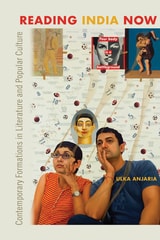
Reading India Now
Contemporary Formations in Literature and Popular CultureUlka Anjaria
Temple University Press, 2019
In an age of social media and reality television, reading and consumption habits in India now demand homegrown pulp fictions. Ulka Anjaria categorizes post-2000 Indian literature and popular culture as constituting “the contemporary,” a movement defined by new and experimental forms—where high- and low-brow meet, and genres break down.
Reading India Now studies the implications of this developing trend as both the right-wing resurges and marginalized voices find expression. Anjaria explores the fiction of Chetan Bhagat and Anuja Chauhan as well as Aamir Khan’s television talk show, Satyamev Jayate, plus the work of documentarian Paromita Vohra, to argue how different kinds of texts are involved in imagining new political futures for an India in transition. Contemporary literature and popular culture in India might seem artless and capitalistic, but it is precisely its openness to the world outside that allows these new works to offer significant insight into the experiences and sensibilities of contemporary India.
Reading Job with St. Thomas Aquinas
Matthew Levering
Catholic University of America Press, 2020
Reading Medieval Images
The Art Historian and the ObjectElizabeth Sears and Thelma K. Thomas, Editors
University of Michigan Press, 2002
What kind of language do they use to descibe what they see? How do they construct arguments using visual evidence? What sorts of arguments do they make? In this unusual anthology, eighteen prominent art historians specializing in the medieval field (European, Byzantine, and Islamic) provide answers to these fundamental questions, not directly but by way of example. Each author, responding to invitation, has chosen for study a single image or object and has submitted it to sustained analysis. The collection of essays, accompanied by statements on methodology by the editors, offers an accessible introduction to current art-historical practice.
Thelma K. Thomas is Associate Professor of the History of Art and Associate Curator of the Kelsey Museum, University of Michigan.
Reading National Geographic
Catherine A. Lutz and Jane L. Collins
University of Chicago Press, 1993
Lutz and Collins take us inside the National Geographic Society to investigate how its photographers, editors, and designers select images and text to produce representations of Third World cultures. Through interviews with the editors, they describe the process as one of negotiating standards of "balance" and "objectivity," informational content and visual beauty. Then, in a close reading of some six hundred photographs, they examine issues of race, gender, privilege, progress, and modernity through an analysis of the way such things as color, pose, framing, and vantage point are used in representations of non-Western peoples. Finally, through extensive interviews with readers, the authors assess how the cultural narratives of the magazine are received and interpreted, and identify a tension between the desire to know about other peoples and their ways and the wish to validate middle-class American values.
The result is a complex portrait of an institution and its role in promoting a kind of conservative humanism that acknowledges universal values and celebrates diversity while it allows readers to relegate non-Western peoples to an earlier stage of progress. We see the magazine and the Society as a key middlebrow arbiter of taste, wealth, and power in America, and we get a telling glimpse into middle-class American culture and all the wishes, assumptions, and fears it brings to bear on our armchair explorations of the world.
Reading North by South
On Latin American Literature, Culture, and PoliticsNeil Larsen
University of Minnesota Press, 1995
Reading North by South was first published in 1995. Minnesota Archive Editions uses digital technology to make long-unavailable books once again accessible, and are published unaltered from the original University of Minnesota Press editions.
Neil Larsen is concerned with misleading interpretations of literature and culture that dominate Latin American studies in North America. In Reading North by South he attempts to correct the distorted views that have prevailed by proposing the need for a freshly conceived historical materialist approach to Latin American texts and cultural practices.
Reading North by South opens with reflections on how North America has read Latin America since the advent of popular fiction from authors like Cortázar and García Márquez. Larsen argues that the North American academy tends to interpret Latin American texts through a postmodern lens of cultural politics that ignores historical realism, and he contends that more attention needs to be paid to historical and class issues. He provides insightful commentaries on political discourses, cultural events, films, and literary texts, and maintains that the canonization of the modernist aesthetic in the United States has resulted in a marginalization of writers and writing that reflect the historical realities of Latin American politics.
As it analyzes important points of debate within and outside of Latin American studies, Reading North by South draws upon a wide diversity of texts written in Portuguese, Spanish and English. Of particular interest is Larsen's discussion of writings from the Caribbean, an area that is not frequently included in Latin American studies. Reading North by South will lead readers to question the expectations and preconceptions that inform their readings of Latin American literature.
Neil Larsen is associate professor of Spanish and Latin American literature at Northeastern University. He is the author of Modernism and Hegemony: A Materialist Critique of Aesthetic Agencies (Minnesota, 1990), and editor of The Discourse of Power: Culture, Hegemony, and the Authoritarian State in Latin America (1983).
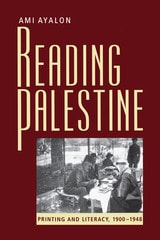
Reading Palestine
Printing and Literacy, 1900-1948By Ami Ayalon
University of Texas Press, 2004
Prior to the twentieth century, Arab society in Palestine was predominantly illiterate, with most social and political activities conducted through oral communication. There were no printing presses, no book or periodical production, and no written signs in public places. But a groundswell of change rapidly raised the region's literacy rates, a fascinating transformation explored for the first time in Reading Palestine.
Addressing an exciting aspect of Middle Eastern history as well as the power of the printed word itself, Reading Palestine describes how this hurried process intensified the role of literacy in every sphere of community life. Ami Ayalon examines Palestine's development of a modern educational system in conjunction with the emergence of a print industry, libraries and reading clubs, and the impact of print media on urban and rural populations. Drawn from extensive archival sources, official reports, autobiographies, and a rich trove of early Palestinian journalism, Reading Palestine provides crucial insight into the dynamic rise of literacy that revolutionized the way Palestinians navigated turbulent political waters.
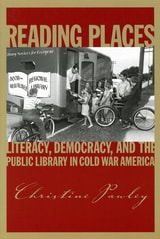
Reading Places
Literacy, Democracy, and the Public Library in Cold War AmericaChristine Pawley
University of Massachusetts Press, 2010
Central to the experiment were well-stocked bookmobiles that brought books to rural districts and the one-room schools that dotted the region. Three years after the project began, state officials and local librarians judged it an overwhelming success. Library circulation figures soared to two-and-a-half times their previous level. Over 90 percent of grade-school children in the rural schools used the bookmobile service, and their reading scores improved beyond expectation.
Despite these successes, however, local communities displayed deeply divided reactions. Some welcomed the book-mobiles and new library services wholeheartedly, valuing print and reading as essential to the exercise of democracy, and keen to widen educational opportunities for children growing up on hardscrabble farms where books and magazines were rare. Others feared the intrusion of govern- ment into their homes and communities, resented the tax increases that library services entailed, and complained about the subversive or immoral nature of some books.
Analyzing the history of tensions between various community groups, Pawley delineates the long-standing antagonisms arising from class, gender, and ethnic differences which contributed to a suspicion of official projects to expand education. Relating a seemingly small story of library policy, she teases out the complex interaction of reading, locality, and cultural difference. In so doing, she illuminates broader questions regarding libraries, literacy, and citizenship, reaching back to the nineteenth century and forward to the present day.
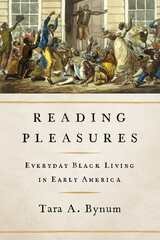
Reading Pleasures
Everyday Black Living in Early AmericaTara A. Bynum
University of Illinois Press, 2023
A daring assertion of Black people’s humanity, Reading Pleasures reveals how four Black writers experienced positive feelings and analyzes the ways these emotions served creative, political, and racialized ends.
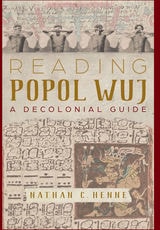
Reading Popol Wuj
A Decolonial GuideNathan C. Henne
University of Arizona Press, 2020
Popol Wujis considered one of the oldest books in the Americas. Various elements of Popol Wuj have appeared in different written forms over the last two millennia and several parts of Popol Wuj likely coalesced in hieroglyphic book form a few centuries before contact with Europeans. Popol Wuj offers a unique interpretation of the Maya world and ways of being from a Maya perspective. However, that perspective is often occluded since the extant Popol Wuj is likely a copy of a copy of a precontact Indigenous text that has been translated many times since the fifteenth century.
Reading Popol Wujoffers readers a path to look beyond Western constructions of literature to engage with this text through the philosophical foundation of Maya thought and culture. This guide deconstructs various translations to ask readers to break out of the colonial mold in approaching this seminal Maya text.
Popol Wuj, or Popol Vuh, in its modern form, can be divided thematically into three parts: cosmogony (the formation of the world), tales of the beings who inhabited the Earth before the coming of people, and chronicles of different ethnic Maya groups in the Guatemala area. Examining thirteen translations of the K’iche’ text, Henne offers a decolonial framework to read between what translations offer via specific practice exercises for reading, studying, and teaching. Each chapter provides a close reading and analysis of a different critical scene based on a comparison of several translations (English and Spanish) of a key K’iche’ word or phrase in order to uncover important philosophical elements of Maya worldviews that resist precise expression in Indo-European languages.
Charts and passages are frontloaded in each chapter so the reader engages in the comparative process before reading any leading arguments. This approach challenges traditional Western reading practices and enables scholars and students to read Popol Wuj—and other Indigenous texts—from within the worldview that created them.
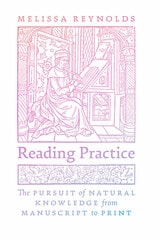
Reading Practice
The Pursuit of Natural Knowledge from Manuscript to PrintMelissa Reynolds
University of Chicago Press, 2024
Reading Practice tells the story of how ordinary people grew comfortable learning from commonplace manuscripts and printed books, such as almanacs, medical recipe collections, and herbals. From the turn of the fifteenth century to the close of the sixteenth century, these were the books English people read when they wanted to attend to their health or understand their place in the universe. Before then, these works had largely been the purview of those who could read Latin. Around 1400, however, medical and scientific texts became available in Middle English while manuscripts became less expensive. These vernacular manuscripts invited their readers into a very old and learned conversation: Hippocrates and Galen weren’t distant authorities whose word was law, they were trusted guides, whose advice could be excerpted, rearranged, recombined, and even altered to suit a manuscript compiler’s needs. This conversation continued even after the printing press arrived in England in 1476. Printers mined manuscripts for medical and scientific texts that they would publish throughout the sixteenth century, though the pressures of a commercial printing market encouraged printers to package these old texts in new ways. Without the weight of authority conditioning their reactions and responses to very old knowledge, and with so many editions of practical books to choose from, English readers grew into confident critics and purveyors of natural knowledge in their own right.
Melissa Reynolds reconstructs shifting attitudes toward medicine and science over two centuries of seismic change within English culture, attending especially to the effects of the Reformation on attitudes toward nature and the human body. Her study shows how readers learned to be discerning and selective consumers of knowledge gradually, through everyday interactions with utilitarian books.
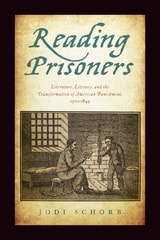
Reading Prisoners
Literature, Literacy, and the Transformation of American Punishment, 1700–1845Schorb, Jodi
Rutgers University Press, 2014
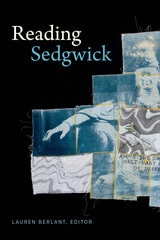
Reading Sedgwick
Lauren Berlant, editor
Duke University Press, 2019
Contributors. Lauren Berlant, Kathryn Bond Stockton, Judith Butler, Lee Edelman, Jason Edwards, Ramzi Fawaz, Denis Flannery, Jane Gallop, Jonathan Goldberg, Meridith Kruse, Michael Moon, José Esteban Muñoz, Chris Nealon, Andrew Parker, H. A. Sedgwick, Karin Sellberg, Michael D. Snediker, Melissa Solomon, Robyn Wiegman
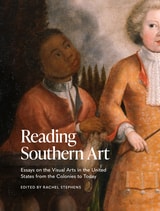
Reading Southern Art
Essays on the Visual Arts in the United States from the Colonies to TodayRachel Stephens
University of Arkansas Press, 2027
For too long, the visual culture of the American South has been framed through narrow lenses: elite patronage, regional nostalgia, and selective narratives that privilege whiteness while overlooking the complexity of the region’s artistic production. Reading Southern Art: Essays on the Visual Arts in the United States from the Colonies to Today intervenes decisively in this tradition, illuminating the vast visual and material history of the South through works produced by a variety of artists across the region.
Edited by Rachel Stephens, this collection examines Southern art from the seventeenth century until today, covering a diverse variety of media, from traditional fine arts to material and visual culture, ephemera, and public monuments. Analyzing an array of works, from portraits to vernacular traditions to contemporary artistic practice, Reading Southern Art considers how histories, visual and otherwise, are constructed and revised and how the art of the American South has shaped, and been shaped by, such contested histories.
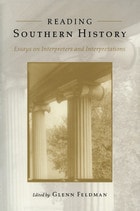
Reading Southern History
Essays on Interpreters and InterpretationsGlenn Feldman
University of Alabama Press, 2001
This collection of essays examines the contributions of some of the most notable interpreters of southern history and culture, furthering our understanding of the best historical work produced on the region.
Historian Glenn Feldman gathers together a group of essays that examine the efforts of important scholars to discuss and define the South's distinctiveness. The volume includes 18 chapters on such notable historians as John Hope Franklin, Anne Firor Scott, Frank L. Owsley, W. J. Cash, and C. Vann Woodward, written by 19 different researchers, both senior historians and emerging scholars, including Jacquelyn Dowd Hall, John Shelton Reed, Bruce Clayton, and Ted Ownby. The essays examine the major work or works of each scholar under consideration as well as that scholar's overall contribution to the study of southern history.
Reading Southern History will enlighten readers on the more compelling themes currently and traditionally explored by southern historians. It will appeal greatly to professors and students as a valuable multidisciplinary introduction to the study of southern history, since several of the essays are on scholars who are working outside the discipline of history proper, in the fields of political science, sociology, journalism, and economics. Feldman's collection, therefore, sheds light on a broad spectrum of themes important in southern history, including the plight of poor whites, race, debates over race and class, the "reconstruction syndrome," continuity versus discontinuity in relation to blacks and whites, and regional culture and distinctiveness.
Reading Southern History will be valuable to students and scholars of women's studies, African American history, working-class history, and ethnic studies, as well as traditional southern history. Most important, the publication makes a significant contribution to the development and ongoing study of the historiography of the South.
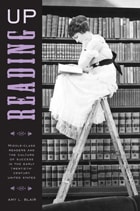
Reading Up
Middle-Class Readers and the Culture of Success in the Early Twentieth-Century United StatesAmy Blair
Temple University Press, 2011
A person who reads a book for self-improvement rather than aesthetic pleasure is “reading up.” Reading Up is Amy Blair's engaging study of popular literary critics who promoted reading generally and specific books as vehicles for acquiring cultural competence and economic mobility. Combining methodologies from the history of the book and the history of reading, to mass-cultural studies, reader-response criticism, reception studies, and formalist literary analysis, Blair shows how such critics influenced the choices of striving readers and popularized some elite writers.
Framed by an analysis of Hamilton Wright Mabie's role promoting the concept of “reading up” during his ten-year stint as the cultivator of literary taste for the highly popular Ladies' Home Journal, Reading Up reveals how readers flocked to literary works that they would be expected to dislike. Blair shows that while readers could be led to certain books by a trusted adviser, they frequently followed their own path in interpreting them in unexpected ways.
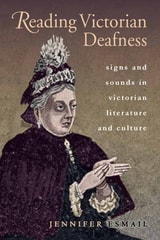
Reading Victorian Deafness
Signs and Sounds in Victorian Literature and CultureJennifer Esmail
Ohio University Press, 2013
Winner of the 2013 Sonya Rudikoff Award for best first book in Victorian Studies
Short-listed for the 2013 British Society for Literature and Science Book Prize.
Reading Victorian Deafness is the first book to address the crucial role that deaf people, and their unique language of signs, played in Victorian culture. Drawing on a range of works, from fiction by Charles Dickens and Wilkie Collins, to poetry by deaf poets and life writing by deaf memoirists Harriet Martineau and John Kitto, to scientific treatises by Alexander Graham Bell and Francis Galton, Reading Victorian Deafness argues that deaf people’s language use was a public, influential, and contentious issue in Victorian Britain.
The Victorians understood signed languages in multiple, and often contradictory, ways: they were objects of fascination and revulsion, were of scientific import and literary interest, and were considered both a unique mode of human communication and a vestige of a bestial heritage. Over the course of the nineteenth century, deaf people were increasingly stripped of their linguistic and cultural rights by a widespread pedagogical and cultural movement known as “oralism,” comprising mainly hearing educators, physicians, and parents.
Engaging with a group of human beings who used signs instead of speech challenged the Victorian understanding of humans as “the speaking animal” and the widespread understanding of “language” as a product of the voice. It is here that Reading Victorian Deafness offers substantial contributions to the fields of Victorian studies and disability studies. This book expands current scholarly conversations around orality, textuality, and sound while demonstrating how understandings of disability contributed to Victorian constructions of normalcy. Reading Victorian Deafness argues that deaf people were used as material test subjects for the Victorian process of understanding human language and, by extension, the definition of the human.
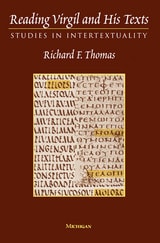
Reading Virgil and His Texts
Studies in IntertextualityRichard F. Thomas
University of Michigan Press, 2000
The articles and notes included in this volume have been selected for their diachronic aspect in addition to the synchronic status they had in their original context. Dealing with the intricate ways in which Virgil, and in the introductory chapter his predecessor Catullus, manipulated and appropriated their inherited Greek and Roman literary tradition, this book presents a coherent profile, through these detailed studies, of the mechanics of one of the most dynamic periods in the literary history of any culture.
Richard Thomas--one of the most important voices in Latin literary studies today--shows little anxiety about objections to authorial intentionality. Throughout there is a working assumption that intertextual connections can be established and, further, that functions and purposes, even intended ones, may be inferred from those connections.
This book will be of interest to scholars and students of Greek and Latin literature but will also be of great value to students of medieval, Renaissance, and early modern vernacular literatures, most of whose poets see themselves as closely connected to Virgil.
Richard F. Thomas is Professor of Greek and Latin, Harvard University.
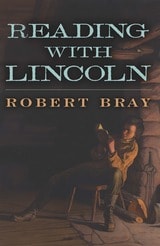
Reading With Lincoln
Robert Bray
Southern Illinois University Press, 2010
Through extensive reading and reflection, Abraham Lincoln fashioned a mind as powerfully intellectual and superlatively communicative as that of any other American political leader. Reading with Lincoln uncovers the how of Lincoln’s inspiring rise to greatness by connecting the content of his reading to the story of his life.
At the core of Lincoln’s success was his self-education, centered on his love of and appreciation for learning through books. From his early studies of grammar school handbooks and children’s classics to his interest in Shakespeare’s Macbeth and the Bible during his White House years, what Lincoln read helped to define who he was as a person and as a politician. This unique study delves into the books, pamphlets, poetry, plays, and essays that influenced Lincoln’s thoughts and actions.
Exploring in great depth and detail those readings that inspired the sixteenth president, author Robert Bray follows Lincoln’s progress closely, from the young teen composing letters for illiterate friends and neighbors to the politician who keenly employed what he read to advance his agenda. Bray analyzes Lincoln’s radical period in New Salem, during which he came under the influence of Anglo-American and French Enlightenment thinkers such as Thomas Paine, C. F. Volney, and Voltaire, and he investigates Lincoln’s appreciation of nineteenth-century lyric poetry, which he both read and wrote. Bray considers Lincoln’s fascination with science, mathematics, political economics, liberal social philosophy, theology, and the Bible, and devotes special attention to Lincoln’s enjoyment of American humor. While striving to arrive at an understanding of the role each subject played in the development of this remarkable leader, Bray also examines the connections and intertextual relations between what Lincoln read and how he wrote and spoke.
This comprehensive and long-awaited book provides fresh insight into the self-made man from the wilderness of Illinois. Bray offers a new way to approach the mind of the political artist who used his natural talent, honed by years of rhetorical study and practice, to abolish slavery and end the Civil War.
Reading Women in the New Testament Letters
Korinna Zamfir
SBL Press, 2024
Reading across Borders
Afghans, Iranians, and Literary NationalismAria Fani
University of Texas Press, 2024
2025 René Wellek Prize, Monograph, American Comparative Literature Association
The dynamic and interconnected ways Afghans and Iranians invented their modern selves through literature.
Contrary to the presumption that literary nationalism in the Global South emerged through contact with Europe alone, Reading across Borders demonstrates how the cultural forms of Iran and Afghanistan as nation-states arose from their shared Persian heritage and cross-cultural exchange in the twentieth century. In this book, Aria Fani charts the individuals, institutions, and conversations that made this exchange possible, detailing the dynamic and interconnected ways Afghans and Iranians invented their modern selves through new ideas about literature.
Fani illustrates how voluntary and state-funded associations of readers helped formulate and propagate "literature" as a recognizable notion, adapting and changing Persian concepts to fit this modern idea. Focusing on early twentieth-century periodicals with readers in Afghan and Iranian cities and their diaspora, Fani exposes how nationalism intensified—rather than severed—cultural contact among two Persian-speaking societies amidst the diverging and competing demands of their respective nation-states. This interconnected history was ultimately forgotten, shaping many of the cultural disputes between Iran and Afghanistan today.
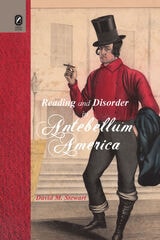
Reading and Disorder in Antebellum America
David M. Stewart
The Ohio State University Press, 2011
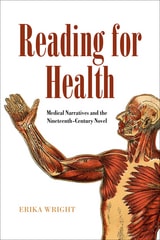
Reading for Health
Medical Narratives and the Nineteenth-Century NovelErika Wright
Ohio University Press, 2016
In Reading for Health: Medical Narratives and the Nineteenth-Century Novel, Erika Wright argues that the emphasis in Victorian Studies on disease as the primary source of narrative conflict that must be resolved has obscured the complex reading practices that emerge around the concept of health. By shifting attention to the ways that prevention of illness and the preservation of well-being operate in fiction, both thematically and structurally, Wright offers a new approach to reading character and voice, order and temporality, setting and metaphor. As Wright reveals, while canonical works by Austen, Brontë, Dickens, Martineau, and Gaskell register the pervasiveness of a conventional “therapeutic” form of action and mode of reading, they demonstrate as well an equally powerful investment in the achievement and maintenance of “health”—what Wright refers to as a “hygienic” narrative—both in personal and domestic conduct and in social interaction of the individual within the community.
Reading for Realism
The History of a U.S. Literary Institution, 1850–1910Nancy Glazener
Duke University Press, 1997
Combining reception theory with a materialist analysis of the social formations in which realist reading practices circulated, Glazener’s study reveals the elitist underpinnings of literary realism. At the book’s center is the Atlantic group of magazines, whose influence was part of the cultural machinery of the Northeastern urban bourgeoisie and crucial to the development of literary realism in America. Glazener shows how the promotion of realism by this group of publications also meant a consolidation of privilege—primarily in terms of class, gender, race, and region—for the audience it served. Thus American realism, so often portrayed as a quintessentially populist form, actually served to enforce existing structures of class and power.
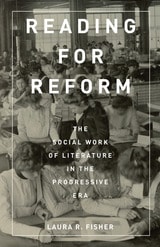
Reading for Reform
The Social Work of Literature in the Progressive EraLaura R. Fisher
University of Minnesota Press, 2019
An unprecedented examination of class-bridging reform and U.S. literary history at the turn of the twentieth century
Reading for Reform rewrites the literary history of late nineteenth and early twentieth century America by putting social reform institutions at the center of literary and cultural analysis. Examining the vibrant, often fractious literary cultures that developed as part of the Progressive mandate to uplift the socially disadvantaged, it shows that in these years reformers saw literature as a way to combat the myriad social problems that plagued modern U.S. society. As they developed distinctly literary methods for Americanizing immigrants, uplifting and refining wage-earning women, and educating black students, their institutions gave rise to a new social purpose for literature.
Class-bridging reform institutions—the urban settlement house, working girls’ club, and African American college—are rarely addressed in literary history. Yet, Laura R. Fisher argues, they engendered important experiments in the form and social utility of American literature, from minor texts of Yiddish drama and little-known periodical and reform writers to the fiction of Edith Wharton and Nella Larsen. Fisher delves into reform’s vast and largely unexplored institutional archives to show how dynamic sites of modern literary culture developed at the margins of social power.
Fisher reveals how reformist approaches to race, class, religion, and gender formation shaped American literature between the 1880s and the 1920s. In doing so, she tells a new story about the fate of literary practice, and the idea of literature’s practical value, during the very years that modernist authors were proclaiming art’s autonomy from concepts of social utility.
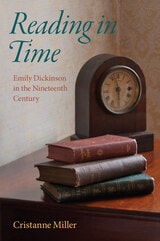
Reading in Time
Emily Dickinson in the Nineteenth CenturyCristanne Miller
University of Massachusetts Press, 2012
Before 1865, Dickinson at least ambivalently considered publication, circulated relatively few poems, and saved almost everything she wrote in organized booklets. After this date, she wrote far fewer poems, circulated many poems without retaining them, and took less interest in formally preserving her work. Yet, Miller argues, even when circulating relatively few poems, Dickinson was vitally engaged with the literary and political culture of her day and, in effect, wrote to her contemporaries. Unlike previous accounts placing Dickinson in her era, Reading in Time demonstrates the extent to which formal properties of her poems borrow from the short-lined verse she read in schoolbooks, periodicals, and single-authored volumes. Miller presents Dickinson's writing in relation to contemporary experiments with the lyric, the ballad, and free verse, explores her responses to American Orientalism, presents the dramatic lyric as one of her preferred modes for responding to the Civil War, and gives us new ways to understand the patterns of her composition and practice of poetry.
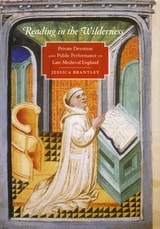
Reading in the Wilderness
Private Devotion and Public Performance in Late Medieval EnglandJessica Brantley
University of Chicago Press, 2007
Drawing on the work of W. J. T. Mitchell, Michael Camille, and others working at the image-text crossroads, Reading in the Wilderness addresses the manuscript’s texts and illustrations to examine connections between reading and performance within the solitary monk’s cell and also outside. Brantley reimagines the medieval codex as a site where the meanings of images and words are performed, both publicly and privately, in the act of reading.
Reading the Book of Nature
How Eight Best Sellers Reconnected Christianity and the Sciences on the Eve of the Victorian AgeJonathan R. Topham
University of Chicago Press, 2022
When Charles Darwin returned to Britain from the Beagle voyage in 1836, the most talked-about scientific books of the day were the Bridgewater Treatises. This series of eight works was funded by a bequest of the last Earl of Bridgewater and written by leading men of science appointed by the president of the Royal Society to explore "the Power, Wisdom, and Goodness of God, as manifested in the Creation." Securing public attention beyond all expectations, the series offered Darwin’s generation a range of approaches to one of the great questions of the age: how to incorporate the newly emerging disciplinary sciences into Britain’s overwhelmingly Christian culture.
Drawing on a wealth of archival and published sources, including many unexplored by historians, Jonathan R. Topham examines how and to what extent the series contributed to a sense of congruence between Christianity and the sciences in the generation before the fabled Victorian conflict between science and religion. Building on the distinctive insights of book history and paying close attention to the production, circulation, and use of the books, Topham offers new perspectives on early Victorian science and the subject of science and religion as a whole.
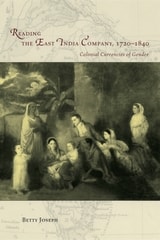
Reading the East India Company 1720-1840
Colonial Currencies of GenderBetty Joseph
University of Chicago Press, 2003
Drawing on the British East India Company's records as well as novels, memoirs, portraiture and guidebooks, Joseph shows how the company's economic and archival practices intersected to produce colonial "fictions" or "truth-effects" that strictly governed class and gender roles—in effect creating a "grammar of power" that kept the far-flung empire intact. And while women were often excluded from this archive, Joseph finds that we can still hear their voices at certain key historical junctures. Attending to these voices, Joseph illustrates how the writing of history belongs not only to the colonial project set forth by British men, but also to the agendas and mechanisms of agency—of colonized Indian, as well as European women. In the process, she makes a valuable and lasting contribution to gender studies, postcolonial theory, and the history of South Asia.
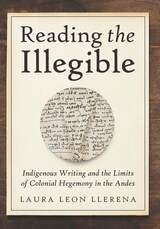
Reading the Illegible
Indigenous Writing and the Limits of Colonial Hegemony in the AndesLaura Leon Llerena
University of Arizona Press, 2023
The concept of legibility allows us to reconsider this unique manuscript within the intertwined histories of literacy, knowledge, and colonialism. Reading the Illegible shows that the anonymous author(s) of the Huarochirí Manuscript, along with two contemporaneous Andean-authored texts by Joan de Santa Cruz Pachacuti and Felipe Guaman Poma de Ayala, rewrote the history of writing and the notion of Christianity by deploying the colonizers’ technology of alphabetic writing.
Reading the Illegible weaves together the story of the peoples, places, objects, and media that surrounded the creation of the anonymous Huarochirí Manuscript to demonstrate how Andean people endowed the European technology of writing with a new social role in the context of a multimedia society.
Reading the Middle Generation Anew
Culture, Community, and Form in Twentieth-Century American PoetryEric Haralson
University of Iowa Press, 2006
In addition to having worked during the broad middle of the last century, these poets constitute the center of twentieth-century American poetry in the larger sense, refuting invidious connotations of “middle” as coming after the great moderns and being superseded by a proliferating postmodern experimentation. This middle generation mediates the so-called American century and its prodigious body of poetry, even as it complicates historical and aesthetic categorizations.
Taking diverse formal and thematic angles on these poets—deconstructionist, biographical-historical, and more formalist accounts—this book re-examines their between-ness and ambivalence: their various positionings and repositionings in aesthetic, political, and personal matters. The essays study the interplay between these writers and such shifting formations as religious discourse, consumerism, militarism and war, the ideology of America as “nature’s nation,” and U.S. race relations and ethnic conflicts. Reading the Middle Generation Anew also shows the legacy of the middle generation, the ways in which their lives and writings continue to be a shaping force in American poetry. This fresh and invigorating collection will be of great interest to literary scholars and poets.
Reading the Renaissance
Black Women's Literary Reception and Taste in Chicago, 1932-1953Mary I. Unger
University of Massachusetts Press, 2025
From 1932 to 1953, during the Black Chicago Renaissance, numerous literary events were held within and for the city’s Black community. In book clubs, public forums, print reviews, little magazines, local programming, and other public venues, Black women in particular debated the role of literature in racial uplift efforts, set literary standards, and acted as community gatekeepers for cultural production during a time known as the Black Chicago Renaissance. Through these inspiring efforts, a mix of publishers, well-known authors, and everyday readers significantly fostered a robust literary culture in the Windy City.
Reading the Renaissance constructs a reception history of the Black women who read and reviewed, published and promoted, and collected and curated literature of the era. Mary Unger interprets how local figures such as Vivian G. Harsh, Ora Morrow, Gwendolyn Brooks, Alice Browning, Fern Gayden, and Margaret Walker cultivated particular literary tastes through collective acts of reading and reception. She does so by recovering a network of readers, book clubs, literary magazines, civic programs, and book businesses that Black women created, led, and transformed during the early 1930s through the early 1950s in Bronzeville, Chicago’s predominantly Black South Side neighborhood.
This illuminating work includes close readings of texts alongside letters, scrapbooks, meeting minutes, reviews, and other ephemera of local reading practices to show how Black women facilitated diverse strategies of reading while instructing community members how to engage a variety of print cultures at the time. Unger demonstrates how Black women readers influenced individual authors as well as the norms and expectations of African American literature more broadly, becoming important (yet too often overlooked) players in American literary history.
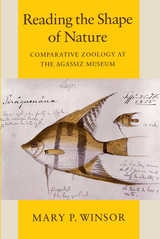
Reading the Shape of Nature
Comparative Zoology at the Agassiz MuseumMary P. Winsor
University of Chicago Press, 1991
In 1859, Louis Agassiz established the Museum of Comparative Zoology to house research on the ideal types that he believed were embodied in all living forms. Agassiz's vision arose from his insistence that the order inherent in the diversity of life reflected divine creation, not organic evolution. But the mortar of the new museum had scarcely dried when Darwin's Origin was published. By Louis Agassiz's death in 1873, even his former students, including his son Alexander, had defected to the evolutionist camp. Alexander, a self-made millionaire, succeeded his father as director and introduced a significantly different agenda for the museum.
To trace Louis and Alexander's arguments and the style of science they established at the museum, Winsor uses many fascinating examples that even zoologists may find unfamiliar. The locus of all this activity, the museum building itself, tells its own story through a wonderful series of archival photographs.
Reading the Skies
A Cultural History of English Weather, 1650-1820Vladimir Jankovic
University of Chicago Press, 2001
Jankovic interweaves classical traditions, folk/popular beliefs and practices, and the increasingly quantitative approaches of urban university men to understanding the wonders of the skies. He places special emphasis on the role that detailed meteorological observations played in natural history and chorography, or local geography; in religious and political debates; and in agriculture. Drawing on a number of archival sources, including correspondence and weather diaries, as well as contemporary pamphlets, tracts, and other printed sources reporting prodigious phenomena in the skies, this book will interest historians of science, Britain, and the environment.
Reading the Song of Songs with St. Thomas Aquinas
Serge-Thomas Bonino
Catholic University of America Press, 2022
Reading the World
Encyclopedic Writing in the Scholastic AgeMary Franklin-Brown
University of Chicago Press, 2012
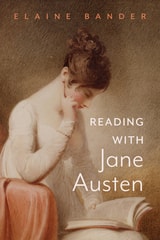
Reading with Jane Austen
Elaine Bander
Bucknell University Press, 2026
Jane Austen has more readers today than at any time in history. Many of Austen’s legions of fans, however, came to her novels after first seeing films or other adaptations made for twenty-first-century audiences. Austen herself conversely spent her literary career undermining romantic clichés and rethinking novel conventions. Confident that she and her contemporaries shared a common reading culture, Austen deliberately constructed her novels to set readerly expectations, only to disrupt or confound those expectations by challenging her readers’ assumptions and values. In Reading with Jane Austen, Elaine Bander carefully rereads the great author’s novels—beginning with her late work of juvenilia, “Catharine, or The Bower,” and ending with her final fragment, “Sanditon”—against the rich context of late Georgian literary and intellectual culture. In doing so, Bander invites us into the transformative experience that Austen intentionally designed for her earliest readers, adding new layers of appreciation for those who love her work.
Published by Bucknell University Press. Distributed worldwide by Rutgers University Press.
Elaine Bander speaking at the Atwater Library in Quebec (https://youtu.be/UeEjFOfp9cQ?si=Wv2hsLxkGK157WZI)