Results by title
8113 books match the query 'Literary Criticism' and 415 start with r
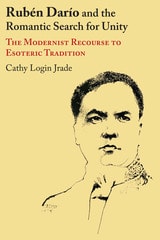
Rubén Darío and the Romantic Search for Unity
The Modernist Recourse to Esoteric TraditionBy Cathy Login Jrade
University of Texas Press, 1983
Modernism was the major Spanish American literary movement of the late nineteenth and early twentieth centuries. Leader of that influential movement was Rubén Darío, the Nicaraguan now recognized as one of the most important Hispanic poets of all time.
Like the Romantics in England and the Symbolists on the Continent, Darío and other Modernists were strongly influenced by occultist thought. But, as the poet Octavio Paz has written, "academic criticism has ... preferred to close its eyes to the stream of occultism that runs throughout Darío's work. This silence damages our comprehension of his poetry."
Cathy Login Jrade's groundbreaking study corrects this critical oversight. Her work clearly demonstrates that esoteric tradition is central to Modernism and that an understanding of this centrality clarifies both the nature of the movement and its relationship to earlier European literature.
After placing Modernism in a broad historical and literary perspective, Jrade examines the impact of esoteric beliefs upon Darío's view of the world and the role of poetry in it. Through detailed and insightful analyses of key poems, she explores the poet's quest for solutions to the nineteenth-century crisis of belief.
The movement that Ruben Darío headed brought Hispanic poetry into the mainstream of the "modern tradition," with its sense of fragmentation and alienation and its hope for integration and reconciliation with nature. Rubén Darío and the Romantic Search for Unity enriches our understanding of that movement and the work of its leading poet.
Rue Traversière
Yves Bonnefoy
Seagull Books, 1972
Praised by Paul Auster as “one of the rare poets in the history of literature to have sustained the highest level of artistic excellence throughout an entire lifetime,” Yves Bonnefoy is widely considered the foremost French poet of his generation. Proving that his prose is just as lyrical, Rue Traversière, written in 1977, is one of his most harmonious works. Each of the fifteen discrete or linked texts, whose lengths range from brief notations to long, intense, self-questioning pages, is a work of art in its own right: brief and richly suggestive as haiku, or long and intricately wrought in syntax and thought; and all are as rewarding in their sounds and rhythms, and their lightning flashes of insight, as any sonnet. “I can write all I like; I am also the person who looks at the map of the city of his childhood and doesn’t understand,” says the section that gives the book its title, as he revisits childhood cityscapes and explores the tricks memory plays on us.
A mixture of genres—the prose poem, the personal essay, quasi-philosophical reflections on time, memory, and art—this is a book of both epigrammatic concision and dreamlike narratives that meander with the poet’s thought as he struggles to understand and express some of the undercurrents of human life. The book’s layered texts echo and elaborate on one another, as well as on aspects of Bonnefoy’s own poetics and thought.
Ruin and Restitution
Reinterpreting Romanticism in SpainPhilip W. Silver
Vanderbilt University Press, 1997
Ruins of Modernity
Julia Hell and Andreas Schönle, eds.
Duke University Press, 2009
Several contributors discuss ideas about ruins developed by philosophers such as Immanuel Kant, Georg Simmel, and Walter Benjamin. One contributor examines how W. G. Sebald’s novel The Rings of Saturn betrays the ruins erased or forgotten in the Hegelian philosophy of history. Another analyzes the repressed specter of being bombed out of existence that underpins post-Second World War modernist architecture, especially Le Corbusier’s plans for Paris. Still another compares the ways that formerly dominant white populations relate to urban-industrial ruins in Detroit and to colonial ruins in Namibia. Other topics include atomic ruins at a Nevada test site, the connection between the cinema and ruins, the various narratives that have accrued around the Inca ruin of Vilcashuamán, Tolstoy’s response in War and Peace to the destruction of Moscow in the fire of 1812, the Nazis’ obsession with imperial ruins, and the emergence in Mumbai of a new “kinetic city” on what some might consider the ruins of a modernist city. By focusing on the concept of ruin, this collection sheds new light on modernity and its vast ramifications and complexities.
Contributors. Kerstin Barndt, Jon Beasley-Murray, Russell A. Berman, Jonathan Bolton, Svetlana Boym, Amir Eshel, Julia Hell, Daniel Herwitz, Andreas Huyssen, Rahul Mehrotra, Johannes von Moltke, Vladimir Paperny, Helen Petrovsky, Todd Presner, Helmut Puff, Alexander Regier, Eric Rentschler, Lucia Saks, Andreas Schönle, Tatiana Smoliarova, George Steinmetz, Jonathan Veitch, Gustavo Verdesio, Anthony Vidler
Ruins
Classical Theater and Broken MemoryOdai Johnson
University of Michigan Press, 2018
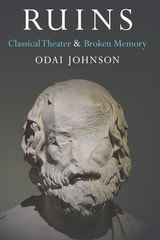
Much of the theater of antiquity is marked by erasures: missing origins, broken genres, fragments of plays, ruins of architecture, absented gods, remains of older practices imperfectly buried and ghosting through the civic productions that replaced them. Ruins: Classical Theater and Broken Memory traces the remains, the remembering, and the forgetting of performance traditions of classical theater. The book argues that it is only when we look back over the accumulation of small evidence over a thousand-year sweep of classical theater that the remarkable and unequaled endurance of the tradition emerges. In the absence of more evidence, Odai Johnson turns instead to the absence itself, pressing its most legible gaps into a narrative about scars, vanishings, erasures, and silence: all the breakages that constitute the ruins of antiquity.
In ten wide-ranging case studies, theater history and performance theory are brought together to examine the texts, artifacts, and icons left behind, reading them in fresh ways to offer an elegantly written, extended meditation on “how the aesthetic of ruins offered a model for an ideal that dislodged and ultimately stood in for the historic.”
Russia Reads Rousseau, 1762-1825
Thomas Barran
Northwestern University Press, 2002
Russia's Legal Fictions
Harriet Murav
University of Michigan Press, 1998
Russia's Rome
Imperial Visions, Messianic Dreams, 1890–1940Judith E. Kalb
University of Wisconsin Press, 2008
Russian Dramatic Theory from Pushkin to the Symbolists
An AnthologyTranslated and edited by Laurence P. Senelick
University of Texas Press, 1981
Although younger than most European theatrical traditions, the Russian professional theater has generated an exciting body of criticism and theory which until recently has remained unknown or nearly inaccessible in the West. This anthology presents a selection of important Russian writing on the aesthetics of drama and the theater from 1828 to 1914.
The focus of these essays, most published here for the first time in English, is on the so-called Crisis in the Theater of 1904 to 1914, a lively debate between the symbolists and the naturalists that evoked brilliant polemic writing from Meyerhold, Bely, Bryusov, and others. Along with Chekhov's amusing critique of Sarah Bernhardt ("monstrously facile!") and Ivanov's abstruse analysis of the essence of tragedy, the essays form a running commentary on the development of the Russian theater: Pushkin on his predecessors, Gogol on his own work, Belinsky on Gogol, Sleptsov on Ostrovsky and Leskov, Bely on Chekhov's The Cherry Orchard ("enervated people, trying to forget the terror of life"), the symbolists on one another.
Each selection is printed in its entirety, with extensive notes, and a lengthy introduction places all the pieces within their historical and cultural contexts to comprise a brief history of Russian dramatic theory before the revolution. This volume is essential reading for all who wish to extend their knowledge of the Russian contribution to theatrical history, theory, and criticism.
Russian Grotesque Realism
The Great Reforms and the Gentry DeclineAni Kokobobo
The Ohio State University Press, 2018
Russian Grotesque Realism: The Great Reforms and the Gentry Decline offers a comprehensive reevaluation of the Russian realist novel and proposes that a composite style, “grotesque realism,” developed in response to social upheaval during the post-Reform era. In this compelling new study, Ani Kokobobo argues that if the realism of pre-Reform Russia could not depict socioeconomic change directly, the grotesque provided an indirect means for Russian writers to capture the instability of the times and the decline of the gentry. While realism historically represented the psychological depth of characters, the grotesque focused more on the body, materialism, and categorical confusions in order to depict characters whose humanity had eroded.
With original readings of some of Russian realism’s greatest novels, Anna Karenina, Demons, and Brothers Karamazov, as well as lesser known novels like The Family Golovlev, The Precipice, Resurrection, and Cathedral Folk, Russian Grotesque Realism traces the transformation of gentry representation from spiritual strivers and thinkers to more materialist beings. By the end of the nineteenth century, the gentry, originally seen as society’s preservers, were represented as grotesque, reflecting a broader societal breakdown that would eventually precipitate the end of the novel genre itself.
Russian Minimalism
From the Prose Poem to the Anti-StoryAdrian Wanner
Northwestern University Press, 2003
The paradoxical genre of the prose poem, developed by the French poet Charles Baudelaire, provides Wanner with an overarching theoretical rubric for a variety of works of Russian literature, ranging from Ivan Turgenev's "Poems in Prose" to a host of decadent, symbolist, realist, and futurist miniatures, including Fedor Sologub's "Little Fairy Tales," Aleksei Remizov's dreams, Vasilii Kandinskii's prose poems, and Daniil Kharms' absurdist ministories. His book demonstrates how the negativity inherent in the form of the prose poem transformed the overwrought lyricism of fin de siècle prose into the ascetic starkness of the twentieth-century minimalist anti-story.
Russian Performances
Word, Object, ActionEdited by Julie A. Buckler, Julie A. Cassiday, and Boris Wolfson
University of Wisconsin Press, 2018
Challenging the primacy of the written word in this field, the volume fosters a larger intellectual community informed by theories and practices of performance from anthropology, art history, dance studies, film studies, cultural and social history, literary studies, musicology, political science, theater studies, and sociology.

Russia’s Black Genius
A Sourcebook on the African Heritage of Alexander PushkinEdited by Emily Wang and Korey Garibaldi
Amherst College Press, 2027
Russia’s Black Genius: A Sourcebook on the African Heritage of Alexander Pushkin brings together primary sources related to the racialization of Russian poet Alexander Pushkin and his Afro-Russian great-grandfather, the military engineer and general Abram Petrovich Gannibal. While Pushkin is a canonical figure and renowned to this day as Russia’s national poet, his African heritage is often overlooked or poorly understood; meanwhile Gannibal, despite his compelling life story, has become a relatively obscure figure outside of Russia. Yet over the course of the nineteenth and twentieth centuries, it was common to find discussions of Pushkin’s Black and multiracial ancestry in books and periodicals on both sides of the Atlantic. Building on the work of a small but influential cohort of scholars and intellectuals who have illuminated the racial dimensions of Pushkin’s legacy, this volume makes primary and source materials available, often for the first time, to readers who are not fluent in the Russian language. Ranging from US criticism and English translations of Russian, German, and French texts to numerous accounts of Pushkin’s life and works penned by Black Americans, the texts in this sourcebook expand and complicate the historical reception of Pushkin in Europe and the United States. Through translation and interdisciplinary dialogue, Russia’s Black Genius brings one of Russia’s—and the world’s— foremost poets into conversation with a broader swath of global readers.
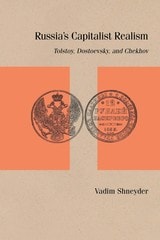
Russia’s Capitalist Realism
Tolstoy, Dostoevsky, and ChekhovVadim Shneyder
Northwestern University Press, 2021
Russia’s Capitalist Realism examines how the literary tradition that produced the great works of Leo Tolstoy, Fyodor Dostoevsky, and Anton Chekhov responded to the dangers and possibilities posed by Russia’s industrial revolution. During Russia’s first tumultuous transition to capitalism, social problems became issues of literary form for writers trying to make sense of economic change. The new environments created by industry, such as giant factories and mills, demanded some kind of response from writers but defied all existing forms of language.
This book recovers the rich and lively public discourse of this volatile historical period, which Tolstoy, Dostoevsky, and Chekhov transformed into some of the world’s greatest works of literature. Russia’s Capitalist Realism will appeal to readers interested in nineteenth‑century Russian literature and history, the relationship between capitalism and literary form, and theories of the novel.
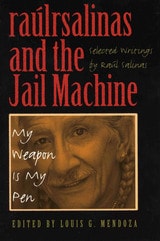
raúlrsalinas and the Jail Machine
My Weapon Is My PenSelected writings by Raúl R. Salinas
University of Texas Press, 2006
Raúl R. Salinas is regarded as one of today's most important Chicano poets and human rights activists, but his passage to this place of distinction took him through four of the most brutal prisons in the country. His singular journey from individual alienation to rage to political resistance reflected the social movements occurring inside and outside of prison, making his story both personal and universal.
This groundbreaking collection of Salinas' journalism and personal correspondence from his years of incarceration and following his release provides a unique perspective into his spiritual, intellectual, and political metamorphosis. The book also offers an insider's view of the prison rebellion movement and its relation to the civil rights and anti-war movements of the 1960s and 1970s. The numerous letters between Salinas and his family, friends, and potential allies illustrate his burgeoning political awareness of the cause and conditions of his and his comrades' incarceration and their link to the larger political and historical web of social relations between dominant and subaltern groups. These collected pieces, as well as two interviews with Salinas—one conducted upon his release from prison in 1972, the second more than two decades later—reveal to readers the transformation of Salinas from a street hipster to a man seeking to be a part of something larger than himself. Louis Mendoza has painstakingly compiled a body of work that is autobiographical, politically insurgent, and representative.