Results by title
57 books match the query 'AIDS & HIV' and 3 start with s
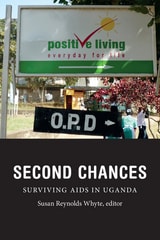
Second Chances
Surviving AIDS in UgandaSusan Reynolds Whyte, editor
Duke University Press, 2014
During the first decade of this millennium, many thousands of people in Uganda who otherwise would have died from AIDS got second chances at life. A massive global health intervention, the scaling up of antiretroviral therapy (ART), saved them and created a generation of people who learned to live with treatment. As clients they joined programs that offered free antiretroviral medicine and encouraged "positive living." Because ART is not a cure but a lifelong treatment regime, its consequences are far-reaching for society, families, and individuals. Drawing on personal accounts and a broad knowledge of Ugandan culture and history, the essays in this collection explore ART from the perspective of those who received second chances. Their concerns about treatment, partners, children, work, food, and bodies reveal the essential sociality of Ugandan life. The collection is based on research undertaken by a team of social scientists including both Western and African scholars.
Contributors. Phoebe Kajubi, David Kyaddondo, Lotte Meinert, Hanne O. Mogensen, Godfrey Etyang Siu, Jenipher Twebaze, Michael A. Whyte, Susan Reynolds Whyte
Contributors. Phoebe Kajubi, David Kyaddondo, Lotte Meinert, Hanne O. Mogensen, Godfrey Etyang Siu, Jenipher Twebaze, Michael A. Whyte, Susan Reynolds Whyte
[more]
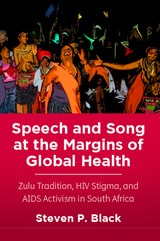
Speech and Song at the Margins of Global Health
Zulu Tradition, HIV Stigma, and AIDS Activism in South AfricaSteven P. Black
Rutgers University Press, 2019
Speech and Song at the Margins of Global Health tells the story of a unique Zulu gospel choir comprised of people living with HIV in South Africa, and how they maintained healthy, productive lives amid globalized inequality, international aid, and the stigma that often comes with having HIV. By singing, joking, and narrating about HIV in Zulu, the performers in the choir were able to engage with international audiences, connect with global health professionals, and also maintain traditional familial respect through the prism of performance. The focus on gospel singing in the narrative provides a holistic viewpoint on life with HIV in the later years of the pandemic, and the author’s musical engagement led to fieldwork in participants’ homes and communities, including the larger stigmatized community of infected individuals. This viewpoint suggests overlooked ways that aid recipients contribute to global health in support, counseling, and activism, as the performers set up instruments, waited around in hotel lobbies, and struck up conversations with passersby and audience members. The story of the choir reveals the complexity and inequities of global health interventions, but also the positive impact of those interventions in the crafting of community.
[more]

Stagestruck
Theater, AIDS, and the Marketing of Gay AmericaSarah Schulman
Duke University Press, 1998
In Stagestruck noted novelist and outspoken critic Sarah Schulman offers an account of her growing awareness of the startling similarities between her novel People in Trouble and the smash Broadway hit Rent. Written with a powerful and personal voice, Schulman’s book is part gossipy narrative, part behind-the-scenes glimpse into the New York theater culture, and part polemic on how mainstream artists co-opt the work of “marginal” artists to give an air of diversity and authenticity to their own work. Rising above the details of her own case, Schulman boldly uses her suspicions of copyright infringement as an opportunity to initiate a larger conversation on how AIDS and gay experience are being represented in American art and commerce.
Closely recounting her discovery of the ways in which Rent took materials from her own novel, Schulman takes us on her riveting and infuriating journey through the power structures of New York theater and media, a journey she pursued to seek legal restitution and make her voice heard. Then, to provide a cultural context for the emergence of Rent—which Schulman experienced first-hand as a weekly theater critic for the New York Press at the time of Rent’s premiere—she reveals in rich detail the off- and off-off-Broadway theater scene of the time. She argues that these often neglected works and performances provide more nuanced and accurate depictions of the lives of gay men, Latinos, blacks, lesbians and people with AIDS than popular works seen in full houses on Broadway stages. Schulman brings her discussion full circle with an incisive look at how gay and lesbian culture has become rapidly commodified, not only by mainstream theater productions such as Rent but also by its reduction into a mere demographic made palatable for niche marketing. Ultimately, Schulman argues, American art and culture has made acceptable a representation of “the homosexual” that undermines, if not completely erases, the actual experiences of people who continue to suffer from discrimination or disease. Stagestruck’s message is sure to incite discussion and raise the level of debate about cultural politics in America today.
Closely recounting her discovery of the ways in which Rent took materials from her own novel, Schulman takes us on her riveting and infuriating journey through the power structures of New York theater and media, a journey she pursued to seek legal restitution and make her voice heard. Then, to provide a cultural context for the emergence of Rent—which Schulman experienced first-hand as a weekly theater critic for the New York Press at the time of Rent’s premiere—she reveals in rich detail the off- and off-off-Broadway theater scene of the time. She argues that these often neglected works and performances provide more nuanced and accurate depictions of the lives of gay men, Latinos, blacks, lesbians and people with AIDS than popular works seen in full houses on Broadway stages. Schulman brings her discussion full circle with an incisive look at how gay and lesbian culture has become rapidly commodified, not only by mainstream theater productions such as Rent but also by its reduction into a mere demographic made palatable for niche marketing. Ultimately, Schulman argues, American art and culture has made acceptable a representation of “the homosexual” that undermines, if not completely erases, the actual experiences of people who continue to suffer from discrimination or disease. Stagestruck’s message is sure to incite discussion and raise the level of debate about cultural politics in America today.
[more]