Results by title
87 books match the query 'AIDS (Disease)' and 2 start with s
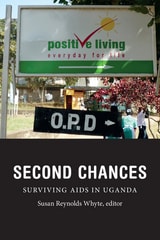
Second Chances
Surviving AIDS in UgandaSusan Reynolds Whyte, editor
Duke University Press, 2014
During the first decade of this millennium, many thousands of people in Uganda who otherwise would have died from AIDS got second chances at life. A massive global health intervention, the scaling up of antiretroviral therapy (ART), saved them and created a generation of people who learned to live with treatment. As clients they joined programs that offered free antiretroviral medicine and encouraged "positive living." Because ART is not a cure but a lifelong treatment regime, its consequences are far-reaching for society, families, and individuals. Drawing on personal accounts and a broad knowledge of Ugandan culture and history, the essays in this collection explore ART from the perspective of those who received second chances. Their concerns about treatment, partners, children, work, food, and bodies reveal the essential sociality of Ugandan life. The collection is based on research undertaken by a team of social scientists including both Western and African scholars.
Contributors. Phoebe Kajubi, David Kyaddondo, Lotte Meinert, Hanne O. Mogensen, Godfrey Etyang Siu, Jenipher Twebaze, Michael A. Whyte, Susan Reynolds Whyte
Contributors. Phoebe Kajubi, David Kyaddondo, Lotte Meinert, Hanne O. Mogensen, Godfrey Etyang Siu, Jenipher Twebaze, Michael A. Whyte, Susan Reynolds Whyte
[more]

Structural Intimacies
Sexual Stories in the Black AIDS EpidemicMackenzie, Sonja
Rutgers University Press, 2013
One of the most relevant social problems in contemporary American life is the continuing HIV epidemic in the Black population. With vivid ethnographic detail, this book brings together scholarship on the structural dimensions of the AIDS epidemic and the social construction of sexuality to assert that shifting forms of sexual stories—structural intimacies—are emerging, produced by the meeting of intimate lives and social structural patterns. These stories render such inequalities as racism, poverty, gender power disparities, sexual stigma, and discrimination as central not just to the dramatic, disproportionate spread of HIV in Black communities in the United States, but to the formation of Black sexualities.
Sonja Mackenzie elegantly argues that structural vulnerability is felt—quite literally—in the blood, in the possibilities and constraints on sexual lives, and in the rhetorics of their telling. The circulation of structural intimacies in daily life and in the political domain reflects possibilities for seeking what Mackenzie calls intimate justice at the nexus of cultural, economic, political, and moral spheres. Structural Intimacies presents a compelling case: in an era of deepening medicalization of HIV/AIDS, public health must move beyond individual-level interventions to community-level health equity frames and policy changes
Sonja Mackenzie elegantly argues that structural vulnerability is felt—quite literally—in the blood, in the possibilities and constraints on sexual lives, and in the rhetorics of their telling. The circulation of structural intimacies in daily life and in the political domain reflects possibilities for seeking what Mackenzie calls intimate justice at the nexus of cultural, economic, political, and moral spheres. Structural Intimacies presents a compelling case: in an era of deepening medicalization of HIV/AIDS, public health must move beyond individual-level interventions to community-level health equity frames and policy changes
[more]