Results by title
61 books match the query 'Action' and 4 start with s
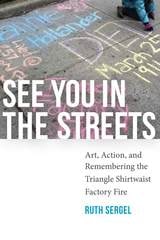
See You in the Streets
Art, Action, and Remembering the Triangle Shirtwaist Factory FireRuth Sergel
University of Iowa Press, 2016
In 1911, a fire at the Triangle Shirtwaist Factory in New York City took the lives of 146 workers, most of them young immigrant women and girls. Their deaths galvanized a movement for social and economic justice then, but today’s laborers continue to battle dire working conditions. How can we bring the lessons of the Triangle fire back into practice today? For artist Ruth Sergel, the answer was to fuse art, activism, and collective memory to create a large-scale public commemoration that invites broad participation and incites civic engagement. See You in the Streets showcases her work.
It all began modestly in 2004 with Chalk, an invitation to all New Yorkers to remember the 146 victims of the fire by inscribing their names and ages in chalk in front of their former homes. This project inspired Sergel to found the Remember the Triangle Fire Coalition, a broad alliance of artists and activists, universities and unions—more than 250 partners nationwide—to mark the 2011 centennial of the infamous blaze. Putting the coalition together and figuring what to do and how to do it were not easy. This book provides a lively account of the unexpected partnerships, false steps, joyous collective actions, and sustainability of such large public works. Much more than an object lesson from the past, See You in the Streets offers an exuberant perspective on building a social art practice and doing public history through argument and agitation, creativity and celebration with an engaged public.

Seedtime of Reform
American Social Service and Social Action, 1918-1933Clarke A. Chambers
University of Minnesota Press, 1963
Seedtime of Reform was first published in 1963. Minnesota Archive Editions uses digital technology to make long-unavailable books once again accessible, and are published unaltered from the original University of Minnesota Press editions.
This is a detailed history of the social welfare movement in the United States during the period from the end of World War I to the inauguration of President Franklin D. Roosevelt, an era which most historians characterize as one of normalcy and reaction. In his book Professor Chambers demonstrates that this was actually a seedtime of reform, a period when the groundwork was laid for many of the sweeping social changes which were to take place under the New Deal.
While it is true, as the author points out, that the years from 1918 to 1933 were not hospitable to the cause of reform, it was during these years that reform leaders and welfare workers (and the associations and agencies they directed) elaborated new theories and programs of action to alleviate, prevent, and overcome certain persisting social ills. Although little was constructively achieved until new political leadership, operating in the context of acute and prolonged economic crisis, acted in the 1930s, much of what we identify as the New Deal was rooted not only in prewar progressivism but in the research, agitation, and welfare services of the 1920s as well. Reformers and welfare workers made especially significant contributions in the areas of housing, social security, public works, federal responsibility for dependent groups in society, and working conditions.

Shaping the Campus Conversation on Student Learning and Experience
Activating the Results of Assessment in ActionKaren Brown
Assoc of College & Research Libraries, 2018

Society in Action
The Theory of Social BecomingPiotr Sztompka
University of Chicago Press, 1991
Sztompka connects the interpretations of such collective activity to a wider grasp of the nature of social action. The result is a comprehensive and original theory of social change which focuses on the self-transforming influence on society of its members' striving for freedom, autonomy, and self-fulfillment. He develops his theory by means of a general concept of "social becoming," the roots of which he traces to the early romantic and humanist work of Karl Marx and his followers and to two influential sociological schools of today, the theory of agency and historical sociology.
Sztompka situates his theory midway between the rigid determinism of social totalities and the unbridled voluntarism of free individuals. Social change, he demonstrates, can be understood neither as the outcome of individual actions taken alone nor as structurally determined actions. Instead, he confers upon social organizations and movements a "self-transcending" quality: they express human agency yet, by virtue of their active character, are quite often able to achieve unpredictable outcomes.
Throughout his analysis of social movements and revolutions in history, Sztompka emphasizes the dynamics of spontaneous social change generated from below—a theoretical testimony to the rapid and fundamental social change in Eastern Europe in recent history. Against the fashions of postmodernist malaise, boredom, and disenchantment, his theory of social becoming expresses the possibility of emancipation, of change leading to positive gains. His work registers a belief in progress, not inevitably gained, but its attainment fully dependent upon the creativity and optimism of an active citizenry.