Results by title
90 books match the query 'Activism' and 5 start with s

Sacred Modern
Faith, Activism, and Aesthetics in the Menil CollectionBy Pamela G. Smart
University of Texas Press, 2010
Renowned as one of the most significant museums built by private collectors, the Menil Collection in Houston, Texas, seeks to engage viewers in an acutely aesthetic, rather than pedagogical, experience of works of art. The Menil's emphasis on being moved by art, rather than being taught art history, comes from its founders' conviction that art offers a way to reintegrate the sacred and the secular worlds. Inspired by the French Catholic revivalism of the interwar years that recast Catholic tradition as the avant-garde, Dominique and John de Menil shared with other Catholic intellectuals a desire to reorder a world in crisis by imbuing modern cultural forms with religious faith, binding the sacred with the modern.
Sacred Modern explores how the Menil Collection gives expression to the religious and political convictions of its founders and how "the Menil way" is being both perpetuated and contested as the Museum makes the transition from operating under the personal direction of Dominique de Menil to the stewardship of career professionals. Taking an ethnographic approach, Pamela G. Smart analyzes the character of the Menil aesthetic, the processes by which it is produced, and the sensibilities that it is meant to generate in those who engage with the collection. She also offers insight into the extraordinary impact Dominique and John de Menil had on the emergence of Houston as a major cultural center.

Social Fabric
Art and Activism in Contemporary BrazilEdited by Maria Emilia Fernandez, Adele Nelson, and MacKenzie Stevens
University of Texas Press, 2023
Social Fabric: Art and Activism in Contemporary Brazil brings together the work of ten artists who reflect upon the long-standing histories of oppressive power structures in the territory now known as Brazil. Blurring the line between art and activism and spanning installation, painting, performance, photography, sculpture, and video, these artists contribute to local and global conversations about the state of democracy, racial injustice, and the violence inflicted by the nation-state. This first English-language, book-length study of contemporary Brazilian art in relationship to activism assembles artist-authored texts, interviews, essays, and a conceptual mapping of Brazilian history to illuminate the function of art as a platform for critical engagement with the historical, political, and cultural configurations of a particular place. By refusing to remain neutral, these artists create spaces of vibrant and vital community and self-construction to explore how healing and justice may be possible, especially in the Black, LGBTQIA+, and Indigenous communities to which many of them belong.
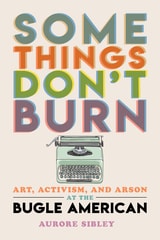
Some Things Don’t Burn
Art, Activism, and Arson at the Bugle AmericanAurore Sibley
Wisconsin Historical Society Press, 2026
A fierce, vibrant portrait of a newspaper that refused to go up in smoke.
From 1970 to 1978, the Bugle American wasn’t just an alternative newspaper―it was the sparkplug that propelled Milwaukee’s emergence as an influential cultural hub. With its incisive political coverage, razor-sharp cartoons, and in-depth reporting on the city’s explosive music scene, the Bugle American was a lifeline for artists, activists, and readers from Milwaukee to Madison hungry for independent journalism.
Then, on a cold night in February 1975, everything nearly ended. A firebomb ripped through the Bugle American offices, endangering the lives of staff and burning the building to the ground. The crime was never solved. But the paper didn’t die. Supported by a stunned but determined community―and high-profile allies including Leonard Cohen and George Reedy―the Bugle American rose from the ashes to publish the very next week.
In Some Things Don’t Burn: Art, Activism, and Arson at the Bugle American, author Aurore Sibley tells the full story of this influential underground paper: its founding ideals, its creative energy, its brushes with fame, and its lasting impact. With access to rare materials and family insights―her parents met at the Bugle American, and her father served as one of its editors―Sibley layers investigative research with personal narrative, exploring how revisiting the past helped her reconcile with her father’s complicated life and death.
Featuring dozens of photographs and illustrations, including cartoons and sketches by renowned underground artist and Bugle American co-founder Denis Kitchen, this book brings readers inside the quirky, passionate, and often chaotic world of a newsroom fighting to stay alive and independent.
A gripping story of art, activism, community, and resilience, Some Things Don’t Burn reminds us that while buildings can be destroyed, the ideals that ignite a movement are much harder to extinguish.

Spectacles of Reform
Theater and Activism in Nineteenth-Century AmericaAmy E. Hughes
University of Michigan Press, 2014
In the nineteenth century, long before film and television arrived to electrify audiences with explosions, car chases, and narrow escapes, it was America's theaters that offered audiences such thrills, with "sensation scenes" of speeding trains, burning buildings, and endangered bodies, often in melodramas extolling the virtues of temperance, abolition, and women's suffrage. In Spectacles of Reform , Amy E. Hughes scrutinizes these peculiar intersections of spectacle and reform, revealing that spectacle plays a crucial role in American activism. By examining how theater producers and political groups harnessed its power and appeal, Hughes suggests that spectacle was—and remains—central to the dramaturgy of reform.
Engaging evidence from lithographs to children's books to typography catalogs, Hughes traces the cultural history of three famous sensation scenes—the drunkard suffering from the delirium tremens, the fugitive slave escaping over a river, and the victim tied to the railroad tracks—assessing how they conveyed, allayed, and denied concerns about the rights and responsibilities of citizenship. These images also appeared in printed propaganda, suggesting that the coup de théâtre was an essential part of American reform culture. Additionally, Hughes argues that today's producers and advertisers continue to exploit the affective dynamism of spectacle, reaching an even broader audience through film, television, and the Internet.
To be attuned to the dynamics of spectacle, Hughes argues, is to understand how we see. Consequently, Spectacles of Reform will interest not only theater historians, but also scholars and students of political, literary, and visual culture who are curious about how U.S. citizens saw themselves and their world during a pivotal period in American history.
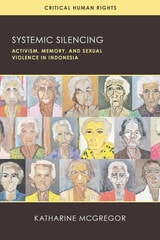
Systemic Silencing
Activism, Memory, and Sexual Violence in IndonesiaKatharine E. McGregor
University of Wisconsin Press, 2023