210 books match the query 'African Studies' and 13 start with s

cover of Sacred River: A Novel

Sacred River

A Novel

Syl Cheney-Coker

Ohio University Press, 2015

The reincarnation of a legendary nineteenth-century Caribbean emperor as a contemporary African leader is at the heart of this novel. Sacred River deals with the extraordinary lives, hopes, powerful myths, stories, and tragedies of the people of a modern West African nation. It is also the compelling love story of an idealistic philosophy professor and an ex-courtesan of incomparable beauty. Two hundred years after his death, the great Haitian emperor Henri Christophe miraculously appears in a dream to Tankor Satani, president of the fictional West African country of Kissi, with instructions for Tankor to continue Henri Christophe’s rule, which had been interrupted by “that damned Napoleon.” Ambitious in scope, Sacred River is a diaspora-inspired novel, in which Cheney-Coker has tackled the major themes of politics, social strife, crime and punishment, and human frailty and redemption in Malagueta, the fictional, magical town and its surroundings first created by the author in The Last Harmattan of Alusine Dunbar, for which he was awarded the coveted Commonwealth Writers’ Prize. Sacred River is equally about love and politics, and marks the return to fiction of one of Africa’s major writers.
[more]
cover of Scream for Me, Africa!: Heavy Metal Identities in Post-Colonial Africa

Scream for Me, Africa!

Heavy Metal Identities in Post-Colonial Africa

Edward Banchs

Intellect Books, 2023

An engaging look at the various metal scenes across the African continent.

Scream for Me Africa! examines the hard rock and metal scenes in five African countries: Botswana, Togo, South Africa, Kenya, and Ghana. Edward Banchs interviewed musicians, producers, and fans in each country to create vivid pictures of each of these rarely discussed scenes. The book considers how the subculture of heavy metal is viewed in postcolonial Africa and examines how musicians on the continent have stepped forward to make this genre their own. It looks at Africa's blossoming scenes through various themes, including hybridity, othering, and political tensions.  

[more]
cover of Screening Morocco: Contemporary Film in a Changing Society

Screening Morocco

Contemporary Film in a Changing Society

Valérie K. Orlando

Ohio University Press, 2011

Since 1999 and the death of King Hassan II, Morocco has experienced adramatic social transformation. Encouraged by the more openly democraticclimate fostered by young King Mohammed VI, filmmakers have begunto explore the sociocultural and political debates of their country whilealso seeking to document the untold stories of a dark past.Screening Morocco: Contemporary Film in a ChangingSociety focuses on Moroccan films produced and distributedfrom 1999 to the present. Moroccan cinema serves as an all-inclusive medium that providesa sounding board for a society that is remaking itself.Male and female directors present the face of an engaged,multiethnic and multilingual society. Their cinematographypromotes a country that is dynamic and connected to theglobal sociocultural economy of the twenty-first century. Atthe same time, they seek to represent the closed, obscurepast of a nation’s history that has rarely been told, drawingon themes such as human rights abuse, the former incarcerationof thousands during the Lead Years, women’semancipation, poverty, and claims for social justice. Screening Morocco will introduce American readers to therichness in theme and scope of the cinematic production ofMorocco.
[more]
cover of Senghor: Writings on Politics

Senghor

Writings on Politics

Léopold Sédar Senghor. Edited and translated by Yohann C. Ripert

Duke University Press, 2025
Senghor: Writings on Politics brings Léopold Sédar Senghor’s most vital essays, speeches, and political writings to English-language readers for the first time. Spanning the colonial and postcolonial years between 1937 and 1971, this volume captures Senghor’s evolution from a pioneering poet and cofounder of Négritude to the president of Senegal as he grappled with the complexities of postcolonial identity, governance, and cultural hybridity. Senghor’s reflections on topics ranging from federalism and decolonization to Francophonie reveal his commitment to weaving African and European cultural threads into a vision of global solidarity in ways that resonate with contemporary debates on race, culture, and politics. Inviting readers to engage with a seminal figure whose legacy continues to inspire new ways of thinking about freedom, independence, and coexistence, this landmark book furthers our understanding of one of the twentieth century’s most influential cultural thinkers.
[more]
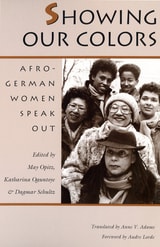
cover of Showing Our Colors: Afro-German Women Speak Out

Showing Our Colors

Afro-German Women Speak Out

May Optiz

University of Massachusetts Press, 1992

Showing Our Colors: Afro-German Women Speak Out is an English translation of the German book Farbe bekennen, edited by author May Ayim, Katharina Oguntoye, and Dagmar Schultz. It is the first published book by Afro-Germans. It is the first written use of the term Afro-German.
[more]
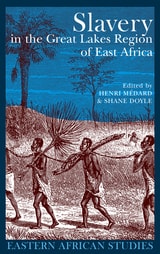
cover of Slavery in the Great Lakes Region of East Africa

Slavery in the Great Lakes Region of East Africa

Henri Médard

Ohio University Press, 2007

Slavery in the Great Lakes Region of East Africa is a collection of ten studies by the most prominent historians of the region. Slavery was more important in the Great Lakes region of Eastern Africa than often has been assumed, and Africans from the interior played a more complex role than was previously recognized. The essays in this collection reveal the connections between the peoples of the region as well as their encounters with the conquering Europeans. The contributors challenge the assertion that domestic slavery increased in Africa as a result of the international trade. Slavery in this region was not a uniform phenomenon and the line between enslaved and non-slave labor was fine. Kinship ties could mark the difference between free and unfree labor. Social categories were not always clear-cut and the status of a slave could change within a lifetime.

Contents:
- Introduction by Henri Médard
- Language Evidence of Slavery to the Eighteenth Century by David Schoenbrun
- The Rise of Slavery & Social Change in Unyamwezi 1860–1900 by Jan-Georg Deutsch
- Slavery & Forced Labour in the Eastern Congo 1850–1910 by David Northrup
- Legacies of Slavery in North West Uganda ‘The One-Elevens’ by Mark Leopold
- Human Booty in Buganda: The Seizure of People in War, c.1700–c.1900 by Richard Reid
- Stolen People & Autonomous Chiefs in Nineteenth-Century Buganda by Holly Hanson
- Women’s Experiences of Slavery in Late Nineteenth- & Early Twentieth-Century Uganda by Michael W. Tuck
- Slavery & Social Oppression in Ankole 1890–1940 by Edward I. Steinhart
- The Slave Trade in Burundi & Rwanda at the Beginning of German Colonisation 1890–1906 by Jean-Pierre Chretien
- Bunyoro & the Demography of Slavery Debate by Shane Doyle
[more]
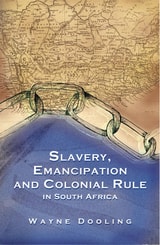
cover of Slavery, Emancipation and Colonial Rule in South Africa

Slavery, Emancipation and Colonial Rule in South Africa

Wayne Dooling

Ohio University Press, 2008
Slavery, Emancipation and Colonial Rule in South Africa examines the rural Cape Colony from the earliest days of Dutch colonial rule in the mid-seventeenth century to the outbreak of the South African War in 1899. For slaves and slave owners alike, incorporation into the British Empire at the beginning of the nineteenth century brought fruits that were bittersweet. The gentry had initially done well by accepting British rule, but were ultimately faced with the legislated ending of servile labor. To slaves and Khoisan servants, British rule brought freedom, but a freedom that remained limited. The gentry accomplished this feat only with great difficulty. Increasingly, their dominance of the countryside was threatened by English-speaking merchants and money-lenders, a challenge that stimulated early Afrikaner nationalism. The alliances that ensured nineteenth-century colonial stability all but fell apart as the descendants of slaves and Khoisan turned on their erstwhile masters during the South African War of 1899–1902.
[more]
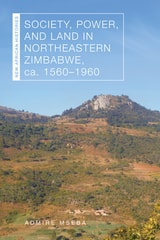
cover of Society, Power, and Land in Northeastern Zimbabwe, ca. 1560–1960

Society, Power, and Land in Northeastern Zimbabwe, ca. 1560–1960

Admire Mseba

Ohio University Press, 2024

A little over two decades ago, Zimbabwe undertook its Fast Track Land Reform Programme. Critics saw it as nothing more than an assault on human and property rights for political expedience by a ruling elite that was fast losing its power. In contrast, those sympathetic to the land reform program saw it as fundamental to the righting of colonialism’s historical wrongs. Yet, rural displacements at the hands of state actors, or of those closely connected to them, continue. As in the past, the continuing land conflicts are mostly understood as the result of the actions of an authoritarian state that exploits its control of land for the political and economic benefit of those who inhabit it. These explanations share one thing in common: each understands the country’s perpetual land questions in terms of the actions or inactions of the colonial or the postcolonial state.

This book refocuses attention on how regimes of power rooted in kinship, gender, generation, and status have, individually and in combination, informed access to land in precolonial northeastern Zimbabwe. It then examines how these regimes of power interacted with colonial policies to inform the African experience in colonial Zimbabwe. Further, the book places land and the ability to ensure its fecundity at the center of the making and moderation of precolonial political power and how this power was impacted by the imposition of colonial rule.

Tracing the dynamics of land and power from precolonial times, together with their entanglement with colonial policies, is important, for this relationship is almost always neglected by both scholars and policymakers drawn to the high drama of colonial and postcolonial politics of land. This oversight has real consequences on our understandings of landed inequalities and how they are addressed. When Zimbabwe’s postcolonial state focused on colonially induced racialized land inequalities, its land reform efforts left older forms of landed inequalities based on gender, generation, and ideas of belonging intact. The book, which details these inequalities, reminds Zimbabweans and others that if the quest for equity espoused in postcolonial land reforms is to be meaningful, it must be attentive to both colonially induced inequalities and those enduring disparities that predated, were deepened by, and outlived colonial rule. At the same time, Zimbabweans who now live with a postcolonial state that is increasingly centralizing power over land may well learn from past societies’ creative efforts to limit the authority of their leaders.
[more]
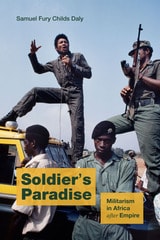
cover of Soldier's Paradise: Militarism in Africa after Empire

Soldier's Paradise

Militarism in Africa after Empire

Samuel Fury Childs Daly

Duke University Press, 2024

In Soldier’s Paradise, Samuel Fury Childs Daly tells the story of how Africa’s military dictators tried and failed to transform their societies into martial utopias. Across the continent, independence was followed by a wave of military coups and revolutions. The soldiers who led them had a vision. In Nigeria and other former British colonies, officers governed like they fought battles—to them, politics was war by other means. Civilians were subjected to military-style discipline, which was indistinguishable from tyranny. Soldiers promised law and order, and they saw judges as allies in their mission to make society more like an army. But law was not the disciplinary tool soldiers thought it was. Using legal records, archival documents, and memoirs, Daly shows how law both enabled militarism and worked against it. For Daly, the law is a place to see decolonization’s tensions and ironies—independence did not always mean liberty, and freedom had a militaristic streak. In a moment when militarism is again on the rise in Africa, Daly describes not just where it came from but why it lasted so long.
[more]
cover of Staging the Amistad: Three Sierra Leonean Plays

Staging the Amistad

Three Sierra Leonean Plays

Charlie Haffner

Ohio University Press, 2019
Staging the Amistad collects in print for the first time plays about the Amistad slave revolt by three of Sierra Leone’s most influential playwrights of the latter decades of the twentieth century: Charlie Haffner, Yulisa Amadu “Pat” Maddy, and Raymond E. D. de’Souza George. Until the late 1980s, when the first of these plays was performed, the 1839 shipboard slave rebellion and the return of its victors to their homes in what is modern-day Sierra Leone had been an unrecognized chapter in the country’s history. The plays recast the tale of heroism, survival, and resistance to tyranny as a distinctly Sierra Leonean story, emphasizing the agency of its African protagonists. For this reason, Haffner, Maddy, and de’Souza George counterbalance the better-known American representations of the rebellion, which center on American characters and American political and cultural concerns. The first public performances of these plays constituted a watershed moment. Written and staged immediately before and after the start of Sierra Leone’s decade-long conflict, they brought the Amistad rebellion to public consciousness. Furthermore, their turn to a uniquely Sierra Leonean history of heroic resistance to tyranny highlights the persistent faith in nation-state nationalism and the dreams of decolonization.
[more]
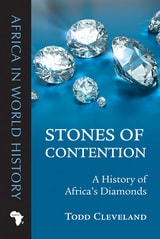
cover of Stones of Contention: A History of Africa’s Diamonds

Stones of Contention

A History of Africa’s Diamonds

Todd Cleveland

Ohio University Press, 2014

Africa supplies the majority of the world’s diamonds, yet consumers generally know little about the origins and history of these precious stones beyond sensationalized media accounts of so-called blood diamonds.

Stones of Contention explores the major developments in the remarkable history of Africa’s diamonds, from the earliest stirrings of international interest in the continent’s mineral wealth in the first millennium A.D. to the present day. In the European colonial period, the discovery of diamonds in South Africa ushered in an era of unprecedented greed during which monopolistic enterprises exploited both the mineral resources and the indigenous workforce. In the aftermath of World War II, the governments of newly independent African states, both democratic and despotic, joined industry giant De Beers and other corporations to oversee and profit from mining activity on the continent.

The book also considers the experiences of a wide array of Africans—from informal artisanal miners, company mineworkers, and indigenous authorities to armed rebels, mining executives, and premiers of mineral-rich states—and their relationships to the stones that have the power to bring both wealth and misery. With photos and maps, Stones of Contention illustrates the scope and complexity of the African diamond trade as well as its impact on individuals and societies.

[more]
cover of Succession to High Office in Botswana: Three Case Studies

Succession to High Office in Botswana

Three Case Studies

Jack Parson

Ohio University Press, 1990
This book examines the process through which the mantle of leadership passed from one leader to another in Botswana. It concerns the succession to high office in Botswana over the course of more than half a century from the colonial time to the present. Three case studies explore the relationship between the British colonial authorities and the tribal leaders in affirming the legitimacy of the tribal chiefs of the Bangwato tribe in the former Bechuanaland protectorate. The studies examine the succession crises of the Bangwato first in 1925 and again between 1948 to 1953 and the political changes from the Botswana National Archives contained in the appendices fully support the text.
[more]
cover of Swahili Beyond the Boundaries: Literature, Language, and Identity

Swahili Beyond the Boundaries

Literature, Language, and Identity

Alamin Mazrui

Ohio University Press, 2007

Africa is a marriage of cultures: African and Asian, Islamic and Euro-Christian. Nowhere is this fusion more evident than in the formation of Swahili, Eastern Africa’s lingua franca, and its cultures. Swahili Beyond the Boundaries: Literature, Language, and Identity addresses the moving frontiers of Swahili literature under the impetus of new waves of globalization in the twentieth and twenty-first centuries. These momentous changes have generated much theoretical debate on several literary fronts, as Swahili literature continues to undergo transformation in the mill of human creativity.

Swahili literature is a hybrid that is being reconfigured by a conjuncture of global and local forces. As the interweaving of elements of the colonizer and the colonized, this hybrid formation provides a representation of cultural difference that is said to constitute a “third space,” blurring existing boundaries and calling into question established identitarian categorizations. This cultural dialectic is clearly evident in the Swahili literary experience as it has evolved in the crucible of the politics of African cultural production.

However, Swahili Beyond the Boundaries demonstrates that, from the point of view of Swahili literature, while hybridity evokes endless openness on questions of home and identity, it can simultaneously put closure on specific forms of subjectivity. In the process of this contestation, a new synthesis may be emerging that is poised to subject Swahili literature to new kinds of challenges in the politics of identity, compounded by the dynamics and counterdynamics of post–Cold War globalization.
[more]