Results by title
239 books match the query 'Agriculture' and 13 start with s
Salmon and Acorns Feed Our People
Colonialism, Nature, and Social ActionKari Marie Norgaard
Rutgers University Press, 2019
Since time before memory, large numbers of salmon have made their way up and down the Klamath River. Indigenous management enabled the ecological abundance that formed the basis of capitalist wealth across North America. These activities on the landscape continue today, although they are often the site of intense political struggle. Not only has the magnitude of Native American genocide been of remarkable little sociological focus, the fact that this genocide has been coupled with a reorganization of the natural world represents a substantial theoretical void. Whereas much attention has (rightfully) focused on the structuring of capitalism, racism and patriarchy, few sociologists have attended to the ongoing process of North American colonialism. Salmon and Acorns Feed Our People draws upon nearly two decades of examples and insight from Karuk experiences on the Klamath River to illustrate how the ecological dynamics of settler-colonialism are essential for theorizing gender, race and social power today.
Saving Seeds, Preserving Taste
Heirloom Seed Savers in AppalachiaBill Best
Ohio University Press, 2013
The Brown Goose, the White Case Knife, Ora’s Speckled Bean, Radiator Charlie’s Mortgage Lifter—these are just a few of the heirloom fruits and vegetables you’ll encounter in Bill Best’s remarkable history of seed saving and the people who preserve both unique flavors and the Appalachian culture associated with them. As one of the people at the forefront of seed saving and trading for over fifty years, Best has helped preserve numerous varieties of beans, tomatoes, corn, squashes, and other fruits and vegetables, along with the family stories and experiences that are a fundamental part of this world. While corporate agriculture privileges a few flavorless but hardy varieties of daily vegetables, seed savers have worked tirelessly to preserve genetic diversity and the flavors rooted in the Southern Appalachian Mountains—referred to by plant scientists as one of the vegetative wonders of the world.
Saving Seeds, Preserving Taste will introduce readers to the cultural traditions associated with seed saving, as well as the remarkable people who have used grafting practices and hand-by-hand trading to keep alive varieties that would otherwise have been lost. As local efforts to preserve heirloom seeds have become part of a growing national food movement, Appalachian seed savers play a crucial role in providing alternatives to large-scale agriculture and corporate food culture. Part flavor guide, part people’s history, Saving Seeds, Preserving Taste will introduce you to a world you’ve never known—or perhaps remind you of one you remember well from your childhood.

Saving Seeds, Preserving Taste
Heirloom Seed Savers in AppalachiaBill Best
Ohio University Press, 0
Saving Seeds, Preserving Taste will introduce readers to the cultural traditions associated with seed saving, as well as the remarkable people who have used grafting practices and hand-by-hand trading to keep alive varieties that would otherwise have been lost. As local efforts to preserve heirloom seeds have become part of a growing national food movement, Appalachian seed savers play a crucial role in providing alternatives to large-scale agriculture and corporate food culture. Part flavor guide, part people’s history, Saving Seeds, Preserving Taste will introduce you to a world you’ve never known — or perhaps remind you of one you remember well from your childhood.
Seed Testing
Principles and PracticesSabry G. Elias
Michigan State University Press, 2012
An essential reference for students, seed technologists, researchers, and seed industry personnel, this comprehensive guide outlines the most widely performed modern seed quality tests, explores the principles behind them, the history of seed testing, why seeds are tested and when, and sampling, sub-sampling, seed laboratory management, accreditation, and seed quality assurance programs. The authors describe statistical applications to seed testing and tolerances, and they provide a detailed morphological and structural description of seed formation and development. The book examines the testing of genetic traits and transgenic seeds, including DNA and protein genetic purity tests, and cultivar purity identification for conventional seeds. In addition to the most common seed purity and viability tests, tests for seed and seedling vigor, seed-borne diseases and seed moisture determination are also discussed.
Seeds and Sovereignty
Debate Over the Use and Control of Plant Genetic ResourcesJack R. Jr. Kloppenburg, ed.
Duke University Press, 1988
Twenty experts from several nations, representing both the natural and social sciences, consider the historical background, the issue of patent rights as applied to plant germplasm, the nature of global genetic interdependence, the internationalization of the seed industry, the implications of biotechnology on genetic resources, the Third World attitude toward the debate, and the viewpoints of the International Agricultural Research Centers.
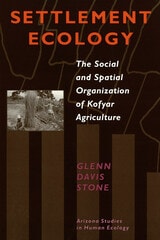
Settlement Ecology
The Social and Spatial Organization of Kofyar AgricultureGlenn Davis Stone
University of Arizona Press, 1996
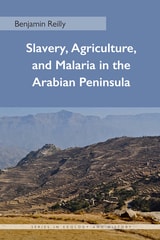
Slavery, Agriculture, and Malaria in the Arabian Peninsula
Benjamin Reilly
Ohio University Press, 2015
In Slavery, Agriculture, and Malaria in the Arabian Peninsula, Benjamin Reilly illuminates a previously unstudied phenomenon: the large-scale employment of people of African ancestry as slaves in agricultural oases within the Arabian Peninsula. The key to understanding this unusual system, Reilly argues, is the prevalence of malaria within Arabian Peninsula oases and drainage basins, which rendered agricultural lands in Arabia extremely unhealthy for people without genetic or acquired resistance to malarial fevers. In this way, Arabian slave agriculture had unexpected similarities to slavery as practiced in the Caribbean and Brazil.
This book synthesizes for the first time a body of historical and ethnographic data about slave-based agriculture in the Arabian Peninsula. Reilly uses an innovative methodology to analyze the limited historical record and a multidisciplinary approach to complicate our understandings of the nature of work in an area that is popularly thought of solely as desert. This work makes significant contributions both to the global literature on slavery and to the environmental history of the Middle East—an area that has thus far received little attention from scholars.
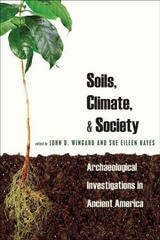
Soils, Climate and Society
Archaeological Investigations in Ancient AmericaJohn D. Wingard
University Press of Colorado, 2013
The volume traces the origins of agriculture, the transition to agrarian societies, the sociocultural implications of agriculture, agriculture's effects on population, and the theory of carrying capacity, considering the relation of agriculture to the profound social changes that it wrought in the New World. Soil science plays a significant, though varied, role in each case study, and is the common component of each analysis. Soil chemistry is also of particular importance to several of the studies, as it determines the amount of food that can be produced in a particular soil and the effects of occupation or cultivation on that soil, thus having consequences for future cultivators.
Soils, Climate and Society demonstrates that renewed investigation of agricultural production and demography can answer questions about the past, as well as stimulate further research. It will be of interest to scholars of archaeology, historical ecology and geography, and agricultural history.
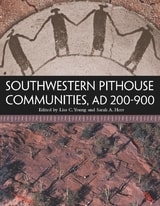
Southwestern Pithouse Communities, AD 200-900
Edited by Lisa C. Young and Sarah A. Herr
University of Arizona Press, 2012
Pithouses are the earliest identifiable domestic architecture in many areas of the world, and can provide insights into the origins of communities--a fundamental component of past and present societies. In this book, Lisa Young and Sarah Herr invite archaeologists to explore the development of communities using information from pithouse sites in the American Southwest.
Using regional and topical syntheses to investigate the formation of pithouse communities, contributors to this volume examine the complex relationship between the economic transition to agricultural dependence and the social changes associated with sedentism. They discover that during this transformation, peoples' relationship with the landscape changed in ways that affected their use of space, community organization, and cultural identity.
Employing various theoretical perspectives, these contributions analyze changes in pithouses, site layout, communal architecture, and settlement patterns to investigate the development of place-based communities. Chapters look at community formation strategies in populous regions like the northern San Juan Basin, the southern Colorado Plateau, Mimbres/southern Mogollon, and Hohokam Basin and Range and compare them with social structures in more sparsely populated regions like the northeast Hohokam peripheries, the Arizona Transition Zone, the Cibola region, southeast New Mexico, and the northern Rio Grande. The book also includes thematic discussions of panregional economic change, the complex relationship between house and household, and the demographic shifts accompanying the Neolithic Demographic Transition.
An essential book for students and archaeologists interested in the origins of communities, Southwestern Pithouse Communities is also an important comparative resource for scholars interested in social change during the transition to settled village life.
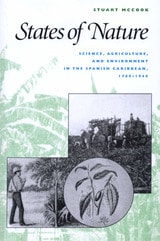
States of Nature
Science, Agriculture, and Environment in the Spanish Caribbean, 1760-1940By Stuart George McCook
University of Texas Press, 2002
The process of nation-building in Latin America transformed the relations between the state, the economy, and nature. Between 1760 and 1940, the economies of most countries in the Spanish Caribbean came to depend heavily on the export of plant products, such as coffee, tobacco, and sugar. After the mid-nineteenth century, this model of export-led economic growth also became a central tenet of liberal projects of nation-building. As international competition grew and commodity prices fell over this period, Latin American growers strove to remain competitive by increasing agricultural production. By the turn of the twentieth century, their pursuit of export-led growth had generated severe environmental problems, including soil exhaustion, erosion, and epidemic outbreaks of crop diseases and pests.
This book traces the history of the intersections between nature, economy, and nation in the Spanish Caribbean through a history of the agricultural and botanical sciences. Growers and governments in Venezuela, Puerto Rico, Cuba, Colombia, and Costa Rica turned to scientists to help them establish practical and ideological control over nature. They hoped to use science to alleviate the pressing environmental and economic stresses, without having to give up their commitment to export-led growth. Starting from an overview of the relationship among science, nature, and development throughout the export boom of 1760 to 1930, Stuart McCook examines such topics as the relationship between scientific plant surveys and nation-building, the development of a "creole science" to address the problems of tropical agriculture, the ecological rationalization of the sugar industry, and the growth of technocratic ideologies of science and progress. He concludes with a look at how the Great Depression of the 1930s changed the paradigms of economic and political development and the role of science and nature in these paradigms.
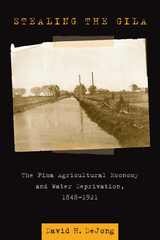
Stealing the Gila
The Pima Agricultural Economy and Water Deprivation, 1848-1921David H. DeJong
University of Arizona Press, 2009
This economic vitality did not last, however. As immigrants settled upstream from the Pima villages, they deprived the Indians of the water they needed to sustain their economy. DeJong traces federal, territorial, and state policies that ignored Pima water rights even though some policies appeared to encourage Indian agriculture. This is a particularly egregious example of a common story in the West: the flagrant local rejection of Supreme Court rulings that protected Indian water rights. With plentiful maps, tables, and illustrations, DeJong demonstrates that maintaining the spreading farms and growing towns of the increasingly white population led Congress and other government agencies to willfully deny Pimas their water rights.
Had their rights been protected, DeJong argues, Pimas would have had an economy rivaling the local and national economies of the time. Instead of succeeding, the Pima were reduced to cycles of poverty, their lives destroyed by greed and disrespect for the law, as well as legal decisions made for personal gain.
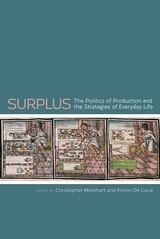
Surplus
The Politics of Production and the Strategies of Everyday LifeChristopher T. Morehart
University Press of Colorado, 2015
The concept of surplus captures the politics of production and also conveys the active material means by which people develop the strategies to navigate everyday life. Surplus: The Politics of Production and the Strategies of Everyday Life examines how surpluses affected ancient economies, governments, and households in civilizations across Mesoamerica, the Southwest United States, the Andes, Northern Europe, West Africa, Mesopotamia, and eastern Asia.
A hallmark of archaeological research on sociopolitical complexity, surplus is central to theories of political inequality and institutional finance. This book investigates surplus as a macro-scalar process on which states or other complex political formations depend and considers how past people—differentially positioned based on age, class, gender, ethnicity, role, and goal—produced, modified, and mobilized their social and physical worlds.
Placing the concept of surplus at the forefront of archaeological discussions on production, consumption, power, strategy, and change, this volume reaches beyond conventional ways of thinking about top-down or bottom-up models and offers a comparative framework to examine surplus, generating new questions and methodologies to elucidate the social and political economies of the past.
Contributors include Douglas J. Bolender, James A. Brown, Cathy L. Costin, Kristin De Lucia, Timothy Earle, John E. Kelly, Heather M. L. Miller, Christopher R. Moore, Christopher T. Morehart, Neil L. Norman, Ann B. Stahl, Victor D. Thompson, T. L. Thurston, and E. Christian Wells.
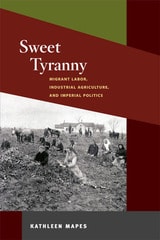
Sweet Tyranny
Migrant Labor, Industrial Agriculture, and Imperial PoliticsKathleen Mapes
University of Illinois Press, 2008