Results by title
69 books match the query 'American Culture' and 9 start with s
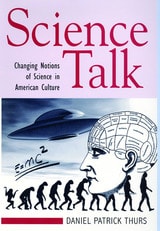
Science Talk
Changing Notions of Science in American CultureDaniel Patrick Thurs
Rutgers University Press, 2007
Science news is met by the public with a mixture of fascination and disengagement. On the one hand, Americans are inflamed by topics ranging from the question of whether or not Pluto is a planet to the ethics of stem-cell research. But the complexity of scientific research can also be confusing and overwhelming, causing many to divert their attentions elsewhere and leave science to the “experts.”
Whether they follow science news closely or not, Americans take for granted that discoveries in the sciences are occurring constantly. Few, however, stop to consider how these advances—and the debates they sometimes lead to—contribute to the changing definition of the term “science” itself. Going beyond the issue-centered debates, Daniel Patrick Thurs examines what these controversies say about how we understand science now and in the future. Drawing on his analysis of magazines, newspapers, journals and other forms of public discourse, Thurs describes how science—originally used as a synonym for general knowledge—became a term to distinguish particular subjects as elite forms of study accessible only to the highly educated.
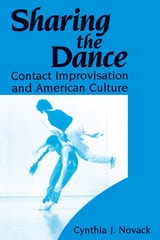
Sharing the Dance
Contact Improvisation and American CultureCynthia J. Novack
University of Wisconsin Press, 1990
While focusing on the changing practice of contact improvisation through two decades of social transformation, Novack’s work incorporates the history of rock dancing and disco, the modern and experimental dance movements of Merce Cunningham, Anna Halprin, and Judson Church, among others, and a variety of other physical activities, such as martial arts, aerobics, and wrestling.
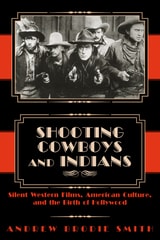
Shooting Cowboys and Indians
Silent Western Films, American Culture, and the Birth of HollywoodAndrew Brodie Smith
University Press of Colorado, 2003
Tracing the western from its hazy silent-picture origins in the 1890s to the advent of talking pictures in the 1920s, Smith examines the ways in which silent westerns contributed to the overall development of the film industry.
Focusing on such early important production companies as Selig Polyscope, New York Motion Picture, and Essanay, Smith revises current thinking about the birth of Hollywood and the establishment of Los Angeles as the nexus of filmmaking in the United States. Smith also reveals the role silent westerns played in the creation of the white male screen hero that dominated American popular culture in the twentieth century.
Illustrated with dozens of historic photos and movie stills, this engaging and substantive story will appeal to scholars interested in Western history, film history, and film studies as well as general readers hoping to learn more about this little-known chapter in popular filmmaking.
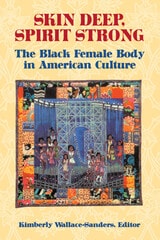
Skin Deep, Spirit Strong
The Black Female Body in American CultureKimberly Wallace-Sanders, Editor
University of Michigan Press, 2002
The collection blends original and classic essays to reveal the interconnections among art, literature, public policy, the history of medicine, and theories about sexuality with regard to bodies that are both black and female. Contributors include Rachel Adams, Elizabeth Alexander, Lisa Collins, Bridgette Davis, Lisa E.Farrington, Anne Fausto-Sterling, Beverly Guy-Sheftall, Evelynn Hammonds, Terri Kapsalis, Jennifer L. Morgan, Siobhan B. Somerville, Kimberly Wallace-Sanders, Carla Williams, and Doris Witt.
Skin Deep, Spirit Strong: The Black Female Body in American Culture will appeal to both the academic reader attempting to integrate race into discussion about the female body and to the general reader curious about the history of black female representation.
Kimberly Wallace-Sanders is Assistant Professor, Graduate Institute of Liberal Arts and Institute of Women's Studies, Emory University.
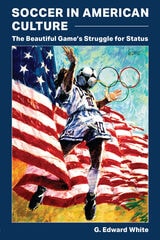
Soccer in American Culture
The Beautiful Game’s Struggle for StatusG. Edward White
University of Missouri Press, 2023
In Soccer in American Culture: The Beautiful Game’s Struggle for Status, G. Edward White seeks to answer two questions. The first is why the sport of soccer failed to take root in the United States when it spread from England around much of the rest of the world in the late nineteenth and twentieth centuries. The second is why the sport has had a significant renaissance in America since the last decade of the twentieth century, to the point where it is now the 4th largest participatory sport in the United States and is thriving, in both men’s and women’s versions, at the high school, college, and professional levels.
White considers the early history of “Association football” (soccer) in England, the persistent struggles by the sport to establish itself in America for much of the twentieth century, the role of public high schools and colleges in marginalizing the sport, the part played by FIFA, the international organization charged with developing soccer around the globe, in encumbering the development of the sport in the United States, and the unusual history of women’s soccer in America, which evolved in the twentieth century from a virtually nonexistent sport to a major factor in the emergence of men’s—as well as women's—soccer in the U.S. in the twentieth century.
Incorporating insights from sociology and economics, White explores the multiple factors that have resulted in the sport of soccer struggling to achieve major status in America and why it currently has nothing like the cultural impact of other popular American sports—baseball and American football— which can be seen by the comparative lack of attention paid to it in sports media, its low television ratings, and virtually nonexistent radio broadcast coverage.
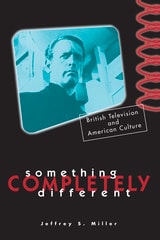
Something Completely Different
British Television And American CultureJeffrey S. Miller
University of Minnesota Press, 2000
The first comprehensive study of the influence British programming had on American television.
The first comprehensive study of the influence British programming had on American television.
Between Emma Peel and the Ministry of Silly Walks, British television had a significant impact on American popular culture in the 1960s and 1970s. In Something Completely Different, Jeffrey Miller offers the first comprehensive study of British programming on American television, discussing why the American networks imported such series as The Avengers and Monty Python’s Flying Circus; how American audiences received these uniquely British shows; and how the shows’ success reshaped American television.Miller’s lively analysis covers three genres: spy shows, costume dramas, and sketch comedies. In addition to providing his close readings of the series themselves, Miller considers the networks’ packaging of the programs for American viewers and the influences that led to their acceptance, including the American television industry’s search for new advertising revenue and the creation of PBS.Something Completely Different concludes with a discussion of the American programs and genres that owed their existence to British progenitors. Miller convincingly argues that much of what came to define American television by 1980 was in fact British in origin, a contention that casts a new light on traditional discussions of American cultural imperialism.ISBN 0-8166-3240-5 Cloth £31.00 $44.95xxISBN 0-8166-3241-3 Paper £12.50 $17.95x208 Pages 17 black-and-white photos 5 7/8 x 9 JanuaryTranslation inquiries: University of Minnesota Press
Steppin' Out
New York Nightlife and the Transformation of American CultureLewis A. Erenberg
University of Chicago Press, 1984

Studies in American Culture
Dominant Ideas and ImagesJoseph J. Kwiat and Mary C. Turpie, Editors
University of Minnesota Press, 1960
Studies in American Culture was first published in 1960. Minnesota Archive Editions uses digital technology to make long-unavailable books once again accessible, and are published unaltered from the original University of Minnesota Press editions.
The last decade has seen a revolutionary interest at colleges and universities both in this country and abroad in the field known variously as American Studies, American Civilization, or American Culture. Now the time is ripe for a critical look at the field, to assess its intellectual and cultural problems, and to anticipate its future. This is what the contributors to this volume do, through thoughtful discussions and interesting examples of studies in American ideas and images.
There are sixteen contributors, members of the faculties of a number of colleges and universities, and representatives of various specialties such as literary history and criticism; social, intellectual, and aesthetic history; political, economic, and social theory.
In the introductory chapter, Henry Nash Smith discusses the problems of method which confront scholars in American Studies. The chapters which follow contain outstanding examples of scholarship in American Studies. The authors are Reuel Denney, John W. Ward, Mulford Q. Sibley, David R. Weimer, William Van O'Connor, Bernard Bowron, Leo Marx, Arnold Rose, Allen Tate, David W. Noble, J. C. Levenson, Joseph J. Kwiat, Theodore C. Blegen, and Charles H. Foster. In the final chapter, Robert E. Spiller looks at the past, present, and future of American Studies.
All the contributors as well as the editors are now or have been associated with the American Studies program at the University of Minnesota and with the late Tremaine McDowell, chairman of the program for thirteen years and a pioneer in the development of the discipline.
The book will be useful to anyone interested in American thought, culture, and society, to those conducting American Studies programs, and to their students.
Swingin' the Dream
Big Band Jazz and the Rebirth of American CultureLewis A. Erenberg
University of Chicago Press, 1998
"Swingin' the Dream is an intelligent, provocative study of the big band era, chiefly during its golden hours in the 1930s; not merely does Lewis A. Erenberg give the music its full due, but he places it in a larger context and makes, for the most part, a plausible case for its importance."—Jonathan Yardley, Washington Post Book World
"An absorbing read for fans and an insightful view of the impact of an important homegrown art form."—Publishers Weekly
"[A] fascinating celebration of the decade or so in which American popular music basked in the sunlight of a seemingly endless high noon."—Tony Russell, Times Literary Supplement