Results by title
61 books match the query 'American West' and 6 start with s

Shooting Polaris
A Personal Survey in the American WestJohn Hales
University of Missouri Press, 2005
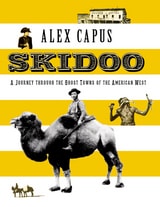
Skidoo
A Journey through the Ghost Towns of the American WestAlex Capus
Haus Publishing, 2013
Walking in the footsteps of bank robbers and grave diggers, desperadoes and Native Americans, beer brewers and child brides, Capus uncovers story after story of adventure, violence, and exploration. Near Salt Wells, Nevada, he learns the story of a luckless inventor whose corpse was discovered frozen in the desert, an icicle hanging from its nose. In Skidoo, California, he tells us of a brawling bartender, Hootch Simpson, who was hanged twice—once by a mob, once by the law—before being beheaded during his autopsy. And in Flagstaff, Arizona, Capus traces the long-lost origins of Route 66, as a narrow, isolated trail for Edward Fitzgerald Beale’s Camel Corps.
Packed with period detail, and told with a verve and enthusiasm to rival Pecos Bill, the stories in Skidoo are sure to enchant any lover of Western tales or America’s wild history.
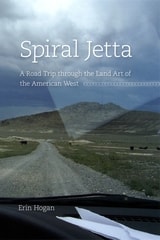
Spiral Jetta
A Road Trip through the Land Art of the American WestErin Hogan
University of Chicago Press, 2008
Erin Hogan hit the road in her Volkswagen Jetta and headed west from Chicago in search of the monuments of American land art: a salty coil of rocks, four hundred stainless steel poles, a gash in a mesa, four concrete tubes, and military sheds filled with cubes. Her journey took her through the states of Utah, Nevada, New Mexico, Arizona, and Texas. It also took her through the states of anxiety, drunkenness, disorientation, and heat exhaustion. Spiral Jetta is a chronicle of this journey.
A lapsed art historian and devoted urbanite, Hogan initially sought firsthand experience of the monumental earthworks of the 1970s and the 1980s—Robert Smithson’s Spiral Jetty, Nancy Holt’s Sun Tunnels, Walter De Maria’s Lightning Field, James Turrell’s Roden Crater, Michael Heizer’s Double Negative, and the contemporary art mecca of Marfa, Texas. Armed with spotty directions, no compass, and less-than-desert-appropriate clothing, she found most of what she was looking for and then some.
“I was never quite sure what Hogan was looking for when she set out . . . or indeed whether she found it. But I loved the ride. In Spiral Jetta, an unashamedly honest, slyly uproarious, ever-probing book, art doesn’t magically have the power to change lives, but it can, perhaps no less powerfully, change ways of seeing.”—Tom Vanderbilt, New York Times Book Review
“The reader emerges enlightened and even delighted. . . . Casually scrutinizing the artistic works . . . while gamely playing up her fish-out-of-water status, Hogan delivers an ingeniously engaging travelogue-cum-art history.”—Atlantic
“Smart and unexpectedly hilarious.”—Kevin Nance, Chicago Sun-Times
“One of the funniest and most entertaining road trips to be published in quite some time.”—June Sawyers, Chicago Tribune
“Hogan ruminates on how the work affects our sense of time, space, size, and scale. She is at her best when she reexamines the precepts of modernism in the changing light of New Mexico, and shows how the human body is meant to be a participant in these grand constructions.”—New Yorker

Spiral Jetta
A Road Trip through the Land Art of the American WestErin Hogan
University of Chicago Press, 2008
Erin Hogan hit the road in her Volkswagen Jetta and headed west from Chicago in search of the monuments of American land art: a salty coil of rocks, four hundred stainless steel poles, a gash in a mesa, four concrete tubes, and military sheds filled with cubes. Her journey took her through the states of Utah, Nevada, New Mexico, Arizona, and Texas. It also took her through the states of anxiety, drunkenness, disorientation, and heat exhaustion. Spiral Jetta is a chronicle of this journey.
A lapsed art historian and devoted urbanite, Hogan initially sought firsthand experience of the monumental earthworks of the 1970s and the 1980s—Robert Smithson’s Spiral Jetty, Nancy Holt’s Sun Tunnels, Walter De Maria’s Lightning Field, James Turrell’s Roden Crater, Michael Heizer’s Double Negative, and the contemporary art mecca of Marfa, Texas. Armed with spotty directions, no compass, and less-than-desert-appropriate clothing, she found most of what she was looking for and then some.
“I was never quite sure what Hogan was looking for when she set out . . . or indeed whether she found it. But I loved the ride. In Spiral Jetta, an unashamedly honest, slyly uproarious, ever-probing book, art doesn’t magically have the power to change lives, but it can, perhaps no less powerfully, change ways of seeing.”—Tom Vanderbilt, New York Times Book Review
“The reader emerges enlightened and even delighted. . . . Casually scrutinizing the artistic works . . . while gamely playing up her fish-out-of-water status, Hogan delivers an ingeniously engaging travelogue-cum-art history.”—Atlantic
“Smart and unexpectedly hilarious.”—Kevin Nance, Chicago Sun-Times
“One of the funniest and most entertaining road trips to be published in quite some time.”—June Sawyers, Chicago Tribune
“Hogan ruminates on how the work affects our sense of time, space, size, and scale. She is at her best when she reexamines the precepts of modernism in the changing light of New Mexico, and shows how the human body is meant to be a participant in these grand constructions.”—New Yorker

Staging Migrations toward an American West
From Ida B. Wells to Rhodessa JonesMarta Effinger-Crichlow
University Press of Colorado, 2014
Four case studies consider how the featured women—activist Ida B. Wells, singer Sissieretta "Black Patti” Jones, World War II black female defense-industry workers, and performance artist Rhodessa Jones—imagined and experienced the American West geographically and symbolically at different historical moments. Dissecting the varied ways they used migration to survive in the world from the viewpoint of theater and performance theory, Effinger-Crichlow reconceptualizes the migration histories of black women in nineteenth- and twentieth-century America.
This interdisciplinary study expands the understanding of the African American struggle for unconstrained movement and full citizenship in the United States and will interest students and scholars of American and African American history, women and gender studies, theater, and performance theory.
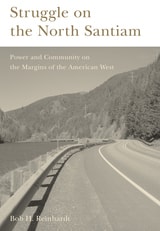
Struggle on the North Santiam
Power and Community on the Margins of the American WestBob H Reinhardt
Oregon State University Press, 2020
In this deeply researched account, historian Bob H. Reinhardt connects the North Santiam Canyon’s history to that of the Pacific Northwest and the United States more broadly. Readers will learn about specific events that illuminate themes in the region’s history: railroad development as seen through the failed dreams of the Oregon Pacific Railroad, federal land scams in the Oregon land fraud trials of the early twentieth century, the causes and consequences of mid-century river development projects like Detroit Dam, the post-war booms and busts of the timber industry, the spotted owl/ancient forest debate in the 1980s and 1990s, and the promises and perils of Oregon’s recreational tourism economy.
From nineteenth-century interactions between Native and non-Native peoples to the changing fortunes of the timber industry and questions about economic and environmental sustainability in the twenty-first century, the book offers important insights into power dynamics in small communities and marginal places. Struggle on the North Santiam will be of interest to scholars of the American West and thoughtful readers interested in Oregon and Pacific Northwest history.