Results by title
138 books match the query 'Appreciation' and 8 start with s
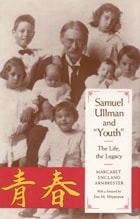
Samuel Ullman and "Youth"
The Life, the LegacyMargaret E. Armbrester
University of Alabama Press, 2009
Thousands of wonderful and sometimes strange fads have captured the public fancy in the almost five decades since the end of World War II. Most have been short-lived and soon faded away. There is, however, a poem that has not only withstood the vicissitudes of time, but has spread around the world like the waves lapping at a beach. This is the poem "Youth," by Samuel Ullman.
In December 1945, the Reader’s Digest published the poem and reported that General Douglas MacArthur, Commander of the Allied Forces, Far East, kept a copy of the poem near his desk.
Around that time, Yoshio Okada, a Japanese businessman, bought a copy of that December 1945 edition of the Reader's Digest, read the poem and was deeply affected by it. He translated it into Japanese and displayed it in his office as a guiding inspiration. Many of Okada's friends read the poem and were fascinated by its beauty. It began to receive national publicity through newspapers and magazines and became popular throughout Japan, especially among the intellectual community. Part of the reason for this widespread popularity is the excellence of the translation. Yoshio Okada, a man of noble character, gifted with a profound philosophy of life and literary talent, translated the poem into a beautiful, soulstirring Japanese version.
Samuel Ullman's “Youth” reflects the truth of life, and his outcry of spirituality touches the intrinsic nature of man.
Satire in Narrative
Petronius, Swift, Gibbon, Melville, & PynchonBy Frank Palmeri
University of Texas Press, 1990
Virtually all theories of satire define it as a criticism of contemporary society. Some argue that satire criticizes the present in favor of a standard of values that has been superseded, and thus that satire is generally backward-looking and conservative. While this is often true of poetic satire, in this study Frank Palmeri asserts that narrative satire performs a different function, that it parodies both the established view of the world and that of its opponents, offering its own distinctive critical perspective.
This theory of satire builds on the idea of dialogical parody in the work of Russian theorist Mikhail Bakhtin, while revising Bakhtin's estimate of carnival. In Palmeri's view, the carnivalesque offers only an inverted mirror image of authoritative discourse, while parodic narrative satire suggests an alternative to both the official world and its inverted opposite.
Palmeri applies this theory of narrative satire to five works of world literature, each of which has generated sharp controversy about the genre to which it rightly belongs: Petronius' Satyricon, Jonathan Swift's A Tale of a Tub, Edward Gibbon's Decline and Fall of the Roman Empire, Herman Melville's The Confidence-Man, and Thomas Pynchon's The Crying of Lot 49. He analyzes the features that link these works and shows how the changing pairs of alternatives that are parodied in these satires reflect changes in the terms of social and cultural oppositions.
Satire in Narrative will appeal to comparatists, specialists in eighteenth-century and American literature, and others interested in theories of genre and the relations between literary forms and social history.
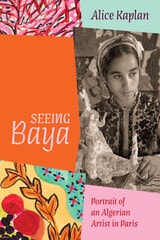
Seeing Baya
Portrait of an Algerian Artist in ParisAlice Kaplan
University of Chicago Press, 2024
On a flower farm in colonial Algeria, a servant and field worker known as Baya escaped the drudgery of her labor by coloring the skirts in fashion magazines. Three years later, in November 1947, her paintings and fanciful clay beasts were featured in a solo show in Paris. She wasn’t yet sixteen years old. In this first biography of Baya, Alice Kaplan tells the story of a young woman seemingly trapped in subsistence who becomes a sensation in the French capital, then mysteriously fades from the history of modern art—only to reemerge after independence as an icon of Algerian artistic heritage.
The toast of Paris for the 1947 season, Baya inspired colonialist fantasies about her “primitive” genius as well as genuine appreciation. She was featured in newspapers, on the radio, and in a newsreel; her art was praised by Breton and Camus, Marchand and Braque. At the dawn of Algerian liberation, her appearance in Paris was used to stage the illusion of French-Algerian friendship, while horrific French massacres in Algeria were still fresh in memory.
Kaplan uncovers the central figures in Baya’s life and the role they played in her artistic career. Among the most poignant was Marguerite Caminat-McEwen-Benhoura, who took Baya from her sister’s farm to Algiers, where Baya worked as Marguerite’s maid and was given paint and brushes. A complex and endearing character, Marguerite—and her Pygmalion ambitions—was decisive in shaping Baya’s destiny. Kaplan also looks closely at Baya’s earliest paintings with an eye to their themes, their palette and design, and their enduring influence.
In vivid prose that brings Baya’s story into the present, Kaplan’s book, the fruit of scrupulous research in Algiers, Blida, Paris, and Provence, allows us to see in a whole new light the beloved artist who signed her paintings simply “Baya.”
Shakespeare and the French Poet
Yves Bonnefoy
University of Chicago Press, 2004
Translated specifically for an American readership, Shakespeare and the French Poet also features a new interview with Bonnefoy. For Shakespeare scholars, Bonnefoy enthusiasts, and students of literary translation, Shakespeare and the French Poet is a celebration of the global language of poetry and the art of "making someone else's voice live again in one's own."
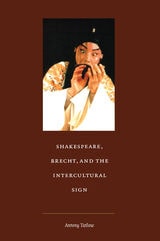
Shakespeare, Brecht, and the Intercultural Sign
Antony Tatlow
Duke University Press, 2001
Reflecting on how, why, and to what effect knowledges and styles of performance pollinate across cultures, Tatlow demonstrates that the employment of one culture’s material in the context of another defamiliarizes the conventions of representation in an act that facilitates access to what previously had been culturally repressed. By reading the intercultural, Tatlow shows, we are able not only to historicize the effects of those repressions that create a social unconscious but also gain access to what might otherwise have remained invisible.
This remarkable study will interest students of cultural interaction and aesthetics, as well as readers interested in theater, Shakespeare, Brecht, China, and Japan.

Sibelius
A Composer's Life and the Awakening of FinlandGlenda Dawn Goss
University of Chicago Press, 2009
One of the twentieth century’s greatest composers, Jean Sibelius (1865–1957) virtually stopped writing music during the last thirty years of his life. Recasting his mysterious musical silence and his undeniably influential life against the backdrop of Finland’s national awakening, Sibelius will be the definitive biography of this creative legend for many years to come.
Glenda Dawn Goss begins her sweeping narrative in the Finland of Sibelius’s youth, which remained under Russian control for the first five decades of his life. Focusing on previously unexamined events, Goss explores the composer’s formative experiences as a Russian subject and a member of the Swedish-speaking Finnish minority. She goes on to trace Sibelius’s relationships with his creative contemporaries, with whom he worked to usher in a golden age of music and art that would endow Finns with a sense of pride in their heritage and encourage their hopes for the possibilities of nationhood. Skillfully evoking this artistic climate—in which Sibelius emerged as a leader—Goss creates a dazzling portrait of the painting, sculpture, literature, and music it inspired. To solve the deepest riddles of Sibelius’s life, work, and enigmatic silence, Goss contends, we must understand the awakening in which he played so great a role.
Situating this national creative tide in the context of Nordic and European cultural currents, Sibelius dramatically deepens our knowledge of a misunderstood musical giant and an important chapter in the intellectual history of Europe.
Style and Music
Theory, History, and IdeologyLeonard B. Meyer
University of Chicago Press, 1997
Meyer devotes the latter part of his book to a sketch-history of nineteenth-century music. He shows explicitly how the beliefs and attitudes of Romanticism influenced the choices of composers from Beethoven to Mahler and into our own time.
"A monumental work. . . . Most authors concede the relation of music to its cultural milieu, but few have probed so deeply in demonstrating this interaction."—Choice
"Probes the foundations of musical research precisely at the joints where theory and history fold into one another."—Kevin Korsyn, Journal of American Musicological Society
"A remarkably rich and multifaceted, yet unified argument. . . . No one else could have brought off this immense project with anything like Meyer's command."—Robert P. Morgan, Music Perception
"Anyone who attempts to deal with Romanticism in scholarly depth must bring to the task not only musical and historical expertise but unquenchable optimism. Because Leonard B. Meyer has those qualities in abundance, he has been able to offer fresh insight into the Romantic concept."—Donal Henahan, New York Times
Sylvia Plath and the Mythology of Women Readers
Janet Badia
University of Massachusetts Press, 2011
Janet Badia investigates the evolution of this narrative, tracing its origins, exposing the gaps and elisions that have defined it, and identifying it as a bullying mythology whose roots lie in a long history of ungenerous, if not outright misogynistic, rhetoric about women readers that has gathered new energy from the backlash against contemporary feminism.
More than just an exposé of our cultural biases against women readers, Badia's research also reveals how this mythology has shaped the production, reception, and evaluation of Plath's body of writing, affecting everything from the Hughes family's management of Plath's writings to the direction of Plath scholarship today. Badia discusses a wide range of texts and issues whose significance has gone largely unnoticed, including the many book reviews that have been written about Plath's publications; films and television shows that depict young Plath readers; editorials and fan tributes written about Plath; and Ted and (daughter) Frieda Hughes's writings about Plath's estate and audience.