Results by title
166 books match the query 'Archives' and 7 start with s
Science in the Archives
Pasts, Presents, FuturesEdited by Lorraine Daston
University of Chicago Press, 2017
With Science in the Archives, Lorraine Daston and her co-authors offer the first study of the important role that these archives play in the natural and human sciences. Reaching across disciplines and centuries, contributors cover episodes in the history of astronomy, geology, genetics, philology, climatology, medicine, and more—as well as fundamental practices such as collecting, retrieval, and data mining. Chapters cover topics ranging from doxology in Greco-Roman Antiquity to NSA surveillance techniques of the twenty-first century. Thoroughly exploring the practices, politics, economics, and potential of the sciences of the archives, this volume reveals the essential historical dimension of the sciences, while also adding a much-needed long-term perspective to contemporary debates over the uses of Big Data in science.
Selected Philosophical, Scientific, and Autobiographical Writings
Marie-Geneviève-Charlotte Thiroux d’Arconville
Iter Press, 2018
Edited and translated by Julie Candler Hayes
The Other Voice in Early Modern Europe: The Toronto Series, volume 58
Serendipity in Rhetoric, Writing, and Literacy Research
Maureen Daly Goggin
Utah State University Press, 2018
In the course of research, most scholars have known moments of surprise, catastrophe, or good fortune, though they seldom refer to these occurrences in reports or discuss them with students. Serendipity in Rhetoric, Writing, and Literacy Research reveals the different kinds of work scholars, particularly those in rhetoric, writing, and literacy, need to do in order to recognize a serendipitous discovery or a missed opportunity.
In published scholarship and research, the path toward discovery seems clean and direct. The dead ends, backtrackings, start-overs, and stumbles that occur throughout the research process are elided, and seems that the researchers started at point A and arrived safely and neatly at point B without incident, as if by magic. The path, however, is never truly clear and straight. Research and writing is messy. Serendipity in Rhetoric, Writing, and Literacy Research features chapters from twenty-three writing scholars who have experienced moments of serendipity in their own work—not by magic or pure chance but through openness and active waiting, which offer an opportunity to prepare the mind.
Serendipity in Rhetoric, Writing, and Literacy Research illustrates the reality of doing research: there is no reliable prescription or one-size-fits-all manual, but success can be found with focused dedication and an open mind.
Contributors: Ellen Barton, Zachary C. Beare, Lynn Z. Bloom, Jennifer Clary-Lemon, Caren Wakerman Converse, Gale Coskan-Johnson, Kim Donehower, Bill Endres, Shirley E. Faulkner-Springfield, Lynée Lewis Gaillet, Brad Gyori, Judy Holiday, Gesa E. Kirsch, Lori Ostergaard, Doreen Piano, Liz Rohan, Ryan Skinnell, Patricia Wilde, Daniel Wuebben
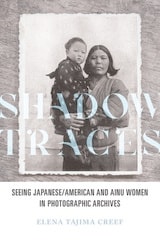
Shadow Traces
Seeing Japanese/American and Ainu Women in Photographic ArchivesElena Tajima Creef
University of Illinois Press, 2022
Innovative and engaging, Shadow Traces illuminates how photographs shape the history of marginalized people and outlines a method for using such materials in interdisciplinary research.

Sins against Nature
Sex and Archives in Colonial New SpainZeb Tortorici
Duke University Press, 2018
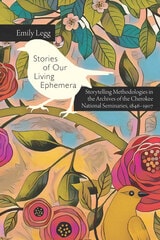
Stories of Our Living Ephemera
Storytelling Methodologies in the Archives of the Cherokee National Seminaries, 1846-1907Emily Legg
Utah State University Press, 2023
Emily Legg turns to the Cherokee medicine wheel and cardinal directions as a Cherokee rhetorical discipline of knowledge making in the archives, an embodied and material practice that steers knowledge through the four cardinal directions around all relations. Going beyond historiography, Legg delineates educational practices that are intertwined with multiple strands of traditional Cherokee stories that privilege Indigenous and matriarchal theoretical lenses. Stories of Our Living Ephemera synthesizes the connections between contemporary and nineteenth-century academic experiences to articulate the ways that colonial institutions and research can be Indigenized by centering Native American sovereignty.
By undoing the erasure of Cherokee literacy and educational practices, Stories of Our Living Ephemera celebrates the importance of storytelling, especially for those who are learning about Indigenous histories and rhetorics. This book is of cultural importance and value to academics interested in composition and pedagogy, the Cherokee Nation, and a general audience seeking to learn about Indigenous rhetorical devices and Cherokee history.
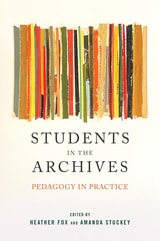
Students in the Archives
Pedagogy in PracticeEdited by Heather Fox and Amanda Stuckey
University of Illinois Press, 2026
The contributors examine approaches that integrate exhibitions with archived artifacts, collections, recovery, and digital humanities projects. Throughout, they connect these approaches to conversations about using archived materials in teaching and learning. The essays also feature observations about the work produced from collaborations and provide resources for sustaining future archival pedagogy. Topics include teaching in the twenty-first century; ways to support inclusivity, accessibility, and equity through engagements with digital and non-digital sources; and partnerships across disciplines, grade levels, and learning spaces through the collaborative relationships that emerge from archival teaching.
Interdisciplinary and up-to-date, Students in the Archives reveals how engagement with archived artifacts and collections opens spaces for conversations about the historical, social, and political contexts embedded in their productions and dissemination.