Results by title
83 books match the query 'Birth' and 12 start with s

Satan the Heretic
The Birth of Demonology in the Medieval WestAlain Boureau
University of Chicago Press, 2006
Depicting this new demonology, Satan the Heretic considers the period between the mid-thirteenth and mid-fourteenth centuries when demons, in the eyes of Church authorities, suddenly burst forth, more real and more terrifying than ever before in the history of Christianity. Boureau argues that the rise in this obsession with demons occurs at the crossroads of the rise of sovereignties and of the individual, a rise that, tellingly, also coincides with the emergence of the modern legal system in the European West.
Teeming with original insights and lively anecdotes, Satan the Heretic is a significant contribution to the history of Christian demonology from one of the most original minds in the field of medieval studies today.
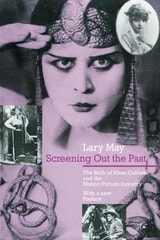
Screening Out the Past
The Birth of Mass Culture and the Motion Picture IndustryLary May
University of Chicago Press, 1983
"It is impossible to follow a narrow trail through the movies. The vistas keep opening, and May, linking movies to mass society, finds and makes new perceptions on emerging women, the rise of the studios, the special growth and appeal of Los Angeles, the nature of studio leadership and the early and persistent imputed corrupting power of film."—Charles Champlin, Los Angeles Times
"Lary May . . . has provided a set of new and rich insights into the changing patterns of American culture, 1890-1929. . . . His concentration on social and cultural history indirectly provides answers to questions which have baffled political historians for several decades."—David W. Noble, Minneapolis Tribune
"[Screening Out the Past is] a scrupulously argued, clearly written account of Hollywood's role in bringing America skipping and giggling from the Victorian world into the twentieth century. May is splendid on the psychology of the immigrant movie moguls, on Douglas Fairbanks and Mary Pickford as post Great War role models, and many other things."—Philip French, London Sunday Observor
"Altogether, the book represents the most successful blending of movie and cultural history to date."—Benjamin McArthur, Journal of Social History

Securing the Future
Investing in Children From Birth to CollegeSheldon Danziger
Russell Sage Foundation, 2000

Sexual Aim and Its Misses
On the Birth of the Sexual SubjectBenjamin Kahan
University of Chicago Press, 0
By shifting the study of sexuality to focus on “sexual aim,” we can understand the birth of the sexual subject—the historical emergence of an understanding of sexuality as an aspect of personhood.
Is it possible that half of the organization of modern sexuality has been forgotten? Historians of sexuality have thought about sexual desire almost exclusively in terms of the sexual object—the person to whom one is attracted. This book offers a history and theory of “sexual aim”—the what and how of desire—arguing that aim furnishes a constitutive and almost wholly ignored governing logic of sexuality.
The term “sexual aim” was coined by Sigmund Freud to describe “modes of gratification”—the sexual acts in which one finds pleasure, from kissing and copulation to voyeurism and fetishism. Benjamin Kahan repurposes this account to tell the complex story of how sexual aim catalyzed the formation of modern sexual identity and continues to operate as a powerful optic for understanding Euro-American sexualities.
Kahan focuses on nonnormative sexual aims, examining the histories of sadism, masochism, voyeurism, exhibitionism, and fetishism in order to articulate the relationship between sexual acts and sexuality. Drawing on diaries, court records, erotica, literary texts, marriage manuals, and medical treatises, Kahan vividly maps the emergence of the sexual subject from the early modern period through the twentieth century to furnish a new account of sexual modernity.

Shooting Cowboys and Indians
Silent Western Films, American Culture, and the Birth of HollywoodAndrew Brodie Smith
University Press of Colorado, 2003
Tracing the western from its hazy silent-picture origins in the 1890s to the advent of talking pictures in the 1920s, Smith examines the ways in which silent westerns contributed to the overall development of the film industry.
Focusing on such early important production companies as Selig Polyscope, New York Motion Picture, and Essanay, Smith revises current thinking about the birth of Hollywood and the establishment of Los Angeles as the nexus of filmmaking in the United States. Smith also reveals the role silent westerns played in the creation of the white male screen hero that dominated American popular culture in the twentieth century.
Illustrated with dozens of historic photos and movie stills, this engaging and substantive story will appeal to scholars interested in Western history, film history, and film studies as well as general readers hoping to learn more about this little-known chapter in popular filmmaking.

Skull in the Ashes
Murder, a Gold Rush Manhunt, and the Birth of Circumstantial Evidence in AmericaPeter Kaufman
University of Iowa Press, 2013

Someday All the Adults Will Die!
The Birth of Texas PunkPat Blashill
University of Texas Press, 2025
A deep dive into the early days of punk in Austin, Texas, this oral history immerses readers in a diverse and influential music scene.
Texas has always teemed with music and counterculture. When punk came to the state in 1978, it flourished in San Antonio, Dallas, Houston, and, especially, Austin. Punk and post-punk musicians, including nationally acclaimed bands like the Butthole Surfers, the Big Boys, the Dicks, and Daniel Johnston influenced local culture before slashing into the American musical psyche. (See Kurt Cobain sporting Johnston’s “Hi, How are you?” T-shirt.) Someday All the Adults Will Die! is an oral history of punk in Texas, from its rise in the late 1970s, through its strong anti-racist, feminist, and queer peak, to its dissolution in the late 1980s.
Now a seasoned music journalist, Blashill experienced the zenith of Texas punk as a teenager, and he captures its intensity in words and pictures. Someday All the Adults Will Die! is rife with electrifying images and firsthand tales of what made this scene such a storm of pleasures and terrors, uncompromising artists, and wild performances. This dynamic portrait of an untamed, all-out musical era is a must-read for fans of punk music, counterculture, and live music.
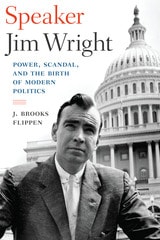
Speaker Jim Wright
Power, Scandal, and the Birth of Modern PoliticsBy J. Brooks Flippen
University of Texas Press, 2018
Honorable Mention, Ramirez Family Award for Most Significant Scholarly Book, Texas Institute of Letters, 2019
Jim Wright made his mark on virtually every major public policy issue in the later twentieth century—energy, education, taxes, transportation, environmental protection, civil rights, criminal justice, and foreign relations, among them. He played a significant role in peace initiatives in Central America and in the Camp David Accords, and he was the first American politician to speak live on Soviet television. A Democrat representing Texas’s twelfth district (Fort Worth), Wright served in the US House of Representatives from the Eisenhower administration to the presidency of George H. W. Bush, including twelve years (1977–1989) as majority leader and speaker. His long congressional ascension and sudden fall in a highly partisan ethics scandal spearheaded by Newt Gingrich mirrored the evolution of Congress as an institution.
Speaker Jim Wright traces the congressman’s long life and career in a highly readable narrative grounded in extensive interviews with Wright and access to his personal diaries. A skilled connector who bridged the conservative and liberal wings of the Democratic party while forging alliances with Republicans to pass legislation, Wright ultimately fell victim to a new era of political infighting, as well as to his own hubris and mistakes. J. Brooks Flippen shows how Wright’s career shaped the political culture of Congress, from its internal rules and power structure to its growing partisanship, even as those new dynamics eventually contributed to his political demise. To understand Jim Wright in all his complexity is to understand the story of modern American politics.

Spider Web
The Birth of American AnticommunismNick Fischer
University of Illinois Press, 2016
Spirituals and the Birth of a Black Entertainment Industry
Sandra Jean Graham
University of Illinois Press, 2018
Subversive Sounds
Race and the Birth of Jazz in New OrleansCharles B. Hersch
University of Chicago Press, 2008
Subversive Sounds probes New Orleans’s history, uncovering a web of racial interconnections and animosities that was instrumental to the creation of a vital American art form—jazz. Drawing on oral histories, police reports, newspaper accounts, and vintage recordings, Charles Hersch brings to vivid life the neighborhoods and nightspots where jazz was born.
This volume shows how musicians such as Jelly Roll Morton, Nick La Rocca, and Louis Armstrong negotiated New Orleans’s complex racial rules to pursue their craft and how, in order to widen their audiences, they became fluent in a variety of musical traditions from diverse ethnic sources. These encounters with other music and races subverted their own racial identities and changed the way they played—a musical miscegenation that, in the shadow of Jim Crow, undermined the pursuit of racial purity and indelibly transformed American culture.
“More than timely . . . Hersch orchestrates voices of musicians on both sides of the racial divide in underscoring how porous the music made the boundaries of race and class.”—New Orleans Times-Picayune
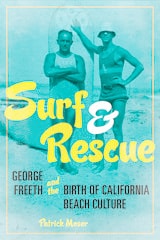
Surf and Rescue
George Freeth and the Birth of California Beach CulturePatrick Moser
University of Illinois Press, 2022
A compelling merger of biography and sports history, Surf and Rescue brings to light the forgotten figure whose novel way of seeing the beach sparked the imaginations of people around the world.