384 books match the query 'Black Studies (Global)' and 35 start with s

cover of Sacred Leaves of Candomblé: African Magic, Medicine, and Religion in Brazil

Sacred Leaves of Candomblé

African Magic, Medicine, and Religion in Brazil

By Robert A. Voeks

University of Texas Press, 1997

Winner, Hubert Herring Book Award, Pacific Coast Council on Latin American Studies

Candomblé, an African religious and healing tradition that spread to Brazil during the slave trade, relies heavily on the use of plants in its spiritual and medicinal practices. When its African adherents were forcibly transplanted to the New World, they faced the challenge not only of maintaining their culture and beliefs in the face of European domination but also of finding plants with similar properties to the ones they had used in Africa.

This book traces the origin, diffusion, medicinal use, and meaning of Candomblé's healing pharmacopoeia—the sacred leaves. Robert Voeks examines such topics as the biogeography of Africa and Brazil, the transference—and transformation—of Candomblé as its adherents encountered both native South American belief systems and European Christianity, and the African system of medicinal plant classification that allowed Candomblé to survive and even thrive in the New World. This research casts new light on topics ranging from the creation of African American cultures to tropical rain forest healing floras.
[more]
cover of Safe Space: Finding Safety in Solidarity and Self-Determination

Safe Space

Finding Safety in Solidarity and Self-Determination

Raphaëlle Red

Seagull Books, 2026

An urgent and intimate meditation on what it means to feel—and to be—safe. 

In Safe Space, Raphaëlle Red traces the physiological toll of insecurity on marginalized lives across literature, film, music, and political discourse. In conversation with artists and thinkers such as James Baldwin, Nina Simone, June Jordan, Ja’Tovia Gary, and Leslie Feinberg, she maps the genealogy of “safe spaces,” from their radical origins to their contested place in today’s public debates. Rather than dismissing or defending the concept, Red asks what we might recover if we redefined safety not as fragility or withdrawal, but as self-determination, collective defense, and the right to opacity. She explores the tension between feeling and reality, protection and powerlessness, the language of safety, and the politics it sustains. Along the way, she grounds her reflections in personal narrative, European and North American contexts, and contemporary movements of resistance. At once theoretical and deeply personal, Safe Space refuses easy answers. Instead, it imagines safe space as temporary, regenerative, and insurgent—a practice of care and solidarity that unsettles hierarchies rather than reproducing them. A book for anyone wrestling with fear, vulnerability, and the fragile promise of collective liberation.

[more]
cover of Say Her Name: Centering Black Feminism and Black Women in Sport

Say Her Name

Centering Black Feminism and Black Women in Sport

Letisha Engracia Cardoso Brown

Rutgers University Press, 2025

Say Her Name: Centering Black Feminism and Black Women in Sports offers an in-depth look into the lived experiences of Blackgirlwomen as athletes, activists, and everyday people through a Black feminist lens. With so much research on race centered on Black men and gender research focusing on white women, Say Her Name offers a necessary conversation that places Blackgirlwomen at the center of discussion.

Say Her Name delves deeply into issues of gender, the politics of punishment, athlete activism, the politics of Black hair, fingernails and fashion, and the representation and commodification of Blackgirlwomen in sport and society. An entry point into the growing research in sport studies and beyond from a Black feminist lens, Say Her Name offers a clear window into the power and potential of nuanced examinations of sport. As a reflection of the larger social world, sport provides a framework for understanding larger social issues, including racism, sexism, and misogynoir. Blackgirlwomen have varied experiences in sport, and Say Her Name provides a window into those experiences. The book discusses Black women in sports including the South African runner Caster Semenya and the American runners Florence Griffith Joyner and Sha’Carri Richardson, as well as Venus and Serena Williams, Gabby Douglas, and Simone Biles. The women in this book have lived experiences that speak to the larger experiences of Black women and girls in sport and society, while also leaning into a larger discussion of the importance of the social movement #SayHerName.

 
[more]
cover of Scenes from the Shadows: Afro-Argentine Life in the Twentieth Century

Scenes from the Shadows

Afro-Argentine Life in the Twentieth Century

Robert J. Cottrol and Lea Geler

Ohio University Press, 2027

Scenes from the Shadows challenges one of the most enduring myths of Argentine history: that Afro-Argentines had disappeared by the twentieth century. Bringing together leading scholars of race, culture, and history, the volume demonstrates that Afro-descendant communities remained a vital part of Argentine society even as official narratives, public institutions, and popular memory rendered them increasingly invisible. Drawing on oral histories, community newspapers, family archives, ethnography, and archival research, the contributors recover the lives, organizations, and cultural worlds that persisted beneath the surface of Argentina’s self-image as a White, European nation.

Focusing on Buenos Aires—home to the country’s largest Afro-descendant population and the epicenter of debates over race and national identity—the book situates Argentina within the broader history of the African diaspora in Latin America and examines how ideologies of Whitening (blanqueamiento), racial classification, urban development, and national identity obscured Afro-descendant presence throughout the twentieth century. The chapters explore Black celebrity and performance culture, tango, Afro-Porteño associational life, community journalism, public employment, migration, gender, and the formation of Afro-descendant social networks, revealing how Afro-Argentines negotiated exclusion while sustaining vibrant traditions of community, creativity, and belonging.

More than a recovery of forgotten histories, Scenes from the Shadows offers a new interpretation of modern Argentina itself. It shows how race continued to shape social life even in a society that denied its importance and how Afro-descendant communities endured despite powerful pressures toward erasure. A major contribution to Afro-Latin American studies, Argentine history, and diaspora scholarship, the volume restores Afro-Argentines to their place in the story of twentieth-century Argentina and provides a powerful framework for understanding the relationship between race, memory, and nationhood.

Contributors

Paulina L. Alberto
Judith M. Anderson
Laura Colabella
Robert J. Cottrol
Alejandra Egido
Alejandro Frigerio
Lea Geler
Lucas Glasman
Miriam Gomes
Chisu Teresa Ko
Eva Lamborghini
Marta Maffia
Carmen Yannone
[more]
cover of Searching for Sycorax: Black Women's Hauntings of Contemporary Horror

Searching for Sycorax

Black Women's Hauntings of Contemporary Horror

Brooks, Kinitra D

Rutgers University Press, 2018
Searching for Sycorax highlights the unique position of Black women in horror as both characters and creators. Kinitra D. Brooks creates a racially gendered critical analysis of African diasporic women, challenging the horror genre’s historic themes and interrogating forms of literature that have often been ignored by Black feminist theory. Brooks examines the works of women across the African diaspora, from Haiti, Trinidad, and Jamaica, to England and the United States, looking at new and canonized horror texts by Nalo Hopkinson, NK Jemisin, Gloria Naylor, and Chesya Burke. These Black women fiction writers take advantage of horror’s ability to highlight U.S. white dominant cultural anxieties by using Africana folklore to revise horror’s semiotics within their own imaginary. Ultimately, Brooks compares the legacy of Shakespeare’s Sycorax (of The Tempest) to Black women writers themselves, who, deprived of mainstream access to self-articulation, nevertheless influence the trajectory of horror criticism by forcing the genre to de-centralize whiteness and maleness.  
[more]
cover of Segregation: A Global History of Divided Cities

Segregation

A Global History of Divided Cities

Carl H. Nightingale

University of Chicago Press, 2012

When we think of segregation, what often comes to mind is apartheid South Africa, or the American South in the age of Jim Crow—two societies fundamentally premised on the concept of the separation of the races. But as Carl H. Nightingale shows us in this magisterial history, segregation is everywhere, deforming cities and societies worldwide.

Starting with segregation’s ancient roots, and what the archaeological evidence reveals about humanity’s long-standing use of urban divisions to reinforce political and economic inequality, Nightingale then moves to the world of European colonialism. It was there, he shows, segregation based on color—and eventually on race—took hold; the British East India Company, for example, split Calcutta into “White Town” and “Black Town.” As we follow Nightingale’s story around the globe, we see that division replicated from Hong Kong to Nairobi, Baltimore to San Francisco, and more. The turn of the twentieth century saw the most aggressive segregation movements yet, as white communities almost everywhere set to rearranging whole cities along racial lines. Nightingale focuses closely on two striking examples: Johannesburg, with its state-sponsored separation, and Chicago, in which the goal of segregation was advanced by the more subtle methods of real estate markets and housing policy.

For the first time ever, the majority of humans live in cities, and nearly all those cities bear the scars of segregation. This unprecedented, ambitious history lays bare our troubled past, and sets us on the path to imagining the better, more equal cities of the future.

[more]
cover of Selected Writings on Race and Difference

Selected Writings on Race and Difference

Stuart Hall

Duke University Press, 2021

In Selected Writings on Race and Difference, editors Paul Gilroy and Ruth Wilson Gilmore gather more than twenty essays by Stuart Hall that highlight his extensive and groundbreaking engagement with race, representation, identity, difference, and diaspora. Spanning the whole of his career, this collection includes classic theoretical essays such as “The Whites of Their Eyes” (1981) and “Race, the Floating Signifier” (1997). It also features public lectures, political articles, and popular pieces that circulated in periodicals and newspapers, which demonstrate the breadth and depth of Hall's contribution to public discourses of race. Foregrounding how and why the analysis of race and difference should be concrete and not merely descriptive, this collection gives organizers and students of social theory ways to approach the interconnections of race with culture and consciousness, state and society, policing and freedom.
[more]
cover of Selected Writings on Visual Arts and Culture: Detour to the Imaginary

Selected Writings on Visual Arts and Culture

Detour to the Imaginary

Stuart Hall. Edited by Gilane Tawadros

Duke University Press, 2024

Stuart Hall’s work on culture, politics, race, and media is familiar to readers throughout the world. Equally important was his decades-long commitment to visual art. As the first collection to bring together Hall’s work on the visual, this volume assembles two dozen of Hall’s essays, lectures, reviews, catalog texts, and conversations on art, film, and photography. Providing rare insights into Hall’s engagement with the “radically different” intellectual and aesthetic space of the visual imaginary, these works articulate the importance of the visual as a site of contestation at the same time as it is a space in which Black artists and filmmakers reframe questions about diaspora, identity, and globalization. Selected Writings on Visual Arts and Culture demonstrates the breadth and range of Hall’s thinking on art, film, photography, archives, and museums. In so doing, it enables us to arrive at radical and innovative ways of understanding the world.
[more]
cover of Selected Writings, Volume 1: Toward a New African Art Discourse

Selected Writings, Volume 1

Toward a New African Art Discourse

Okwui Enwezor. Edited by Terry Smith.

Duke University Press, 2025
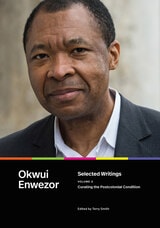
Okwui Enwezor is widely regarded as a leader among the brilliant curators who emerged in the 1990s to set agendas for understanding the global expansiveness of contemporary art. Among his pathfinding exhibitions were the second Johannesburg Biennale (1997), the paradigm-shifting Documenta11 (2002), Archive Fever (2008), and Postwar (2016). In addition to breaking ground as a curator, Enwezor was also a prolific critic, essayist, and theorist. Selected Writings—a landmark two-volume set—brings together Enwezor’s most influential and foundational works. Spanning a quarter-century, these selections reflect the depth and breadth of Enwezor’s writing and its role in his tireless efforts to decolonize the art world. Volume 1, Toward a New African Art Discourse, includes fifteen essays written between 1994 and 2006. Drawn from exhibition catalogs, art journals, interviews with artists, art reviews, curatorial statements, historical studies, and book chapters, these texts show him striving to fulfil the first main ambition that drove his career: to found and sustain what he called a “New African Art Discourse.” Demonstrating that his writing helped fulfill this goal, this collection reaffirms Enwezor’s status as a transformational figure in the global contemporary art world.
[more]
cover of Selected Writings, Volume 2: Curating the Postcolonial Condition, Volume 2

Selected Writings, Volume 2

Curating the Postcolonial Condition, Volume 2

Okwui Enwezor. Edited by Terry Smith.

Duke University Press, 2025

Okwui Enwezor is widely regarded as a leader among the brilliant curators who emerged in the 1990s to set agendas for understanding the global expansiveness of contemporary art. Among his pathfinding exhibitions were the second Johannesburg Biennale (1997), the paradigm-shifting Documenta 11 (2002), Archive Fever (2008), and Postwar (2016). In addition to breaking ground as a curator, Enwezor was also a prolific critic, essayist, and theorist. Selected Writings—a landmark two-volume set—brings together Enwezor’s most influential and foundational works. Spanning a quarter-century, these selections reflect the depth and breadth of Enwezor’s writing and its role in his tireless efforts to decolonize the art world. Volume 2, Curating the Postcolonial Condition, includes seventeen essays written between 2006 and 2019. Drawn from exhibition catalogs, art journals, interviews with artists, art reviews, curatorial statements, historical studies, and book chapters, these texts show him striving to fulfil the second main ambition that drove his career: enabling a critical, diasporic imagining of postcoloniality that would become pervasive within global art discourse. Demonstrating that his writing helped fulfill this goal, this collection reaffirms Enwezor’s status as a transformational figure in the global contemporary art world.
[more]
cover of Senghor: Writings on Politics

Senghor

Writings on Politics

Léopold Sédar Senghor. Edited and translated by Yohann C. Ripert

Duke University Press, 2025
Senghor: Writings on Politics brings Léopold Sédar Senghor’s most vital essays, speeches, and political writings to English-language readers for the first time. Spanning the colonial and postcolonial years between 1937 and 1971, this volume captures Senghor’s evolution from a pioneering poet and cofounder of Négritude to the president of Senegal as he grappled with the complexities of postcolonial identity, governance, and cultural hybridity. Senghor’s reflections on topics ranging from federalism and decolonization to Francophonie reveal his commitment to weaving African and European cultural threads into a vision of global solidarity in ways that resonate with contemporary debates on race, culture, and politics. Inviting readers to engage with a seminal figure whose legacy continues to inspire new ways of thinking about freedom, independence, and coexistence, this landmark book furthers our understanding of one of the twentieth century’s most influential cultural thinkers.
[more]
cover of Sentient Flesh: Thinking in Disorder, Poiesis in Black

Sentient Flesh

Thinking in Disorder, Poiesis in Black

R. A. Judy

Duke University Press, 2020

 In Sentient Flesh R. A. Judy takes up freedman Tom Windham’s 1937 remark “we should have our liberty 'cause . . . us is human flesh" as a point of departure for an extended meditation on questions of the human, epistemology, and the historical ways in which the black being is understood. Drawing on numerous fields, from literary theory and musicology, to political theory and phenomenology, as well as Greek and Arabic philosophy, Judy engages literary texts and performative practices such as music and dance that express knowledge and conceptions of humanity appositional to those grounding modern racialized capitalism. Operating as critiques of Western humanism, these practices and modes of being-in-the-world—which he theorizes as “thinking in disorder,” or “poiēsis in black”—foreground the irreducible concomitance of flesh, thinking, and personhood. As Judy demonstrates, recognizing this concomitance is central to finding a way past the destructive force of ontology that still holds us in thrall. Erudite and capacious, Sentient Flesh offers a major intervention in the black study of life. 
[more]
cover of Shades of Black

Shades of Black

Nathalie Etoke

Seagull Books, 2021

One might say that the womb of death—the Middle Passage, slavery, and colonization—gave birth to Black populations. Taking this observation as her point of departure, Nathalie Etoke examines Black existence today in her riveting new book, Shades of Black. In a white supremacist world, Black bodies hold a specific position, invested with a range of meaning that maintains them in a fixed role, with a script they did not write. The white world has invented and defined the Black person according to its own interests, endowing her with a bereaved humanity. The Black person is confronted with an essential paradox—exist as Black or as a human being? Does the Black person exist for herself or for the other? In the white world, is the Black race the embodiment of a sub-humanity?

Situated at the crossroads of three countries—Cameroon, France, and, now, the United States—Nathalie Etoke is uniquely positioned for this polyphonic reflection on race. She examines what happens when race obliterates historical, social, cultural, and political differences among populations of African descent from different parts of the world. Focusing on recent and ongoing topics in the United States, including the murder of George Floyd, police brutality, the complex symbolism of Barack Obama and Kamala Harris, Etoke explores the relations of violence, oppression, dispossession, and inequalities that have brought us here, face to face with these existential questions: Are you breathing? Are we breathing?

[more]
cover of Shadow Bodies: Black Women, Ideology, Representation, and Politics

Shadow Bodies

Black Women, Ideology, Representation, and Politics

Jordan-Zachery, Julia S.

Rutgers University Press, 2018

What does it mean for Black women to organize in a political context that has generally ignored them or been unresponsive although Black women have shown themselves an important voting bloc? How for example, does #sayhername translate into a political agenda that manifests itself in specific policies? Shadow Bodies focuses on the positionality of the Black woman’s body, which serves as a springboard for helping us think through political and cultural representations. It does so by asking: How do discursive practices, both speech and silences, support and maintain hegemonic understandings of Black womanhood thereby rendering some Black women as shadow bodies, unseen and unremarked upon?  

Grounded in Black feminist thought, Julia S. Jordan-Zachery looks at the functioning of scripts ascribed to Black women’s bodies in the framing of HIV/AIDS, domestic abuse, and mental illness and how such functioning renders some bodies invisible in Black politics in general and Black women’s politics specifically. 
 
[more]
cover of Siblings of Soil: Dominicans and Haitians in the Age of Revolutions

Siblings of Soil

Dominicans and Haitians in the Age of Revolutions

Charlton W. Yingling

University of Texas Press, 2022

2023 Honorable Mention, Isis Duarte Book Prize, Haiti/ Dominican Republic section (LASA)

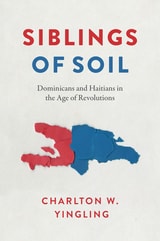
After revolutionary cooperation between Dominican and Haitian majorities produced independence across Hispaniola, Dominican elites crafted negative myths about this era that contributed to anti-Haitianism.


Despite the island’s long-simmering tensions, Dominicans and Haitians once unified Hispaniola. Based on research from over two dozen archives in multiple countries, Siblings of Soil presents the overlooked history of their shared imperial endings and national beginnings from the 1780s to 1822. Haitian revolutionaries both inspired and aided Dominican antislavery and anti-imperial movements. Ultimately, Santo Domingo's independence from Spain came in 1822 through unification with Haiti, as Dominicans embraced citizenship and emancipation. Their collaboration resulted in one of the most unique and inclusive forms of independence in the Americas.

Elite reactions to this era formed anti-Haitian narratives. Racial ideas permeated the revolution, Vodou, Catholicism, secularism, and even Deism. Some Dominicans reinforced Hispanic and Catholic traditions and cast Haitians as violent heretics who had invaded Dominican society, undermining the innovative, multicultural state. Two centuries later, distortions of their shared past of kinship have enabled generations of anti-Haitian policies, assumptions of irreconcilable differences, and human rights abuses.

[more]
cover of Sing and Sing On: Sentinel Musicians and the Making of the Ethiopian American Diaspora

Sing and Sing On

Sentinel Musicians and the Making of the Ethiopian American Diaspora

Kay Kaufman Shelemay

University of Chicago Press, 2022

A sweeping history of Ethiopian musicians during and following the 1974 Ethiopian revolution.

Sing and Sing On is the first study of the forced migration of musicians out of the Horn of Africa dating from the 1974 Ethiopian revolution, a political event that overthrew one of the world’s oldest monarchies and installed a brutal military regime. Musicians were among the first to depart the region, their lives shattered by revolutionary violence, curfews, and civil war. Reconstructing the memories of forced migration, Sing and Sing On traces the challenges musicians faced amidst revolutionary violence and the critical role they played in building communities abroad.

Drawing on the recollections of dozens of musicians, Sing and Sing On details personal, cultural, and economic hardships experienced by musicians who have resettled in new locales abroad. Kay Kaufman Shelemay highlights their many artistic and social initiatives and the ways they have offered inspiration and leadership within and beyond a rapidly growing Ethiopian American diaspora. While musicians held this role as sentinels in Ethiopian culture long before the revolution began, it has taken on new meanings and contours in the Ethiopian diaspora. The book details the ongoing creativity of these musicians while exploring the attraction of return to their Ethiopian homeland over the course of decades abroad. Ultimately, Shelemay shows that musicians are uniquely positioned to serve this sentinel role as both guardians and challengers of cultural heritage.

[more]
cover of Skin and Starch: Manioc and Worldmaking in the Caribbean

Skin and Starch

Manioc and Worldmaking in the Caribbean

Isabel Bradley

Duke University Press, 2027
Skin and Starch traces the movements and meanings of manioc, also known as cassava or yuca, across the Atlantic world to show how this tropical plant sustained both colonial exploitation and assertions of Black and Indigenous humanity. Isabel Bradley follows manioc from Caribbean forest gardens to slaving ships, from plantation provision grounds to maroon subsistence networks, to reveal how transplantations of this tuberous root helped to shape human projects of subjugation and self-making. Drawing from an extensive archive of natural histories, plantation records, printed images, material culture, and francophone Caribbean literature and art, Bradley argues that embodied encounters between manioc and its growers informed modes of perception and possibility for subjects navigating colonial modernity. Skin and Starch presents a dynamic study of the diverse knowledges produced in the orbit of manioc cultivation and the generative forms of resistance and worldmaking that emerged within and against colonial monoculture and its violence.
[more]
cover of Skin and Starch: Manioc and Worldmaking in the Caribbean

Skin and Starch

Manioc and Worldmaking in the Caribbean

Isabel Bradley

Duke University Press, 2027

Skin and Starch traces the movements and meanings of manioc, also known as cassava or yuca, across the Atlantic world to show how this tropical plant sustained both colonial exploitation and assertions of Black and Indigenous humanity. Isabel Bradley follows manioc from Caribbean forest gardens to slaving ships, from plantation provision grounds to maroon subsistence networks, to reveal how transplantations of this tuberous root helped to shape human projects of subjugation and self-making. Drawing from an extensive archive of natural histories, plantation records, printed images, material culture, and francophone Caribbean literature and art, Bradley argues that embodied encounters between manioc and its growers informed modes of perception and possibility for subjects navigating colonial modernity. Skin and Starch presents a dynamic study of the diverse knowledges produced in the orbit of manioc cultivation and the generative forms of resistance and worldmaking that emerged within and against colonial monoculture and its violence.
[more]
cover of Slavery Unseen: Sex, Power, and Violence in Brazilian History

Slavery Unseen

Sex, Power, and Violence in Brazilian History

Lamonte Aidoo

Duke University Press, 2018

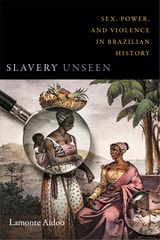
In Slavery Unseen, Lamonte Aidoo upends the narrative of Brazil as a racial democracy, showing how the myth of racial democracy elides the history of sexual violence, patriarchal terror, and exploitation of slaves. Drawing on sources ranging from inquisition trial documents to travel accounts and literature, Aidoo demonstrates how interracial and same-sex sexual violence operated as a key mechanism of the production and perpetuation of slavery as well as racial and gender inequality. The myth of racial democracy, Aidoo contends, does not stem from or reflect racial progress; rather, it is an antiblack apparatus that upholds and protects the heteronormative white patriarchy throughout Brazil's past and on into the present.
[more]
cover of Slavery's Slaughterhouse: Legacies of Animal Agriculture and Chattel Slavery

Slavery's Slaughterhouse

Legacies of Animal Agriculture and Chattel Slavery

Samantha Janaki Pergadia

Duke University Press, 2027
[more]
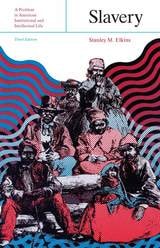
cover of Slavery: A Problem in American Institutional and Intellectual Life

Slavery

A Problem in American Institutional and Intellectual Life

Stanley M. Elkins

University of Chicago Press, 1987

This third edition of Stanley M. Elkin's classic study offers two new chapters by the author. The first, "Slavery and Ideology," considers the discussion and criticism occasioned by this controversial work. Elkins amplifies his original purpose in writing the book and takes into consideration the substantial body of critical commentary. He also attempts a prediction on the course of future research and discussion.
[more]
cover of So Unimaginable a Price: Baldwin and the Black Atlantic

So Unimaginable a Price

Baldwin and the Black Atlantic

John E. Drabinski

Northwestern University Press, 2026

Rereading Baldwin’s nonfiction in the context of midcentury Black Atlantic thought
 
James Baldwin’s nonfiction offers some of the most important and challenging thinking on the experience of race, history, and memory in the Black Atlantic world. Yet much of the scholarly literature on Baldwin’s writing reads his work from inside the sociocultural context of the United States, alongside key interlocutors like Richard Wright, Ralph Ellison, and Lorraine Hansberry. So Unimaginable a Price: Baldwin and the Black Atlantic shifts the critical frame, examining Baldwin’s work as part of a midcentury moment across the wider Atlantic world and tying his reflections to those of thinkers in the Caribbean and Africa to underscore the widening sense, as well as the particularity, of his critical claims. Who is Baldwin to the Atlantic world? And who, then, is Baldwin to the United States? John E. Drabinski recasts Baldwin as a Black Atlantic writer whose unique qualities as a thinker are enhanced by their similarities and differences with fellow writers of liberation in the global Black world.

[more]
cover of Soundscapes of Liberation: African American Music in Postwar France

Soundscapes of Liberation

African American Music in Postwar France

Celeste Day Moore

Duke University Press, 2021
In Soundscapes of Liberation, Celeste Day Moore traces the popularization of African American music in postwar France, where it signaled new forms of power and protest. Moore surveys a wide range of musical genres, soundscapes, and media: the US military's wartime records and radio programs; the French record industry's catalogs of blues, jazz, and R&B recordings; the translations of jazz memoirs; a provincial choir specializing in spirituals; and US State Department-produced radio programs that broadcast jazz and gospel across the French empire. In each of these contexts, individual intermediaries such as educators, producers, writers, and radio deejays imbued African American music with new meaning, value, and political power. Their work resonated among diverse Francophone audiences and transformed the lives and labor of many African American musicians, who found financial and personal success as well as discrimination in France. By showing how the popularity of African American music was intertwined with contemporary structures of racism and imperialism, Moore demonstrates this music's centrality to postwar France and the convergence of decolonization, the expanding globalized economy, the Cold War, and worldwide liberation movements.
[more]
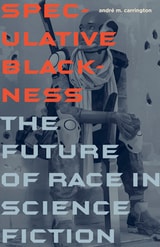
cover of Speculative Blackness: The Future of Race in Science Fiction

Speculative Blackness

The Future of Race in Science Fiction

André M. Carrington

University of Minnesota Press, 2016

In Speculative Blackness, André M. Carrington analyzes the highly racialized genre of speculative fiction—including science fiction, fantasy, and utopian works, along with their fan cultures—to illustrate the relationship between genre conventions in media and the meanings ascribed to blackness in the popular imagination.

Carrington’s argument about authorship, fandom, and race in a genre that has been both marginalized and celebrated offers a black perspective on iconic works of science fiction. He examines the career of actor Nichelle Nichols, who portrayed the character Uhura in the original Star Trek television series and later became a recruiter for NASA, and the spin-off series Star Trek: Deep Space Nine, set on a space station commanded by a black captain. He recovers a pivotal but overlooked moment in 1950s science fiction fandom in which readers and writers of fanzines confronted issues of race by dealing with a fictitious black fan writer and questioning the relevance of race to his ostensible contributions to the 'zines. Carrington mines the productions of Marvel comics and the black-owned comics publisher Milestone Media, particularly the representations of black sexuality in its flagship title, Icon. He also interrogates online fan fiction about black British women in Buffy the Vampire Slayer and the Harry Potter series.

Throughout this nuanced analysis, Carrington theorizes the relationship between race and genre in cultural production, revealing new understandings of the significance of blackness in twentieth-century American literature and culture.

[more]
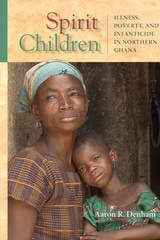
cover of Spirit Children: Illness, Poverty, and Infanticide in Northern Ghana

Spirit Children

Illness, Poverty, and Infanticide in Northern Ghana

Aaron R. Denham

University of Wisconsin Press, 2019

In parts of West Africa, some babies and toddlers are considered spirit children—nonhumans sent from the forest to cause misfortune and destroy the family. These are usually deformed or ailing infants, the very young whose births coincide with tragic events, or children who display unusual abilities. In some of these cases, families seek a solution in infanticide. Many others do not.

Refusing to generalize or oversimplify, Aaron R. Denham offers an ethnographic study of the spirit child phenomenon in Northern Ghana that considers medical, economic, religious, and political realities. He examines both the motivations of the families and the structural factors that lead to infanticide, framing these within the context of global public health. At the same time, he turns the lens on Western societies and the misunderstandings that prevail in discourse about this controversial practice. Engaging the complexity of the context, local meanings, and moral worlds of those confronting a spirit child, Denham offers visceral accounts of families' life and death decisions.
[more]
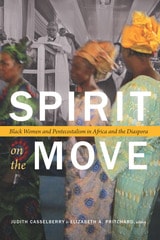
cover of Spirit on the Move: Black Women and Pentecostalism in Africa and the Diaspora

Spirit on the Move

Black Women and Pentecostalism in Africa and the Diaspora

Judith Casselberry and Elizabeth Pritchard, editors

Duke University Press, 2019

Pentecostalism is currently the fastest-growing Christian movement, with hundreds of millions of followers. This growth overwhelmingly takes place outside of the West, and women make up 75 percent of the membership. The contributors to Spirit on the Move examine Pentecostalism's appeal to black women worldwide and the ways it provides them with a source of community and access to power. Exploring a range of topics, from Neo-Pentecostal churches in Ghana that help women challenge gender norms to evangelical gospel musicians in Brazil, the contributors show how Pentecostalism helps black women draw attention to and seek remediation from the violence and injustices brought on by civil war, capitalist exploitation, racism, and the failures of the state. In fleshing out the experiences, theologies, and innovations of black women Pentecostals, the contributors show how Pentecostal belief and its various practices reflect the movement's complexity, reach, and adaptability to specific cultural and political formations.

Contributors. Paula Aymer, John Burdick, Judith Casselberry, Deidre Helen Crumbley, Elizabeth McAlister, Laura Premack, Elizabeth A. Pritchard, Jane Soothill, Linda van de Kamp
[more]
cover of Spiritual Citizenship: Transnational Pathways from Black Power to Ifá in Trinidad

Spiritual Citizenship

Transnational Pathways from Black Power to Ifá in Trinidad

N. Fadeke Castor

Duke University Press, 2017
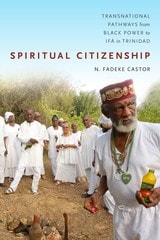
In Spiritual Citizenship N. Fadeke Castor employs the titular concept to illuminate how Ifá/Orisha practices informed by Yoruba cosmology shape local, national, and transnational belonging in African diasporic communities in Trinidad and beyond. Drawing on almost two decades of fieldwork in Trinidad, Castor outlines how the political activism and social upheaval of the 1970s set the stage for African diasporic religions to enter mainstream Trinidadian society. She establishes how the postcolonial performance of Ifá/Orisha practices in Trinidad fosters a sense of belonging that invigorates its practitioners to work toward freedom, equality, and social justice. Demonstrating how spirituality is inextricable from the political project of black liberation, Castor illustrates the ways in which Ifá/Orisha beliefs and practices offer Trinidadians the means to strengthen belonging throughout the diaspora, access past generations, heal historical wounds, and envision a decolonial future.
[more]
cover of Stepping Forward: Black Women in Africa and the Americas

Stepping Forward

Black Women in Africa and the Americas

Catherine Higgs

Ohio University Press, 2002

A unique and important study, Stepping Forward examines the experiences of nineteenth- and twentieth-century black women in Africa and African diaspora communities from a variety of perspectives in a number of different settings.

This wide-ranging collection designed for classroom use explores the broad themes that have shaped black women’s goals, options, and responses: religion, education, political activism, migration, and cultural transformation. Essays by leading scholars in the field examine the lives of black women in the United States and the Caribbean Basin; in the white settler societies of Kenya, Zimbabwe, and South Africa; and in the black settler societies of Liberia and Sierra Leone.

Among the contributors to this volume are historians, political scientists, and scholars of literature, music, and law. What emerges from their work is an image of black women’s agency, self-reliance, and resiliency. Despite cultural differences and geographical variations, black women have provided foundations on which black communities have not only survived, but also thrived. Stepping Forward is a valuable addition to our understanding of women’s roles in these diverse communities.

[more]
cover of Stolen Life

Stolen Life

Fred Moten

Duke University Press, 2018

"Taken as a trilogy, consent not to be a single being is a monumental accomplishment: a brilliant theoretical intervention that might be best described as a powerful case for blackness as a category of analysis."—Brent Hayes Edwards, author of Epistrophies: Jazz and the Literary Imagination

In Stolen Life—the second volume in his landmark trilogy consent not to be a single being—Fred Moten undertakes an expansive exploration of blackness as it relates to black life and the collective refusal of social death. The essays resist categorization, moving from Moten's opening meditation on Kant, Olaudah Equiano, and the conditions of black thought through discussions of academic freedom, writing and pedagogy, non-neurotypicality, and uncritical notions of freedom. Moten also models black study as a form of social life through an engagement with Fanon, Hartman, and Spillers and plumbs the distinction between blackness and black people in readings of Du Bois and Nahum Chandler. The force and creativity of Moten's criticism resonate throughout, reminding us not only of his importance as a thinker, but of the continued necessity of interrogating blackness as a form of sociality.
[more]
cover of Strolling in the Ruins: The Caribbean's Non-sovereign Modern in the Early Twentieth Century

Strolling in the Ruins

The Caribbean's Non-sovereign Modern in the Early Twentieth Century

Faith Smith

Duke University Press, 2023

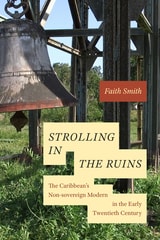
In Strolling in the Ruins Faith Smith engages with a period in the history of the Anglophone Caribbean often overlooked as nondescript, quiet, and embarrassingly pro-imperial within the larger narrative of Jamaican and Trinidadian nationalism. Between the 1865 Morant Bay Rebellion and World War I, British imperialism was taken for granted among both elites and ordinary people, while nationalist discourses would not begin to shape political imagination in the West Indies for decades. Smith argues that this moment, far from being uneventful, disrupts the inevitability of nationhood in the mid-twentieth century and anticipates the Caribbean’s present-day relationship to global power. Smith assembles and analyzes a diverse set of texts, from Carnival songs, poems, and novels to newspapers, photographs, and gardens, to examine theoretical and literary-historiographic questions concerning time and temporality, empire and diaspora, immigration and indigeneity, gender and the politics of desire, Africa’s place within Caribbeanist discourse, and the idea of the Caribbean itself. Closely examining these cultural expressions of apparent quiescence, Smith locates the quiet violence of colonial rule and the insistence of colonial subjects on making meaningful lives.
[more]
cover of Structural Intimacies: Sexual Stories in the Black AIDS Epidemic

Structural Intimacies

Sexual Stories in the Black AIDS Epidemic

Mackenzie, Sonja

Rutgers University Press, 2013

One of the most relevant social problems in contemporary American life is the continuing HIV epidemic in the Black population. With vivid ethnographic detail, this book brings together scholarship on the structural dimensions of the AIDS epidemic and the social construction of sexuality to assert that shifting forms of sexual stories—structural intimacies—are emerging, produced by the meeting of intimate lives and social structural patterns. These stories render such inequalities as racism, poverty, gender power disparities, sexual stigma, and discrimination as central not just to the dramatic, disproportionate spread of HIV in Black communities in the United States, but to the formation of Black sexualities.

Sonja Mackenzie elegantly argues that structural vulnerability is felt—quite literally—in the blood, in the possibilities and constraints on sexual lives, and in the rhetorics of their telling. The circulation of structural intimacies in daily life and in the political domain reflects possibilities for seeking what Mackenzie calls intimate justice at the nexus of cultural, economic, political, and moral spheres. Structural Intimacies presents a compelling case: in an era of deepening medicalization of HIV/AIDS, public health must move beyond individual-level interventions to community-level health equity frames and policy changes
[more]
cover of Structured Luck: Downstream Effects of the U.S. Diversity Visa Program

Structured Luck

Downstream Effects of the U.S. Diversity Visa Program

Onoso Imoagene

Russell Sage Foundation, 2024

The Diversity Immigrant Visa Program is a lottery that awards winners from underrepresented countries the chance to apply for legal permanent residence in the United States. Most lottery winners think of themselves as lucky, viewing the win as an opportunity to pursue better lives for themselves and their families. In Structured Luck, sociologist Onoso Imoagene uses immigrants’ stories to show that while the visa program benefits many recipients, the program’s design can also lead to exploitation in their countries of origin and reduced potential once they are in the United States.

Combining ethnographic observation in Africa and interviews with immigrants, their family members, and friends from Ghana and Nigeria, Imoagene demonstrates that the visa program is a process of “structured luck,” from how people hear about the lottery, who registers for it, and who participates in it to the application requirements for the visa. In Ghana and Nigeria, people often learn about the lottery through friends, colleagues, or relatives who persuade them to enter for the perceived benefits of receiving a visa: opportunities for upward mobility, permanent legal status, and the ability to bring along family members. Though anyone can enter the lottery, not everyone who wins obtains a visa. The visa application process requires proof of a high school diploma or artisan skills, a medical exam, a criminal background check, an interview with U.S. consular officers, and payment of fees.  Such requirements have led to the growth of visa entrepreneurs, who often charge exorbitant fees to steer immigrants through the process. Visa recipients who were on track to obtain university degrees at home often leave in the middle of their studies for the United States but struggle to continue their education due to high U.S. tuition costs. And though their legal status allows them to escape the demoralizing situations that face the undocumented, these immigrants lack the social support that the government sometimes provides for refugees and other migrants. Ultimately, Imoagene notes, the real winner of the visa lottery is not the immigrants themselves but the United States, which benefits from their relatively higher levels of education. Consequently, she argues, the U.S. must do more to minimize the visa program’s negative consequences.

Structured Luck illuminates the trauma, resilience, and determination of immigrants who come to the United States through the Diversity Visa Program and calls for the United States to develop policies that will better integrate them into society.
 
[more]
cover of Subversive Habits: Black Catholic Nuns in the Long African American Freedom Struggle

Subversive Habits

Black Catholic Nuns in the Long African American Freedom Struggle

Shannen Dee Williams

Duke University Press, 2022
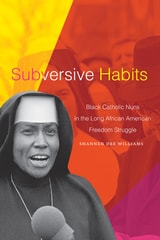
In Subversive Habits, Shannen Dee Williams provides the first full history of Black Catholic nuns in the United States, hailing them as the forgotten prophets of Catholicism and democracy. Drawing on oral histories and previously sealed Church records, Williams demonstrates how master narratives of women’s religious life and Catholic commitments to racial and gender justice fundamentally change when the lives and experiences of African American nuns are taken seriously. For Black Catholic women and girls, embracing the celibate religious state constituted a radical act of resistance to white supremacy and the sexual terrorism built into chattel slavery and segregation. Williams shows how Black sisters—such as Sister Mary Antona Ebo, who was the only Black member of the inaugural delegation of Catholic sisters to travel to Selma, Alabama, and join the Black voting rights marches of 1965—were pioneering religious leaders, educators, healthcare professionals, desegregation foot soldiers, Black Power activists, and womanist theologians. In the process, Williams calls attention to Catholic women’s religious life as a stronghold of white supremacy and racial segregation—and thus an important battleground in the long African American freedom struggle.
[more]
cover of Surviving the Americas: Garifuna Persistence from Nicaragua to New York City

Surviving the Americas

Garifuna Persistence from Nicaragua to New York City

Serena Cosgrove, José Idiáquez, Leonard Joseph Bent, and Andrew Gorvetzian

University of Minnesota Press, 2020

The Garifuna are a Central American, Afro-Indigenous people descended from shipwrecked West Africans and local Indigenous groups on the Caribbean island of St. Vincent. For over two centuries, the Garifuna have experienced oppression, exile, and continued diaspora that has stretched their communities to Honduras, Belize, and beyond. However, little has been written about the experiences of the Garifuna in Nicaragua, a community of about 5,000 who live primarily on the Caribbean coast of the country.

In Surviving the Americas, Serena Cosgrove, José Idiáquez, Leonard Joseph Bent, and Andrew Gorvetzian shed light on what it means to be Garifuna today, particularly in Nicaragua. Their research includes over nine months of fieldwork in Garifuna communities in the Pearl Lagoon on the southern Caribbean coast of Nicaragua and in New York City. The resulting ethnography illustrates the unique social issues of the Nicaraguan Garifuna and how their culture, traditions, and reverence for their ancestors continues to persist.
[more]
cover of Suspicion: Vaccines, Hesitancy, and the Affective Politics of Protection in Barbados

Suspicion

Vaccines, Hesitancy, and the Affective Politics of Protection in Barbados

Nicole Charles

Duke University Press, 2021

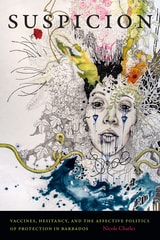
In 2014 Barbados introduced a vaccine to prevent certain strains of the human papillomavirus (HPV) and reduce the risk of cervical cancer in young women. Despite the disproportionate burden of cervical cancer in the Caribbean, many Afro-Barbadians chose not to immunize their daughters. In Suspicion, Nicole Charles reframes Afro-Barbadian vaccine refusal from a question of hesitancy to one of suspicion. Drawing on ethnographic fieldwork, black feminist theory, transnational feminist studies and science and technology studies, Charles foregrounds Afro-Barbadians' gut feelings and emotions and the lingering trauma of colonial and biopolitical violence. She shows that suspicion, far from being irrational, is a fraught and generative affective orientation grounded in concrete histories of mistrust of government and coercive medical practices foisted on colonized peoples. By contextualizing suspicion within these longer cultural and political histories, Charles troubles traditional narratives of vaccine hesitancy while offering new entry points into discussions on racialized biopolitics, neocolonialism, care, affect, and biomedicine across the Black diaspora.

Duke University Press Scholars of Color First Book Award recipient
[more]