Results by title
79 books match the query 'Blood' and 3 start with s
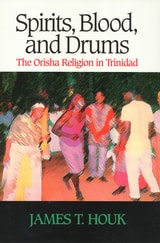
Spirits, Blood and Drums
The Orisha Religion in TrinidadJames T. Houk
Temple University Press, 1995
James Houk's field work in Trinidad and subsequent involvement in the Orisha religion allows him a uniquely intimate perspective on a complex and eclectic religion. Originating in Nigeria, Orisha combines elements of African religions (notably Yoruba), Catholicism, Hinduism, Protestantism Spiritual Baptist, and Kabbalah. A religion of spirits and spirit possession, ceremonies and feasts, churches and shrines, sacrifices and sacred objects, Orisha is constantly shifting and unstable, its practice widely varied. As a belief system, it is a powerful presence in the social structure, culture, and, more recently, the political realm of Trinidad.
Houk carefully examines the historical forces that have transformed Orisha from a relatively simple religion in colonial Trinidad to an abstruse mix of belief, ritual, and symbolism. The voices of worshippers and Orisha leaders spring to life the intensity and power of the religion. Houk's own recounting of participation in many of the mystical ceremonies, including taking on the important role of drummer in several feasts, his initiation into Orisha, and his exceptional field research provide fascinating details essential in understanding the development of this Caribbean religion.

Stained with Blood and Tears
Lynchings, Murder, and Mob Violence in Cairo, Illinois, 1909-1910John A. Beadles
Southern Illinois University Press, 2019
Sweetness in the Blood
Race, Risk, and Type 2 DiabetesJames Doucet-Battle
University of Minnesota Press, 2021
A bold new indictment of the racialization of science
Decades of data cannot be ignored: African American adults are far more likely to develop Type 2 diabetes than white adults. But has science gone so far in racializing diabetes as to undermine the search for solutions? In a rousing indictment of the idea that notions of biological race should drive scientific inquiry, Sweetness in the Blood provides an ethnographic picture of biotechnology’s framings of Type 2 diabetes risk and race and, importantly, offers a critical examination of the assumptions behind the recruitment of African American and African-descent populations for Type 2 diabetes research.
James Doucet-Battle begins with a historical overview of how diabetes has been researched and framed racially over the past century, chronicling one company’s efforts to recruit African Americans to test their new diabetes risk-score algorithm with the aim of increasing the clinical and market value of the firm’s technology. He considers African American reticence about participation in biomedical research and examines race and health disparities in light of advances in genomic sequencing technology. Doucet-Battle concludes by emphasizing that genomic research into sub-Saharan ancestry in fact underlines the importance of analyzing gender before attempting to understand the notion of race. No disease reveals this more than Type 2 diabetes.
Sweetness in the Blood challenges the notion that the best approach to understanding, managing, and curing Type 2 diabetes is through the lens of race. It also transforms how we think about sugar, filling a neglected gap between the sugar- and molasses-sweetened past of the enslaved African laborer and the high-fructose corn syrup- and corporate-fed body of the contemporary consumer-laborer.