Results by title
71 books match the query 'Cancer' and 5 start with s

Scientific Characters
Rhetoric, Politics, and Trust in Breast Cancer ResearchLisa Keränen
University of Alabama Press, 2010
Scientific Characters chronicles the contests over character, knowledge, trust, and truth in a politically charged scientific controversy that erupted after a 1994 Chicago Tribune headline: “Fraud in Breast Cancer Research: Doctor Lied on Data for Decade.” In the aftermath of this dramatic news, Dr. Bernard Fisher, the eminent oncologist and celebrated pioneer of breast cancer research, came under intense scrutiny following allegations that one of his investigators falsified data in landmark breast cancer research. Although he was eventually cleared of all wrongdoing, the controversy called into question the treatment decisions of tens of thousands of women, because Fisher’s research had demonstrated that lumpectomy and radiation were as effective as breast removal for early stage cancers—a finding that was hailed as revolutionary in women’s health care.
Moving back and forth between news coverage, medical journals, letters to the editor, and oncology pamphlets, Lisa Keränen draws insights from rhetoric, literary studies, sociology, and science studies to analyze the roles of character in shaping the outcomes of the “Datagate” controversy. Throughout the scandal, debates about the character of Fisher and other key players endured, showing how scientific knowledge is shaped by perceptions of the personal temperament, trustworthiness, integrity, and transparency of those who produce it. As administrators, politicians, scientists, patients, journalists, and citizens attempted to make sense of what had happened, and to assess the integrity of the research, they raised questions, assigned blame, attributed responsibility, and reshaped the norms of scientific practice. Scientific Characters thusaddresses what happens when scientists, patients, and advocates are called to defend themselves in public concerning complex technical matters with direct implications for human life. In assessing the rhetoric that animated Datagate, Scientific Characters sheds light on the challenges faced by scientists and citizens as science becomes more bureaucratized, dispersed, and accountable to varied publics.
[more]
Sexualizing Cancer
HPV and the Politics of Cancer PreventionLaura Mamo
University of Chicago Press, 2023
The virus that changed how we think about cancer and its culprits—and the vaccine that changed how we talk about sex and its risks.
Starting in 2005, people in the US and Europe were inundated with media coverage announcing the link between cervical cancer and the sexually transmitted virus HPV. Within a year, product ads promoted a vaccine targeting cancer’s viral cause, and girls and women became early consumers of this new cancer vaccine. An understanding of HPV’s broadening association with other cancers led to the identification of new at-risk populations—namely boys and men—and ignited a plethora of gender and sexual issues related to cancer prevention.
Sexualizing Cancer is the first book dedicated to the emergence and proliferation of the HPV vaccine along with the medical capacity to screen for HPV—crucial landmarks in the cancer prevention arsenal based on a novel connection between sex and chronic disease. Interweaving accounts from the realms of biomedical science, public health, and social justice, Laura Mamo chronicles cervical cancer’s journey out of exam rooms and into public discourse. She shows how the late twentieth-century scientific breakthrough that identified the human papilloma virus as having a causative role in the onset of human cancer galvanized sexual politics, struggles for inclusion, new at-risk populations, and, ultimately, a new regime of cancer prevention. Mamo reveals how gender and other equity arguments from within scientific, medical, and advocate communities shaped vaccine guidelines, clinical trial funding, research practices, and clinical programs, with consequences that reverberate today. This is a must-read history of medical expansion—from a “woman’s disease” to a set of cancers that affect all genders—and of lingering sexualization, with specific gendered, racialized, and other contours along the way.
[more]

Small Altars
Justin Gardiner
Tupelo Press, 2024
A book that bends time and fragments narrative.
In Small Altars, Justin Gardiner delves into the world of comic books and superheroes as a means for coming to terms with the many struggles of his brother’s life, as well as his untimely death, offering a lyric and honest portrayal of the tolls of mental illness, the redemptive powers of art and familial love, and the complex workings of grief.
In Small Altars, Justin Gardiner delves into the world of comic books and superheroes as a means for coming to terms with the many struggles of his brother’s life, as well as his untimely death, offering a lyric and honest portrayal of the tolls of mental illness, the redemptive powers of art and familial love, and the complex workings of grief.
[more]
Stories from the Sandbox
Reflections from children, teens and young adults living with Cancer and Blood DisordersJennifer Gretzema
Michigan Publishing Services, 2015
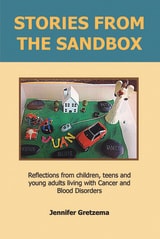
The images and stories in this book were created by patients and families living with Cancer and Blood Disorders. Their expressions, created in the sand and conveyed through the written word, provide insight into what it is like to live with health challenges. Sand tray therapy is a recognized therapeutic modality used with children and adults, providing a sacred space to process experiences using symbols instead of language. Sometimes meaning is further revealed through talking about a sand tray. Other times, it can remain a private expression that holds significance only to its creator. It is a helpful way for youth to process their past and present medical experience, help them set goals, and to teach others about their needs. Sand tray is a window into the thoughts, feelings, and coping styles of youth struggling with illness and hospitalization. Importantly, as youth with chronic medical illnesses often experience pain and discomfort as part of their treatment, the ability to have positive tactile experiences can be a very healing process. This collection of photos and personal stories, facilitated by the Child and Family Life Department, C.S. Mott Children’s Hospital at the University of Michigan, was compiled so that other patients, their families, and their friends can share the authors’ journeys as we all continue to battle these difficult diseases.
[more]
Suspicion
Vaccines, Hesitancy, and the Affective Politics of Protection in BarbadosNicole Charles
Duke University Press, 2021
In 2014 Barbados introduced a vaccine to prevent certain strains of the human papillomavirus (HPV) and reduce the risk of cervical cancer in young women. Despite the disproportionate burden of cervical cancer in the Caribbean, many Afro-Barbadians chose not to immunize their daughters. In Suspicion, Nicole Charles reframes Afro-Barbadian vaccine refusal from a question of hesitancy to one of suspicion. Drawing on ethnographic fieldwork, black feminist theory, transnational feminist studies and science and technology studies, Charles foregrounds Afro-Barbadians' gut feelings and emotions and the lingering trauma of colonial and biopolitical violence. She shows that suspicion, far from being irrational, is a fraught and generative affective orientation grounded in concrete histories of mistrust of government and coercive medical practices foisted on colonized peoples. By contextualizing suspicion within these longer cultural and political histories, Charles troubles traditional narratives of vaccine hesitancy while offering new entry points into discussions on racialized biopolitics, neocolonialism, care, affect, and biomedicine across the Black diaspora.
Duke University Press Scholars of Color First Book Award recipient
Duke University Press Scholars of Color First Book Award recipient
[more]