475 books match the query 'Catholic' and 24 start with s
cover of Sacrifice As Gift

Sacrifice As Gift

Michon M. Matthiesen

Catholic University of America Press, 2012
Sacrifice as Gift is a timely presentation of a forgotten vision of eucharistic sacrifice, one that reconfigures the current philosophical and theological divide between sacrifice and gift.
[more]
cover of Saint Dominic and His Mission

Saint Dominic and His Mission

Augustin Laffay

Catholic University of America Press, 2025
Saint Dominic had dedicated himself to a life of prayer and study as a canon regular at the Cathedral of Osma, Spain in 1197. When on a diplomatic mission through southern France, Dominic and his bishop, Diego, encountered the Cathar heresy. The Spaniards were filled with compassion and sought to counter this heresy by preaching and the example of their holy life. In the ensuing years, and with ecclesiastical approval, Dominic would gather around him a group of men, living a common life in evangelical poverty and dedicated to preaching for the salvation of souls, these were the first members of the Order of Preachers, commonly known as Dominicans. In Saint Dominic and His Mission, two of Saint Dominic’s spiritual sons present a portrait of this Preacher of Grace using extensive research from the archives of the Order to present Dominic and his brethren in their historical context. The first section comprises two parts: a biographical sketch and an evaluation of hagiographic and historical accounts of the life of St. Dominic. It is said that St. Dominic’s gift to the Church is not extensive writings, but a way of life. The second section describes aspects of this distinctly evangelical form life including study and preaching, fraternal life, choral office and the rosary, democratic government, and living in the heart of the Church. In the third section, the authors enlist the help of art historians who present multiple pieces of artwork, ancient and modern, to better know and understand this Doctor of Truth. The final section is a chronology of the life of St. Dominic based on the work of the renowned English Dominic Simon Tugwell, OP. Readers will find that Saint Dominic, whose life and preaching was centered on the Word Incarnate, is a perfect friend and guide to us today as we experience a revival in reverence for the Eucharist and the Sacred Heart of Jesus.
[more]
cover of Saint Joseph and the Carmelite Reform of Saint Teresa of Avila: Father, Teacher of Prayer, Intercessor in Every Need

Saint Joseph and the Carmelite Reform of Saint Teresa of Avila

Father, Teacher of Prayer, Intercessor in Every Need

Joseph F. Chorpenning, OSFS

Catholic University of America Press, 2024
It is a commonplace in devotional literature, historical scholarship, and papal writings that Saint Teresa of Ávila played a key role in the development of veneration of Saint Joseph. Saint Joseph and the Carmelite Reform of Saint Teresa of Ávila unpacks this commonplace by recovering the often-overlooked back story to Teresa’s story, namely, the extraordinarily rich liturgical cult of Saint Joseph in the Ancient Order of Carmel which fully flowered in the Teresian Carmel and beyond, to the universal Church. This volume charts a narrative arc from the liturgical cult of Saint Joseph in the Carmelite Order of Ancient Observance; to Saint Joseph’s vital formative presence in Saint Teresa’s life and reformed Carmel as father, teacher of prayer, and intercessor in every need; to the Carmelite family as a whole giving liturgical expression to its privileged relationship with Saint Joseph by the establishment of the Feast of the Patronage of Saint Joseph; to this feast becoming widespread outside Carmel and ultimately extended to the Universal Church (1847); and, finally, to Saint Joseph’s proclamation as Patron of the Universal Church (1870). An epilogue considers the absence of Joseph’s title “Patron of the Universal Church” in the post-Vatican II liturgical calendar and books, while the papal magisterium has consistently insisted that this patronage is ever necessary for the Church as not only a protection against all dangers, but also an impetus for its mission of evangelization and re-evangelization. An appendix reprints the letter, “Saint Joseph, Patron of Carmel,” jointly issued by the Prior General of the Order of Carmelites of the Ancient Observance and the Superior General of the Order of Discalced Carmelites, to mark the 150th anniversary of the proclamation of Saint Joseph as Patron of the Universal Church.
[more]
cover of Saint Katharine: The Life of Katharine Drexel

Saint Katharine

The Life of Katharine Drexel

Cordelia Frances Biddle

Westholme Publishing, 2015

A Gilded-Age Woman Who Devoted Her Life and Fortune to the American Dispossessed, Established Her Own Religious Order, and Was Ultimately Canonized
When Katharine Drexel was born in 1858, her grandfather, financier Francis Martin Drexel, had a fortune so vast he was able to provide a loan of sixty million dollars to the Union’s cause during the Civil War. Her uncle and mentor, Anthony, established Drexel University to provide instruction to the working class regardless of race, religion, or gender. Her stepmother was Emma Bouvier whose brother, John, became the great-grandfather of Jacqueline Bouvier Kennedy Onassis. Katharine Drexel’s family were American royalty. As a Philadelphia socialite, “Kitty,” as she was often called, adored formal balls and teas, rowing regattas, and sailing races. She was beautiful, intelligent, and high-spirited. But when her stepmother died in 1883, and her father two years later, a sense of desolation nearly overwhelmed her. She was twenty-seven and in possession of a staggering inheritance. Approached for aid by the Catholic Indian Missions, she surprised her family by giving generously of money and time. It was during this period of acute self-examination that she journeyed to Rome for a private audience with Pope Leo XIII. With characteristic energy and fervor, she detailed the plight of the Native Americans, and begged for additional missionaries to serve them. His reply astonished her. “Why not, my child, yourself become a missionary?”
In Saint Katharine: The Life of Katharine Drexel, Cordelia Frances Biddle recounts the extraordinary story of a Gilded Age luminary who became a selfless worker for the welfare and rights of America’s poorest persons. After years of supporting efforts on behalf of African Americans and American Indians, Katharine finally decided to follow her inner voice and profess vows. The act made headlines. Like her father and grandfather, she was a shrewd businessperson; she retained her financial autonomy and established her own order, the Sisters of the Blessed Sacrament. Until her death in 1955, she devoted herself and her inheritance to building much-needed schools in the South and Southwest, despite threats from the Ku Klux Klan and others. Pragmatic, sometimes willful, ardent, and a charismatic leader, Katharine Drexel was an indefatigable champion of justice and parity. When illness incapacitated her in later years, divine radiance was said to emanate from her, a radiance that led to her canonization on October 1, 2000.
[more]
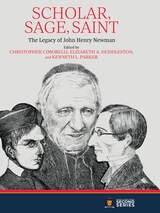
cover of Scholar, Sage, Saint: The Legacy of John Henry Newman

Scholar, Sage, Saint

The Legacy of John Henry Newman

Christopher Cimorelli

Catholic University of America Press, 2026
The canonisation of John Henry Newman in October 2019 has increased public and academic interest in him. A controversial figure during his own lifetime, John Henry Newman’s legacy remains contested by scholars. This conference will explore John Henry Newman as: ·A Scholar: Newman influenced the academic landscape during his lifetime through his time at Oriel, his academic foundations, and his published works. ·A Sage: Newman gained a reputation for providing reliable and wise advice early in his career, which remained even after his reception into the Roman Church in 1845. ·A Saint: Newman studied the lives of the saints and recommended them as exemplars of Christian behaviour. Newman’s work and life invites discussion on the relationship between sanctity and saintliness.
[more]
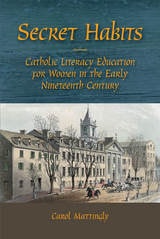
cover of Secret Habits: Catholic Literacy Education for Women in the Early Nineteenth Century

Secret Habits

Catholic Literacy Education for Women in the Early Nineteenth Century

Carol Mattingly

Southern Illinois University Press, 2016

Literacy historians have credited the Protestant mandate to read scripture, as well as Protestant schools, for advances in American literacy. This belief, however, has overshadowed other important efforts and led to an incomplete understanding of our literacy history. In Secret Habits: Catholic Literacy Education for Women in the Early Nineteenth Century, Carol Mattingly restores the work of Catholic nuns and sisters to its rightful place in literacy studies.

Mattingly shows that despite widespread fears and opposition, including attacks by vaunted northeastern Protestant pioneers of literacy, Catholic women nonetheless became important educators of women in many areas of America. They founded convents, convent academies, and schools; developed their own curricula and pedagogies; and persisted in their efforts in the face of significant prejudices. The convents faced sharp opposition from Protestant educators, who often played on anti-Catholic fears to gain support for their own schools. Using a performative rhetoric of good works that emphasized civic involvement, Catholic women were able to educate large numbers of women and expand opportunities for literacy instruction.

A needed corrective to studies that have focused solely on efforts by Protestant educators, Mattingly’s work offers new insights into early nineteenth-century women’s literacy, demonstrating that literacy education was more religiously and geographically diverse than previously recognized. 
[more]
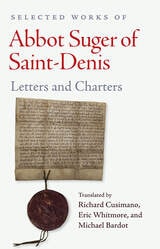
cover of Selected Works of Abbot Suger of Saint-Denis: Letters and Charters

Selected Works of Abbot Suger of Saint-Denis

Letters and Charters

Eric Abbot Suger of Saint-Denis

Catholic University of America Press, 2025
Abbot Suger of Saint-Denis was a pivotal figure in 12th-century France, leaving a lasting impact through his multifaceted foles. His dedication to his abbey of Saint-Denis, wise counsel to kings, mediation of church disputes, and involvement in the Crusades solidify his legacy. His letters and charters offer invaluable insights into the political, religious, and economic landscape of the era, particularly during the Capetian dynasty's formative years. Suger's letters, often addressed to powerful figures, reveal his adept political maneuvering. They document his efforts to consolidate royal authority, maintain peace, and defend the abbey's interests. These writings illuminate medieval diplomacy and the Church's influence on secular affairs. Suger served as a trusted advisor to Kings Louis VI and Louis VII, even acting as regent during the latter's absence on the Second Crusade. He skillfully resolved conflicts among ecclesiastical figures, bolstering royal authority and promoting church unity. Suger's charters meticulously detail the abbey's landholdings, privileges, and administrative practices, reflecting his commitment to restoring its wealth and prestige and protecting the abbey's lands from encroachment. These documents also provide crucial information about the economic and social conditions of 12th-century France, a pivotal period in the development of the French monarchy.
[more]
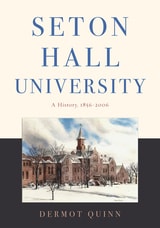
cover of Seton Hall University: A History, 1856–2006

Seton Hall University

A History, 1856–2006

Dermot Quinn

Rutgers University Press, 2023

Founded in 1856 by Bishop James Roosevelt Bayley of Newark, Seton Hall University has played a large part in New Jersey and American Catholic life for nearly two centuries. From its modest beginnings as a small college and seminary to its present position as a major national university, it has always sought to provide “a home for the mind, the heart, and the spirit.”
 
In this vivid and elegantly written history, Dermot Quinn examines how Seton Hall was able to develop as an institution while keeping faith with its founder’s vision. Looking at the men and women who made Seton Hall what it is today, he paints a compelling picture of a university that has enjoyed its share of triumphs but has also suffered tragedy and loss. He shows how it was established in an age of prejudice and transformed in the aftermath of war, while exploring how it negotiated between a distinctly Roman Catholic identity and a mission to include Americans of all faiths. 
 
Seton Hall University not only recounts the history of a great educational institution, it also shares the personal stories of the people who shaped it and were shaped by it: the presidents, the priests, the faculty, the staff, and of course, the students.
[more]
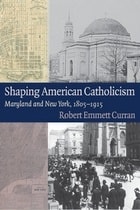
cover of Shaping American Catholicism: Maryland and New York, 1805-1915

Shaping American Catholicism

Maryland and New York, 1805-1915

Robert Emmett Curran

Catholic University of America Press, 2012
Distinguished historian Robert Emmett Curran presents an informed and balanced study of the American Catholic Church's experience in its two most important regions in the nineteenth and twentieth centuries
[more]
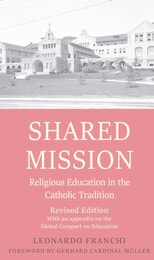
cover of Shared Mission: Religious Education in the Catholic Tradition, Revised Edition

Shared Mission

Religious Education in the Catholic Tradition, Revised Edition

Leonardo Franchi

Catholic University of America Press, 2023
This book is a contribution to scholarship in the field of religious education. Its aim is simple: to offer a critical perspective on the nature of religious education in the light of contemporary developments in Catholic thinking in catechesis and wider thinking in education. The issues raised in the book will provide ample material for fruitful dialogue and constructive debate in the world of Catholic education. Part One revolves around four historical contexts selected specifically to illuminate contemporary developments in the field. While these historical periods have porous boundaries, they offer a working structure in support of the core claims of the book. Part Two explores the complex genealogy of the relationship between catechesis and Religious Education. Key thematic frames of reference within which the relevant Magisterial documents and associated academic literature are set out and explored chronologically thus allowing for some cross-referencing across the themes: unsurprisingly the range of the issues for debate resists a neat packaging within specific time-frames but does provide a helpful working structure. Part Three proposes that a Spirituality of Communion should underpin the Church’s work in catechesis, education and Religious Education. Shared Mission seems to be a satisfactory articulation of the necessary dialogic relationship between both fields and offers a suitable space for both distinction and reciprocity. The revised edition contains an appendix on the Global Compact on Education.
[more]
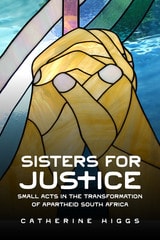
cover of Sisters for Justice: Small Acts in the Transformation of Apartheid South Africa

Sisters for Justice

Small Acts in the Transformation of Apartheid South Africa

Catherine Higgs

University of Wisconsin Press, 2025

Sisters for Justice explores the activism of a select number of Catholic religious sisters in South Africa, beginning in the 1960s. Catherine Higgs analyzes how these individuals’ seemingly small actions in a variety of spheres helped shift policy and contribute to the dismantling of the apartheid state. As she reveals, they helped provide basic medical services to displaced Africans, opened private convent schools to children of all races despite segregationist laws, advocated for African pension rights, served on justice and peace commissions, and joined protests—all while working within the context of a hierarchical male-led church initially hesitant to criticize a state openly hostile to Catholics.

Based on extensive oral history interviews with white and Black sisters as well as deep archival research, this groundbreaking book reveals a largely untold story, nested within the broader literature of women’s activism in South Africa. The result is a new perspective that expands and intensifies our understanding of a dramatic period during which individual actions, in the aggregate, contributed to social change.
[more]
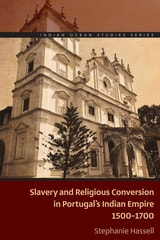
cover of Slavery and Religious Conversion in Portugal's Indian Empire, 1500-1700

Slavery and Religious Conversion in Portugal's Indian Empire, 1500-1700

Stephanie Hassell

Ohio University Press, 2025

In the sixteenth and seventeenth centuries, enslaved Africans and Asians were part of the larger Portuguese project of building and maintaining a Catholic empire in the Indian Ocean. Both the Church and the Crown influenced the owner-slave relationship across households, the most basic organizational unit of power over the populace. Responsible for their enslaved dependents’ conversion to Catholicism, slaveholders became religious stewards whose spiritual duties toward their slaves helped expand the Christian population. This converted population was part of the imperial security apparatus, which conceptualized enslaved Catholics as loyal allies against neighboring Muslim states. They became members of the broader colonial community in which Catholicism also conveyed rights, enabled agency, and provoked household struggles between owners and slaves. Thus, the making of a Catholic empire was a contested process tied to the complex relationships between enslaved individuals, their enslavers, and the Church. The Portuguese Inquisition was a hybrid ecclesiastical and state institution, and its records detail the Crown’s commitment to the creation of a worldwide Catholic empire. Accordingly, inquisitorial encounters brought conversion, slavery, and empire into one field of vision. The Portuguese Inquisition had only one overseas tribunal, located in Goa, India. While most trial records of the Goa Tribunal were destroyed, author Stephanie Hassell has utilized extant sixteenth- and seventeenth-century cases featuring enslaved defendants and witnesses. Her use of thousands of case summaries provides a broader inquisitorial context by showing how prosecutorial trends reflected the anxieties of the Portuguese imperial state. Parish records, ecclesiastical council records, and municipal council records likewise emphasize the significance of religious conversion.
[more]
cover of Slavery and the Catholic Church in the United States: Historical Studies

Slavery and the Catholic Church in the United States

Historical Studies

David J. Endres

Catholic University of America Press, 2023
The intertwining of U.S. Catholicism and race-based slavery is a painful aspect of the Church’s history. Many scholars have shied away from this uncomfortable topic, but in recent years a cadre of historians have studied Catholics’ varied roles: as enslaved persons, slaveholders, defenders of slavery, and, in a few cases, advocates of abolition and emancipation. This collection of nine essays is divided into three sections: enslaved persons and slaveholders, debating abolition and emancipation, and historians and historiography. The studies, many of which are informed by recent archival discoveries, offer a model for historians seeking to understand the relationship between slavery and the Church, not only topically but in terms of methods, contexts, and resources. They contribute to a broader appreciation of religion’s role in race-based slavery and, in doing so, will assist scholars, teachers, and students in the contemporary discussion involving slavery, racism, and their legacies. Slavery and the Catholic Church in the United States witnesses to the fragility of humanity, which is capable of freedom or slavery, brotherhood or hatred. Yet each chapter offers a ray of hope, suggesting how we might acknowledge and respond to this difficult history.
[more]
cover of Social Justice and Subsidiarity: Luigi Taparelli and the Origins of Modern Catholic Social Thought

Social Justice and Subsidiarity

Luigi Taparelli and the Origins of Modern Catholic Social Thought

Thomas C. Behr

Catholic University of America Press, 2020
Luigi Taparelli, SJ, 1793-1862, in his Theoretical Treatise of Natural Right Based on Fact, 1840-43, presents a neo-Thomistic approach to social, economic, and political sciences grounded in an integral conception of the human person as social animal but also as rational truth seeker. His conceptions of social justice and of subsidiarity are fundamental to modern Catholic social teaching (CST). His work moves away from traditionalist-conservative reaction in favor of an authentically human, moderately liberal, modernity built on the harmony of faith and reason. He zealously deconstructs laissez-faire liberal ideology and its socialist progeny in scores of articles in the Civiltà Cattolica, the journal that he co-founded in 1850. His arguments figure prominently in the Syllabus of Errors (1864) of Pius IX. Though a moderate liberal himself, his reputation as anti-liberal reactionary and defender of Papal temporal sovereignty is the chief reason why Pope Leo XIII later sought to quiet Taparelli’s contribution to the foundations and pillars of modern CST that began with the restoration of Thomistic philosophy in Aeterni Patris (1879), and the “magna carta” of modern Catholic social teaching, Rerum Novarum (1891). Pius XI relies heavily on Taparelli’s concept of subsidiarity in Quadragesimo Anno (1931), and sought to advance interest in Taparelli studies. However, Taparelli’s eclectic philosophical orientation and writing style have been a considerable stumbling block. In this present book, Taparelli’s ideas are evaluated both for their philosophical character but also in their historical context. Taparelli’s theories of the just society and ordered liberty, are as timely nowadays for reasoned political and ethical discourse as ever. The book includes an appendix of translated portions of the Theoretical Treatise of Natural Right Based on Fact that relate to subsidiarity.
[more]
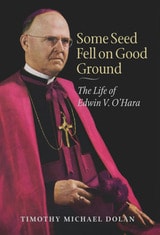
cover of Some Seed Fell on Good Ground: The Life of Edwin V. O'Hara

Some Seed Fell on Good Ground

The Life of Edwin V. O'Hara

Timothy Michael Dolan

Catholic University of America Press, 2012
A man far ahead of his time, Archbishop Edwin V. O'Hara of Kansas City (1881-1956) orchestrated numerous initiatives that profoundly affected American Catholic life.
[more]
cover of Songs for the Fast and Pascha

Songs for the Fast and Pascha

Blake St. Ephrem the Syrian

Catholic University of America Press, 2022
Among the writers of the Syriac Christian tradition, none is as renowned as St. Ephrem of Nisibis (ca. 307–373), known to much of the later Christian world simply as “the Syrian.” The great majority of Ephrem’s works are poetry, with the madrāšē (“teaching songs”) especially prominent. This volume presents English translations of four complete madrāšē cycles of Ephrem: On the Fast, On the Unleavened Bread, On the Crucifixion, and On the Resurrection. These collections include some of the most liturgically oriented songs in Ephrem’s corpus, and, as such, provide a window into the celebration of Lent and Easter in the Syriac-speaking churches of northern Mesopotamia in the fourth century. Even more significantly, they represent some of the oldest surviving poetry composed for these liturgical seasons in the entire Christian tradition. Not only are the liturgical occasions of the springtime months a source of colorful imagery in these texts, but Ephrem also employs traditional motifs of warm weather, spring rainstorms, and revived vegetation, which likely reflect Hellenistic literary influences. Like all of Ephrem’s poetry, these songs express early Christian theology in language that is symbolic, terse, and vibrant. They are rich with biblical allusions and references, especially to the Exodus and Passion narratives. They also reveal a contested religious environment in which Ephrem strove to promote the Christian Pascha and Christian interpretations of Scripture over and against those of Jewish communities in the region, thus maintaining firm boundaries around the identity and practices of the churches.
[more]
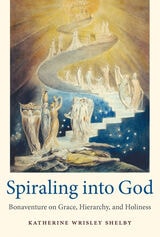
cover of Spiraling Into God: Bonaventure on Grace, Hierarchy , and Holiness

Spiraling Into God

Bonaventure on Grace, Hierarchy , and Holiness

Katherine Wrisley Shelby

Catholic University of America Press, 2023
Spiraling into God: Bonaventure on Grace, Hierarchy, and Holiness offers a systematic account of the Seraphic Doctor’s doctrine of grace across his speculative-academic, mystical, hagiographical, and pastoral texts. It does so by arguing that an account of this kind can only be provided by also attending to his theology of hierarchy, a methodology derived from Bonaventure’s claim in the Major Legend of St. Francis that Francis of Assisi was a “vir hierarchicus,” or hierarchical man. As the book explores in great depth, this appellation relies upon Bonaventure’s reading of a Victorine Dionysian interpreter by the name of Thomas Gallus, whose “angelic anthropology”—or notion of the hierarchical soul—becomes a crucial component within the Seraphic Doctor’s teaching on grace as he interprets the sanctity of St. Francis. Throughout the course of his career, Bonvaenture will define sanctifying grace as a created “inflowing” (influentia) that “hierarchizes” human beings by purifying, illuminating, and perfecting them from within, thus causing them to become a similitude of the Trinity. This book explains what this means and why it matters. Most existing scholarship on this subject in Bonaventure’s thought interprets it as a subtopic with respect to other themes—for example, with respect to his Christology or his Trinitarian theology—rather than taking the time to understand his doctrine of grace in its own right. Alternatively, scholarly treatments of his doctrine of grace will treat it at length, but will only examine the topic as it appears in his more speculative-academic texts—most especially his Commentary on the Sentences or his famous Itinerarium Mentis in Deum—without bringing these into conversation with his pastoral works, sermon literature, or hagiographical texts. This book provides the first unified treatment of Bonaventure’s doctrine of grace across all these different genres of his known corpus, and in so doing, fills a massive lacuna in both Bonaventurean scholarship and in the field of medieval historical theology.
[more]
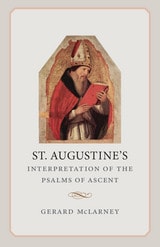
cover of St. Augustine's Interpretaion of the Psalms of Ascent

St. Augustine's Interpretaion of the Psalms of Ascent

Gerard McLarney

Catholic University of America Press, 2014
Recent research has explored how past interpretation can help contextualize current interpretation as well as provide a more colorful and theologically meaningful understanding of scripture. In St. Augustine's Interpretation of the Psalms of Ascent, Gerald McLarney examines Augustine of Hippo's (d. 430) interpretation of the ascent motif in sermons on Psalms 119-133. He looks at the delivery, transmission, and broader context of the sermons, as well as examining the sermons as they stand.
[more]
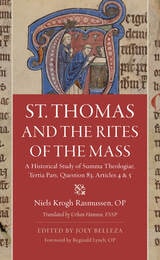
cover of St. Thomas and the Rites of Man: A Historical Study of the Summa Theologiae, Tertia Pars, Question 83, Articles 4 & 5

St. Thomas and the Rites of Man

A Historical Study of the Summa Theologiae, Tertia Pars, Question 83, Articles 4 & 5

Niels Krogh Rasmussen

Catholic University of America Press, 2026
Long buried in the archives of the Dominican studium at Le Saulchoir, the lectorate dissertation of Fr. Niels Krogh Rasmussen, OP, is now made available to a wider English-speaking audience interested in Saint Thomas Aquinas’s contribution to liturgical theology. Originally written in 1966, just after the Second Vatican Council, Rasmussen’s work is a witness to the intense liturgical ferment of those years and expresses an early attempt to appropriate the then-new postconciliar mode of liturgical reflection, bolstered by attentive historical-critical work, in the spirit of Saint Thomas. Treating the saint’s reflection on the Mass rites in the Summa Theologiae, Rasmussen shows how Aquinas, while writing in the disputed question format, nevertheless presents his readers with an expositio Missae, placing him within the tradition of great medieval Mass expositors, from Amalarius of Metz and Florus of Lyon in the ninth century, Saint Albert the Great and Durandus of Mende in the thirteenth century. By isolating this distinctly liturgical content (without, however, completely eschewing its original quaestio format), Rasmussen is able to highlight the distinctiveness of Thomas’s liturgical thought against that of his predecessors and contemporaries. Even if certain insights or expressions of Rasmussen’s may sound dated to the contemporary reader—since this work was composed in that interim period between Inter Oecumenici (1964) and the promulgation of the Missal of Paul VI (1969)—such insights in fact add to the historical value of this dissertation, offering a snapshot of a time when the reform of the liturgy was very much a living process with a terminus yet to be determined. 60 years later, students of Thomism, liturgical theology, and medieval studies can continue to benefit from this work.
[more]
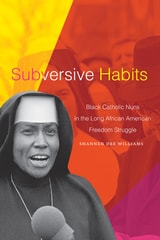
cover of Subversive Habits: Black Catholic Nuns in the Long African American Freedom Struggle

Subversive Habits

Black Catholic Nuns in the Long African American Freedom Struggle

Shannen Dee Williams

Duke University Press, 2022
In Subversive Habits, Shannen Dee Williams provides the first full history of Black Catholic nuns in the United States, hailing them as the forgotten prophets of Catholicism and democracy. Drawing on oral histories and previously sealed Church records, Williams demonstrates how master narratives of women’s religious life and Catholic commitments to racial and gender justice fundamentally change when the lives and experiences of African American nuns are taken seriously. For Black Catholic women and girls, embracing the celibate religious state constituted a radical act of resistance to white supremacy and the sexual terrorism built into chattel slavery and segregation. Williams shows how Black sisters—such as Sister Mary Antona Ebo, who was the only Black member of the inaugural delegation of Catholic sisters to travel to Selma, Alabama, and join the Black voting rights marches of 1965—were pioneering religious leaders, educators, healthcare professionals, desegregation foot soldiers, Black Power activists, and womanist theologians. In the process, Williams calls attention to Catholic women’s religious life as a stronghold of white supremacy and racial segregation—and thus an important battleground in the long African American freedom struggle.
[more]
cover of Summa Theologiae, Prima Pars: Volume 1, The One God, QQ 1-26: With the Commentary of Cardinal Cajetan

Summa Theologiae, Prima Pars

Volume 1, The One God, QQ 1-26: With the Commentary of Cardinal Cajetan

Thomas Aquinas

Catholic University of America Press, 2023
When Leo XII promulgated Aeterni Patris in 1879, he stipulated that the “Leonine,” or official, edition of the Summa should always be printed in conjunction with Cajetan’s Commentary. For five hundred years they were studied together. Generations were trained by reading through the Summa article by article with Cajetan’s commentaries in hand. Early printed editions of the Summa typically included them in a Talmudic arrangement, as marginal text running around each article by Aquinas. This edition imitates that example. Recently, serious thinkers of all denominations – and none – have found new reasons to be interested in St. Thomas. His text is deceptively simple, yet important issues are handled in every article, sometimes below the surface. Cajetan extracts these hidden issues, and explains and elaborates on them with remarkable affinity to modern analytical philosophy. Part of that affinity lies in the use of modal logic, a tool whose importance was overlooked between the Renaissance and the twentieth century. The time is ripe for an analytically-inspired translation of Thomas: hence this volume. Never until now has Cajetan’s Commentary been put into English in its entirety. William Marshner’s translation is consistent with fidelity to the technical force of the original. The translator’s footnotes acknowledge what empirical science has made obsolete in the work of St. Thomas, and also make clear how much today’s science would have saved Thomas useless labor. This volume will, for the first time, make Cajetan’s help available to the modern reader.
[more]
cover of Summa Theologiae, Prima Pars: Volume 2, On the Holy Trinity and Creation in General, QQ 27-74: With the Commentary of Cardinal Cajetan

Summa Theologiae, Prima Pars

Volume 2, On the Holy Trinity and Creation in General, QQ 27-74: With the Commentary of Cardinal Cajetan

Thomas Aquinas

Catholic University of America Press, 2023
When Leo XII promulgated Aeterni Patris in 1879, he stipulated that the “Leonine,” or official, edition of the Summa should always be printed in conjunction with Cajetan’s Commentary. For five hundred years they were studied together. Generations were trained by reading through the Summa article by article with Cajetan’s commentaries in hand. Early printed editions of the Summa typically included them in a Talmudic arrangement, as marginal text running around each article by Aquinas. This edition imitates that example. Recently, serious thinkers of all denominations – and none – have found new reasons to be interested in St. Thomas. His text is deceptively simple, yet important issues are handled in every article, sometimes below the surface. Cajetan extracts these hidden issues, and explains and elaborates on them with remarkable affinity to modern analytical philosophy. Part of that affinity lies in the use of modal logic, a tool whose importance was overlooked between the Renaissance and the twentieth century. The time is ripe for an analytically-inspired translation of Thomas: hence this volume. Never until now has Cajetan’s Commentary been put into English in its entirety. William Marshner’s translation is consistent with fidelity to the technical force of the original. The translator’s footnotes acknowledge what empirical science has made obsolete in the work of St. Thomas, and also make clear how much today’s science would have saved Thomas useless labor. This volume will, for the first time, make Cajetan’s help available to the modern reader.
[more]
cover of Summa Theologiae, Prima Pars: Volume 3, Human Beings and God's Governance of Creation, QQ 75-119: With the Commentary of Cardinal Cajetan

Summa Theologiae, Prima Pars

Volume 3, Human Beings and God's Governance of Creation, QQ 75-119: With the Commentary of Cardinal Cajetan

Thomas Aquinas

Catholic University of America Press, 2023
When Leo XII promulgated Aeterni Patris in 1879, he stipulated that the “Leonine,” or official, edition of the Summa should always be printed in conjunction with Cajetan’s Commentary. For five hundred years they were studied together. Generations were trained by reading through the Summa article by article with Cajetan’s commentaries in hand. Early printed editions of the Summa typically included them in a Talmudic arrangement, as marginal text running around each article by Aquinas. This edition imitates that example. Recently, serious thinkers of all denominations – and none – have found new reasons to be interested in St. Thomas. His text is deceptively simple, yet important issues are handled in every article, sometimes below the surface. Cajetan extracts these hidden issues, and explains and elaborates on them with remarkable affinity to modern analytical philosophy. Part of that affinity lies in the use of modal logic, a tool whose importance was overlooked between the Renaissance and the twentieth century. The time is ripe for an analytically-inspired translation of Thomas: hence this volume. Never until now has Cajetan’s Commentary been put into English in its entirety. William Marshner’s translation is consistent with fidelity to the technical force of the original. The translator’s footnotes acknowledge what empirical science has made obsolete in the work of St. Thomas, and also make clear how much today’s science would have saved Thomas useless labor. This volume will, for the first time, make Cajetan’s help available to the modern reader.
[more]
cover of Syriac Christian Culture: Beginnings to Renaissance

Syriac Christian Culture

Beginnings to Renaissance

Aaron Michael Butts

Catholic University of America Press, 2021

Syriac Christianity developed in the first centuries CE in the Middle East, where it continued to flourish throughout Late Antiquity and the Medieval period, while also spreading widely, as far as India and China. Today, Syriac Christians are found in the Middle East, in India, as well in diasporas scattered across the globe. Over this extended time period and across this vast geographic expanse, Syriac Christians have built impressive churches and monasteries, crafted fine pieces of art, and written and transmitted a sizable body of literature. Though often overlooked, neglected, and even persecuted, Syriac Christianity has been – and continues to be – an important part of the humanistic heritage of the last two millennia. The present volume brings together fourteen studies that offer fresh perspectives on Syriac Christianity, especially its literary texts and authors. The timeframes of the individual studies span from the second-century Syriac translation of the Hebrew Bible up to the thirteenth century with the end of the Syriac Renaissance. Several studies analyze key authors from Late Antiquity, such as Aphrahat, Ephrem, Narsai, and Jacob of Serugh. Others investigate translations into Syriac, both from Hebrew and from Greek, while still others examine hagiography, especially its formation and transmission. Reflecting a growing trend in the field, the volume also devotes significant attention to the Medieval period, during which Syriac Christians lived under Islamic rule. The studies in the volume are united in their quest to explore the richness, diversity, and vibrance of Syriac Christianity.
[more]