Results by title
86 books match the query 'Chile' and 6 start with s

Salt in the Sand
Memory, Violence, and the Nation-State in Chile, 1890 to the PresentLessie Jo Frazier
Duke University Press, 2007
Analyzing multiple memories of state violence, Frazier innovatively shapes social and cultural theory to interpret a range of sources, including local and national government archives, personal papers, popular literature and music, interviews, architectural and ceremonial commemorations, and her ethnographic observations of civic associations, women's and environmental groups, and human rights organizations. A masterful integration of extensive empirical research with sophisticated theoretical analysis, Salt in the Sand is a significant contribution to interdisciplinary scholarship on human rights, democratization, state formation, and national trauma and reconciliation.

Salvador Allende
Revolutionary Democrat: Revolutionarvy DemocratVictor Figueroa Clark
Pluto Press, 2013
This is a political biography of one of the 20th century’s most emblematic left-wing figures - Salvador Allende, who was president of Chile until he was ousted by General Pinochet in a US-supported coup in 1973.
Victor Figueroa Clark guides us through Allende's life and political project, answering some of the most frequently asked questions. Was he a revolutionary or a reformist? A bureaucrat or inspirational democrat? Clark argues that Allende and the Popular Unity Party created a unique fusion which was both revolutionary and democratic.
The process led by Allende was a symbol of hope for the left during his short time in power. Forty years on, and with left governments back in power across Latin America, this book looks back at the man and the process in order to draw vital lessons for the left in Latin America and around the world today.
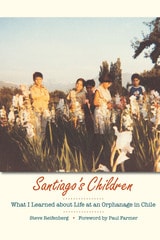
Santiago's Children
What I Learned about Life at an Orphanage in ChileBy Steve Reifenberg
University of Texas Press, 2008
Runner-up, Bronze Medal, Independent Publishers Book Awards: Memoir/Autobiography Category, 2009
Unclear about his future career path, Steve Reifenberg found himself in the early 1980s working at a small orphanage in a poor neighborhood in Santiago, Chile, where a determined single woman was trying to create a stable home for a dozen or so children who had been abandoned or abused. With little more than good intentions and very limited Spanish, the 23-year-old Reifenberg plunged into the life of the Hogar Domingo Savio, becoming a foster father to kids who stretched his capacities for compassion and understanding in ways he never could have imagined back in the United States.
In this beautifully written memoir, Reifenberg recalls his two years at the Hogar Domingo Savio. His vivid descriptions create indelible portraits of a dozen remarkable kids—mature-beyond-her-years Verónica; sullen, unresponsive Marcelo; and irrepressible toddler Andrés, among them. As Reifenberg learns more about the children's circumstances, he begins to see the bigger picture of life in Chile at a crucial moment in its history.
The early 1980s were a time of economic crisis and political uprising against the brutal military dictatorship of Augusto Pinochet. Reifenberg skillfully interweaves the story of the orphanage with the broader national and international forces that dramatically impact the lives of the kids. By the end of Santiago's Children, Reifenberg has told an engrossing story not only of his own coming-of-age, but also of the courage and resilience of the poorest and most vulnerable residents of Latin America.
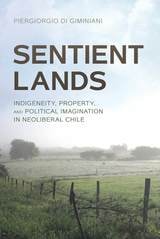
Sentient Lands
Indigeneity, Property, and Political Imagination in Neoliberal ChilePiergiorgio Di Giminiani
University of Arizona Press, 2018
Sentient Lands is a historically grounded ethnography of the Mapuche people’s engagement with state-run reconciliation and land-restitution efforts. Piergiorgio Di Giminiani analyzes environmental relations, property, state power, market forces, and indigeneity to illustrate how land connections are articulated, in both landscape experiences and land claims. Rather than viewing land claims as simply bureaucratic procedures imposed on local understandings and experiences of land connections, Di Giminiani reveals these processes to be disputed practices of world making.
Ancestral land formation is set in motion by the entangled principles of Indigenous and legal land ontologies, two very different and sometimes conflicting processes. Indigenous land ontologies are based on a relation between two subjects—land and people—both endowed with sentient abilities. By contrast, legal land ontologies are founded on the principles of property theory, wherein land is an object of possession that can be standardized within a regime of value. Governments also use land claims to domesticate Indigenous geographies into spatial constructs consistent with political and market configurations.
Exploring the unexpected effects on political activism and state reparation policies caused by this entanglement of Indigenous and legal land ontologies, Di Giminiani offers a new analytical angle on Indigenous land politics.
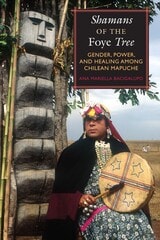
Shamans of the Foye Tree
Gender, Power, and Healing among Chilean MapucheBy Ana Mariella Bacigalupo
University of Texas Press, 2007
Drawing on anthropologist Ana Mariella Bacigalupo's fifteen years of field research, Shamans of the Foye Tree: Gender, Power, and Healing among Chilean Mapuche is the first study to follow shamans' gender identities and performance in a variety of ritual, social, sexual, and political contexts.
To Mapuche shamans, or machi, the foye tree is of special importance, not only for its medicinal qualities but also because of its hermaphroditic flowers, which reflect the gender-shifting components of machi healing practices. Framed by the cultural constructions of gender and identity, Bacigalupo's fascinating findings span the ways in which the Chilean state stigmatizes the machi as witches and sexual deviants; how shamans use paradoxical discourses about gender to legitimatize themselves as healers and, at the same time, as modern men and women; the tree's political use as a symbol of resistance to national ideologies; and other components of these rich traditions.
The first comprehensive study on Mapuche shamans' gendered practices, Shamans of the Foye Tree offers new perspectives on this crucial intersection of spiritual, social, and political power.

Shantytown Protest in Pinochet's Chile
Cathy Lisa Schneider
Temple University Press, 1995