Results by title
134 books match the query 'Chinese' and 10 start with s
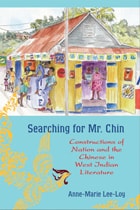
Searching for Mr. Chin
Constructions of Nation and the Chinese in West Indian LiteratureAuthored by Anne-Marie Lee-Loy
Temple University Press, 2010
What do twentieth-century fictional images of the Chinese reveal about the construction of nationhood in the former West Indian colonies? In her groundbreaking interdisciplinary work, Searching for Mr. Chin, Anne-Marie Lee-Loy seeks to map and understand a cultural process of identity formation: “Chineseness” in the West Indies.
Reading behind the stereotypical image of the Chinese in the West Indies, she compares fictional representations of Chinese characters in Jamaica, Trinidad, and Guyana to reveal the social and racial hierarchies present in literature by popular authors such as V.S. Naipaul and Samuel Selvon, as well as lesser known writers and hard to access literary texts.
Using historical, discursive, and theoretical frameworks for her literary analysis, Lee-Loy shows how the unstable and ambiguous “belonging” afforded to this “middleman minority” speaks to the ways in which narrative boundaries of the nation are established. In addition to looking at how Chinese have been viewed as “others,” Lee-Loy examines self-representations of “Chineseness” and how they complicate national narratives of belonging.
Secondhand China
Spain, the East, and the Politics of TranslationCarles Prado-Fonts
Northwestern University Press, 2022
Uncovering an eclectic and surprising archive, Prado-Fonts draws on diverse cultural artifacts from popular literature, journalism, and early cinema to offer a rich account of how China was seen across the West between 1880 and 1930. Enrique Gaspar, Luis de Oteyza, Vicente Blasco Ibáñez, and lesser-known authors writing in Spanish and Catalan put themselves in dialogue with Leo Tolstoy, John Dewey, W. Somerset Maugham, Bertrand Russell, Pearl Buck, and André Malraux, as well as stereotypical figures from popular culture like Fu Manchu and Charlie Chan. Throughout, Prado-Fonts exposes translation as a technology of cultural hegemony and China as an appealing object for representation. A timely contribution to our understanding of how we create and consume knowledge about the world, Secondhand China is essential reading for scholars and students of Orientalism, postcolonial studies, translation studies, comparative literature, and cultural studies.
Sinoglossia
Edited by Andrea Bachner, Howard Chiang, and Yu-Lin Lee
Hong Kong University Press, 2023
Sinoglossia places embodiment, mediality, and translation at the center of this analytical inquiry into Chinese and Sinophone cultures. This book introduces a theory defined by cultural formations not overdetermined by Sinitic linguistic ties. The concept of sinoglossia combines a heteroglossic and heterotopian approach to the critical study of mediated discourses of China and “Chineseness.” From the history of physical examinations and queer subalternity to the cinematic inscription of “Chineseness-as-landscape,” and from Sinopop to the translational writings of Eileen Chang and Syaman Rapongan, this book argues for a flexible conceptualization of cultural objects, conditions, and contexts that draws attention to an array of polyphonic, multi-discursive, and multilingual articulations. In this new horizon of understanding, place or theme create a source of friction and innovation.
Slipstream
Diana Cao
Tupelo Press, 2026
The poems in Slipstream deal with the slippery concept of home, with robots and the internet and other human inventions, and with what we can learn from the natural world around us.
Winner of the Berkshire Prize, Slipstream is a bracing, intimate, and formally adventurous debut that moves with equal grace through personal memory, inherited history, myth, and the ambient technologies of contemporary life. Diana Cao’s poems braid ancient Chinese legend, family migration, illness, love, and grief with moon landers, algorithms, privacy policies, and online ritual, creating a lyric field where the ancestral and the digital speak fluently to one another. The book is formally restless and assured. Sonnets, sestinas, villanelles, fables, and linked sequences feel conversational rather than ornate, their intelligence worn lightly, their music precise and unforced. Throughout, Cao writes with a clarity that never flattens complexity: humor and vulnerability coexist with philosophical rigor. Tenderness is sharpened, not softened, by attention to politics, history, and care.
What emerges is a voice attuned to relational life in all its registers—daughterhood, friendship, desire, citizenship, species—asking how to live, love, and remain lucid inside systems that both sustain and estrange us. Slipstream is a book of uncommon range and emotional intelligence, one that feels fully of this moment while remaining in deep, living conversation with the past.
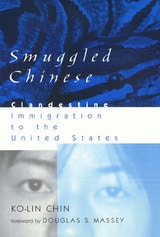
Smuggled Chinese
Ko-Lin Chin
Temple University Press, 1999
When the Golden Venture ran aground off New York's coast in 1993 and ten of the 260 Chinese on board drowned, the public outcry about human smuggling became front-page news. Probing into the causes and consequences of this clandestine traffic, Ko-lin Chin has interviewed more than 300 people -- smugglers, immigrants, government officials, and business owners -- in the United States, China, and Taiwan. Their poignant and chilling testimony describes a flourishing industry in which smugglers -- big and little snakeheads -- command fees as high as $30,000 to move desperate but hopeful men and women around the world. For many who survive the hunger, filthy and crowded conditions, physical and sexual abuse, and other perils of the arduous journey, life in the United States, specifically in New York's Chinatown, is a disappointment if not a curse. Few will return to China, though, because their families depend on the money and status gained by having a relative in the States.
In Smuggled Chinese, Ko-lin Chin puts a human face on this intractable international problem, showing how flaws in national policies and lax law enforcement perpetuate the cycle of desperation and suffering. He strongly believes, however, that the problem of human smuggling will continue as long as China's citizens are deprived of fundamental human rights and economic security.
Smuggled Chinese will engage readers interested in human rights, Asian and Asian American studies, urban studies, and sociology.
Sound and Silence
My Experience with China and LiteratureYan Lianke
Duke University Press, 2024
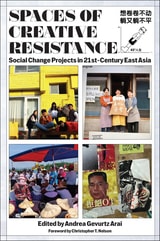
Spaces of Creative Resistance
Social Change Projects in Twenty-First-Century East AsiaAndrea Gevurtz Arai
Rutgers University Press, 2025
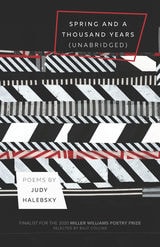
Spring and a Thousand Years (Unabridged)
PoemsJudy Halebsky
University of Arkansas Press, 2020
A translator’s notebook, an almanac, an ecological history, Judy Halebsky’s Spring and a Thousand Years (Unabridged) moves between multiple intersections and sign systems connected in a long glossary poem that serves as the book’s guide to what is lost, erased, or disrupted in transition both from experience to written word and from one language, location, and time period to another.
Writers Li Bai, Matsuo Bashō, Sei Shōnagon, and Du Fu make frequent appearances in centuries ranging from the eighth to the twenty-first, and appear in conversation with Grace Paley, Donald Hall, and Halebsky herself, as the poet explores subjects ranging from work and marriage to environmental destruction. Asking what would happen if these poets—not just their work—appeared in California, the poems slip between different geographies, syntaxes, times, and cultural frameworks.
The role of the literary translator is to bring text from one language into another, working to at once shift and retain the context of the original—from one alphabet to another, one point in time to another. These are poems in homage to translation; they rely on concepts that can bridge time and space, and as a result are as likely to find meaning in donuts or Zumba as they are to find it in the ocean. Spring and a Thousand Years (Unabridged) finds reasons for hope not in how the world should be, but in how it has always been.
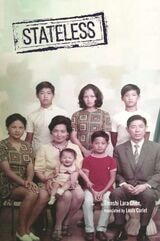
Stateless
Tienshi Lara Chen
National University of Singapore Press, 2023
"In the springtime of the year that I was twenty-one, I found myself stuck at the border between two familiar countries, unable to enter either. I had never felt my statelessness so keenly.”
Japan’s 1971 termination of diplomatic ties with the Republic of China left 9,200 Chinese residents stateless. Tienshi “Lara” Chen was one of them, born to Chinese parents in Yokohama’s Chinatown. What does it mean to be stateless? What does it feel like?
To answer, Stateless presents Chen’s engaging autobiographical account of her bi-cultural upbringing and Japanese education. She reflects on her experience of statelessness eventually led her into a career spanning academia and activism, and she analyzes the contradictions inherent in the concepts of nationality, nation-state, and citizenship, in a world where individual nationality, identity, and experience are increasingly complex. She concludes that the current system of regulating individuals with citizenship is unworkable in the long run.
Blending life writing, auto-ethnography, and a study of stateless communities around Asia, this book unpacks the idea of citizenship by showing the hidden everyday narratives and lived experiences of stateless persons who have no legal ties to any nation-state. Originally published in Japanese, this adapted and updated English edition critically engages with questions of borders, mobility, belonging, and identity.

Sui Sin Far / Edith Maude Eaton
A Literary BiographyAnnette White-Parks; Foreward by Roger Daniels
University of Illinois Press, 1995
Annette White-Parks offers the first full-length biography of the woman now remembered as North America's first published Asian writer. White-Parks reveals an author who defied the in vogue style of "yellow peril" literature to show Chinatowns and their inhabitants as complex, feeling human beings. Her insider's sympathy focused in particular on Chinese American women and children. Confronted with social divisions and discrimination, Sui Sin Far experimented with trickster characters and irony, sharing the coping mechanisms used by other writers who struggled to overcome the marginalization forced on them because of their race, gender, or class.