1566 books match the query 'Christianity' and 111 start with s
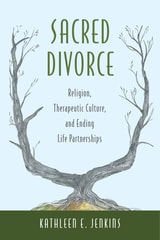
cover of Sacred Divorce: Religion, Therapeutic Culture, and Ending Life Partnerships

Sacred Divorce

Religion, Therapeutic Culture, and Ending Life Partnerships

Jenkins, Kathleen E

Rutgers University Press, 2014

 Even in our world of redefined life partnerships and living arrangements, most marriages begin through sacred ritual connected to a religious tradition. But if marriage rituals affirm deeply held religious and secular values in the presence of clergy, family, and community, where does divorce, which severs so many of these sacred bonds, fit in?  Sociologist Kathleen Jenkins takes up this question in a work that offers both a broad, analytical perspective and a uniquely intimate view of the role of religion in ending marriages.

For more than five years, Jenkins observed religious support groups and workshops for the divorced and interviewed religious practitioners in the midst of divorces, along with clergy members who advised them. Her findings appear here in the form of eloquent and revealing stories about individuals managing emotions in ways that make divorce a meaningful, even sacred process. Clergy from mainline Protestant denominations to Baptist churches, Jewish congregations, Unitarian fellowships, and Catholic parishes talk about the concealed nature of divorce in their congregations.  Sacred Divorce describes their cautious attempts to overcome such barriers, and to assemble meaningful symbols and practices for members by becoming compassionate listeners, delivering careful sermons, refitting existing practices like Catholic annulments and Jewish divorce documents (gets), and constructing new rituals.          

With attention to religious, ethnic, and class variations, covering age groups from early thirties to mid-sixties and separations of only a few months to up to twenty years, Sacred Divorce offers remarkable insight into individual and cultural responses to divorce and the social emotions and spiritual strategies that the clergy and the faithful employ to find meaning in the breach.  At once a sociological document, an ethnographic analysis, and testament of personal experience, Sacred Divorce provides guidance, strategies and answers to readers looking for answers and those looking to heal.
[more]
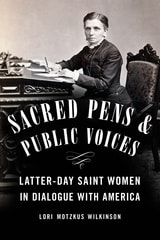
cover of Sacred Pens and Public Voices: Latter-day Saint Women in Dialogue with America

Sacred Pens and Public Voices

Latter-day Saint Women in Dialogue with America

Lori Motzkus Wilkinson

University of Illinois Press, 2026

In the view of many Latter-day Saint women, the religious restoration propounded by Joseph Smith unleashed forces important to female progress. Lori Motzkus Wilkinson examines how LDS women used their agency and sought women’s rights filtered through their religious lens.

Though intellectually connected to figures outside the Church, the LDS women saw them less as
women's rights activists to emulate and more as speakers of truths that, regardless of the origin, should be embraced and harnessed. Wilkinson reveals how Emmeline B. Wells, Susa Young Gates, and other Latter-day Saint women supported and upheld institutional LDS authority and utilized the importance of women’s roles in the home and society as mechanisms for women’s advancement. Even as LDS women continued to engage with prominent national thinkers, their writings and lives demonstrated that they connected with the larger sphere of women’s rights activism before drawing on the LDS concept of women’s divine nature to reshape those ideals to uniquely religious ends.

Original and eye-opening, Sacred Pens and Public Voices revises established narratives about how LDS women interacted with and used ideas taken from national women’s movements.
[more]
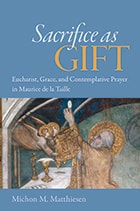
cover of Sacrifice As Gift

Sacrifice As Gift

Michon M. Matthiesen

Catholic University of America Press, 2012
Sacrifice as Gift is a timely presentation of a forgotten vision of eucharistic sacrifice, one that reconfigures the current philosophical and theological divide between sacrifice and gift.
[more]
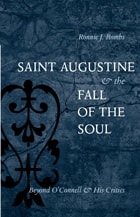
cover of Saint Augustine and the Fall of the Soul: Beyond O'Connell & His Critics

Saint Augustine and the Fall of the Soul

Beyond O'Connell & His Critics

Ronnie J. Rombs 

Catholic University of America Press, 2006
Saint Augustine and the Fall of the Soul: Beyond O'Connell and His Critics provides first a critical examination of O'Connell's theses in a readable summary of his work that spanned over thirty years.
[more]
cover of Saint Cecilia in the Renaissance: The Emergence of a Musical Icon

Saint Cecilia in the Renaissance

The Emergence of a Musical Icon

John A. Rice

University of Chicago Press, 2022

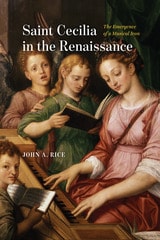
This study uncovers how Saint Cecilia came to be closely associated with music and musicians.

Until the fifteenth century, Saint Cecilia was not connected with music. She was perceived as one of many virgin martyrs, with no obvious musical skills or interests. During the next two centuries, however, she inspired many musical works written in her honor and a vast number of paintings that depicted her singing or playing an instrument.
 
In this book, John A. Rice argues that Cecilia’s association with music came about in several stages, involving Christian liturgy, visual arts, and music. It was fostered by interactions between artists, musicians, and their patrons and the transfer of visual and musical traditions from northern Europe to Italy. Saint Cecilia in the Renaissance explores the cult of the saint in Medieval times and through the sixteenth century when musicians’ guilds in the Low Countries and France first chose Cecilia as their patron. The book then turns to music and the explosion of polyphonic vocal works written in Cecilia’s honor by some of the most celebrated composers in Europe. Finally, the book examines the wealth of visual representations of Cecilia especially during the Italian Renaissance, among which Raphael’s 1515 painting, The Ecstasy of Saint Cecilia, is but the most famous example. Thoroughly researched and beautifully illustrated in color, Saint Cecilia in the Renaissance is the definitive portrait of Saint Cecilia as a figure of musical and artistic inspiration.
[more]
cover of Saint Dominic and His Mission

Saint Dominic and His Mission

Augustin Laffay

Catholic University of America Press, 2025
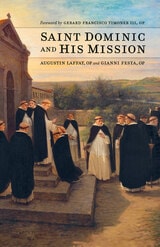
Saint Dominic had dedicated himself to a life of prayer and study as a canon regular at the Cathedral of Osma, Spain in 1197. When on a diplomatic mission through southern France, Dominic and his bishop, Diego, encountered the Cathar heresy. The Spaniards were filled with compassion and sought to counter this heresy by preaching and the example of their holy life. In the ensuing years, and with ecclesiastical approval, Dominic would gather around him a group of men, living a common life in evangelical poverty and dedicated to preaching for the salvation of souls, these were the first members of the Order of Preachers, commonly known as Dominicans. In Saint Dominic and His Mission, two of Saint Dominic’s spiritual sons present a portrait of this Preacher of Grace using extensive research from the archives of the Order to present Dominic and his brethren in their historical context. The first section comprises two parts: a biographical sketch and an evaluation of hagiographic and historical accounts of the life of St. Dominic. It is said that St. Dominic’s gift to the Church is not extensive writings, but a way of life. The second section describes aspects of this distinctly evangelical form life including study and preaching, fraternal life, choral office and the rosary, democratic government, and living in the heart of the Church. In the third section, the authors enlist the help of art historians who present multiple pieces of artwork, ancient and modern, to better know and understand this Doctor of Truth. The final section is a chronology of the life of St. Dominic based on the work of the renowned English Dominic Simon Tugwell, OP. Readers will find that Saint Dominic, whose life and preaching was centered on the Word Incarnate, is a perfect friend and guide to us today as we experience a revival in reverence for the Eucharist and the Sacred Heart of Jesus.
[more]
cover of Saint Joseph and the Carmelite Reform of Saint Teresa of Avila: Father, Teacher of Prayer, Intercessor in Every Need

Saint Joseph and the Carmelite Reform of Saint Teresa of Avila

Father, Teacher of Prayer, Intercessor in Every Need

Joseph F. Chorpenning, OSFS

Catholic University of America Press, 2024
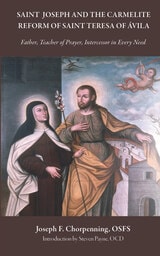
It is a commonplace in devotional literature, historical scholarship, and papal writings that Saint Teresa of Ávila played a key role in the development of veneration of Saint Joseph. Saint Joseph and the Carmelite Reform of Saint Teresa of Ávila unpacks this commonplace by recovering the often-overlooked back story to Teresa’s story, namely, the extraordinarily rich liturgical cult of Saint Joseph in the Ancient Order of Carmel which fully flowered in the Teresian Carmel and beyond, to the universal Church. This volume charts a narrative arc from the liturgical cult of Saint Joseph in the Carmelite Order of Ancient Observance; to Saint Joseph’s vital formative presence in Saint Teresa’s life and reformed Carmel as father, teacher of prayer, and intercessor in every need; to the Carmelite family as a whole giving liturgical expression to its privileged relationship with Saint Joseph by the establishment of the Feast of the Patronage of Saint Joseph; to this feast becoming widespread outside Carmel and ultimately extended to the Universal Church (1847); and, finally, to Saint Joseph’s proclamation as Patron of the Universal Church (1870). An epilogue considers the absence of Joseph’s title “Patron of the Universal Church” in the post-Vatican II liturgical calendar and books, while the papal magisterium has consistently insisted that this patronage is ever necessary for the Church as not only a protection against all dangers, but also an impetus for its mission of evangelization and re-evangelization. An appendix reprints the letter, “Saint Joseph, Patron of Carmel,” jointly issued by the Prior General of the Order of Carmelites of the Ancient Observance and the Superior General of the Order of Discalced Carmelites, to mark the 150th anniversary of the proclamation of Saint Joseph as Patron of the Universal Church.
[more]
cover of Saint Katharine: The Life of Katharine Drexel

Saint Katharine

The Life of Katharine Drexel

Cordelia Frances Biddle

Westholme Publishing, 2015

A Gilded-Age Woman Who Devoted Her Life and Fortune to the American Dispossessed, Established Her Own Religious Order, and Was Ultimately Canonized
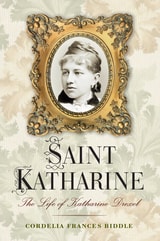
When Katharine Drexel was born in 1858, her grandfather, financier Francis Martin Drexel, had a fortune so vast he was able to provide a loan of sixty million dollars to the Union’s cause during the Civil War. Her uncle and mentor, Anthony, established Drexel University to provide instruction to the working class regardless of race, religion, or gender. Her stepmother was Emma Bouvier whose brother, John, became the great-grandfather of Jacqueline Bouvier Kennedy Onassis. Katharine Drexel’s family were American royalty. As a Philadelphia socialite, “Kitty,” as she was often called, adored formal balls and teas, rowing regattas, and sailing races. She was beautiful, intelligent, and high-spirited. But when her stepmother died in 1883, and her father two years later, a sense of desolation nearly overwhelmed her. She was twenty-seven and in possession of a staggering inheritance. Approached for aid by the Catholic Indian Missions, she surprised her family by giving generously of money and time. It was during this period of acute self-examination that she journeyed to Rome for a private audience with Pope Leo XIII. With characteristic energy and fervor, she detailed the plight of the Native Americans, and begged for additional missionaries to serve them. His reply astonished her. “Why not, my child, yourself become a missionary?”
In Saint Katharine: The Life of Katharine Drexel, Cordelia Frances Biddle recounts the extraordinary story of a Gilded Age luminary who became a selfless worker for the welfare and rights of America’s poorest persons. After years of supporting efforts on behalf of African Americans and American Indians, Katharine finally decided to follow her inner voice and profess vows. The act made headlines. Like her father and grandfather, she was a shrewd businessperson; she retained her financial autonomy and established her own order, the Sisters of the Blessed Sacrament. Until her death in 1955, she devoted herself and her inheritance to building much-needed schools in the South and Southwest, despite threats from the Ku Klux Klan and others. Pragmatic, sometimes willful, ardent, and a charismatic leader, Katharine Drexel was an indefatigable champion of justice and parity. When illness incapacitated her in later years, divine radiance was said to emanate from her, a radiance that led to her canonization on October 1, 2000.
[more]
cover of Saints Observed: Studies of Mormon Village Life, 1850-2005

Saints Observed

Studies of Mormon Village Life, 1850-2005

Howard M. Bahr

University of Utah Press, 2014

The most complete overview and assessment of Mormon village studies available, this volume extends the canon twofold. First, it presents a rich composite view of nineteenth-century Mormon life in the West as seen by qualified observers who did not just pass through but stopped and studied. Second, it connects that early protoethnography to scholarly Mormon village studies in the twentieth century, showing their proper context in the thriving field of community studies. Based mostly on nine famous travelers’ accounts of life among the Mormons, including Richard Burton, Elizabeth Kane, Howard Stansbury, John Gunnison, and Julius Benchley—Bahr’s volume introduces these talented observers, summarizes and analyzes their observation, and constructs a holistic overview of Mormon village life. He concludes by tracing the rise and continuity of Mormon village studies in the twentieth century, beginning with Lowry Nelson’s 1923 research in Escalante, Utah. Over the following three decades, the genre expanded beyond Nelson and his students, becoming more sophisticated and interdisciplinary; by the mid-1950s it was a subfield within the respected arena of community studies. Researchers continued to study Mormon communities in the following decades and into the twenty-first century.
[more]
cover of Saints Without Halos: The Human Side of Mormon History

Saints Without Halos

The Human Side of Mormon History

Leonard J Arrington

Signature Books, 1981
Unlike most Mormon histories, Saints without Halos is a treatment of the human, rather than institutional side of Mormon history. Through the fascinating experiences of seventeen Latter-day Saints, Leonard J. Arrington and Davis Bitton sketch Mormonism from its earliest beginnings to modern times. These are Saints presented not as objects of veneration, but as "human beings who, like the rest of us, struggle to be worthy of the title Latter-day Saint." Two were apostles. One was an enthusiastic supporter and friend of Joseph Smith, who eventually left the main body of the Church to lead his own band to Texas. The other was a link in the chain of a renowned Mormon family whose positions in the leading councils of the Church span virtually the entire history of Mormonism. The other fifteen individuals, except for one colorful non-Mormon advocate, are "ordinary" Latter-day Saints-faithful members who helped realize the vision of their prophetic leaders: a personal friend of Joseph Smith, missionaries and converts, a plural wife, an Indian woman, a widowed immigrant, pioneers and philosophers, bishops and blacksmiths, and even a historian. In this book, the authors of The Mormon Experience draw on their vast knowledge of Mormon diaries and other first-hand accounts to disclose the rich diversity of Mormonism as well as its unity of purpose.
[more]
cover of Saints of the Christianization Age of Central Europe: Tenth to Eleventh Centuries

Saints of the Christianization Age of Central Europe

Tenth to Eleventh Centuries

Cristian Gaspar

Central European University Press, 2012
This volume is the first of two containing hagiographical narratives from medieval Central Europe. The lives of the saints in this volume, from the tenth to eleventh centuries, written not much later, are telling witnesses for the process of Christianization of Bohemia, Poland, Hungary and Dalmatia. Most of them became patrons of their region and highly venerated throughout the Middle Ages. The volume presents the first English translation of a legend of each of these saints with the most recent critical edition of the Latin original and prefaces discussing the textual tradition. In an appendix the extensive hagiographical literature of the saints is being critically surveyed.
[more]
cover of Saints' Lives and Bible Stories for the Stage: A Bilingual Edition

Saints' Lives and Bible Stories for the Stage

A Bilingual Edition

Antonia Pulci

Iter Press, 2010

This fresh translation of five plays securely authored by Antonia Pulci—one of the first published women writers in Renaissance Florence—reveals this gifted dramatist at her finest. Intended primarily for a convent audience, Pulci’s plays give us a fascinating glimpse into how theatrical expressions of female religiosity were animated by both exemplary female saints’ lives and contemporary debates over marriage and virginity. There is much to recommend in this new bilingual presentation. The translations sparkle; and Weaver’s elegant, erudite introduction and her publication of new archival materials not only enrich the historical record concerning Pulci’s life and works but also set it straight.
—Sharon Strocchia
Professor of History, Emory University
[more]
cover of Saints: Faith without Borders

Saints

Faith without Borders

Edited by Françoise Meltzer and Jas Elsner

University of Chicago Press, 2011

While the modern world has largely dismissed the figure of the saint as a throwback, we remain fascinated by excess, marginality, transgression, and porous subjectivity—categories that define the saint. In this collection, Françoise Meltzer and Jas Elsner bring together top scholars from across the humanities to reconsider our denial of saintliness and examine how modernity returns to the lure of saintly grace, energy, and charisma.
Addressing such problems as how saints are made, the use of saints by political and secular orders, and how holiness is personified, Saints takes us on a photo tour of Graceland and the cult of Elvis and explores the changing political takes on Joan of Arc in France. It shows us the self-fashioning of culture through the reevaluation of saints in late-antique Judaism and Counter-Reformation Rome, and it questions the political intent of underlying claims to spiritual attainment of a Muslim sheikh in Morocco and of Sephardism in Israel. Populated with the likes of Francis of Assisi, Teresa of Avila, and Padre Pio, this book is a fascinating inquiry into the status of saints in the modern world.
[more]
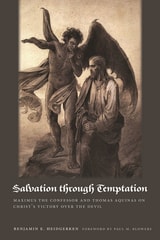
cover of Salvation through Temptation: Maximus the Confessor and Thomas Aquinas on Christ's Victory over the Devil

Salvation through Temptation

Maximus the Confessor and Thomas Aquinas on Christ's Victory over the Devil

Benjamin E. Heidgerken

Catholic University of America Press, 2021

Salvation through Temptation describes the development of predominant Greek and Latin Christian conceptions of temptation and of the work of Christ to heal and restore humankind in the context of that temptation, focusing on Maximus the Confessor and Thomas Aquinas as well-developed examples of Greek and Latin thought on these matters. Maximus and Thomas represent two trajectories concerning the woundedness of human emotionality in the wake of the primordial human sin. Heidgerken argues that Maximus stands in essential continuity with earlier Greek ascetic theology, which conceives of the weakness of fallen humankind in demonological categories, so that the Pauline law of sin is bound to external demonic agents that act upon the human mind through thoughts, desires, and sensory impressions. For Thomas, on the other hand, this wound consists primarily of an internal disordering of the faculties that results from the withdrawal of original grace: concupiscence or the fomes peccati. Yet even in this framework, the devil plays a significant role in Thomas’s account of postlapsarian temptation. On the basis of these differing frameworks for human temptation, Heidgerken demonstrates the centrality of Christ’s exemplarity in the Greek account and the centrality of Christ’s moral perfections in the Latin account. As a consequence of these emphases, the Greek tradition of Maximus places distinct limits on the ability of human emotionality (even that of Christ) to be perfected in this life, whereas Thomas’s approach allows Christ to completely embody a perfected form of human emotionality in his earthly life. Reciprocally, Thomas’s account of Christ’s moral perfections and virtue places distinct limits on his affirmation of Christ’s experience of postlapsarian temptation, whereas Maximus’s account allows for Christ to experience interior forms of temptation that more closely mirror the concrete moral experiences and circumstances of fallen human beings. Salvation through Temptation recommends a retrieval of early ascetic theology and demonology as the best contemporary systematic and ecumenically-viable approach to Christ’s temptation and victory over the devil.
[more]
cover of Same-Sex Dynamics among Nineteenth-Century Americans: A MORMON EXAMPLE

Same-Sex Dynamics among Nineteenth-Century Americans

A MORMON EXAMPLE

D. Michael Quinn

University of Illinois Press, 1996

Winner of the Herbert Feis Award from the American Historical Association and named one of the best religion books of the year by Publishers Weekly, D. Michael Quinn's Same-Sex Dynamics among Nineteenth-Century Americans has elicited critical acclaim as well as controversy. Using Mormonism as a case study of the extent of early America's acceptance of same-sex intimacy, Quinn examines several examples of long-term relationships among Mormon same-sex couples and the environment in which they flourished before the onset of homophobia in the late 1950s.
 
[more]
cover of Sarah's Seasons: An Amish Diary and Conversation

Sarah's Seasons

An Amish Diary and Conversation

Martha Moore Davis

University of Iowa Press, 1997

“Have you ever kept a diary?” With that question author Martha Davis sets out on her journey into the quietly remarkable life of an Old Order Amish woman know to us as Sarah Fisher. Sarah not only kept a diary but welcomed Martha to read it and to view the world through her eyes. The even, peaceful tenor of Sarah's diary entries and the closeness to nature of her life and work will make readers question the pace and values of their own lives, and the degree of social interconnectedness in Sarah's world will offer a model for many of us outside it.

Sarah's brief daily notations, recorded on a calendar throughout 1976 and 1977, reveal an ongoing account of her seasonal routine. In many ways the straightforward simplicity of her writing is a reflection of her life near rural Kalona, Iowa, a life filled with what Martha Davis calls look-easy tasks undertaken without the conveniences of electricity, phones, or automobiles. For Sarah, diaries are a record. “A diary can settle a question, a disagreement,” she tells Martha. “You look back and see what took place. That's history.”

Through their conversations, Martha soon discovered she had more in common with Sarah than diary writing. Though Davis lived in the mainstream culture, an “English” person as the Amish say, like Sarah she grew up on a farm in rural Iowa during the 1950s and 1960s. Like Martha, Sarah had spent several years as a teacher.

In Sarah's Seasons Martha Davis shares their common experiences and common interests—gardening, quilting, and cooking. Alongside Sarah's diary, Martha presents their shared recipes and conversations as well as reflections on her own more modern existence. Because of her friendship with Sarah, the author found a new sense of belonging to and purpose in the mainstream world. In the end, Sarah's diary becomes for Martha a meditation on time and community.
[more]
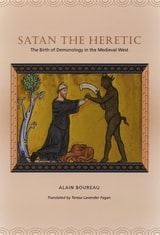
cover of Satan the Heretic: The Birth of Demonology in the Medieval West

Satan the Heretic

The Birth of Demonology in the Medieval West

Alain Boureau

University of Chicago Press, 2006

Before the end of the thirteenth century, theologians had little interest in demons, but with Thomas Aquinas and his formidable “Treatise on Evil” in 1272, everything changed. In Satan the Heretic, Alain Boureau trains his skeptical eye not on Satan or Satanism, but on the birth of demonology and the sudden belief in the power of demons who inhabited Satan’s Court, setting out to understand not why people believed in demons, but why theologians—especially Pope John XXII—became so interested in the subject.

Depicting this new demonology, Satan the Heretic considers the period between the mid-thirteenth and mid-fourteenth centuries when demons, in the eyes of Church authorities, suddenly burst forth, more real and more terrifying than ever before in the history of Christianity. Boureau argues that the rise in this obsession with demons occurs at the crossroads of the rise of sovereignties and of the individual, a rise that, tellingly, also coincides with the emergence of the modern legal system in the European West.

Teeming with original insights and lively anecdotes, Satan the Heretic is a significant contribution to the history of Christian demonology from one of the most original minds in the field of medieval studies today. 
[more]
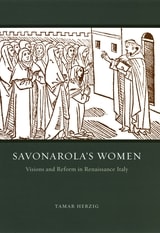
cover of Savonarola's Women: Visions and Reform in Renaissance Italy

Savonarola's Women

Visions and Reform in Renaissance Italy

Tamar Herzig

University of Chicago Press, 2007

Girolamo Savonarola (1452–1498), the religious reformer, preacher, and Florentine civic leader, was burned at the stake as a false prophet by the order of Pope Alexander VI. Tamar Herzig here explores the networks of Savonarola’s female followers that proliferated in the two generations following his death. Drawing on sources from the fifteenth and sixteenth centuries, many never before studied, transcribed, or contextualized in Savonarolan scholarship and religious history, Herzig shows how powerful public figures and clerics continued to ally themselves with these holy women long after the prophet’s death.

In their quest to stay true to their leader’s teachings, Savonarola’s female followers faced hostile superiors within their orders, local political pressures, and the deep-rooted misogynistic assumptions of the Church establishment. This unprecedented volume demonstrates how reform circles throughout the Italian peninsula each tailored Savonarola’s life and works to their particular communities’ regionally specific needs. Savonarola’s Women is an important reconstruction of women’s influence on one of the most important and controversial religious movements in premodern Europe.
[more]
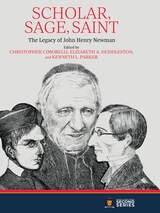
cover of Scholar, Sage, Saint: The Legacy of John Henry Newman

Scholar, Sage, Saint

The Legacy of John Henry Newman

Christopher Cimorelli

Catholic University of America Press, 2026

The canonisation of John Henry Newman in October 2019 has increased public and academic interest in him. A controversial figure during his own lifetime, John Henry Newman’s legacy remains contested by scholars. This conference will explore John Henry Newman as: ·A Scholar: Newman influenced the academic landscape during his lifetime through his time at Oriel, his academic foundations, and his published works. ·A Sage: Newman gained a reputation for providing reliable and wise advice early in his career, which remained even after his reception into the Roman Church in 1845. ·A Saint: Newman studied the lives of the saints and recommended them as exemplars of Christian behaviour. Newman’s work and life invites discussion on the relationship between sanctity and saintliness.
[more]
cover of Science Of Love: Wisdom Of Well Being

Science Of Love

Wisdom Of Well Being

Thomas Oord

Templeton Press, 2004

We all know the saying, "Love can change the world." When science looks at love, it considers cosmology, sociobiology, evolutionary psychology, neurology, sex and romance, and the role of emotions as each relates to love. It also explores religious, ethical, and philosophical issues, such as virtue, creation ex nihilo, progress, divine action, agape, values, religious practices, pacifism, sexuality, friendship, freedom, and marriage. All affect the ways in which people understand each other and interact with one another. In this book, Oord explores these varied dimensions of love, illuminating the love-science symbiosis for both scholars and general readers.

His definition of love is "to act intentionally, in sympathetic response to others (including God), to promote overall well-being. Love acts are influenced by previous actions and executed in the hope of attaining a high degree of good for all." He begins his study with an exploration of the role love plays in all major world religions: Hinduism, Buddhism, Confucianism, Judaism, Islam, and Christianity. He explains how divine love in action can be viewed as consonant with the big bang theory and the continual creation of the universe.

He looks at pacifism and concludes that nonviolence is not always the most loving thing (sometimes violence must be used to rescue victims or prevent holocausts). He explores the animal kingdom to see how creatures work together with the Creator to make the world a better place. And he analyzes the fundamentals of love, the basic characteristics of existence that must be present for love to be expressed. He concludes with the important argument that progress can best be made when religion and science work together to both understand and promote love.
 

[more]
cover of Science and Civilisation between Islam and Christianity

Science and Civilisation between Islam and Christianity

Muhammad Abduh

Gingko, 2025

A translation of a seminal work by Muhammad Abduh.

This book is a translation of Muhammad Abduh’s Al-Islam wa-l-Nasraniyya maa al-Ilm wa-l-Madaniyya (Science and Civilization between Islam and Christianity). Abduh was an Egyptian jurist, religious scholar, theologian, and reformer of Al-Azhar—Egypt’s oldest university and a renowned seat of Islamic learning—who died in 1905. His impact on modern Islam cannot be overstated. In fact, much of modern Muslim thought has, in one way or another, been a reaction to his ideas. Although he is the subject of numerous English studies, only one treatise of his has been translated into English: Risalat al-tawhid (Theology of Unity) by Ishaq Masaad and Kenneth Cragg, in 1966.

Far too little attention has been paid to the treatise translated here and its impact on the Islamic theology of Christianity. This first English translation fills a serious gap in the genre of Islam and Christian-Muslim relations.
 
[more]
cover of Science and Creation: The Search for Understanding

Science and Creation

The Search for Understanding

John C. Polkinghorne

Templeton Press, 2006

John C. Polkinghorne, internationally renowned priest-scientist, addresses fundamental questions about how scientific and theological worldviews relate to each other in this, the second volume (originally published in 1988) of his trilogy, which also included Science and Providence and One World.

Dr. Polkinghorne illustrates how a scientifically minded person approaches the task of theological inquiry, postulating that there exists a close analogy between theory and experiment in science and belief and understanding in theology. He offers a fresh perspective on such questions as: Are we witnessing today a revival a natural theology—the search for God through the exercise of reason and the study of nature? How do the insights of modern physics into the interlacing of order and disorder relate to the Christian doctrine of Creation? What is the relationship between mind and matter?

Polkinghorne states that the "remarkable insights that science affords us into the intelligible workings of the world cry out for an explanation more profound than that which it itself can provide. Religion, if it is to take seriously its claim that the world is the creation of God, must be humble enough to learn from science what that world is actually like.The dialogue between them can only be mutually enriching."

 

[more]
cover of Science and Salvation: Evangelical Popular Science Publishing in Victorian Britain

Science and Salvation

Evangelical Popular Science Publishing in Victorian Britain

Aileen Fyfe

University of Chicago Press, 2004

Threatened by the proliferation of cheap, mass-produced publications, the Religious Tract Society issued a series of publications on popular science during the 1840s. The books were intended to counter the developing notion that science and faith were mutually exclusive, and the Society's authors employed a full repertoire of evangelical techniques—low prices, simple language, carefully structured narratives—to convert their readers. The application of such techniques to popular science resulted in one of the most widely available sources of information on the sciences in the Victorian era.

A fascinating study of the tenuous relationship between science and religion in evangelical publishing, Science and Salvation examines questions of practice and faith from a fresh perspective. Rather than highlighting works by expert men of science, Aileen Fyfe instead considers a group of relatively undistinguished authors who used thinly veiled Christian rhetoric to educate first, but to convert as well. This important volume is destined to become essential reading for historians of science, religion, and publishing alike.
[more]
cover of Science, Religion, and Mormon Cosmology

Science, Religion, and Mormon Cosmology

Erich Robert Paul

University of Illinois Press, 1992

If cosmology connotes an understanding of the structure of both a physical and a transcendent universe, contends Erich Robert Paul, it is virtually impossible to understand Mormonism outside the dimensions of cosmological thinking. This unique study examines how Mormonism shaped its cosmic vision by using and developing cosmological ideas, and what this process says about science, religion, and Mormonism itself.
 
[more]
cover of Secret Covenants: New Insights on Early Mormon Polygamy

Secret Covenants

New Insights on Early Mormon Polygamy

Bruno, Cheryl L.

Signature Books, 2024

Navigating the intricate labyrinth of early Mormon plural marriage can be fascinating, frustrating, and often confusing. The essays in this volume venture into the depths of historical inquiry, presenting a diverse array of perspectives on the subject. Authored by a consortium of esteemed scholars and researchers in the field of Mormon studies, it addresses the nuanced intricacies of Joseph Smith’s involvement in plural marriage.

Delving into the core of this discourse, these experts meticulously analyze foundational documents, highlighting the complexities Joseph Smith faced in practicing plural marriage and shedding light on the legal aspects of polygamy in 1840s Illinois. It navigates lesser-known details of Smith’s proposals and relationships, including the enigmatic story of Fanny Alger.

Secret Covenants presents a balanced exploration. It critiques traditional portrayals, providing multiple viewpoints, such as the examination of Emma Smith’s vehement rejection of polygamy after her husband’s death, and an analysis of the societal impact on women within polygamous unions. Furthermore, the authors address evolving doctrinal debates triggered by the “Marriage Revelation” and its impact on Mormon philosophy and thought.

This anthology serves as a foundational resource for academic scholars, individuals interested in religious history, and anyone seeking to understand the many layers of Mormon plural marriage.
[more]
cover of Secret Habits: Catholic Literacy Education for Women in the Early Nineteenth Century

Secret Habits

Catholic Literacy Education for Women in the Early Nineteenth Century

Carol Mattingly

Southern Illinois University Press, 2016

Literacy historians have credited the Protestant mandate to read scripture, as well as Protestant schools, for advances in American literacy. This belief, however, has overshadowed other important efforts and led to an incomplete understanding of our literacy history. In Secret Habits: Catholic Literacy Education for Women in the Early Nineteenth Century, Carol Mattingly restores the work of Catholic nuns and sisters to its rightful place in literacy studies.

Mattingly shows that despite widespread fears and opposition, including attacks by vaunted northeastern Protestant pioneers of literacy, Catholic women nonetheless became important educators of women in many areas of America. They founded convents, convent academies, and schools; developed their own curricula and pedagogies; and persisted in their efforts in the face of significant prejudices. The convents faced sharp opposition from Protestant educators, who often played on anti-Catholic fears to gain support for their own schools. Using a performative rhetoric of good works that emphasized civic involvement, Catholic women were able to educate large numbers of women and expand opportunities for literacy instruction.

A needed corrective to studies that have focused solely on efforts by Protestant educators, Mattingly’s work offers new insights into early nineteenth-century women’s literacy, demonstrating that literacy education was more religiously and geographically diverse than previously recognized. 
[more]
cover of Secular Days, Sacred Moments: The America Columns of Robert Coles

Secular Days, Sacred Moments

The America Columns of Robert Coles

Robert Coles

Michigan State University Press, 2013
No writer or public intellectual of our era has been as sensitive to the role of faith in the lives of ordinary Americans as Robert Coles. Though not religious in the conventional sense, Coles is unparalleled in his astute understanding and respect for the relationship between secular life and sacredness, which cuts across his large body of work. Drawing inspiration from figures like Dietrich Bonhoeffer, Dorothy Day, and Simone Weil, Coles’s extensive writings explore the tug of war between faith and doubt. As Coles himself admits, the “back-and-forthness between faith and doubt is the story of my life.” These thirty-one thought-provoking essays are drawn from Coles’s weekly column in the Catholic publication America. In them, he turns his inquisitive lens on a range of subjects and issues, from writers and painters to his recent reading and film viewing, contemporary events and lingering controversies, recollections of past and present mentors, events of his own daily life, and ordinary encounters with students, patients, neighbors, and friends. Addressing moral questions openly and honestly with a rare combination of rectitude and authorial modesty, these essays position Coles as a preeminent, durable, and trusted voice in the continuing national conversation over religion, civic life, and moral purpose.
[more]
cover of Seeing with the Eyes of the Heart: Cultivating a Sacramental Imagination in an Age of Pornography

Seeing with the Eyes of the Heart

Cultivating a Sacramental Imagination in an Age of Pornography

Elizabeth T. Groppe

Catholic University of America Press, 2020
In an era in which the internet has made pornography readily accessible, Seeing with the Eyes of the Heart offers a theological critique of pornography and retrieves from the Christian tradition an alternative visual culture. This visual culture is constituted by both the character of the images we behold and the manner in which we see. Contributors include psychologists William M. Struthers and Jill Manning, who address the neurological effects of pornography and its influences on personal, familial, and social life. Their professional analysis is complemented by the testimony of a young man in recovery from pornography addiction. In an exposition of Christian visual culture, Orthodox iconographer Randi Sider-Rose describes the spiritual discipline of icon writing, Danielle M. Peters, S.T.D., surveys the iconography and art of Marian traditions, and art historian Dianne Phillips elucidates the meaning of divine desire as evident in Catholic visual culture of the late medieval and early modern periods. Catholic theologians Ann W. Astell, Nathanial Peters, Boyd Taylor Coolman, and Nicolas Ogle discuss specific practices and dimensions of the Catholic tradition that can contribute to the cultivation of sacramental vision, and David W. Fagerberg, Kimberly Hope Belcher, Jennifer Newsome Martin, and John C. Cavadini offer reflections on sacramental imagination and the healing of vision. Seeing with the Eyes of the Heart is a work of scholarship composed with pastoral care and concern, and it will be serviceable to both classroom teachers and pastoral ministers. A special feature of the book is an inset of seventy-two full-color plates featuring both classic and contemporary works of Christian iconography and art. The essays and images invite readers to behold in beauty the truth that we are created by the triune God not for sexual objectification but with a sacramental vocation to deification through Christ and the Holy Spirit of love.
[more]
cover of Seeker Churches: Promoting Traditional Religion in a Nontraditional Way

Seeker Churches

Promoting Traditional Religion in a Nontraditional Way

Kimon Howland Sargeant

Rutgers University Press, 2000

America’s religious landscape is in flux. New churches are springing up and many older churches are redefining themselves to survive. At the forefront of this denominational free-for-all are evangelical “seeker” churches.

These churches target “seekers”—individuals of any faith or denominational background who seek spiritual fulfillment but are not currently affiliated with any specific church. By focusing on this largely untapped group, seeker churches have become one of the fastest-growing religious movements in the country. In his study, Kimon Sargeant provides a sociological context for the rise of these churches by exploring the rituals, messages, strategies, and denominational functions of this emerging form of American evangelical Protestantism. 

Featuring live bands, professional lighting and sound systems, and multi-media presentations, seeker churches are attracting many people who have “dropped out” of organized religion.  To broaden their appeal, they offer attenders advice on everyday issues ranging from relationships to finance.
Sargeant focuses on the success of the Willow Creek Association, the seeker church association started by the Willow Creek Community Church near Chicago.  With over 5,000 member churches, the seven-year old association has already outdistanced 90 percent of American denominations and is the leader of the seeker church movement.  Through eyewitness accounts and careful research, Sargeant reveals the “seeker” movement to be a “reformation” of American Protestantism.
[more]
cover of Seeking the Straight and Narrow: Weight Loss and Sexual Reorientation in Evangelical America

Seeking the Straight and Narrow

Weight Loss and Sexual Reorientation in Evangelical America

Lynne Gerber

University of Chicago Press, 2011
Losing weight and changing your sexual orientation are both notoriously difficult to do successfully. Yet many faithful evangelical Christians believe that thinness and heterosexuality are godly ideals—and that God will provide reliable paths toward them for those who fall short. Seeking the Straight and Narrow is a fascinating account of the world of evangelical efforts to alter our strongest bodily desires.
 
Drawing on fieldwork at First Place, a popular Christian weight-loss program, and Exodus International, a network of ex-gay ministries, Lynne Gerber explores why some Christians feel that being fat or gay offends God, what exactly they do to lose weight or go straight, and how they make sense of the program’s results—or, frequently, their lack. Gerber notes the differences and striking parallels between the two programs, and, more broadly, she traces the ways that other social institutions have attempted to contain the excesses associated with fatness and homosexuality. Challenging narratives that place evangelicals in constant opposition to dominant American values, Gerber shows that these programs reflect the often overlooked connection between American cultural obsessions and Christian ones.
[more]
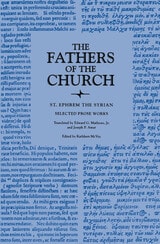
cover of Selected Prose Works: Commentary on Genesis, Commentary on Exodus, Homily on Our Lord, Letter to Publius

Selected Prose Works

Commentary on Genesis, Commentary on Exodus, Homily on Our Lord, Letter to Publius

Saint Ephrem the Syrian

Catholic University of America Press, 1994

This volume presents for the first time in the Fathers of the Church series the work of an early Christian writer who did not write in either Greek or Latin. It offers new English translations of selected prose works by St. Ephrem the Syrian (c. A.D. 309-373).
[more]
cover of Selected Works of Abbot Suger of Saint-Denis: Letters and Charters

Selected Works of Abbot Suger of Saint-Denis

Letters and Charters

Eric Abbot Suger of Saint-Denis

Catholic University of America Press, 2025
Abbot Suger of Saint-Denis was a pivotal figure in 12th-century France, leaving a lasting impact through his multifaceted foles. His dedication to his abbey of Saint-Denis, wise counsel to kings, mediation of church disputes, and involvement in the Crusades solidify his legacy. His letters and charters offer invaluable insights into the political, religious, and economic landscape of the era, particularly during the Capetian dynasty's formative years. Suger's letters, often addressed to powerful figures, reveal his adept political maneuvering. They document his efforts to consolidate royal authority, maintain peace, and defend the abbey's interests. These writings illuminate medieval diplomacy and the Church's influence on secular affairs. Suger served as a trusted advisor to Kings Louis VI and Louis VII, even acting as regent during the latter's absence on the Second Crusade. He skillfully resolved conflicts among ecclesiastical figures, bolstering royal authority and promoting church unity. Suger's charters meticulously detail the abbey's landholdings, privileges, and administrative practices, reflecting his commitment to restoring its wealth and prestige and protecting the abbey's lands from encroachment. These documents also provide crucial information about the economic and social conditions of 12th-century France, a pivotal period in the development of the French monarchy.
[more]
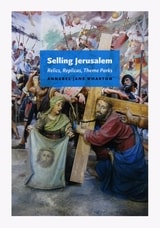
cover of Selling Jerusalem: Relics, Replicas, Theme Parks

Selling Jerusalem

Relics, Replicas, Theme Parks

Annabel Jane Wharton

University of Chicago Press, 2006

Jerusalem currently stands at the center of a violent controversy that threatens the stability of both the Middle East and the world. This volatility, observes Annabel Jane Wharton, is only the most recent manifestation of a centuries-old obsession with the control of the Holy City—military occupation and pilgrimage being two familiar forms of “ownership.” Wharton makes the innovative argument here that the West has also sought to possess Jerusalem by acquiring its representations. 

From relics of the True Cross and Templar replicas of the Holy Sepulchre to Franciscan recreations of the Passion to nineteenth-century mass-produced prints and contemporary theme parks, Wharton describes the evolving forms by which the city has been possessed in the West. She also maps those changing embodiments of the Holy City against shifts in the western market. From the gift-and-barter economy of the early Middle Ages to contemporary globalization, both money and the representations of Jerusalem have become progressively incorporeal, abstract, illusionistic, and virtual. 

Selling Jerusalem offers a penetrating introduction to the explosive combination of piety and capital at work in religious objects and global politics. It is sure to interest students and scholars of art history, economic history, popular culture, religion, and architecture, as well as those who want to better understand Jerusalem’s problematic place in history.
[more]
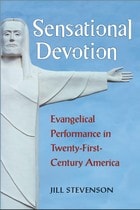
cover of Sensational Devotion: Evangelical Performance in Twenty-First-Century America

Sensational Devotion

Evangelical Performance in Twenty-First-Century America

Jill Stevenson

University of Michigan Press, 2015
Sensational Devotion examines contemporary Passion plays, biblical theme parks, Holy Land recreations, creationist museums, and megachurches in order to understand how they serve their evangelical believer-users while also shaping larger cultural and national dialogues. Jill Stevenson explores how performative media support specific theologies and core beliefs by creating sensual, live experiences for those who use them. The book explores evangelical performance across a range of media and sites, including film, television, theater, tourist attractions, museums, and places of worship. Using historical research coupled with firsthand experiences, it critically examines these spaces and events within their specific religious, cultural, and national contexts, while placing them within a long devotional tradition to suggest how they cultivate religious belief by generating vivid, sensual, affectively oriented, and individualized experiences. Stevenson’s analysis builds upon existing work on performance and cognition, as well as theories of affect, as it contributes to existing scholarship on American evangelicalism and evangelical Christian media. 
[more]
cover of Serbian Orthodox Fundamentals: The Quest for an Eternal Identity

Serbian Orthodox Fundamentals

The Quest for an Eternal Identity

Christos Mylonas

Central European University Press, 2003
This book is a comprehensive exposition of the interaction of a national (the Serbian people) and a religiou (the Orthodox Christian faith) content, in the formation of a distinctive national identity and a mode of being. Its interdisciplinary approach, drawing on sociology, social anthropology, theology, political theory, Balkan historiography, and Serbian folklore, is deployed to provide a powerful and original analysis of how Serbian Orthodoxy has resulted in the sacralisation of the Serbian nation by framing the parameters of its existence. Addresses the following questions: what 'makes' a Serb? Are meaningful assumptions possible by introducing Serbian Orthodoxy as the primal point of reference? Why does religion appear to have an especially strong appeal?
[more]
cover of Seton Hall University: A History, 1856–2006

Seton Hall University

A History, 1856–2006

Dermot Quinn

Rutgers University Press, 2023

Founded in 1856 by Bishop James Roosevelt Bayley of Newark, Seton Hall University has played a large part in New Jersey and American Catholic life for nearly two centuries. From its modest beginnings as a small college and seminary to its present position as a major national university, it has always sought to provide “a home for the mind, the heart, and the spirit.”
 
In this vivid and elegantly written history, Dermot Quinn examines how Seton Hall was able to develop as an institution while keeping faith with its founder’s vision. Looking at the men and women who made Seton Hall what it is today, he paints a compelling picture of a university that has enjoyed its share of triumphs but has also suffered tragedy and loss. He shows how it was established in an age of prejudice and transformed in the aftermath of war, while exploring how it negotiated between a distinctly Roman Catholic identity and a mission to include Americans of all faiths. 
 
Seton Hall University not only recounts the history of a great educational institution, it also shares the personal stories of the people who shaped it and were shaped by it: the presidents, the priests, the faculty, the staff, and of course, the students.
[more]
cover of Sexual Identity and Faith: Helping Clients Find Congruence

Sexual Identity and Faith

Helping Clients Find Congruence

Mark A. Yarhouse

Templeton Press, 2019

Christians who struggle with a conflict between their sexual and religious identities have few therapeutic options available to them. ‘Sexual orientation change efforts’ (SOCE) have rightly fallen out of favor and are no longer practiced by most clinicians. At the same time, the common approach of gay affirmative therapy (GAT) can at times present challenges and may not be a good fit when clients hold to conventional religious beliefs and values.

An alternative to these methods is Sexual Identity Therapy (SIT)—an approach that aims to provide individuals with a safe therapeutic space to explore the tension between their sexuality and their faith. Working within the SIT framework, clients are able to resolve their inner conflict to their personal satisfaction and to freely choose a coherent identity that enables them to move forward in life.

SIT has several stages, each designed to enable the client to make meaning out of his or her same-sex sexuality. At no point in the process is the client encouraged to choose one sexual identity over another. The ultimate goal of SIT is congruence. Congruence is achieved when a person freely adopts an identity and lives it out in ways that are in keeping with his or her beliefs and values. The SIT model is brought to life throughout the book with the help of case studies drawn from the author’s 20 years of experience.

Written for both Christian and non-religious clinicians, Sexual Identity and Faith is an informed, respectful, and nuanced guide to help people navigate the difficult conflict between who they are sexually and what they believe religiously.
[more]
cover of Sexuality and Authority in the Catholic Church

Sexuality and Authority in the Catholic Church

Monica Migliorino Miller

University of Scranton Press, 1995

Monica Migliorino Miller articulates a theology that breaks open the essence of ecclesial authority.  Authority, if it is authority at all, derives from and exists for authentic Christian worship, namely, the Holy Eucharist.
 
If authority is derived from Eucharistic worship, then authority is fundamentally the authority of a covenant.  This book shows that this covenant is spoken according to a primordial sexual language rooted in creation itself.
[more]
cover of Shades of White Flight: Evangelical Congregations and Urban Departure

Shades of White Flight

Evangelical Congregations and Urban Departure

Mark T. Mulder

Rutgers University Press, 2015

Since World War II, historians have analyzed a phenomenon of “white flight” plaguing the urban areas of the northern United States. One of the most interesting cases of “white flight” occurred in the Chicago neighborhoods of Englewood and Roseland, where seven entire church congregations from one denomination, the Christian Reformed Church, left the city in the 1960s and 1970s and relocated their churches to nearby suburbs. In Shades of White Flight, sociologist Mark T. Mulder investigates the migration of these Chicago church members, revealing how these churches not only failed to inhibit white flight, but actually facilitated the congregations’ departure.
 
Using a wealth of both archival and interview data, Mulder sheds light on the forces that shaped these midwestern neighborhoods and shows that, surprisingly, evangelical religion fostered both segregation as well as the decline of urban stability. Indeed, the Roseland and Englewood stories show how religion—often used to foster community and social connectedness—can sometimes help to disintegrate neighborhoods. Mulder describes how the Dutch CRC formed an insular social circle that focused on the local church and Christian school—instead of the local park or square or market—as the center point of the community. Rather than embrace the larger community, the CRC subculture sheltered themselves and their families within these two places. Thus it became relatively easy—when black families moved into the neighborhood—to sell the church and school and relocate in the suburbs. This is especially true because, in these congregations, authority rested at the local church level and in fact they owned the buildings themselves. 
 
Revealing how a dominant form of evangelical church polity—congregationalism—functioned within the larger phenomenon of white flight, Shades of White Flight lends new insights into the role of religion and how it can affect social change, not always for the better. 
 
 
[more]
cover of Shaker Textile Arts

Shaker Textile Arts

Beverly Gordon

University Press of New England, 1982
Today we witness a steadily growing interest in the Shakers and their way of life, especially their crafts. Although Shaker furniture, architecture, and herbs, for example, have been written about repeatedly, there are no other studies in depth of another all-important element in Shaker lives--Shaker textiles. Beverly Gordon, an experienced craftswoman and teacher, presents a comprehensive, illustrated book on the kinds of textiles the Shakers used, how they were produced, and their cultural and economic importance to the communities. She shows how Shaker beliefs were manifested in the actual artifacts and integrates detailed technical information in a way that will appeal to the nonprofessional admirers of these crafts as well as to experts. Professional dealers may use the book to verify the authenticity of a variety of items. An introductory chapter is followed by sections on the general characteristics of the textiles, their importance in Shaker lives, and the types of textile activities they undertook. Textile production, including fiber preparation, spinning, weaving, dyeing, knitting, crocheting, and sewing, is examined. Detailed descriptions of rugs and floor coverings, chair and seat tapes and cushions, clothing and personal accessories, popular cloth, and fancywork are followed by appendices on original Shaker weaving drafts, analyses of rugs and chair seat tapes, dye recipes, and instructions for knitting and constructing “fancy” items. This indispensable reference work results in part from the author’s close association with Shaker textiles between 1973 and 1977, when she was a textile interpreter at Hancock Shaker Village. Since then she has had access to artifacts and original manuscripts and documents throughout the country, works that are reflected in her full bibliography. A study from the procurement and processing of materials to the uses of finished products, this is a book of lasting value to collectors and antique dealers, museum curators, home economists, historians, weavers, and fiber artists with related specialties.
[more]
cover of Shakers at the Center: Manifesting Spirits & Spectacles in Nineteenth-Century America

Shakers at the Center

Manifesting Spirits & Spectacles in Nineteenth-Century America

Edited by Douglas L. Winiarski

University of Massachusetts Press, 2026

Exploring the theological, social, and cultural dimensions of one of America’s most ambitious prophetic movements 

The Shakers’ Era of Manifestations ranks among the most astounding events in American religious history. During the 1840s, members of the United Society of Believers in Christ’s Second Appearing embarked on an audacious project of receiving visions, revelations, and other manifestations from the spirit world and convincing both themselves and the world’s people of their reality. Gifted Shakers known as “instruments” surrendered their bodies to possessing spirits and celestial beings who, in turn, provided the Believers with an unimaginable number of revelatory communications that collapsed time and space, rewrote the Bible, and vastly expanded traditional Protestant beliefs and practices. The fruits of Shaker spiritualism would gain a permanent place in America’s public consciousness. 

Hundreds of volumes and thousands of pages of inspired writings, music, and art from the New Era or period of Mother's Work, as the Shakers called it, crowd the shelves of a half dozen major research libraries. The archive is so vast, so extraordinary, so seemingly bizarre that few scholars have dared tackle it in its totality. The authors of this volume, specialists in nineteenth-century American religious studies, have collaborated to produce an extensive analysis of Mother Ann’s Work. They examine a fascinating range of topics: speaking with the dead; the spectacle of Shaker rituals; race, gender, and family life; and the material culture of physical and spiritual things; as well as manuscripts, books, songs, objects, and art produced during the New Era. 

Shakers at the Center brings the sprawling elements of the Era of Manifestations together in a single volume. Written for students, scholars, and general readers alike, it will stand for years as the definitive history of the Shakers’ most fascinating and vexing historical period. 

Contributors include the volume editor as well as Emily Suzanne Clark, Brett Malcolm Grainger, Sonia Hazard, Dana Logan, Carol Medlicott, Sally M. Promey, Erik R. Seeman, Ryan K. Smith, and David Walker. 
[more]
cover of Shakespeare's Tribe: Church, Nation, and Theater in Renaissance England

Shakespeare's Tribe

Church, Nation, and Theater in Renaissance England

Jeffrey Knapp

University of Chicago Press, 2004

Most contemporary critics characterize Shakespeare and his tribe of fellow playwrights and players as resolutely secular, interested in religion only as a matter of politics or as a rival source of popular entertainment. Yet as Jeffrey Knapp demonstrates in this radical new reading, a surprising number of writers throughout the English Renaissance, including Shakespeare himself, represented plays as supporting the cause of true religion.

To be sure, Renaissance playwrights rarely sermonized in their plays, which seemed preoccupied with sex, violence, and crime. During a time when acting was regarded as a kind of vice, many theater professionals used their apparent godlessness to advantage, claiming that it enabled them to save wayward souls the church could not otherwise reach. The stage, they argued, made possible an ecumenical ministry, which would help transform Reformation England into a more inclusive Christian society.

Drawing on a variety of little-known as well as celebrated plays, along with a host of other documents from the English Renaissance, Shakespeare's Tribe changes the way we think about Shakespeare and the culture that produced him.

Winner of the Best Book in Literature and Language from the Association of American Publishers' Professional/Scholarly division, the Conference on Christianity and Literature Book Award, and the Roland H. Bainton Prize for Literature from the Sixteenth Century Society and Conference.
[more]
cover of Shaking the World for Jesus: Media and Conservative Evangelical Culture

Shaking the World for Jesus

Media and Conservative Evangelical Culture

Heather Hendershot

University of Chicago Press, 2004

In 1999, the Reverend Jerry Falwell outed Tinky-Winky, the purple character from TV's Teletubbies. Events such as this reinforced in many quarters the common idea that evangelicals are reactionary, out of touch, and just plain paranoid. But reducing evangelicals to such caricatures does not help us understand their true spiritual and political agendas and the means they use to advance them. Shaking the World for Jesus moves beyond sensationalism to consider how the evangelical movement has effectively targeted Americans—as both converts and consumers—since the 1970s.

Thousands of products promoting the Christian faith are sold to millions of consumers each year through the Web, mail order catalogs, and even national chains such as Kmart and Wal-Mart. Heather Hendershot explores in this book the vast industry of film, video, magazines, and kitsch that evangelicals use to spread their message. Focusing on the center of conservative evangelical culture—the white, middle-class Americans who can afford to buy "Christian lifestyle" products—she examines the industrial history of evangelist media, the curious subtleties of the products themselves, and their success in the religious and secular marketplace.

To garner a wider audience, Hendershot argues, evangelicals have had to carefully temper their message. But in so doing, they have painted themselves into a corner. In the postwar years, evangelical media wore the message of salvation on its sleeve, but as the evangelical media industry has grown, many of its most popular products have been those with heavily diluted Christian messages. In the eyes of many followers, the evangelicals who purvey such products are sellouts—hucksters more interested in making money than spreading the word of God.

Working to understand evangelicalism rather than pass judgment on it, Shaking the World for Jesus offers a penetrating glimpse into a thriving religious phenomenon.
[more]
cover of Shaping American Catholicism: Maryland and New York, 1805-1915

Shaping American Catholicism

Maryland and New York, 1805-1915

Robert Emmett Curran

Catholic University of America Press, 2012
Distinguished historian Robert Emmett Curran presents an informed and balanced study of the American Catholic Church's experience in its two most important regions in the nineteenth and twentieth centuries
[more]
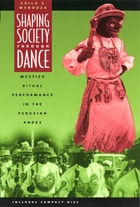
cover of Shaping Society through Dance: Mestizo Ritual Performance in the Peruvian Andes

Shaping Society through Dance

Mestizo Ritual Performance in the Peruvian Andes

Zoila S. Mendoza

University of Chicago Press, 2000

During the patron saint fiesta in the Andean town of San Jerónimo, Peru, crowds gather at sunset in the town square, eagerly awaiting the entrance of the colorful dance troupes, or comparsas. With their masks, music, and surprising interpretations of contemporary events, the comparsas of the Cusco region are the focus of this multifaceted work. At the crossroads of folklore and ritual, mass media and local preferences, and regional and national identity, the comparsas—recorded here on VHS, DVD, and compact disc—have become a powerful way for the local people to make sense of their place in Peru and in the world. As Zoila Mendoza shows, they do more than reflect societal changes, they actively transform society.

In this fluid world, she argues, racial and ethnic identities are shaped more by notions of what is decent, elegant, and modern rather than by skin color or status. As the different troupes vie for the townspeople's recognition as the most "authentic" group, these notions are challenged and reworked. A fascinating look at a rich tradition, this innovative work is also a compelling example of the critical anthropology of performance.
[more]
cover of Shared Mission: Religious Education in the Catholic Tradition, Revised Edition

Shared Mission

Religious Education in the Catholic Tradition, Revised Edition

Leonardo Franchi

Catholic University of America Press, 2023
This book is a contribution to scholarship in the field of religious education. Its aim is simple: to offer a critical perspective on the nature of religious education in the light of contemporary developments in Catholic thinking in catechesis and wider thinking in education. The issues raised in the book will provide ample material for fruitful dialogue and constructive debate in the world of Catholic education. Part One revolves around four historical contexts selected specifically to illuminate contemporary developments in the field. While these historical periods have porous boundaries, they offer a working structure in support of the core claims of the book. Part Two explores the complex genealogy of the relationship between catechesis and Religious Education. Key thematic frames of reference within which the relevant Magisterial documents and associated academic literature are set out and explored chronologically thus allowing for some cross-referencing across the themes: unsurprisingly the range of the issues for debate resists a neat packaging within specific time-frames but does provide a helpful working structure. Part Three proposes that a Spirituality of Communion should underpin the Church’s work in catechesis, education and Religious Education. Shared Mission seems to be a satisfactory articulation of the necessary dialogic relationship between both fields and offers a suitable space for both distinction and reciprocity. The revised edition contains an appendix on the Global Compact on Education.
[more]
cover of Shifting Borders and a Tattered Passport: Intellectual Journeys of a Mormon Academic

Shifting Borders and a Tattered Passport

Intellectual Journeys of a Mormon Academic

Armand L. Mauss

University of Utah Press, 2012

The life of a Mormon intellectual in the secular academic community is likely to include some contradictions between belief, scholarship, and the changing times. In his memoir, Armand L. Mauss recounts his personal and intellectual struggles—inside and outside the LDS world—from his childhood to his days as a graduate student at UC Berkeley in the 1960s through his many years as a professor.

As an important and influential observer and author in the Mormon intellectual world, Mauss has witnessed how, in attempting to suppress independent and unsponsored scholarship during the final decades of the twentieth century, LDS leaders deliberately marginalized important intellectual support and resources that could have helped, in the twenty-first century, to refurbish the public image of the church. As a sociologist, he notes how the LDS Church, as a large, complex organization, strives to adjust its policies and practices in order to maintain an optimal balance between unique, appealing claims on the one hand and public acceptance on the other. He also discusses national and academic controversies over the New Religious Movements of the 1960s and 1970s. Writing in clear language, Mauss shows how he has navigated the boundaries where his faith and academic life intersect, and reveals why a continuing commitment to the LDS Church must be a product of choice more than of natural or supernatural “proof.”
 

[more]
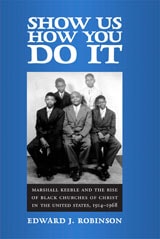
cover of Show Us How You Do It: Marshall Keeble and the Rise of Black Churches of Christ in the United States, 1914-1968

Show Us How You Do It

Marshall Keeble and the Rise of Black Churches of Christ in the United States, 1914-1968

Edward J. Robinson

University of Alabama Press, 2008
Marshall Keeble (1878–1968) was the premier evangelist in black Churches of Christ from 1931 until his death in 1968. Born and reared in middle Tennessee, Keeble came under the influence of Preston Taylor, Samuel Womack, and Alexander Campbell, as well as the social influence of Booker T. Washington. In 1914, Keeble committed himself to full-time evangelism and by the 1920s had established himself as a noteworthy preacher. By the time of his death, he reportedly had baptized 40,000 people and had established more than 200 congregations, some of which still flourish today. Show Us How You Do It is the first critical study of Keeble and his evangelical career.
 
Based on primary sources, Edward Robinson reconstructs the life, public ministry, missionary activities, and the reception of Keeble among Churches of Christ. He also explores Keeble’s relationship with white businessmen and how he secured white support in establishing a large fellowship of African American Churches of Christ in the South. Show Us How You Do It details Keeble’s theology, ethos, and polemics toward other churches. Robinson demonstrates Keeble’s legacy in the labor of his African American co-workers and of the students who attended Nashville Christian Institute.
 
Of the approximately 2.5 million members of the Churches of Christ in the U.S., an estimated 10 percent are African-Americans, and many in this fellowship can trace their affiliation to Keeble and to those whom he trained.
[more]
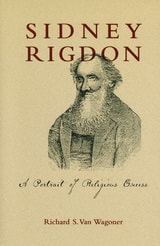
cover of Sidney Rigdon: A Portrait of Religious Excess

Sidney Rigdon

A Portrait of Religious Excess

Richard S. Van Wagoner

Signature Books, 2006

In the late 1820s a fiery young minister in western Ohio converted nearly 1,000 proselytes to the Reformed Baptist Movement. As these schismatics organized themselves into the new Disciples of Christ church, the Reverend Sidney Rigdon was already aligning himself with another, more radical movement, the Latter-day Saints, where he quickly became the LDS prophet’s principal advisor and spokesman. He served Joseph Smith loyally for the next fourteen years, even through a brief spat over the prophet’s romantic interest in his teenage daughter.

Next to Smith, Rigdon was the most influential early Mormon. He imported Reformed Baptist teachings into Latter-day Saint theology, wrote the canonized Lectures on Faith, championed communalism and isolationism, and delivered many of the most significant early sermons, including the famous Salt Sermon and the Ohio temple dedicatory address.

Following Smith’s death, Rigdon parted company with Brigham Young to lead his own group of some 500 secessionists Mormons in Pennsylvania. Rigdon’s following gradually dwindled, as the one-time orator took to wandering the streets, taunting indifferent passersby with God’s word. He was later recruited by another Mormon faction. Although he refused to meet with them, he agreed to be their prophet and send revelations by mail. Before long he had directed them to settle far-off Iowa and Manitoba, among other things. At his death, his followers numbered in the hundreds, and today they number about 10,000, mostly in Pennsylvania.

“Rigdon is a biographer’s dream,” writes Richard Van Wagoner. Intellectually gifted, manic-depressive, an eloquent orator and social innovator but a chronic indigent, Rigdon aspired to altruism but demanded advantage and deference. When he lost prominence, his early attainments were virtually written out of the historical record.

Correcting this void, Van Wagoner has woven the psychology of religious incontinence into the larger fabric of social history. In doing so, he reminds readers of the significance of this nearly-forgotten founding member of the LDS First Presidency. Nearly ten million members in over one hundred churches trace their heritage to Joseph Smith. Many are unaware of the importance of Rigdon’s contributions to their inherited theology.
[more]
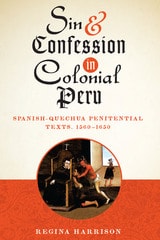
cover of Sin and Confession in Colonial Peru: Spanish-Quechua Penitential Texts, 1560-1650

Sin and Confession in Colonial Peru

Spanish-Quechua Penitential Texts, 1560-1650

By Regina Harrison

University of Texas Press, 2014

A central tenet of Catholic religious practice, confession relies upon the use of language between the penitent and his or her confessor. In the sixteenth and seventeenth centuries, as Spain colonized the Quechua-speaking Andean world, the communication of religious beliefs and practices—especially the practice of confession—to the native population became a primary concern, and as a result, expansive bodies of Spanish ecclesiastic literature were translated into Quechua. In this fascinating study of the semantic changes evident in translations of Catholic catechisms, sermons, and manuals, Regina Harrison demonstrates how the translated texts often retained traces of ancient Andean modes of thought, despite the didactic lessons they contained.

In Sin and Confession in Colonial Peru, Harrison draws directly from confession manuals to demonstrate how sin was newly defined in Quechua lexemes, how the role of women was circumscribed to fit Old World patterns, and how new monetized perspectives on labor and trade were taught to the subjugated indigenous peoples of the Andes by means of the Ten Commandments. Although outwardly confession appears to be an instrument of oppression, the reformer Bartolomé de Las Casas influenced priests working in the Andes; through their agency, confessional practice ultimately became a political weapon to compel Spanish restitution of Incan lands and wealth. Bringing together an unprecedented study (and translation) of Quechua religious texts with an expansive history of Andean and Spanish transculturation, Harrison uses the lens of confession to understand the vast and telling ways in which language changed at the intersection of culture and religion.

[more]