Results by title
153 books match the query 'Cities and towns' and 14 start with s
School Siting and Healthy Communities
Why Where We Invest in School Facilities MattersRebecca Miles
Michigan State University Press, 2012
In recent decades, many metropolitan areas in the United States have experienced a decline in the population of urban centers and rapid growth in the suburbs, with new schools being built outside of cities and existing urban schools facing closure. These new schools are increasingly larger and farther from residences; in contrast, urban school facilities are often in closer proximity to homes but are also in dire need of upgrading or modernization. This eye-opening book explores the compelling health and economic rationales for new approaches to school siting, including economic savings to school districts, transportation infrastructure needs, and improved child health. An essential examination of public policy issues associated with school siting, this compiled volume will assist policy makers and help the public understand why it is important for government and school districts to work together on school siting and capital expenditures and how these new outlooks will improve local and regional outcomes.
Second Cities
Globalization and Local Politics in Manchester and PhiladelphiaAuthored by Jerome I. Hodos
Temple University Press, 2013
Manchester, England, and Philadelphia, Pennsylvania, are what sociologist Jerome Hodos calls second cities—viable alternatives to well-known global cities such as London and New York. In Second Cities, Hodos considers how Manchester and Philadelphia have confronted problems of globalization over the past two centuries.
This thought-provoking, comparative look at these cities examines their histories, economies, migration patterns, cultural innovations, transportation planning, and self-identities. Hodos demonstrates not just how the two cities are positioned in global flows of capital, goods, people, and ideas but also how each has used what he calls “municipal foreign policy” to preserve and rejuvenate its position over time. The second city offers an illustrative lens through which to view other urban centers, from Atlanta to Bangalore, Seattle, and Turin.
Hodos’s description and analysis of urban development over a broad time frame offer lessons for policy makers, scholars, and community leaders concerned with the impact of globalization on their own cities.
Second Tier Cities
Rapid Growth beyond the MetropolisAnn Markusen
University of Minnesota Press, 1999
Analyzes and compares the rapid growth of medium-sized cities.
Over the past thirty years, transnational investment, trade, and government policies have encouraged the decentralization of national economies, disrupting traditional patterns of urban and regional growth. Many smaller cities-such as Seattle, Washington; Campinas, Brazil; Oita, Japan; and Kumi, Korea-have grown markedly faster than the largest metropolitan regions. These “second tier cities” are home to specialized industrial complexes that have taken root, provided significant job growth, and attracted mobile capital and labor.
The culmination of an ambitious five-year, fourteen-city research project conducted by an international team of economists and geographers, Second Tier Cities examines the potential of these new regions to balance uneven regional development, create good, stable jobs, and moderate hyper-urbanization. Comparing across national borders, the contributors describe four types of second tier cities: Marshallian industrial districts, hub-and-spoke cities, satellite platforms, and government-anchored complexes. They find that both industrial and regional policies have been important contributors to the rise of second tier cities, though the former often trump the latter. Lessons for local, national, and international policymakers are drawn. The authors are critical of devolution and argue that it must be accompanied by strong labor and environmental standards and mechanisms to overcome differential regional resource endowments.Contributors: Clelio Campolina Diniz, U Federal de Minas Gerais, Brazil; Masatomi Funaba, Kobe U of Commerce, Japan; Elyse Golob, NYC Economic Development Goup; Mia Gray, Cambridge U; Jun Ho Jeong, Oxford U; Sam Ock Park, Seoul National U; Mohammad Razavi; Fabiana Borges T. Santos, U Federal de Minas Gerais, Brazil; and Masayuki Sasaki, Kanzawa U, Japan.
Shanghai Rising
State Power and Local Transformations in a Global MegacityXiangming Chen
University of Minnesota Press, 2009
Analyzing a Chinese city’s dazzling rise to global megacity status
Until around 1990, Shanghai was China’s premier but sluggish industrial center. Now at the beginning of the twenty-first century, the joint impact of global forces and state power has turned Shanghai into a dynamic megacity. Shanghai’s remarkable growth in economy, infrastructure, and global presence has prompted questions about the Shanghai “miracle.” This collection places the city’s unprecedented rise in a rare comparative examination of U.S. cities, as well as with Asian megacities Singapore and Hong Kong, providing a nuanced account of how Shanghai’s politics, economy, society, and space have been transformed by macro- and micro-level forces.
Contributors: Stephen W. K. Chiu, Chinese U of Hong Kong; K. C. Ho, National U of Singapore; John D. Kasarda, U of North Carolina; Hanlong Lu, Shanghai Academy of Social Sciences; Tai-lok Lui, Chinese U of Hong Kong; Ann R. Markusen, U of Minnesota; Anthony M. Orum, U of Illinois, Chicago; Yuan Ren, Fudan U Shanghai; Saskia Sassen, Columbia U; Jiaming Sun, Texas A&M U, Commerce; Fulong Wu, Cardiff U; Pingkang Yu, George Washington U; Tingwei Zhang, U of Illinois, Chicago; Zhenhua Zhou, Development Research Center, Shanghai Municipal Government.
Signs in America's Auto Age
Signatures of Landscape and PlaceJohn A. & Keith A. Jakle & Sculle
University of Iowa Press, 2004
Space and Pluralism
Can Contemporary Cities Be Places of Tolerance?Stefano Moroni
Central European University Press, 2016
Spearheads for Reform
The Social Settlements and the Progressive Movement, 1890-1914Davis, Allen
Rutgers University Press, 1985

Spectacle and Topophilia
Reading Early Modern and Postmodern Hispanic CulturesDavid R. Castillo
Vanderbilt University Press, 2011
Sprawl
A Compact HistoryRobert Bruegmann
University of Chicago Press, 2005
In his incisive history of the expanded city, Bruegmann overturns every assumption we have about sprawl. Taking a long view of urban development, he demonstrates that sprawl is neither recent nor particularly American but as old as cities themselves, just as characteristic of ancient Rome and eighteenth-century Paris as it is of Atlanta or Los Angeles. Nor is sprawl the disaster claimed by many contemporary observers. Although sprawl, like any settlement pattern, has undoubtedly produced problems that must be addressed, it has also provided millions of people with the kinds of mobility, privacy, and choice that were once the exclusive prerogatives of the rich and powerful.
The first major book to strip urban sprawl of its pejorative connotations, Sprawl offers a completely new vision of the city and its growth. Bruegmann leads readers to the powerful conclusion that "in its immense complexity and constant change, the city-whether dense and concentrated at its core, looser and more sprawling in suburbia, or in the vast tracts of exurban penumbra that extend dozens, even hundreds, of miles-is the grandest and most marvelous work of mankind."
“There are scores of books offering ‘solutions’ to sprawl. Their authors would do well to read this book.”—Witold Rybczynski, Slate
St. Louis
Evolution Of American Urban LandscapeERIC SANDWEISS
Temple University Press, 2001
In this book, Eric Sandweiss scrutinizes the everyday landscape -- streets, houses, neighborhoods, and public buildings -- as it evolved in a classic American city. Bringing to life the spaces that most of us pass without noticing, he reveals how the processes of dividing, trading, improving, and dwelling upon land are acts that reflect and shape social relations. From its origins as a French colonial settlement in the eighteenth century to the present day, St. Louis offers a story not just about how our past is diagrammed in brick and asphalt, but also about the American city's continuing viability as a place where the balance of individual rights and collective responsibilities can be debated, demonstrated and adjusted for generations to come.
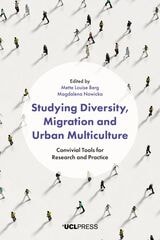
Studying Diversity, Migration and Urban Multiculture
Convivial Tools for Research and PracticeEdited by Mette Louise Berg and Magdalena Nowicka
University College London, 2019
Drawing on a range of innovative and participatory methods, each chapter examines conviviality in different cities across the United Kingdom. The contributors ask how the research process itself can be made more convivial and show how power relations between researchers, those researched, and research users can be reconfigured—in the process producing much needed new knowledge and understanding about urban diversity, multiculturalism and conviviality. Examples include embroidery workshops with diverse faith communities, arts work with child language brokers in schools, and life story and walking methods with refugees. Studying Diversity, Migration and Urban Multiculture is interdisciplinary in scope and includes contributions from sociologists, anthropologists, and social psychologists, as well as chapters by practitioners and activists. It provides fresh perspectives on methodological debates in qualitative social research, and will be of interest to scholars, students, practitioners, activists, and policymakers who work on migration, urban diversity, conviviality and conflict, and integration and cohesion.
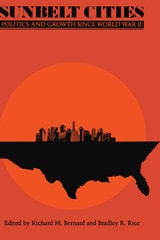
Sunbelt Cities
Politics and Growth since World War IIEdited by Richard M. Bernard and Bradley R. Rice
University of Texas Press, 1983
Between 1940 and 1980, the Sunbelt region of the United States grew in population by 112 percent, while the older, graying Northeast and Midwest together grew by only 42 percent. Phoenix expanded by an astonishing 1,138 percent. San Diego, Houston, Dallas–Fort Worth, Tampa, Miami, and Atlanta quadrupled in size. Even a Sunbelt laggard such as New Orleans more than doubled its population.
Sunbelt Cities brings together a collection of outstanding original essays on the growth and late-twentieth-century political development of the major metropolitan areas below the thirty-seventh parallel. The cities surveyed are Albuquerque, Atlanta, Dallas–Fort Worth, Houston, Los Angeles, Miami, New Orleans, Oklahoma City, Phoenix, San Antonio, San Diego, and Tampa. Each author examines the economic and social causes of postwar population growth in the city under consideration and the resulting changes in its political climate. Major causes of growth such as changing economic conditions, industrial recruitment, lifestyle preferences, and climate are discussed. Particular attention is paid to the role of the federal government, especially the Pentagon, in encouraging development in the Sunbelt. Describing characteristic political developments of many of these cities, the authors note shifting political alliances, the ouster of machines and business elites from political power, and the rise of minority and neighborhood groups in local politics.
Sunbelt Cities is the first full-scale scholarly examination of the region popularly conceived as the Sunbelt. As one of the first works to thoroughly examine a wide range of cities within the region, it has served as a standard reference on the area for some time.
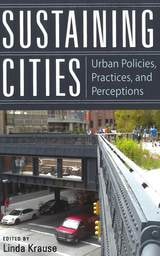
Sustaining Cities
Urban Policies, Practices, and PerceptionsKrause, Linda
Rutgers University Press, 2012
What has happened to cities after the global economic recession? Sustaining Cities answers this question by explaining how failed governmental policies contributed to urban problems and offering best practices for solving them.
From social scientists and urban planners to architects and literary and film critics, the authors of this unique collection suggest real responses to this crisis. Could the drastic declines in housing markets have been avoided? Yes, if we reframe our housing values. Do you want to attract corporate investment to your town? You might want to think twice about doing so. The extinction of the “Celtic Tiger” may be charted in statistics, but the response in popular Irish mystery novels is much more compelling. China, while not immune to market vicissitudes, still booms, but at a considerable cost to its urban identities.
Whether constructing a sustainable social framework for Mexican mega-cities or a neighborhood in London, these nine essays consider some strikingly similar strategies. And perhaps, as the contributors suggest, it’s time to look beyond the usual boundaries of urban, suburban, and exurban to forge new links among these communities that will benefit all citizens. Accessible to anyone with an interest in how cities cope today, Sustaining Cities presents a cautionary tale with a hopeful ending.
SynergiCity
Reinventing the Postindustrial CityEdited by Paul Hardin Kapp and Paul J. Armstrong
University of Illinois Press, 2012