Results by title
206 books match the query 'City Planning & Urban Development' and 12 start with s
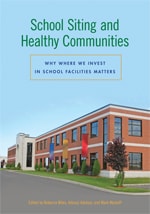
School Siting and Healthy Communities
Why Where We Invest in School Facilities MattersRebecca Miles
Michigan State University Press, 2012
In recent decades, many metropolitan areas in the United States have experienced a decline in the population of urban centers and rapid growth in the suburbs, with new schools being built outside of cities and existing urban schools facing closure. These new schools are increasingly larger and farther from residences; in contrast, urban school facilities are often in closer proximity to homes but are also in dire need of upgrading or modernization. This eye-opening book explores the compelling health and economic rationales for new approaches to school siting, including economic savings to school districts, transportation infrastructure needs, and improved child health. An essential examination of public policy issues associated with school siting, this compiled volume will assist policy makers and help the public understand why it is important for government and school districts to work together on school siting and capital expenditures and how these new outlooks will improve local and regional outcomes.
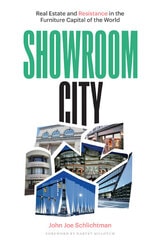
Showroom City
Real Estate and Resistance in the Furniture Capital of the WorldJohn Joe Schlichtman
University of Minnesota Press, 2022
A unique and engaging account of local urban decision-making within the globalizing world
High Point, North Carolina, is known as the “Furniture Capital of the World.” Once a manufacturing stronghold, most of its furniture factories have closed over the past forty years, with production shipped off to low-wage countries. Yet as manufacturing left, the city tightened its hold on a biannual global exposition that serves as the world’s furniture fashion runway. At the High Point Market, visitors from more than one hundred nations traverse twelve million square feet of meticulous design. Downtown buildings—once courthouses, movie theaters, post offices, and gas stations—are now chic showroom spaces, even as many sit empty between each exposition.
In Showroom City, John Joe Schlichtman applies an ethnographic lens to the global exposition’s relationship with High Point after it defeated rival Chicago in the 1960s and established itself as the world’s dominant furniture center. In recent decades, following trends in global finance, private equity firms were increasingly behind downtown High Point’s real estate transactions, coordinated by buyers far removed from the region. Then, in one massive transaction in 2011, a firm funded by Bain Capital purchased every major showroom building, and the majority of downtown real estate was under one owner.
Showroom City is a story of exclusionary growth and unchecked development, of a city flailing to fill the void left by its dwindling factories. But beyond that Schlichtman engages the general lessons behind both High Point’s deindustrialization and its stunning reinvention as a furniture fashion, merchandising, and design node. With great nuance, he delves deeply to reveal how power operates locally and how citizens may affirm, exploit, influence, and resist the takeover of their community.
Snarl
In Defense of Stalled Traffic and Faulty NetworksRuth A. Miller
University of Michigan Press, 2014
Ruth A. Miller excavates a centuries-old history of nonhuman and nonbiological constitutional engagement and outlines a robust mechanical democracy that challenges existing theories of liberal and human political participation. Drawing on an eclectic set of legal, political, and automotive texts from France, Turkey, and the United States, she proposes a radical mechanical re-articulation of three of the most basic principles of democracy: vitality, mobility, and liberty.
Rather than defending a grand theory of materialist or posthumanist politics, or addressing abstract concepts or “things” writ large, Miller invites readers into a self-contained history of constitutionalism situated in a focused discussion of automobile traffic congestion in Paris, Istanbul, and Boston. Within the mechanical public sphere created by automotive space, Snarl finds a model of democratic politics that transforms our most fundamental assumptions about the nature, and constitutional potential, of life, movement, and freedom.
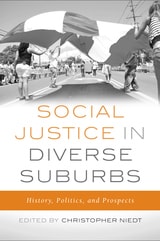
Social Justice in Diverse Suburbs
History, Politics, and ProspectsChristopher Niedt
Temple University Press, 2013
Editor Christopher Niedt and his contributors shed light on organizing and conflict in the suburbs with historical and contemporary case studies. Chapters address topical issues ranging from how suburbanites actively fought school segregation to industrial pollution and displacement along the suburban-rural fringe. Social Justice in Diverse Suburbs also considers struggles for integration and environmental justice as well as efforts to preserve suburban history and organize immigrant communities.
Contributors include: Douglas R. Appler, Aaron Cavin, Nancy A. Denton, Lisa Feldstein, Casey Gallagher, Anne Galletta, Joseph Gibbons, Robert Gioielli, Lucas Owen Kirkpatrick, JoAnna Mitchell-Brown, Manuel Pastor, john a. powell, Jason Reece, Alex Schafran, June Williamson, and the editor.
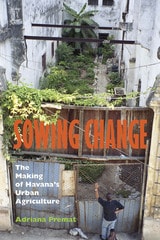
Sowing Change
The Making of Havana's Urban AgricultureAdriana Premat
Vanderbilt University Press, 2012
Space and Pluralism
Can Contemporary Cities Be Places of Tolerance?Stefano Moroni
Central European University Press, 2016
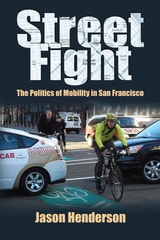
Street Fight
The Politics of Mobility in San FranciscoJason Henderson
University of Massachusetts Press, 2013
Faced with intolerable congestion and noxious pollution, cities around the world are rethinking their reliance on automobiles. In the United States a loosely organized livability movement seeks to reduce car use by reconfiguring urban space into denser, transit-oriented, walkable forms, a development pattern also associated with smart growth and new urbanism. Through a detailed case study of San Francisco, Jason Henderson examines how this is not just a struggle over what type of transportation is best for the city, but a series of ideologically charged political fights over issues of street space, public policy, and social justice.
Historically San Francisco has hosted many activist demonstrations over its streets, from the freeway revolts of the 1960s to the first Critical Mass bicycle rides decades later. Today the city's planning and advocacy establishment is changing zoning laws to limit the number of parking spaces, encouraging new car-free housing near transit stations, and applying “transit first” policies, such as restricted bus lanes. Yet Henderson warns that the city's accomplishments should not be romanticized. Despite significant gains by livability advocates, automobiles continue to dominate the streets, and the city's financially strained bus system is slow and often unreliable.
Both optimistic and cautionary, Henderson argues that ideology must be understood as part of the struggle for sustainable cities and that three competing points of view—progressive, neoliberal, and conservative—have come to dominate the contemporary discourse about urban mobility. Consistent with its iconic role as an incubator of environmental, labor, civil rights, and peace movements, San Francisco offers a compelling example of how the debate over sustainable urban transportation may unfold both in the United States and globally.
Struggling Giants
City-Region Governance in London, New York, Paris, and TokyoPaul Kantor
University of Minnesota Press, 2012
Throughout the past thirty years a small number of city-regions have achieved unprecedented global status in the world economy while undergoing radical changes. Struggling Giants examines the transformation of four of the most significant metropolises: London, New York, Paris, and Tokyo. This volume analyzes the thorniest issues these sprawling city-regions have faced, including ameliorating social problems through public policies, the effect of globalization on local governance, and the relationships between local, regional, and national institutions.
Three critical themes frame Struggling Giants. The first is the continuing struggle for governability in the midst of regional governmental fragmentation. The second theme is how the city-regions fight to manage powerful political biases. Policy-making is often selective, the authors find, and governments are more responsive to economic exigencies than to social or environmental needs. Finally, these city-regions are shown to be strong economic leaders in part because they are able to change—although the authors reveal that pragmatism and piecemeal policy solutions can still prevail.
Sunbelt Cities
Politics and Growth since World War IIEdited by Richard M. Bernard and Bradley R. Rice
University of Texas Press, 1983
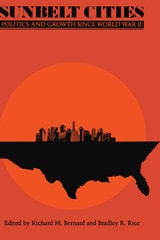
Between 1940 and 1980, the Sunbelt region of the United States grew in population by 112 percent, while the older, graying Northeast and Midwest together grew by only 42 percent. Phoenix expanded by an astonishing 1,138 percent. San Diego, Houston, Dallas–Fort Worth, Tampa, Miami, and Atlanta quadrupled in size. Even a Sunbelt laggard such as New Orleans more than doubled its population.
Sunbelt Cities brings together a collection of outstanding original essays on the growth and late-twentieth-century political development of the major metropolitan areas below the thirty-seventh parallel. The cities surveyed are Albuquerque, Atlanta, Dallas–Fort Worth, Houston, Los Angeles, Miami, New Orleans, Oklahoma City, Phoenix, San Antonio, San Diego, and Tampa. Each author examines the economic and social causes of postwar population growth in the city under consideration and the resulting changes in its political climate. Major causes of growth such as changing economic conditions, industrial recruitment, lifestyle preferences, and climate are discussed. Particular attention is paid to the role of the federal government, especially the Pentagon, in encouraging development in the Sunbelt. Describing characteristic political developments of many of these cities, the authors note shifting political alliances, the ouster of machines and business elites from political power, and the rise of minority and neighborhood groups in local politics.
Sunbelt Cities is the first full-scale scholarly examination of the region popularly conceived as the Sunbelt. As one of the first works to thoroughly examine a wide range of cities within the region, it has served as a standard reference on the area for some time.
Sustainable Food Systems
The Role of the CityRobert Biel
University College London, 2016
Sustainable High-Rise Buildings
Design, technology, and innovationKheir Al-Kodmany
The Institution of Engineering and Technology, 2022
Sustaining Cities
Urban Policies, Practices, and PerceptionsKrause, Linda
Rutgers University Press, 2012
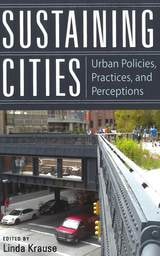
What has happened to cities after the global economic recession? Sustaining Cities answers this question by explaining how failed governmental policies contributed to urban problems and offering best practices for solving them.
From social scientists and urban planners to architects and literary and film critics, the authors of this unique collection suggest real responses to this crisis. Could the drastic declines in housing markets have been avoided? Yes, if we reframe our housing values. Do you want to attract corporate investment to your town? You might want to think twice about doing so. The extinction of the “Celtic Tiger” may be charted in statistics, but the response in popular Irish mystery novels is much more compelling. China, while not immune to market vicissitudes, still booms, but at a considerable cost to its urban identities.
Whether constructing a sustainable social framework for Mexican mega-cities or a neighborhood in London, these nine essays consider some strikingly similar strategies. And perhaps, as the contributors suggest, it’s time to look beyond the usual boundaries of urban, suburban, and exurban to forge new links among these communities that will benefit all citizens. Accessible to anyone with an interest in how cities cope today, Sustaining Cities presents a cautionary tale with a hopeful ending.