Results by title
90 books match the query 'Civilization, Modern' and 6 start with s
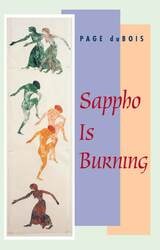
Sappho Is Burning
Page duBois
University of Chicago Press, 1995
In Sappho is Burning, duBois reads Sappho as a disruptive figure at the very origin of our story of Western civilization. Sappho is beyond contemporary categories, inhabiting a space outside of reductively linear accounts of our common history. She is a woman, but also an aristocrat, a Greek, but one turned toward Asia, a poet who writes as a philosopher before philosophy, a writer who speaks of sexuality that can be identified neither with Michel Foucault's account of Greek sexuality, nor with many versions of contemporary lesbian sexuality. She is named as the tenth muse, yet the nine books of her poetry survive only in fragments. She disorients, troubles, undoes many certitudes in the history of poetry, the history of philosophy, the history of sexuality. DuBois argues that we need to read Sappho again.
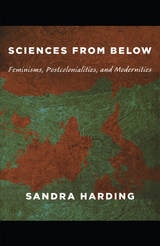
Sciences from Below
Feminisms, Postcolonialities, and ModernitiesSandra Harding
Duke University Press, 2008
Describing the work of the post-Kuhnian science studies scholars Bruno Latour, Ulrich Beck, and the team of Michael Gibbons, Helga Nowtony, and Peter Scott, Harding reveals how, from different perspectives, they provide useful resources for rethinking the modernity versus tradition binary and its effects on the production of scientific knowledge. Yet, for the most part, they do not take feminist or postcolonial critiques into account. As Harding demonstrates, feminist science studies and postcolonial science studies have vital contributions to make; they bring to light not only the male supremacist investments in the Western conception of modernity and the historical and epistemological bases of Western science but also the empirical knowledge traditions of the global South. Sciences from Below is a clear and compelling argument that modernity studies and post-Kuhnian, feminist, and postcolonial sciences studies each have something important, and necessary, to offer to those formulating socially progressive scientific research and policy.
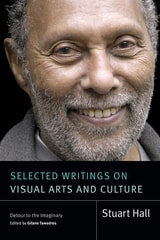
Selected Writings on Visual Arts and Culture
Detour to the ImaginaryStuart Hall. Edited by Gilane Tawadros
Duke University Press, 2024
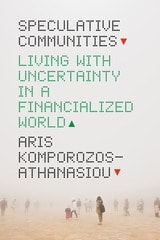
Speculative Communities
Living with Uncertainty in a Financialized WorldAris Komporozos-Athanasiou
University of Chicago Press, 2022
In Speculative Communities, Aris Komporozos-Athanasiou examines the ways that speculation has moved beyond financial markets to shape fundamental aspects of our social and political lives. As ordinary people make exceptional decisions, such as the American election of a populist demagogue or the British vote to leave the European Union, they are moving from time-honored and -tested practices of governance, toward the speculative promise of a new, more uncertain future. This book shows how even our methods of building community have shifted to the speculative realm as social media platforms enable and amplify our volatile wagers.
For Komporozos-Athanasiou, “to speculate” means increasingly “to connect,” to endorse the unknown pre-emptively, and often daringly, as a means of social survival. Grappling with the question of how more uncertainty can lead to its full-throated embrace rather than dissent, Speculative Communities shows how finance has become the model for society writ large. As Komporozos-Athanasiou argues, virtual marketplaces, new social media, and dating apps bring finance’s opaque infrastructures into the most intimate realms of our lives, leading to a new type of speculative imagination across economy, culture, and society.
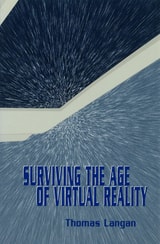
Surviving the Age of Virtual Reality
Thomas Langan
University of Missouri Press, 2000
As the technological phenomenon known as the worldwide web permeates civilization, it creates some cultures and destroys others. In this pioneering book, philosopher Thomas Langan explores "virtual reality"Can inherently contradictory phrase"and the effects of technology on our very being. In our present-day high- technology environment, making simple, everyday decisions is difficult because the virtual world we've created doesn't necessarily operate according to the old "common sense." To retain our intellectual fitness, we must, Langan argues, consider these essential questions: If virtual reality is, in fact, reality, what is this life that we are caught up in? What is being within the context of virtual reality? How can we establish a system for distinguishing truth from fiction?
Although technology minimizes distances between people and makes the information they seek more accessible, it simultaneously blurs the line dividing fact from falsehood and real from virtual. An individual's intellectual survival is threatened as technological advancement challenges our collective understanding of what reality is. Because much of the information that is presented as fact simply works to fulfill a specific agenda, we cannot accept as truth everything that appears on the internet or in the media. To survive, we must learn to manage our lives and resources despite the flood of information we are bombarded with daily.
Addressing the general educated reader, Surviving the Age of Virtual Reality expertly interweaves the worlds of technology and philosophy, pushing the analysis of this technological and human phenomenon to new depths.
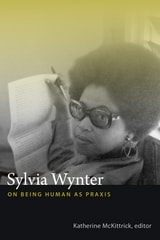
Sylvia Wynter
On Being Human as PraxisKatherine McKittrick, ed.
Duke University Press, 2015