Results by title
52 books match the query 'Cognitive Science' and 4 start with s
Science and Emotions after 1945
A Transatlantic PerspectiveEdited by Frank Biess and Daniel M. Gross
University of Chicago Press, 2014
Through the first half of the twentieth century, emotions were a legitimate object of scientific study across a variety of disciplines. After 1945, however, in the wake of Nazi irrationalism, emotions became increasingly marginalized and postwar rationalism took central stage. Emotion remained on the scene of scientific and popular study but largely at the fringes as a behavioral reflex, or as a concern of the private sphere. So why, by the 1960s, had the study of emotions returned to the forefront of academic investigation?
In Science and Emotions after 1945, Frank Biess and Daniel M. Gross chronicle the curious resurgence of emotion studies and show that it was fueled by two very different sources: social movements of the 1960s and brain science. A central claim of the book is that the relatively recent neuroscientific study of emotion did not initiate – but instead consolidated – the emotional turn by clearing the ground for multidisciplinary work on the emotions. Science and Emotions after 1945 tells the story of this shift by looking closely at scientific disciplines in which the study of emotions has featured prominently, including medicine, psychiatry, neuroscience, and the social sciences, viewed in each case from a humanities perspective.
In Science and Emotions after 1945, Frank Biess and Daniel M. Gross chronicle the curious resurgence of emotion studies and show that it was fueled by two very different sources: social movements of the 1960s and brain science. A central claim of the book is that the relatively recent neuroscientific study of emotion did not initiate – but instead consolidated – the emotional turn by clearing the ground for multidisciplinary work on the emotions. Science and Emotions after 1945 tells the story of this shift by looking closely at scientific disciplines in which the study of emotions has featured prominently, including medicine, psychiatry, neuroscience, and the social sciences, viewed in each case from a humanities perspective.
[more]
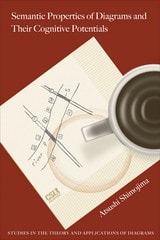
Semantic Properties of Diagrams and Their Cognitive Potentials
Atsushi Shimojima
CSLI, 2015
Why are diagrams sometimes so useful, facilitating our understanding and thinking, while at other times they can be unhelpful and even misleading? Drawing on a comprehensive survey of modern research in philosophy, logic, artificial intelligence, cognitive psychology, and graphic design, Semantic Properties of Diagrams and Their Cognitive Potentials reveals the systematic reasons for this dichotomy, showing that the cognitive functions of diagrams are rooted in the characteristic ways they carry information. In analyzing the logical mechanisms behind the relative efficacy of diagrammatic representation, Atsushi Shimojima provides deep insight into the crucial question: What makes a diagram a diagram?
[more]

Snakes, Sunrises, and Shakespeare
How Evolution Shapes Our Loves and FearsGordon H. Orians
University of Chicago Press, 2014
Our breath catches and we jump in fear at the sight of a snake. We pause and marvel at the sublime beauty of a sunrise. These reactions are no accident; in fact, many of our human responses to nature are steeped in our deep evolutionary past—we fear snakes because of the danger of venom or constriction, and we welcome the assurances of the sunrise as the predatory dangers of the dark night disappear. Many of our aesthetic preferences—from the kinds of gardens we build to the foods we enjoy and the entertainment we seek—are the lingering result of natural selection.
In this ambitious and unusual work, evolutionary biologist Gordon H. Orians explores the role of evolution in human responses to the environment, beginning with why we have emotions and ending with evolutionary approaches to aesthetics. Orians reveals how our emotional lives today are shaped by decisions our ancestors made centuries ago on African savannas as they selected places to live, sought food and safety, and socialized in small hunter-gatherer groups. During this time our likes and dislikes became wired in our brains, as the appropriate responses to the environment meant the difference between survival or death. His rich analysis explains why we mimic the tropical savannas of our ancestors in our parks and gardens, why we are simultaneously attracted to danger and approach it cautiously, and how paying close attention to nature’s sounds has resulted in us being an unusually musical species. We also learn why we have developed discriminating palates for wine, and why we have strong reactions to some odors, and why we enjoy classifying almost everything.
By applying biological perspectives ranging from Darwin to current neuroscience to analyses of our aesthetic preferences for landscapes, sounds, smells, plants, and animals, Snakes, Sunrises, and Shakespeare transforms how we view our experience of the natural world and how we relate to each other.
[more]
Suicidal
Why We Kill OurselvesJesse Bering
University of Chicago Press, 2018
For much of his thirties, Jesse Bering thought he was probably going to kill himself. He was a successful psychologist and writer, with books to his name and bylines in major magazines. But none of that mattered. The impulse to take his own life remained. At times it felt all but inescapable.
Bering survived. And in addition to relief, the fading of his suicidal thoughts brought curiosity. Where had they come from? Would they return? Is the suicidal impulse found in other animals? Or is our vulnerability to suicide a uniquely human evolutionary development? In Suicidal, Bering answers all these questions and more, taking us through the science and psychology of suicide, revealing its cognitive secrets and the subtle tricks our minds play on us when we’re easy emotional prey. Scientific studies, personal stories, and remarkable cross-species comparisons come together to help readers critically analyze their own doomsday thoughts while gaining broad insight into a problem that, tragically, will most likely touch all of us at some point in our lives. But while the subject is certainly a heavy one, Bering’s touch is light. Having been through this himself, he knows that sometimes the most effective response to our darkest moments is a gentle humor, one that, while not denying the seriousness of suffering, at the same time acknowledges our complicated, flawed, and yet precious existence.
Authoritative, accessible, personal, profound—there’s never been a book on suicide like this. It will help you understand yourself and your loved ones, and it will change the way you think about this most vexing of human problems.
[more]