Results by title
89 books match the query 'Communities' and 4 start with s
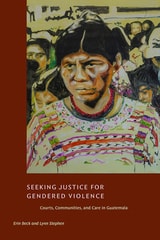
Seeking Justice for Gendered Violence
Courts, Communities, and Care in GuatemalaErin Beck and Lynn Stephen
Duke University Press, 2026
Guatemala is one of the first countries in Latin America to codify femicide as a crime and to establish separate victim-centric institutions of justice to address Violence Against Women and Girls (VAWG), including specialized courts and public prosecutors. Despite these pathbreaking legal reforms, Indigenous women in Guatemala face formidable barriers to seeking justice for and escaping the multiple overlapping forms of violence that they confront. Seeking Justice for Gendered Violence dissects the efficacy of VAWG legislative reforms, examining how they both challenge and perpetuate vicious cycles of impunity and gender-based violence on the ground. Drawing on extensive case studies developed over Erin Beck and Lynn Stephen’s ten years of ethnographic research with an Indigenous research team focused on Indigenous communities, activists, public prosecutors, and government officials, Seeking Justice for Gendered Violence investigates how VAWG reforms in Guatemala interact with preexisting societal structures and local communities, exposing the advances and limits of state-driven solutions while illuminating how Indigenous women leverage grassroots knowledge to survive and resist violence, and to support one another in reformed but flawed systems.
[more]
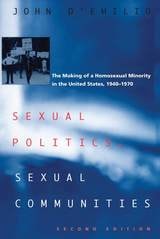
Sexual Politics, Sexual Communities
Second EditionJohn D'Emilio
University of Chicago Press, 1998
With thorough documentation of the oppression of homosexuals and biographical sketches of the lesbian and gay heroes who helped the contemporary gay culture to emerge, Sexual Politics, Sexual Communities supplies the definitive analysis of the homophile movement in the U.S. from 1940 to 1970. John D'Emilio's new preface and afterword examine the conditions that shaped the book and the growth of gay and lesbian historical literature.
"How many students of American political culture know that during the McCarthy era more people lost their jobs for being alleged homosexuals than for being Communists? . . . These facts are part of the heretofore obscure history of homosexuality in America—a history that John D'Emilio thoroughly documents in this important book."—George DeStefano, Nation
"John D'Emilio provides homosexual political struggles with something that every movement requires—a sympathetic history rendered in a dispassionate voice."—New York Times Book Review
"A milestone in the history of the American gay movement."—Rudy Kikel, Boston Globe
[more]

Still Connected
Family and Friends in America Since 1970Claude S. Fischer
Russell Sage Foundation, 2011
National news reports periodically proclaim that American life is lonelier than ever, and new books on the subject with titles like Bowling Alone generate considerable anxiety about the declining quality of Americans' social ties. Still Connected challenges such concerns by asking a simple yet significant question: have Americans' bonds with family and friends changed since the 1970s, and, if so, how? Noted sociologist Claude Fischer examines long-term trends in family ties and friendships and paints an insightful and ultimately reassuring portrait of Americans' personal relationships. Still Connected analyzes forty years of survey research to address whether and how Americans' personal ties have changed—their involvement with relatives, the number of friends they have and their contacts with those friends, the amount of practical and emotional support they are able to count on, and how emotionally tied they feel to these relationships. The book shows that Americans today have fewer relatives than they did forty years ago and that formal gatherings have declined over the decades—at least partially as a result of later marriages and more women in the work force. Yet neither the overall quantity of personal relationships nor, more importantly, the quality of those relationships has diminished. Americans' contact with relatives and friends, as well as their feelings of emotional connectedness, has changed relatively little since the 1970s. Although Americans are marrying later and single people feel lonely, few Americans report being socially isolated and the percentage who do has not really increased. Fischer maintains that this constancy testifies to the value Americans place on family and friends and to their willingness to adapt to changing circumstances in ways that sustain their social connections. For example, children now often have schedules as busy as their parents. Yet today's parents spend more quality time with their children than parents did forty years ago—although less in the form of organized home activities and more in the form of accompanying them to play dates or sports activities. And those family meals at home that seem to be disappearing? While survey research shows that families dine at home together less often, it also shows that they dine out together more often. Americans are fascinated by the quality of their relationships with family and friends and whether these bonds fray or remain stable over time. With so many voices heralding the demise of personal relationships, it's no wonder that confusion on this topic abounds. An engrossing and accessible social history, Still Connected brings a much-needed note of clarity to the discussion. Americans' personal ties, this book assures us, remain strong.
[more]

Storying the Self
Performance and CommunitiesJess Moriarty and Ross Adamson
Intellect Books, 2023
Using writing and narrative to make sociopolitical meaning from autobiography.
Through a wide array of texts and methodologies, Storying the Self spotlights autoethnographic research—and pushes the discipline in new directions. This edited volume aims to explore critical and creative approaches to understanding the self in relation to vital social, cultural, and political spheres. Chapters touch on memory and nostalgia, voluntourism in Malawi, the importance of intersectionality, documentary filmmaking, epilepsy, and other experiences to examine the role of the self, as both researcher and storyteller.
Storying the Self features contributions by Ross Adamson, Suzy Bamblett, Emily Bell, Jenni Cresswell, Hannah Davita Ludikhuijze, Sandra Lyndon, Vanessa Marr, Éva Mikuska, Jess Moriarty, Deirdre Russell, Louise Spiers, Holly Stewart, and Lucianna Whittle. It is the first book in Intellect’s innovative new series Performance and Communities, which celebrates, challenges, and researches performance in the real world.
[more]