Results by title
80 books match the query 'Community development' and 3 start with s
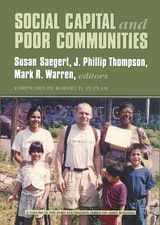
Social Capital and Poor Communities
Susan Saegert
Russell Sage Foundation, 2001
Neighborhood support groups have always played a key role in helping the poor survive, but combating poverty requires more than simply meeting the needs of day-to-day subsistence. Social Capital and Poor Communities shows the significant achievements that can be made through collective strategies, which empower the poor to become active partners in revitalizing their neighborhoods. Trust and cooperation among residents and local organizations such as churches, small businesses, and unions form the basis of social capital, which provides access to resources that would otherwise be out of reach to poor families. Social Capital and Poor Communities examines civic initiatives that have built affordable housing, fostered small businesses, promoted neighborhood safety, and increased political participation. At the core of each initiative lie local institutions—church congregations, parent-teacher groups, tenant associations, and community improvement alliances. The contributors explore how such groups build networks of leaders and followers and how the social power they cultivate can be successfully transferred from smaller goals to broader political advocacy. For example, community-based groups often become platforms for leaders hoping to run for local office. Church-based groups and interfaith organizations can lobby for affordable housing, job training programs, and school improvement. Social Capital and Poor Communities convincingly demonstrates why building social capital is so important in enabling the poor to seek greater access to financial resources and public services. As the contributors make clear, this task is neither automatic nor easy. The book's frank discussions of both successes and failures illustrate the pitfalls—conflicts of interest, resistance from power elites, and racial exclusion—that can threaten even the most promising initiatives. The impressive evidence in this volume offers valuable insights into how goal formation, leadership, and cooperation can be effectively cultivated, resulting in a remarkable force for change and a rich public life even for those communities mired in seemingly hopeless poverty. A Volume in the Ford Foundation Series on Asset Building
[more]
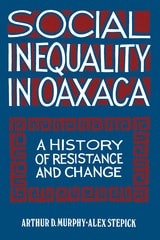
Social Inequality in Oaxaca
A History of Resistance and ChangeArthur Murphy
Temple University Press, 1991
"Anthropologists Murphy and Stepick trace urbanization in the capital city of the state of Oaxaca for more than 2,000 years. Their study represents a micro perspective that describes the colonias populares, the poor neighborhoods, and the struggles of Oaxacans to survive and improve life in marginal communities.... The book is well organized, with excellent annotated footnotes and a reading list."
--Choice
This may be the only book that analyzes the urbanization of one area from its origins more than two thousand years ago to the present. Arthur Murphy and Alex Stepick examine Oaxaca, Mexico, where they have been doing research regularly for the last twenty years. Paying particular attention to neighborhoods, families, and economic activities, they focus on issues of poverty and inequality.
Oaxaca is a city marked by socioeconomic inequality that has felt the alternating trends of integration into and isolation from the broader world. It is a city in which tens of thousands of households resolutely try to adapt, to survive and pass on something of themselves to their children. With rich ethnographic material and historical research, Murphy and Stepick describe gender roles, the dynamic nature of households, the importance of compadrazgo (co-godparenthood) as a social institution, class-based political struggles and strikes, and the role of children in redeeming their parents from poverty.
Individual life histories emerge from their research, each representing diverse class, familial, and economic structures within Oaxacan society.
"Murphy and Stepick catch Oaxaca at a special time in its history. When the illustrious works of theory in the academic disciplines have faded, when Foucault is a footnote and deconstruction derided, books like this one will still be valuable. A portrait of a city during the most difficult period of its country's recent economic history."
--Henry A. Selby (from the Foreword)
[more]
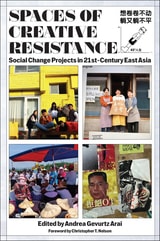
Spaces of Creative Resistance
Social Change Projects in Twenty-First-Century East AsiaAndrea Gevurtz Arai
Rutgers University Press, 2025
Spaces of Creative Resistance: Social Change Projects in Twenty-First-Century East Asia brings together an exciting cross-regional interdisciplinary group of scholars, scholar activists, artists, and others for a collection that addresses the last two decades' hollowing out of social connections, socioeconomic income gaps, and general precarity of life in East Asian societies. Written by authors from China, Japan, South Korea, Taiwan, and Hong Kong, each chapter is focused on people making a difference together in socially sustainable ways, particularly in the areas of gender, labor, and environments—both built and natural. These projects all constitute acts of creative resistance to neoliberal development, and each act of creative resistance demonstrates how individuals and communities across East Asia are making new worlds and lifeways in the small and everyday. Taking on larger political and economic forces that affect their lives and communities, each project and group of individuals featured here is focused on making more liveable presents and more possible futures.
[more]