Results by title
324 books match the query 'Comparative literature' and 21 start with s

Sacramental Shopping
Louisa May Alcott, Edith Wharton, and the Spirit of Modern ConsumerismSarah Way Sherman
University of New Hampshire Press, 2013
Written a generation apart and rarely treated together by scholars, Little Women (1868) and The House of Mirth (1905) share a deep concern with materialism, moral development, and self-construction. The heroines in both grapple with conspicuous consumption, an aspect of modernity that challenges older beliefs about ethical behavior and core identity.
Placing both novels at the historical intersection of modern consumer culture and older religious discourse on materialism and identity, Sarah Way Sherman analyzes how Alcott and Wharton rework traditional Protestant discourse to interpret their heroines' struggle with modern consumerism. Her conclusion reveals how Little Women's optimism, still buoyed by otherworldly justice, providential interventions, and the notion of essential identity, ultimately gives way to the much darker vision of modern materialistic culture in The House of Mirth.
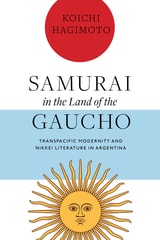
Samurai in the Land of the Gaucho
Transpacific Modernity and Nikkei Literature in ArgentinaKoichi Hagimoto
Vanderbilt University Press, 2023
In the early twentieth century, historical imaginings of Japan contributed to the Argentine vision of “transpacific modernity." Intellectuals such as Eduardo Wilde and Manuel Domecq García celebrated Japanese customs and traditions as important values that can be integrated into Argentine society. But a new generation of Nikkei or Japanese Argentines is rewriting this conventional narrative in the twenty-first century. Nikkei writers such as Maximiliano Matayoshi and Alejandra Kamiya are challenging the earlier, unapologetic view of Japan based on their own immigrant experiences.
Compared to the experience of political persecution against Japanese immigrants in Brazil and Peru, the Japanese in Argentina generally lived under a more agreeable sociopolitical climate. In order to understand the "positive" perception of Japan in Argentine history and literature, Samurai in the Land of the Gaucho turns to the current debate on race in Argentina, particularly as it relates to the discourse of whiteness. One of the central arguments is that Argentina's century-old interest in Japan represents a disguised method of (re)claiming its white, Western identity.
Through close readings of diverse genres (travel writing, essay, novel, short story, and film) Samurai in the Land of the Gaucho yields a multi-layered analysis in order to underline the role Japan has played in both defining and defying Argentine modernity from the twentieth century to the present.

Schechner Plays
Edited by Richard Schechner
Intellect Books, 2025
This book offers a collection of Richard Schechner’s performance texts ranging from orthodox plays to group-devised texts. Covering the full breadth of his work from the 1950s to the present, it includes several never-before-published early texts as well as updated versions of well-known productions such as Dionysus in 69, YokastaS, Makbeth, and Imagining O. Márta Minier's introduction gives an overview of Schechner's work, while Schechner introduces each script in terms of their intellectual and production contexts.
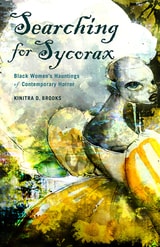
Searching for Sycorax
Black Women's Hauntings of Contemporary HorrorBrooks, Kinitra D
Rutgers University Press, 2018
Secondhand China
Spain, the East, and the Politics of TranslationCarles Prado-Fonts
Northwestern University Press, 2022
Uncovering an eclectic and surprising archive, Prado-Fonts draws on diverse cultural artifacts from popular literature, journalism, and early cinema to offer a rich account of how China was seen across the West between 1880 and 1930. Enrique Gaspar, Luis de Oteyza, Vicente Blasco Ibáñez, and lesser-known authors writing in Spanish and Catalan put themselves in dialogue with Leo Tolstoy, John Dewey, W. Somerset Maugham, Bertrand Russell, Pearl Buck, and André Malraux, as well as stereotypical figures from popular culture like Fu Manchu and Charlie Chan. Throughout, Prado-Fonts exposes translation as a technology of cultural hegemony and China as an appealing object for representation. A timely contribution to our understanding of how we create and consume knowledge about the world, Secondhand China is essential reading for scholars and students of Orientalism, postcolonial studies, translation studies, comparative literature, and cultural studies.
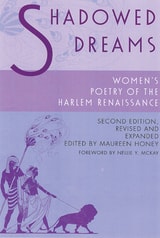
Shadowed Dreams
Women's Poetry of the Harlem RenaissanceMcKay, Nellie
Rutgers University Press, 2006
The first edition of Shadowed Dreams was a groundbreaking anthology that brought to light the contributions of women poets to the Harlem Renaissance. This revised and expanded version contains twice the number of poems found in the original, many of them never before reprinted, and adds eighteen new voices to the collection to once again strike new ground in African American literary history. Also new to this edition are nine period illustrations and updated biographical introductions for each poet.
Shadowed Dreams features new poems by Gwendolyn Bennett, Anita Scott Coleman, Mae Cowdery, Blanche Taylor Dickinson, Alice Dunbar-Nelson, Jessie Fauset, Angelina Weld Grimké, Gladys Casely Hayford (a k a Aquah Laluah), Virginia Houston, Georgia Douglas Johnson, Helene Johnson, Effie Lee Newsome, Esther Popel, and Anne Spencer, as well as writings from newly discovered poets Carrie Williams Clifford, Edythe Mae Gordon, Alvira Hazzard, Gertrude Parthenia McBrown, Beatrice Murphy, Lucia Mae Pitts, Grace Vera Postles, Ida Rowland, and Lucy Mae Turner, among others.
Covering the years 1918 through 1939 and ranging across the period’s major and minor journals, as well as its anthologies and collections, Shadowed Dreams provides a treasure trove of poetry from which to mine deeply buried jewels of black female visions in the early twentieth century.
Shakespeare and Interpretation, or What You Will
Brayton Polka
University of Delaware Press, 2011
Brayton Polka takes both a textual and theoretical approach to seven plays of Shakespeare: Macbeth, Othello, Twelfth Night, All’s Well That Ends Well, Julius Caesar, Troilus and Cressida, and Hamlet. He calls upon the Bible and the ideas of major European thinkers, above all, Kierkegaard and Spinoza, to argue that the concept of interpretation that underlies both Shakespeare’s plays and our own lives as moderns is the golden rule of the Bible: the command to love your neighbor as yourself. What you will (the alternative title of Twelfth Night ) thus captures the idea that interpretation is the very act by which we constitute our lives. For it is only in willing what others will—in loving relationships—that we enact a concept of interpretation that is adequate to our lives.
Polka argues that it is the aim of Shakespeare, when representing the ancient world in plays like Julius Caesar and Troilus and Cressida, and also in his long narrative poem “The Rape of Lucrece,” to dramatize the fundamental differences between ancient (pagan) values and modern (biblical) values or between what he articulates as contradiction and paradox. The ancients are fatally destroyed by the contradictions of their lives of which they remain ignorant. In contrast, we moderns in the biblical tradition, like those who figure in Shakespeare’s other works, are responsible for addressing and overcoming the contradictions of our lives through living the interpretive paradox of “what you will,” of treating all human beings as our neighbor. Shakespeare’s comedies and tragedies, notwithstanding their dramatically different form, share this interpretive framework of paradox. As the author shows in his book, texts without interpretation are blind and interpretation without texts is empty.
Published by University of Delaware Press. Distributed worldwide by Rutgers University Press.
Shakespeare's Folktale Sources
Charlotte Artese
University of Delaware Press, 2015
Published by University of Delaware Press. Distributed worldwide by Rutgers University Press.
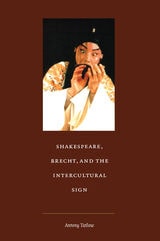
Shakespeare, Brecht, and the Intercultural Sign
Antony Tatlow
Duke University Press, 2001
Reflecting on how, why, and to what effect knowledges and styles of performance pollinate across cultures, Tatlow demonstrates that the employment of one culture’s material in the context of another defamiliarizes the conventions of representation in an act that facilitates access to what previously had been culturally repressed. By reading the intercultural, Tatlow shows, we are able not only to historicize the effects of those repressions that create a social unconscious but also gain access to what might otherwise have remained invisible.
This remarkable study will interest students of cultural interaction and aesthetics, as well as readers interested in theater, Shakespeare, Brecht, China, and Japan.
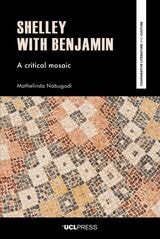
Shelley with Benjamin
A Critical MosaicMathelinda Nabugodi
University College London, 2023
Shelley with Benjamin is an experiment in comparative reading. Born a century apart, Percy Bysshe Shelley and Walter Benjamin are separated by time, language, temperament, and genre. One is a Romantic poet known for his revolutionary politics and delicate lyricism, and the other is a melancholy intellectual who pioneered a dialectical method of thinking in constellations. Yet, taken together, their ideas are mutually illuminating.
In a series of close readings that are by turns playful, erotic, and violent, Mathelinda Nabugodi unveils affinities between two writers whose works are simultaneously interventions in literary history and blueprints for an emancipated future. In addition to offering fresh interpretations of both major and minor writings, she elucidates the personal and ethical stakes of literary criticism. The book will appeal to readers of Shelley and Benjamin as well as those with an interest in comparative literature, literary theory, romantic poetics, and creative critical writing.
Shock and Awe
American Exceptionalism and the Imperatives of the Spectacle in Mark Twain’s A Connecticut Yankee in King Arthur’s CourtWilliam V. Spanos
Dartmouth College Press, 2013

Slavic Excursions
Essays on Russian and Polish LiteratureDonald Davie
University of Chicago Press, 1991
Small Aesthetics
Experience, Embodiment, and Critical CareNate Mickelson
Northwestern University Press, 2027
Synthesizing emerging theories of aesthetic action in relation to literary and art criticism
Drawing attention to what critical theorist Heather Love identifies as “the micro,” contemporary artists use small materials and cross‑media methods to elicit interpretation and foster critical engagement, immersing audiences in the entangled relations engendered with near and distant others through artistic experience. Small Aesthetics analyzes this insurgent tradition in twentieth- and twenty‑first-century poetry and art to show how it confronts the challenges of creating mutually sustaining lives. Feminist and feminist‑of‑color theorists have long argued that acts of care take on critical force when they foreground collective well-being and solidarity across power, class, and cultural differences. Guided by their insights, Nate Mickelson proposes that literary and visual artworks elicit acts of caring attention that engage audiences in their responsibilities to tend to the collective structures through which their lives unfold. Through his close readings, he extends the “post‑critical turn” in literary and art criticism and demonstrates the urgent vitality of feminist, Black, Latine, queer, and trans lives in increasingly hostile social contexts.

Something We Have That They Don't
British and American Poetic Relations since 1925Steve & Mark Clark & Ford
University of Iowa Press, 2004
(I like the way the English spell it
They’re so clever about some things
Probably smarter generally than we are
Although there is supposed to be something
We have that they don’'t—'don’t ask me
What it is. . . .)
—John Ashbery, “Tenth Symphony”
Something We Have That They Don’t presents a variety of essays on the relationship between British and American poetry since 1925. The essays collected here all explore some aspect of the rich and complex history of Anglo-American poetic relations of the last seventy years. Since the dawn of Modernism poets either side of the Atlantic have frequently inspired each other’s developments, from Frost’s galvanizing advice to Edward Thomas to rearrange his prose as verse, to Eliot’s and Auden’s enormous influence on the poetry of their adopted nations (“whichever Auden is,” Eliot once replied when asked if he were a British or an American poet, “I suppose, I must be the other”); from the impact of Charles Olson and other Black Mountain poets on J. H. Prynne and the Cambridge School, to the widespread influence of Frank O'Hara and Robert Lowell on a diverse range of contemporary British poets. Clark and Ford’s study aims to chart some of the currents of these ever-shifting relations. Poets discussed in these essays include John Ashbery, W. H. Auden, Elizabeth Bishop, T. S. Eliot, Mark Ford, Robert Graves, Thom Gunn, Lee Harwood, Geoffrey Hill, Michael Hofmann, Susan Howe, Robert Lowell, and W. B. Yeats.
“Poetry and sovereignty,” Philip Larkin remarked in an interview of 1982, “are very primitive things”: these essays consider the ways in which even seemingly very “unprimitive” poetries can be seen as reflecting and engaging with issues of national sovereignty and self-interest, and in the process they pose a series of fascinating questions about the national narratives that currently dominate definitions of the British and American poetic traditions.
This innovative and exciting new collection will be of great interest to students and scholars of British and American poetry and comparative literature.
Something and Nothingness
The Fiction of John Updike and John FowlesJohn Neary
Southern Illinois University Press, 1992
John Neary shows that the theological dichotomy of via negativa (which posits the authentic experience of God as absence, darkness, silence) and via affirmativa (which emphasizes presence, images, and the sounds of the earth) is an overlooked key to examining and comparing the works of John Fowles and John Updike.
Drawing on his extensive knowledge of both Christian and secular existentialism within the modern theology of Barth and Levinas and the contemporary critical theory of Derrida and J. Hillis Miller, Neary demonstrates the ultimate affinity of these authors who at first appear such opposites. He makes clear that Fowles’s postmodernist, metafictional experiments reflect the stark existentialism of Camus and Sartre while Updike’s social realism recalls Kierkegaard’s empirical faith in a generous God within a kind of Christian deconstructionism.
Neary’s perception of uncanny similarities between the two authors—whose respective careers are marked by a series of novels that structurally and thematically parallel each other—and the authors’ shared long-term interest in existentialism and theology support both his critical comparison and his argument that neither author is "philosophically more sophisticated nor aesthetically more daring."
Southwest Asia
The Transpacific Geographies of Chicana/o LiteratureJayson Gonzales Sae-Saue
Rutgers University Press, 2016
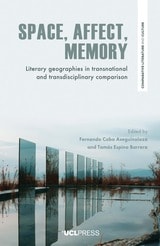
Space, Affect, Memory
Literary Geographies in Transnational and Transdisciplinary ComparisonEdited by Fernando Cabo Aseguinolaza and Tomás Espino Barrera
University College London, 2025
Space, Affect, Memory highlights the centrality of space in modern and contemporary culture, both as an object of study and as a concept that underpins research and creative practice. In so doing, the book argues for the necessity of a new approach to space that fully integrates its affective and memorial dimensions. Encompassing lesser-known works in English, Spanish, Portuguese, French, Italian, and Japanese, the essays expand the scope of previous scholarship in literary geography. They also offer a unique analysis of the performative aspect of representation, incorporating analyses of non-textual media like photography, performance, and architecture.
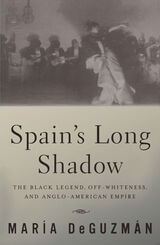
Spain's Long Shadow
The Black Legend, Off-Whiteness, and Anglo-American EmpireMaría DeGuzmán
University of Minnesota Press, 2005
England and the Netherlands, Spain’s imperial rivals of the sixteenth and seventeenth centuries, imagined Spain as a land of cruel and degenerate barbarians of la leyenda negra (the Black Legend), in league with the powers of “blackest darkness” and driven by “dark motives.” In Spain’s Long Shadow, María DeGuzmán explores how this convenient demonization made its way into American culture—and proved essential to the construction of whiteness. DeGuzmán’s work reaches from the late eighteenth century—in the wake of the American Revolution—to the present. Surveying a broad range of texts and images, from Poe’s “William Wilson” and John Singer Sargent’s El Jaleo to Richard Wright’s Pagan Spain and Kathy Acker’s Don Quixote, Spain’s Long Shadow shows how the creation of Anglo-American ethnicity as specifically American has depended on the casting of Spain as a colonial alter ego. The symbolic power of Spain in the American imagination, DeGuzmán argues, is not just a legacy of that nation’s colonial presence in the Americas; it lives on as well in the “blackness” of Spain and Spaniards—in the assigning of people of Spanish origin to an “off-white” racial category that reserves the designation of white for Anglo-Americans. By demonstrating how the Anglo-American imagination needs Spain and Spaniards as figures of attraction and repulsion, DeGuzmán makes a compelling and illuminating case for treating Spain as the imperial alter ego of the United States. Cross-cultural and interdisciplinary, ambitious in its chronological sweep, and elegant in its interpretation of literary and visual works, DeGuzmán’s book leads us to a powerful new understanding of the nature—and history—of American ethnicity.
Spenser, Milton, and the Redemption of the Epic Hero
Christopher Bond
University of Delaware Press, 2011
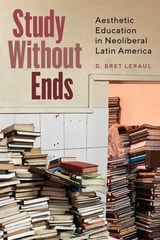
Study Without Ends
Aesthetic Education in Neoliberal Latin AmericaD. Bret Leraul
Northwestern University Press, 2026
Calls for aesthetic education to unite cultural practices of radical imagination with everyday practices of care
While Latin America was neoliberalism’s laboratory, Argentina and Chile have been crucibles for its cultural logics. In this book, D. Bret Leraul examines the rise of neoliberal culture in the Southern Cone through the educational infrastructures that disseminate and reproduce it. Leraul draws on literature and criticism, the history of higher education, and examples of recent social movements to propose a theory of cultural production for social transformation.
Study Without Ends charts the cultural consequences of introducing a neoliberal rationality into the region’s higher education landscape. The university’s increasing centrality within the literary institution and the rise of theoretical prose fiction suggest that poetics today is less about crafting literary works than instructing readers. At the same time, despite efforts to reduce education to human capital investment, it remains a process of personal and social transformation, as recent activism by Chilean students and Argentinean unemployed workers shows. In response to the compounding crises of social reproduction represented by the informal work and precarious livelihoods of people rendered surplus populations, and inspired by the decommodified labor of students, artists, women, and the unemployed, Leraul calls for a materialist aesthetic education that unites artistic culture’s practices of radical imagination and everyday culture’s practices of care.
Subversive Traditions
Reinventing the West African EpicJonathon Repinecz
Michigan State University Press, 2019