Results by title
57 books match the query 'Corporations' and 8 start with s

Secret Manoeuvres in the Dark
Corporate and Police Spying on ActivistsEveline Lubbers
Pluto Press, 2012
The exposure of undercover policeman Mark Kennedy in the eco-activist movement revealed how the state monitors and undermines political activism. This book shows the other grave threat to our political freedoms - undercover activities by corporations.
Secret Manoeuvres in the Dark documents how corporations are halting legitimate action and investigation by activists. Using exclusive access to previously confidential sources, Eveline Lubbers shows how companies such as Nestlé, Shell and McDonalds use covert methods to evade accountability. She argues that corporate intelligence gathering has shifted from being reactive to pro-active, with important implications for democracy itself.
Secret Manoeuvres in the Dark will be vital reading for activists, investigative and citizen journalists, and all who care about freedom and democracy in the 21st century.
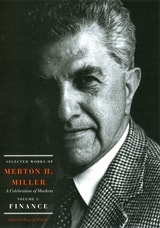
Selected Works of Merton H. Miller
A Celebration of Markets: Volume 1: FinanceMerton H. Miller
University of Chicago Press, 2002
Miller was perhaps best known for a series of highly influential papers he cowrote in the 1950s and 1960s with fellow Nobel laureate Franco Modigliani that advanced a set of capital structure theorems later dubbed the "M and M propositions." In brief, the M and M propositions state that the actions of investors, firms, and capital markets will cause the market value of a firm to be independent of its capital structure. In other words, a corporation's value depends on its investments in people, ideas, and physical capital goods and not on the mix of bonds, stocks, and other securities used to finance the investments. Four of these papers are reprinted here, together with important later work by Miller in macroeconomics, corporate capital structure, management science, asset pricing, and the economic and regulatory problems of the financial services industry.
Diverse and innovative, the papers in Selected Works of Merton H. Miller will interest students and practitioners of economics, finance, and business, as well as policymakers responsible for market regulation.
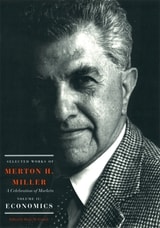
Selected Works of Merton H. Miller
A Celebration of Markets: Volume 2: EconomicsMerton H. Miller
University of Chicago Press, 2002
Miller was perhaps best known for a series of highly influential papers he cowrote in the 1950s and 1960s with fellow Nobel laureate Franco Modigliani that advanced a set of capital structure theorems later dubbed the "M and M propositions." In brief, the M and M propositions state that the actions of investors, firms, and capital markets will cause the market value of a firm to be independent of its capital structure. In other words, a corporation's value depends on its investments in people, ideas, and physical capital goods and not on the mix of bonds, stocks, and other securities used to finance the investments. Four of these papers are reprinted here, together with important later work by Miller in macroeconomics, corporate capital structure, management science, asset pricing, and the economic and regulatory problems of the financial services industry.
Diverse and innovative, the papers in Selected Works of Merton H. Miller will interest students and practitioners of economics, finance, and business, as well as policymakers responsible for market regulation.
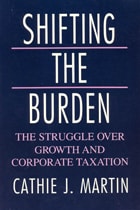
Shifting the Burden
The Struggle over Growth and Corporate TaxationCathie J. Martin
University of Chicago Press, 1991
Remarkably accessible and rich in historical evidence, Shifting the Burden is the most compelling explanation to date of how our nation's tax policy is formulated. Cathie J. Martin shows how presidents' cultivation of allies within the business community and struggles within that community itself combine to shape tax policy.
Sick Planet
Corporate Food and MedicineStan Cox
Pluto Press, 2008
Neoliberals often point to improvements in public health and nutrition as examples of globalisation's success, but this book argues that the corporate food and medicine industries are destroying environments and ruining living conditions across the world.
Scientist Stan Cox expertly draws out the strong link between Western big business and environmental destruction. This is a shocking account of the huge damage that drug manufacturers and large food corporations are inflicting on the health of people and crops worldwide. Companies discussed include Wal-Mart, GlaxoSmithKline, Tyson Foods and Monsanto. On issues ranging from the poisoning of water supplies in South Asia to natural gas depletion and how it threatens global food supplies, Cox shows how the demand for profits is always put above the public interest.
While individual efforts to "shop for a better world" and conserve energy are laudable, Cox explains that they need to be accompanied by an economic system that is grounded in ecological sustainability if we are to find a cure for our Sick Planet.
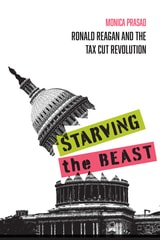
Starving the Beast
Ronald Reagan and the Tax Cut RevolutionMonica Prasad
Russell Sage Foundation, 2018
Drawing on never-before seen archival documents, Prasad traces the history of the 1981 tax cut—the famous “supply side” tax cut, which became the cornerstone for the next several decades of Republican domestic economic policy. She demonstrates that the main impetus behind this tax cut was not business group pressure, racial animus, or a belief that tax cuts would pay for themselves.
Rather, the tax cut emerged because in America--unlike in the rest of the advanced industrial world—progressive policies are not embedded within a larger political economy that is favorable to business. Since the end of World War II, many European nations have combined strong social protections with policies to stimulate economic growth such as lower taxes on capital and less regulation on businesses than in the United State. Meanwhile, the United States emerged from World War II with high taxes on capital and some of the strongest regulations on business in the advanced industrial world. This adversarial political economy could not survive the economic crisis of the 1970s.
Starving the Beast suggests that taking inspiration from the European model of progressive policies embedded in market-promoting political economy could serve to build an American economy that works better for all.
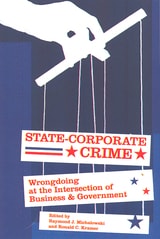
State-Corporate Crime
Wrongdoing at the Intersection of Business and GovernmentMichalowski, Raymond J
Rutgers University Press, 2006
Despite growing attention to crimes by those in positions of trust, however, violations in business and similar wrongdoing in government are still often treated as fundamentally separate problems. In State-Corporate Crime, Raymond J. Michalowski and Ronald C. Kramer bring together fifteen essays to show that those in positions of political and economic power frequently operate in collaboration, and are often all too willing to sacrifice the well-being of the many for the private profit and political advantage of the few.
Drawing on case studies including the explosion of the space shuttle Challenger, Ford Explorer rollovers, the crash of Valujet flight 592, nuclear weapons production, and war profiteering, the essays bear frank witness to those who have suffered, those who have died, and those who have contributed to the greatest human and environmental devastations of our time. This book is a much needed reminder that the most serious threats to public health, security, and safety are not those petty crimes that appear nightly on local news broadcasts, but rather are those that result from corruption among the wealthiest and most powerful members of society.
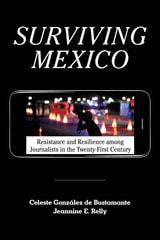
Surviving Mexico
Resistance and Resilience among Journalists in the Twenty-first CenturyBy Celeste González de Bustamante and Jeannine E. Relly
University of Texas Press, 2021
Mott KTA Journalism and Mass Communication Research Award, Kappa Tau Alpha
Tankard Book Award, Association for Education in Journalism and Mass Communication (AEJMC)
Knudson Latin America Prize, Association for Education in Journalism and Mass Communication (AEJMC)
Since 2000, more than 150 journalists have been killed in Mexico. Today the country is one of the most dangerous in the world in which to be a reporter. In Surviving Mexico, Celeste González de Bustamante and Jeannine E. Relly examine the networks of political power, business interests, and organized crime that threaten and attack Mexican journalists, who forge ahead despite the risks.
Amid the crackdown on drug cartels, overall violence in Mexico has increased, and journalists covering the conflict have grown more vulnerable. But it is not just criminal groups that want reporters out of the way. Government forces also attack journalists in order to shield corrupt authorities and the very criminals they are supposed to be fighting. Meanwhile some news organizations, enriched by their ties to corrupt government officials and criminal groups, fail to support their employees. In some cases, journalists must wait for a “green light” to publish not from their editors but from organized crime groups. Despite seemingly insurmountable constraints, journalists have turned to one another and to their communities to resist pressures and create their own networks of resilience. Drawing on a decade of rigorous research in Mexico, González de Bustamante and Relly explain how journalists have become their own activists and how they hold those in power accountable.