4531 books match the query 'Cultural & Ethnic Studies' and 296 start with s

cover of SARS Stories: Affect and Archive of the 2003 Pandemic

SARS Stories

Affect and Archive of the 2003 Pandemic

Belinda Kong

Duke University Press, 2024

In SARS Stories, Belinda Kong delves into the cultural archive of the 2003 SARS pandemic, examining Chinese-language creative works and social practices at the epicenters of the outbreak in China and Hong Kong. As the COVID-19 pandemic has highlighted issues of anti-Asian racism and sinophobia, Kong traces how Chinese people navigated the SARS pandemic and created meaning amid crisis through cultures of epidemic expression. From sentimental romances and Cantopop songs to raunchy sex comedies and crowdsourced ghost tales, unexpected and minor genres and creators of Chinese popular culture highlight the resilience and humanity of those living through the pandemic. Rather than narrating pandemic life in terms of crisis and catastrophe, Kong argues that these works highlight Chinese practices of community, care, and love amid disease. She also highlights the persistence of orientalism in anglophone accounts of SARS index patients and global reporting on COVID-era China. Kong shows how the Chinese experiences of living with SARS can reshape global feelings toward pandemic social life and foster greater fellowship in the face of pandemics.
[more]
cover of Sacred Leaves of Candomblé: African Magic, Medicine, and Religion in Brazil

Sacred Leaves of Candomblé

African Magic, Medicine, and Religion in Brazil

By Robert A. Voeks

University of Texas Press, 1997

Winner, Hubert Herring Book Award, Pacific Coast Council on Latin American Studies

Candomblé, an African religious and healing tradition that spread to Brazil during the slave trade, relies heavily on the use of plants in its spiritual and medicinal practices. When its African adherents were forcibly transplanted to the New World, they faced the challenge not only of maintaining their culture and beliefs in the face of European domination but also of finding plants with similar properties to the ones they had used in Africa.

This book traces the origin, diffusion, medicinal use, and meaning of Candomblé's healing pharmacopoeia—the sacred leaves. Robert Voeks examines such topics as the biogeography of Africa and Brazil, the transference—and transformation—of Candomblé as its adherents encountered both native South American belief systems and European Christianity, and the African system of medicinal plant classification that allowed Candomblé to survive and even thrive in the New World. This research casts new light on topics ranging from the creation of African American cultures to tropical rain forest healing floras.
[more]
cover of Sacred Men: Law, Torture, and Retribution in Guam

Sacred Men

Law, Torture, and Retribution in Guam

Keith L. Camacho

Duke University Press, 2019

Between 1944 and 1949 the United States Navy held a war crimes tribunal that tried Japanese nationals and members of Guam's indigenous Chamorro population who had worked for Japan's military government. In Sacred Men Keith L. Camacho traces the tribunal's legacy and its role in shaping contemporary domestic and international laws regarding combatants, jurisdiction, and property. Drawing on Giorgio Agamben's notions of bare life and Chamorro concepts of retribution, Camacho demonstrates how the U.S. tribunal used and justified the imprisonment, torture, murder, and exiling of accused Japanese and Chamorro war criminals in order to institute a new American political order. This U.S. disciplinary logic in Guam, Camacho argues, continues to directly inform the ideology used to justify the Guantánamo Bay detention center, the torture and enhanced interrogation of enemy combatants, and the American carceral state.
[more]
cover of Sacred River: A Novel

Sacred River

A Novel

Syl Cheney-Coker

Ohio University Press, 2015

The reincarnation of a legendary nineteenth-century Caribbean emperor as a contemporary African leader is at the heart of this novel. Sacred River deals with the extraordinary lives, hopes, powerful myths, stories, and tragedies of the people of a modern West African nation. It is also the compelling love story of an idealistic philosophy professor and an ex-courtesan of incomparable beauty. Two hundred years after his death, the great Haitian emperor Henri Christophe miraculously appears in a dream to Tankor Satani, president of the fictional West African country of Kissi, with instructions for Tankor to continue Henri Christophe’s rule, which had been interrupted by “that damned Napoleon.” Ambitious in scope, Sacred River is a diaspora-inspired novel, in which Cheney-Coker has tackled the major themes of politics, social strife, crime and punishment, and human frailty and redemption in Malagueta, the fictional, magical town and its surroundings first created by the author in The Last Harmattan of Alusine Dunbar, for which he was awarded the coveted Commonwealth Writers’ Prize. Sacred River is equally about love and politics, and marks the return to fiction of one of Africa’s major writers.
[more]
cover of Sacred Sisterhoods: A Celebration of Black Women's Friendships on Television and in Film

Sacred Sisterhoods

A Celebration of Black Women's Friendships on Television and in Film

Edited by Imani M. Cheers

The Ohio State University Press, 2025

The dramatic expansion of Black women into creative positions in television and film production since the 1990s has introduced a previously invisible range of themes in Black women’s lives to wide audiences. In Imani M. Cheers’s richly interdisciplinary Sacred Sisterhoods, contributors offer an overdue analysis and elevation of Black women’s creative authority in popular culture: its history, successes, influence, and future possibilities. Focusing on the theme of Black women’s friendship, star voices from across academia, journalism, the arts, and activism offer critical-cultural commentary and personal reflections on the evolution of Black women directors, writers, producers, and showrunners from the 1930s through 2023.

Creative visionaries from Debbie Allen to Quinta Brunson, along with shows and films from Living Single to Hidden Figures—and many others—receive their due in these rigorous, lively, and accessible essays. Spotlighting the nuances and normalcy of Black women’s sacred sisterhoods, contributors reveal the indelible mark modern Black consciousness and creative control leave on our popular culture every day in an anthology that will be essential to scholars and students of contemporary media, race, and gender, as well as to general readers.

Contributors:
Imani M. Cheers, Monique A. Gamble, Marquita Gammage, Kandace Harris, Crystal L. Holmes, Makeba Lavan, Rondrea Danielle Mathis, Miriam J. Petty-Adams, De Anna Reese, Randi Richardson, Beretta E. Smith-Shomade, Andrene M. Taylor, Kristen Warner, and Shauntae Brown White

[more]
cover of Sacred Steel: Inside an African American Steel Guitar Tradition

Sacred Steel

Inside an African American Steel Guitar Tradition

Robert Stone

University of Illinois Press, 2010

In this book, Robert L. Stone follows the sound of steel guitar into the music-driven Pentecostal worship of two related churches: the House of God and the Church of the Living God. A rare outsider who has gained the trust of members and musicians inside the church, Stone uses nearly two decades of research, interviews, and fieldwork to tell the story of a vibrant musical tradition that straddles sacred and secular contexts.
 
Most often identified with country and western bands, steel guitar is almost unheard of in African American churches--except for the House of God and the Church of the Living God, where it has been part of worship since the 1930s. Sacred Steel traces the tradition through four generations of musicians and in some two hundred churches extending across the country from Florida to California, Michigan to Alabama. Presenting detailed portraits of musical pioneers such as brothers Troman and Willie Eason and contemporary masters such as Chuck Campbell, Glenn Lee, and Robert Randolph, Stone expertly outlines the fundamental tensions between sacred steel musicians and church hierarchy.
 
In this thorough analysis of the tradition, Stone explores the function of the music in church meetings and its effect on the congregations. He also examines recent developments such as the growing number of female performers, the commercial appeal of the music, and younger musicians' controversial move of the music from the church to secular contexts.
[more]
cover of Safe in a Midwife's Hands: Birthing Traditions from Africa to the American South

Safe in a Midwife's Hands

Birthing Traditions from Africa to the American South

Linda Janet Holmes

The Ohio State University Press, 2023
A Ms. Magazine “Most Anticipated Feminist Book of 2023” After a less-than-positive experience giving birth as a Black woman in the 1970s, Linda Janet Holmes launched a lifetime of work as an activist dedicated to learning about and honoring alternative birth traditions and the Black women behind them. Safe in a Midwife’s Hands brings together what Holmes has gleaned from the countless midwives who have shared with her their experiences, at a time when their knowledge and holistic approaches are essential counterbalances to a medical system that routinely fails Black mothers and babies. Building on work she began in the 1980s, when she interviewed traditional Black midwives in Alabama and Virginia, Holmes traveled to Ghana, Ethiopia, and Kenya to visit midwives there. In detailing their work, from massage to the uses of medicinal plants to naming ceremonies, she links their voices to those of midwives and doulas in the US. She thus illuminates parallels between birthing traditions that have survived hundreds of years of colonialism, enslavement, Jim Crow, and ongoing medical racism to persist as vital cultural practices that promote healthy outcomes for mothers and babies during pregnancy, birth, and beyond.
[more]
cover of Salsa Crossings: Dancing Latinidad in Los Angeles

Salsa Crossings

Dancing Latinidad in Los Angeles

Cindy García

Duke University Press, 2013
In Los Angeles, night after night, the city's salsa clubs become social arenas where hierarchies of gender, race, and class, and of nationality, citizenship, and belonging are enacted on and off the dance floor. In an ethnography filled with dramatic narratives, Cindy García describes how local salseras/os gain social status by performing an exoticized L.A.–style salsa that distances them from club practices associated with Mexicanness. Many Latinos in Los Angeles try to avoid "dancing like a Mexican," attempting to rid their dancing of techniques that might suggest that they are migrants, poor, working-class, Mexican, or undocumented. In L.A. salsa clubs, social belonging and mobility depend on subtleties of technique and movement. With a well-timed dance-floor exit or the lift of a properly tweezed eyebrow, a dancer signals affiliation not only with a distinctive salsa style but also with a particular conceptualization of latinidad.
[more]
cover of Salt and State: An Annotated Translation of the <em>Songshi</em> Salt Monopoly Treatise

Salt and State

An Annotated Translation of the <em>Songshi</em> Salt Monopoly Treatise

Cecilia Lee-fang Chien

University of Michigan Press, 2004
Salt and State is an annotated translation of a treatise on salt from Song China. From its inception in the Han dynasty (206 B.C.–220 A.D.), the salt monopoly was a key component in the Chinese government's financial toolkit. Salt, with its highly localized and large-scale production, was an ideal target for bureaucratic management.
In the Song dynasty (960–1279), fiscal pressures on the government had intensified with increased centralization and bureaucratization. A bloated administration and an enormous standing army maintained against incursions by aggressive steppe neighbors placed tremendous strain on Song finances. Developing the salt monopoly seemed a logical and indeed urgent strategy, but each actor in this plan—the emperor, local officials, monopoly administrators, producers, merchants, and consumers—had his own interests to protect and advance. Thus attempts to maximize the effectiveness of the monopoly meant frequent policy swings and led to levels of corruption that would ultimately undo the Song.
Unlike other contemporary sources, the Songshi treatise organizes its subject into an intelligible and detailed narrative, elucidating special terminology, the bureaucracy and its processes, and debates relating to Chinese finance and politics, as well as the salt industry itself. Professor Chien's extensive annotation relies on parallel histories that corroborate and supplement the Songshi account, together providing a comprehensive study of this important institution in China's premodern political economy.
[more]
cover of Salud Latina: Structural Inequality and the Social Determinants of Latino Health in the United States

Salud Latina

Structural Inequality and the Social Determinants of Latino Health in the United States

Yoshira D. Macías Mejía

Michigan State University Press, 2027

Latinos living in the United States continue to face institutional racism and systemic oppression in many aspects of their lives. This volume focuses on discriminatory policies and practices in the health sector and reveals how they compound contemporary health inequities among Latinos. Through a combination of rigorous data analysis and personal narratives, the contributors explore critical dimensions of Latino health, including systemic disparities in healthcare access and insurance, the effects of state immigration policies on health outcomes, unique challenges facing undocumented immigrants, adolescent socio-emotional development, aging populations, Latina women’s physical and mental health, farmworker occupational hazards, and pathways toward health equity. Together, the chapters show that Latinos in the United States continue to face four fundamental barriers to health equity, namely immigrant legal status restrictions, anti-immigrant policies, inadequate quality care from healthcare systems lacking cultural competency, and limited occupational protections. This timely work provides essential evidence for policymakers, public health practitioners, and researchers seeking to understand and address persistent health disparities affecting America's largest ethnic minority population.
[more]
cover of Salvadoran Imaginaries: Mediated Identities and Cultures of Consumption

Salvadoran Imaginaries

Mediated Identities and Cultures of Consumption

Cecilia M. Rivas

Rutgers University Press, 2014

 Ravaged by civil war throughout the 1980s and 1990s, El Salvador has now emerged as a study in contradictions. It is a country where urban call centers and shopping malls exist alongside rural poverty. It is a land now at peace but still grappling with a legacy of violence. It is a place marked by deep social divides, yet offering a surprising abundance of inclusive spaces. Above all, it is a nation without borders, as widespread emigration during the war has led Salvadorans to develop a truly transnational sense of identity.

In Salvadoran Imaginaries, Cecilia M. Rivas takes us on a journey through twenty-first century El Salvador and to the diverse range of sites where the nation’s postwar identity is being forged. Combining field ethnography with media research, Rivas deftly toggles between the physical spaces where the new El Salvador is starting to emerge and the virtual spaces where Salvadoran identity is being imagined, including newspapers, literature, and digital media. This interdisciplinary approach enables her to explore the multitude of ways that Salvadorans negotiate between reality and representation, between local neighborhoods and transnational imagined communities, between present conditions and dreams for the future.

Everyday life in El Salvador may seem like a simple matter, but Rivas digs deeper, across many different layers of society, revealing a wealth of complex feelings that the nation’s citizens have about power, opportunity, safety, migration, and community. Filled with first-hand interviews and unique archival research, Salvadoran Imaginaries offers a fresh take on an emerging nation and its people. 

[more]
cover of Samskrta-Subodhini: A Sanskrit Primer

Samskrta-Subodhini

A Sanskrit Primer

Madhav M. Deshpande

University of Michigan Press, 1999

Saṃskṛta-Subodinī: A Sanskrit Primer marks the culmination of Professor Deshpande’s experience of teaching Sanskrit at the University of Michigan for over twenty-five years. Tested in classes at Michigan and elsewhere and successively improved for over twenty years, the teaching materials in the book now offer an effective tool to learn and teach Sanskrit. The focus is Sanskrit as a language, rather than as a religious or mystical entity. Deshpande’s primer also simplifies the process of learning Sanskrit by dissociating this language-learning process from the heavy burdens imposed both by the tradition of Indo-European linguistics and the tradition of indigenous Sanskrit grammarians in India. By treating Sanskrit as a productive language, rather than as a dead language merely to be deciphered, the book represents a significant advance over the traditional Western approach to the study of Sanskrit.
Work on this book began in 1976, and now almost two generations of Professor Deshpande's students have used successively improved versions. The book’s examples include many modified versions of classical Sanskrit passages from epic texts such as the Mahabharata and the Ramayana. The book also contains examples from Hindu, Buddhist, and Jain traditions, as well as samples of Sanskrit poetry and satire.
[more]
cover of Samurai among Panthers: Richard Aoki on Race, Resistance, and a Paradoxical Life

Samurai among Panthers

Richard Aoki on Race, Resistance, and a Paradoxical Life

Diane C. Fujino

University of Minnesota Press, 2012

An iconic figure of the Asian American movement, Richard Aoki (1938–2009) was also, as the most prominent non-Black member of the Black Panther Party, a key architect of Afro-Asian solidarity in the 1960s and ’70s. His life story exposes the personal side of political activism as it illuminates the history of ethnic nationalism and radical internationalism in America.

A reflection of this interconnection, Samurai among Panthers weaves together two narratives: Aoki’s dramatic first-person chronicle and an interpretive history by a leading scholar of the Asian American movement, Diane C. Fujino. Aoki’s candid account of himself takes us from his early years in Japanese American internment camps to his political education on the streets of Oakland, to his emergence in the Black Panther Party. As his story unfolds, we see how his parents’ separation inside the camps and his father’s illegal activities shaped the development of Aoki’s politics. Fujino situates his life within the context of twentieth-century history—World War II, the Cold War, and the protests of the 1960s. She demonstrates how activism is both an accidental and an intentional endeavor and how a militant activist practice can also promote participatory democracy and social service.

The result of these parallel voices and analysis in Samurai among Panthers is a complex—and sometimes contradictory—portrait of a singularly extraordinary activist and an expansion and deepening of our understanding of the history he lived.

[more]
cover of San Francisco's International Hotel: Mobilizing the Filipino American Community in the Anti-Eviction Movement

San Francisco's International Hotel

Mobilizing the Filipino American Community in the Anti-Eviction Movement

Estella Habal

Temple University Press, 2008
The struggle to save the International Hotel and prevent the eviction of its elderly residents became a focal point in the creation of the contemporary Asian American movement, especially among Filipinos.  Like other minorities who were looking for positive models in their past to build an identity movement, Filipino youth found their "roots" in the stories and lives of the "manongs" (respected elders), and the anti-eviction movement became a key site for the formation of a distinct Filipino American consciousness. Estella Habal, a student activist during the anti-eviction protests, relates this history  within the context of the broader left politics of the era, the urban housing movement, and San Francisco city politics.  Ultimately, the hotel was razed, but a new one now occupies the site and commemorates the residents and activists who fought for low-income housing for the elderly and their right to remain in their own community.
[more]
cover of Sancho's Journal: Exploring the Political Edge with the Brown Berets

Sancho's Journal

Exploring the Political Edge with the Brown Berets

By David Montejano

University of Texas Press, 2012

How do people acquire political consciousness, and how does that consciousness transform their behavior? This question launched the scholarly career of David Montejano, whose masterful explorations of the Mexican American experience produced the award-winning books Anglos and Mexicans in the Making of Texas, 1836–1986, a sweeping outline of the changing relations between the two peoples, and Quixote’s Soldiers: A Local History of the Chicano Movement, 1966–1981, a concentrated look at how a social movement “from below” began to sweep away the last vestiges of the segregated social-political order in San Antonio and South Texas. Now in Sancho’s Journal, Montejano revisits the experience that set him on his scholarly quest—“hanging out” as a participant-observer with the South Side Berets of San Antonio as the chapter formed in 1974.

Sancho’s Journal presents a rich ethnography of daily life among the “batos locos” (crazy guys) as they joined the Brown Berets and became associated with the greater Chicano movement. Montejano describes the motivations that brought young men into the group and shows how they learned to link their individual troubles with the larger issues of social inequality and discrimination that the movement sought to redress. He also recounts his own journey as a scholar who came to realize that, before he could tell this street-level story, he had to understand the larger history of Mexican Americans and their struggle for a place in U.S. society. Sancho’s Journal completes that epic story.

[more]
cover of Sanctuary Everywhere: The Fugitive Sacred in the Sonoran Desert

Sanctuary Everywhere

The Fugitive Sacred in the Sonoran Desert

Barbara Andrea Sostaita

Duke University Press, 2024

In Sanctuary Everywhere, Barbara Andrea Sostaita reimagines practices of sanctuary along the U.S.-Mexico border in order to explore the possibilities for radical fugitivity in the face of militarized border enforcement. After the 2016 presidential election, churches, universities, cities, and even states began declaring themselves sanctuaries. Sostaita proposes that these calls for expanded sanctuary are insufficient when dealing with the everyday workings of immigration enforcement. Through fieldwork in migrant clinics, shelters, and the Sonoran Desert, Sostaita demonstrates that, as a sacred practice, sanctuary cannot be fixed in any one destination or mandate. She turns to those working to create sanctuary on the move, from a deported nurse offering medical care on the border to incarcerated migrant women denying rules on touch in detention facilities to collectives set up to honor those who died crossing the border. Understanding sanctuary to be a set of fugitive practices that escapes the everyday, Sostaita shows us how, in the wake of extreme violence and loss, migrants create sanctuaries of their own to care for the living and the dead.
[more]
cover of Sanctuary Stage: The Greenwich Mews Theatre, 1951-1974

Sanctuary Stage

The Greenwich Mews Theatre, 1951-1974

Hillary Miller

University of Michigan Press, 2027

In 1951, white and Black artists from the progressive theaters of downtown and Harlem came together to create the Greenwich Mews Theatre. For over two decades the venue defied Jim Crow casting practices and Red Scare censorship; the theatre provided refuge to blacklisted artists and a stage for dramas of the civil rights movement. In Sanctuary Stage: The Greenwich Mews Theatre, 1951-1974, author Hillary Miller tells the history of this groundbreaking West Village institution through its productions and its network of leftist dramatists. Jointly sponsored and protected by a Presbyterian church and a synagogue, the Mews and its innovative producer Stella Holt earned accolades with staging works by Alice Childress, Langston Hughes, Loften Mitchell, Seán O’Casey, and George Tabori, and in its final chapter, the creation of the bilingual Greenwich Mews Spanish Theatre. Miller traces the rise and demise of this interracial and interfaith hub for cultural expression until its final fracture amid artistic and social turbulence in the 1970s.  

Through its oppositional performance practices, the collective blurred the lines between the mainstream and the underground, bringing together multiethnic theater communities, anti-fascist activists, pro-labor audiences, and circles of interfaith justice movements.

[more]
cover of Sanctuary: Exclusion, Violence, and Indigenous Migrants in the East Bay

Sanctuary

Exclusion, Violence, and Indigenous Migrants in the East Bay

Cruz Medina

The Ohio State University Press, 2024

In Sanctuary, Cruz Medina presents a powerful counterstory to dominant narratives surrounding Latin American and Global South im/migration by bringing attention to the displacement of Indigenous Guatemalan Maya people who seek refuge in the United States. These migrants have exchanged gang and narcotrafficker violence for the dehumanizing and exclusionary rhetoric of US political leaders, militarized immigration enforcement, false promises of empowerment through literacy, and further displacement from gentrification. Medina combines decolonial critical race theory with autoethnography to examine white supremacist policies that impact US and transnational Indigenous populations who have been displaced by neocolonial projects of capitalism.

Taking a Northern California community of migrants from Guatemala as a case study, Medina demonstrates the ways in which immigration policy and educational barriers exclude Indigenous migrant populations. He follows the community at the “Sanctuary”—a Spanish-speaking church in the East Bay Area that serves as a place of worship, English language instruction, and refuge for migrants. Medina assembles participant observations, interviews, surveys, and other data to provide points of entry into intersecting issues of immigration, violence, language, and property and to untangle aspects of citizenship, exclusion, and assumptions about literacy.

[more]
cover of Sandino's Daughters Revisited: Feminism in Nicaragua

Sandino's Daughters Revisited

Feminism in Nicaragua

Randall, Margaret

Rutgers University Press, 1994

Sandino's Daughters, Margaret Randall's conversations with Nicaraguan women in their struggle against the dictator Somoza in 1979, brought the lives of a group of extraordinary female revolutionaries to the American and world public. The book remains a landmark. Now, a decade later, Randall returns to interview many of the same women and others. In Sandino's Daughters Revisited, they speak of their lives during and since the Sandinista administration, the ways in which the revolution made them strong  — and also held them back. Ironically, the 1990 defeat of the Sandinistas at the ballot box has given Sandinista women greater freedom to express their feelings and ideas.

Randall interviewed these outspoken women from all walks of life: working-class Diana Espinoza, head bookkeeper of a employee-owned factory; Daisy Zamora, a vice minister of culture under the Sandinistas; and Vidaluz Meneses, daughter of a Somozan official, who ties her revolutionary ideals to her Catholicism. The voices of these women, along with nine others, lead us to recognize both the failed promises and continuing attraction of the Sandinista movement for women. This is a moving account of the relationship between feminism and revolution as it is expressed in the daily lives of Nicaraguan women.

[more]
cover of Sandino's Daughters: Testimonies of Nicaraguan Women in Struggle

Sandino's Daughters

Testimonies of Nicaraguan Women in Struggle

Randall, Margaret

Rutgers University Press, 1995

"A collection of varied and amazing lives, all bent on shaping history. Together, these experienced, undeterred Nicaraguan women offer powerful clues about a truly revolutionary and democratizing feminism."––Adrienne Rich

"If it were not for writers like Margaret, how would women around the world find each other when there is such an institutional effort to keep us apart and silent? Here Margaret brings us the voice of Sandino's daughters, honoring his hat and wearing their own, wiser now, having been part of political and personal revolution."––Holly Near

"Powerful, moving, and challenging. Everyone interested in decency and justice will want to read Sandino's Daughters Revisited."––Blanche Wiesen Cook

Sandino's Daughters, Margaret Randall's conversations with Nicaraguan women in their struggle against the dictator Somoza in 1979, brought the lives of a group of extraordinary female revolutionaries to the American and world public. The book remains a landmark. Now, a decade later, Randall returns to interview many of the same women and others. In Sandino's Daughters Revisited, they speak of their lives during and since the Sandinista administration, the ways in which the revolution made them strong––and also held them back. Ironically, the 1990 defeat of the Sandinistas at the ballot box has given Sandinista women greater freedom to express their feelings and ideas.

Randall interviewed these outspoken women from all walks of life: working-class Diana Espinoza, head bookkeeper of a employee-owned factory; Daisy Zamora, a vice minister of culture under the Sandinistas; and Vidaluz Meneses, daughter of a Somozan official, who ties her revolutionary ideals to her Catholicism. The voices of these women, along with nine others, lead us to recognize both the failed promises and continuing attraction of the Sandinista movement for women. This is a moving account of the relationship between feminism and revolution as it is expressed in the daily lives of Nicaraguan women.

[more]
cover of Sandlot Seasons: SPORT IN BLACK PITTSBURGH

Sandlot Seasons

SPORT IN BLACK PITTSBURGH

Rob Ruck

University of Illinois Press, 1987

[more]
cover of Satchel Paige's America

Satchel Paige's America

William Price Fox

University of Alabama Press, 2005

Captures the sometimes outrageous, often humorous, and always bigger-than-life spirit of the World's Greatest Pitcher, Leroy Satchel Paige

This book began when the author met "the Satch" for the first time at the Twilight Zone Lounge of the Rhythm Lanes Bowling Alley in Kansas City. What started as a simple interview for Holiday magazine quickly grew into an animated conversation that lasted nearly a week as Paige and Fox moved from bar to club to restaurant to auto repair shop and from one topic to the next. Fox describes, with amazement, the reception the legendary baseball player received at Gates' Place, a famous barbecue restaurant, and The Flamingo, a big dance club. Over the course of the week, Paige shared stories about his start in the Negro leagues, his time with the Kansas City Monarchs, and barnstorming around the country, sleeping on the ground because there were no hotels for blacks. He also tells of his breakthrough to the big leagues when he signed with the Cleveland Indians and later pitched two shutouts against the Chicago White Sox.

In addition to his baseball career, Paige tells Fox about his childhood in Mobile, Alabama, catching fish during the Jubilee, throwing rocks at white boys, hustling bags at the train station, and working in the Depression era medicine shows. In contrast to these humble beginnings, Satchel recounts his later connections with film and music celebrities like Orson Welles, Jelly Roll Morton, Billie Holliday, and Cab Calloway. He also expounds on his friendships with other sports greats, including Goose Tatum, Meadowlark Lemon, and Sugar Ray Robinson.

The ironic intersections between oppression and fame, and between poverty and wealth, that emerge from Paige's narrative memoir exemplify the affliction of talent and genius in an era of racial discrimination and segregation.

[more]
cover of Saved for a Purpose: A Journey from Private Virtues to Public Values

Saved for a Purpose

A Journey from Private Virtues to Public Values

James A. Joseph

Duke University Press, 2015

The son of a minister, James A. Joseph grew up in Louisiana’s Cajun country, where his parents taught him the value of education and the importance of serving others. These lessons inspired him to follow a career path that came to include working in senior executive or advisory positions for four U. S. Presidents and with the legendary Nelson Mandela to build a new democracy in South Africa. Saved for a Purpose is Joseph’s ethical autobiography, in which he shares his moral philosophy and his insights on leadership.  

In an engaging and personal style, Joseph shows how his commitment to applying moral and ethical principles to large groups and institutions played out in his work in the civil rights movement in Alabama and as a college chaplain in California in the turbulent 1960s. His time later as vice president of the Cummins Engine Company provided an opportunity to promote corporate ethics, and his tenure as Under Secretary of the Interior in the Carter Administration underscored the difficulty and weight of making the right decisions while balancing good policy analysis with transcendent moral principles.

In 1996 President Clinton selected Joseph to become the United States Ambassador to South Africa. His recollections of working with Nelson Mandela, whom he describes as a noble and practical politician, and his observations about what he learned from Desmond Tutu and others about reconciliation contain some of the book’s most poignant passages.

Saved for a Purpose is unique, as Joseph combines his insights from working to integrate values into America’s public and private sectors with his long engagement with ethics as an academic discipline and as a practical guide for social behavior. Ultimately, it reflects Joseph’s passionate search for values that go beyond the personal to include the ethical imperatives that should be applied to the communal.

[more]
cover of Saving Face: The Emotional Costs of the Asian Immigrant Family Myth

Saving Face

The Emotional Costs of the Asian Immigrant Family Myth

Angie Y. Chung

Rutgers University Press, 2016
Tiger Mom. Asian patriarchy. Model minority children. Generation gap. The many images used to describe the prototypical Asian family have given rise to two versions of the Asian immigrant family myth. The first celebrates Asian families for upholding the traditional heteronormative ideal of the “normal (white) American family” based on a hard-working male breadwinner and a devoted wife and mother who raises obedient children. The other demonizes Asian families around these very same cultural values by highlighting the dangers of excessive parenting, oppressive hierarchies, and emotionless pragmatism in Asian cultures.
 
Saving Face cuts through these myths, offering a more nuanced portrait of Asian immigrant families in a changing world as recalled by the people who lived them first-hand: the grown children of Chinese and Korean immigrants. Drawing on extensive interviews, sociologist Angie Y. Chung examines how these second-generation children negotiate the complex and conflicted feelings they have toward their family responsibilities and upbringing. Although they know little about their parents’ lives, she reveals how Korean and Chinese Americans assemble fragments of their childhood memories, kinship narratives, and racial myths to make sense of their family experiences. However, Chung also finds that these adaptive strategies come at a considerable social and psychological cost and do less to reconcile the social stresses that minority immigrant families endure today.
 
Saving Face not only gives readers a new appreciation for the often painful generation gap between immigrants and their children, it also reveals the love, empathy, and communication strategies families use to help bridge those rifts. 
 
[more]
cover of Savoring the Salt: The Legacy of Toni Cade Bambara

Savoring the Salt

The Legacy of Toni Cade Bambara

edited by Linda Janet Holmes and Cheryl A. Wall

Temple University Press, 2007

The extraordinary spirit of Toni Cade Bambara lives on in Savoring the Salt, a vibrant and appreciative recollection of the work and legacy of the multi-talented African American writer, teacher, filmmaker, and activist.  Among the contributors who remember Bambara, reflect on her work, and examine its meaning today are Toni Morrison, Amiri Baraka, Pearl Cleage, Ruby Dee, Beverly Guy-Sheftall, Nikki Giovanni, Avery Gordon, Audre Lorde, and Sonia Sanchez.

Admiring readers have kept Bambara's fiction in print since her first collection of stories, Gorilla, My Love, was published in 1972.  She continued to write -- and her audience and reputation continued to grow -- until her untimely death in 1995.  Savoring the Salt includes excerpts from her published and unpublished writings, along with interviews and photos of Bambara.  The mix of poets and scholars, novelists and critics, political activists and filmmakers represented here testifies to the ongoing importance and enduring appeal of her work.

[more]
cover of Saxony in German History: Culture, Society, and Politics, 1830-1933

Saxony in German History

Culture, Society, and Politics, 1830-1933

James Retallack, Editor

University of Michigan Press, 2000

During the hundred years examined in this volume, ordinary Germans discovered a new and powerful attachment to the nation. But throughout this period, national loyalties competed with preexisting loyalties to the locality and the region. The resulting tension made it difficult for Germans to assign clear priorities to one kind of symbolic attachment over another.
Focusing on the east German state of Saxony, the contributors to this volume refuse easy resolution of that tension, seeking instead to illustrate how local, regional, and national cultures commingled, diverged, and influenced each other over time. By considering both the erosion and the persistence of traditional identities and regional boundaries, these essays help to restore an appreciation of regional "ways of seeing," suggesting they really did matter--in their own right, and for the nation as a whole.
Topics considered include the expansion of a German reading public, Jewish emancipation, the formation of socio-moral milieus, working-class leisure, the expansion of the public sphere, the rise of consumer co-operatives, gendered attempts to fashion the "new" liberal man, and degradation rituals in the 1920s. Presenting to English-reading audiences the fruits of cutting-edge research conducted in Saxon archives since 1989, the contributors offer innovative ways to reassess the larger sweep of German history.
This book serves as a how-to guide for the study of any region in history. Beyond its primary appeal to European historians, it will also speak to students and scholars in comparative politics and sociology.
James Retallack is Professor of History, University of Toronto.
[more]
cover of Scales of Captivity: Racial Capitalism and the Latinx Child

Scales of Captivity

Racial Capitalism and the Latinx Child

Mary Pat Brady

Duke University Press, 2022
In Scales of Captivity, Mary Pat Brady traces the figure of the captive or cast-off child in Latinx and Chicanx literature and art between chattel slavery’s final years and the mass deportations of the twenty-first century. She shows how Latinx expressive practices expose how every rescaling of economic and military power requires new modalities of capture, new ways to bracket and hedge life. Through readings of novels by Helena María Viramontes, Oscar Casares, Lorraine López, Maceo Montoya, Reyna Grande, Daniel Peña, and others, Brady illustrates how submerged captivities reveal the way mechanisms of constraint such as deportability ground institutional forms of carceral modernity and how such practices scale relations by naturalizing the logic of scalar hierarchies underpinning racial capitalism. By showing how representations of the captive child critique the entrenched logic undergirding colonial power, Brady challenges racialized modes of citizenship while offering visions for living beyond borders.
[more]
cover of Scales of Resistance: Indigenous Women’s Transborder Activism

Scales of Resistance

Indigenous Women’s Transborder Activism

Maylei Blackwell

Duke University Press, 2022

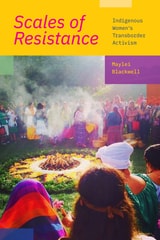
In Scales of Resistance Maylei Blackwell narrates how Indigenous women’s activism in Mexico and its diaspora weaves in and between local, national, continental, and transborder scales. Drawing on more than seventy testimonials and twenty years of fieldwork spent accompanying Indigenous women activists, Blackwell focuses on how these activists navigate the blockages to their participation and transform exclusionary spaces into scales of resistance. Blackwell shows how activists in Mexico and those in the migrant stream that runs from Oaxaca into California redefined women’s roles in community decision-making. They did so by scaling down Indigenous autonomy to their own bodies, homes, and communities; grounding their political claims within Indigenous epistemologies and the gendered nature of social organization; and scaling up to regional, national, and continental contexts. This allowed them to place themselves at the heart of Indigenous resistance and autonomy, decolonizing gender hierarchies and creating new scales of participation. Blackwell reveals the importance of moving across different types of scale and contrasting colonial divisions of scale itself with Indigenous conceptions of scale, space, solidarity, and connection.
[more]
cover of Scandinavians in Chicago: The Origins of White Privilege in Modern America

Scandinavians in Chicago

The Origins of White Privilege in Modern America

Erika K. Jackson

University of Illinois Press, 2019

Scandinavian immigrants encountered a strange paradox in 1890s Chicago. Though undoubtedly foreign, these newcomers were seen as Nordics--the "race" proclaimed by the scientific racism of the era as the very embodiment of white superiority. As such, Scandinavians from the beginning enjoyed racial privilege and the success it brought without the prejudice, nativism, and stereotyping endured by other immigrant groups. Erika K. Jackson examines how native-born Chicagoans used ideological and gendered concepts of Nordic whiteness and Scandinavian ethnicity to construct social hegemony. Placing the Scandinavian-American experience within the context of historical whiteness, Jackson delves into the processes that created the Nordic ideal. She also details how the city's Scandinavian immigrants repeated and mirrored the racial and ethnic perceptions disseminated by American media. An insightful look at the immigrant experience in reverse, Scandinavians in Chicago bridges a gap in our understanding of how whites constructed racial identity in America.
[more]
cover of Scarlet and Black, Volume Two: Constructing Race and Gender at Rutgers, 1865-1945

Scarlet and Black, Volume Two

Constructing Race and Gender at Rutgers, 1865-1945

Kendra Boyd

Rutgers University Press, 2020

The 250th anniversary of the founding of Rutgers University is a perfect moment for the Rutgers community to reconcile its past, and acknowledge its role in the enslavement and debasement of African Americans and the disfranchisement and elimination of Native American people and culture. Scarlet and Black, Volume 2, continues to document the history of Rutgers’s connection to slavery, which was neither casual nor accidental—nor unusual. Like most early American colleges, Rutgers depended on slaves to build its campuses and serve its students and faculty; it depended on the sale of black people to fund its very existence. This second of a planned three volumes continues the work of the Committee on Enslaved and Disenfranchised Population in Rutgers History. This latest volume includes: an introduction to the period studied (from the end of the Civil War through WWII) by Deborah Gray White; a study of the first black students at Rutgers and New Brunswick Theological Seminary; an analysis of African-American life in the City of New Brunswick during the period; and profiles of the earliest black women to matriculate at Douglass College.

To learn more about the work of the Committee on Enslaved and Disenfranchised Population in Rutgers History, visit the project's website at http://scarletandblack.rutgers.edu
[more]
cover of Scarred Landscapes: Place, Trauma, and Memory in Caribbean Latinx Art

Scarred Landscapes

Place, Trauma, and Memory in Caribbean Latinx Art

Stephanie Lewthwaite

University of Arizona Press, 2025

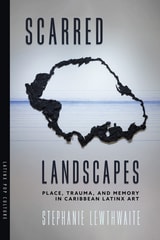
Scarred Landscapes is a groundbreaking exploration of the rich and complex works of Caribbean Latinx artists. Scholar Stephanie Lewthwaite documents the work of ten influential artists of Cuban, Dominican, and Puerto Rican descent, based in New York City from the 1970s to the present. Through their diverse practices, including painting, printmaking, photography, sculpture, installation, video, and performance art, these artists confront the legacies of colonial trauma and their own experiences of diasporic unbelonging and artworld marginality.

The book combines formal analysis with artist testimony, exhibition histories, and theoretical frameworks from trauma, memory, and archipelagic studies, to offer a multifaceted examination of Caribbean Latinx art. Lewthwaite explores how these artists practice “archipelagic memory,” a generative, decolonial, and coalitional form of memory work that envisions alternative modes of belonging in difference and solidarity with others. By connecting different people, pasts, and places, Caribbean Latinx artists expose the reverberations of trauma while imagining other worlds beyond it. 

This work puts Caribbean Latinx artists at the center of debates about the exclusions of dominant memory narratives and contemporary art worlds, highlighting their contributions to a wider decolonial project of remembrance. By revealing the interconnectedness of traumatic histories and the potential for art to foster empathy and justice, Lewthwaite’s work underscores the importance of relational and decolonial thought for imagining a better society.

 
[more]
cover of Scenes from la Cuenca de Los Angeles y otros Natural Disasters

Scenes from la Cuenca de Los Angeles y otros Natural Disasters

Susana Chávez-Silverman

University of Wisconsin Press, 2010
This is a rarity in contemporary writing, a truly bilingual enterprise, as in Susana Chávez-Silverman’s previous memoir, Killer Crónicas. Chávez-Silverman switches between English and Spanish, creating alinguistic mestizaje that is still a surprise encounter in the world of letters today, and the author forms one of a small but growing band of writers to embrace bilingualism as a literary force. Also like Killer Crónicas, each chapter in Scenes from la Cuenca de Los Angeles is a “crónica,” a vignette that began as intimate diary entries and e-mails and letters to lovers, friends, and ghosts from the past. These episodic chapters follow the Chávez-Silverman’s personal history, from California to South Africa and Australia and back, from unfathomable loss to deeply felt joy. Readers drawn into this witty book will confront their own conceptions of boundaries, borders, languages, memories, and spaces.
 
Honorable Mention, Best Biography in Spanish or Bilingual, International Latino Book Awards
[more]
cover of Schooling Citizens: The Struggle for African American Education in Antebellum America

Schooling Citizens

The Struggle for African American Education in Antebellum America

Hilary J. Moss

University of Chicago Press, 2009

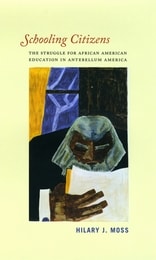
While white residents of antebellum Boston and New Haven forcefully opposed the education of black residents, their counterparts in slaveholding Baltimore did little to resist the establishment of African American schools. Such discrepancies, Hilary Moss argues, suggest that white opposition to black education was not a foregone conclusion. Through the comparative lenses of these three cities, she shows why opposition erupted where it did across the United States during the same period that gave rise to public education.

As common schooling emerged in the 1830s, providing white children of all classes and ethnicities with the opportunity to become full-fledged citizens, it redefined citizenship as synonymous with whiteness. This link between school and American identity, Moss argues, increased white hostility to black education at the same time that it spurred African Americans to demand public schooling as a means of securing status as full and equal members of society. Shedding new light on the efforts of black Americans to learn independently in the face of white attempts to withhold opportunity, Schooling Citizens narrates a previously untold chapter in the thorny history of America’s educational inequality.
[more]
cover of Schools Betrayed: Roots of Failure in Inner-City Education

Schools Betrayed

Roots of Failure in Inner-City Education

Kathryn M. Neckerman

University of Chicago Press, 2007

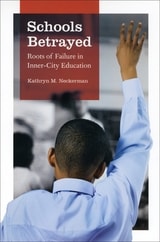
The problems commonly associated with inner-city schools were not nearly as pervasive a century ago, when black children in most northern cities attended school alongside white children. In Schools Betrayed, her innovative history of race and urban education, Kathryn M. Neckerman tells the story of how and why these schools came to serve black children so much worse than their white counterparts.

Focusing on Chicago public schools between 1900 and 1960, Neckerman compares the circumstances of blacks and white immigrants, groups that had similarly little wealth and status yet came to gain vastly different benefits from their education. Their divergent educational outcomes, she contends, stemmed from Chicago officials’ decision to deal with rising African American migration by segregating schools and denying black students equal resources. And it deepened, she shows, because of techniques for managing academic failure that only reinforced inequality. Ultimately, these tactics eroded the legitimacy of the schools in Chicago’s black community, leaving educators unable to help their most disadvantaged students.

Schools Betrayed will be required reading for anyone who cares about urban education.

[more]
cover of Science and Medicine in Twentieth-Century China: Research and Education

Science and Medicine in Twentieth-Century China

Research and Education

John Z. Bowers, J. William Hess, and Nathan Sivin, Editors

University of Michigan Press, 1988
The first part of this volume is devoted is devoted to synoptical and analytical examinations by historians of attempts to root modern science in China during the Republican period. The second contains reports by scientists who have been involved in China’s recent efforts to modernize. Topics include genetic research, taxonomy, contraception, food policy, and schistosomiasis. With an introduction by Nathan Sivin.
[more]
cover of Scratchin' and Survivin': Hustle Economics and the Black Sitcoms of Tandem Productions

Scratchin' and Survivin'

Hustle Economics and the Black Sitcoms of Tandem Productions

Adrien Sebro

Rutgers University Press, 2024

The 1970s was a golden age for representations of African American life on TV sitcoms: Sanford & Son, Good Times, The Jeffersons. Surprisingly, nearly all the decade’s notable Black sitcoms were made by a single company, Tandem Productions. Founded by two white men, the successful team behind All in the Family, writer Norman Lear and director Bud Yorkin, Tandem gave unprecedented opportunities to Black actors, writers, and producers to break into the television industry. However, these Black auteurs also struggled to get the economic privileges and creative autonomy regularly granted to their white counterparts. 
 
Scratchin’ and Survivin’ discovers surprising parallels between the behind-the-scenes drama at Tandem and the plotlines that aired on their sitcoms, as both real and fictional African Americans devised various strategies for getting their fair share out of systems prone to exploiting their labor. The media scholar Adrien Sebro describes these tactics as a form of “hustle economics,” and he pays special attention to the ways that Black women—including actresses like LaWanda Page, Isabel Sanford, and Esther Rolle—had to hustle for recognition. Exploring Tandem’s complex legacy, including its hit racially mixed sitcom Diff’rent Strokes, he showcases the Black talent whose creative agency and labor resilience helped to transform the television industry.
 

[more]
cover of Scream for Me, Africa!: Heavy Metal Identities in Post-Colonial Africa

Scream for Me, Africa!

Heavy Metal Identities in Post-Colonial Africa

Edward Banchs

Intellect Books, 2023

An engaging look at the various metal scenes across the African continent.

Scream for Me Africa! examines the hard rock and metal scenes in five African countries: Botswana, Togo, South Africa, Kenya, and Ghana. Edward Banchs interviewed musicians, producers, and fans in each country to create vivid pictures of each of these rarely discussed scenes. The book considers how the subculture of heavy metal is viewed in postcolonial Africa and examines how musicians on the continent have stepped forward to make this genre their own. It looks at Africa's blossoming scenes through various themes, including hybridity, othering, and political tensions.  

[more]
cover of Screening Asian Americans

Screening Asian Americans

Feng, Peter X

Rutgers University Press, 2002

This innovative essay collection explores Asian American cinematic representations historically and socially, on and off screen, as they contribute to the definition of American character. The history of Asian Americans on movie screens, as outlined in Peter X Feng’s introduction, provides a context for the individual readings that follow. Asian American cinema is charted in its diversity, ranging across activist, documentary, experimental, and fictional modes, and encompassing a wide range of ethnicities (Filipino, Vietnamese, Indian, Japanese, Korean, Chinese, and Taiwanese). Covered in the discussion are filmmakers—Theresa Hak Kyung Cha, Ang Lee, Trinh T. Minh-ha, and Wayne Wang—and films such as The Wedding Banquet, Surname Viet Given Name Nam, and Chan is Missing.

Throughout the volume, as Feng explains, the term screening has a twofold meaning—referring to the projection of Asian Americans as cinematic bodies and the screening out of elements connected with these images. In this doubling, film representation can function to define what is American and what is foreign. Asian American filmmaking is one of the fastest growing areas of independent and studio production. This volume is key to understanding the vitality of this new cinema.

[more]
cover of Screening China: Critical Interventions, Cinematic Reconfigurations, and the Transnational Imaginary in Contemporary Chinese Cinema

Screening China

Critical Interventions, Cinematic Reconfigurations, and the Transnational Imaginary in Contemporary Chinese Cinema

Zhang Yingjin

University of Michigan Press, 2001
Even as lawsuits challenging its admissions policies made their way through the courts, the University of Michigan carried the torch for affirmative action in higher education.In June 2003, the Supreme Court vindicated UM's position on affirmative action when it ruled that race may be used as a factor for universities in their admissions programs, thus confirming what the UM had argued all along: diversity in the classroom translates to a beneficial and wide-ranging social value. With the green light given to the law school's admissions policies, Defending Diversity validates the positive benefits gained by students in a diverse educational setting.Written by prominent University of Michigan faculty, Defending Diversity is a timely response to the court's ruling. Providing factual background, historical setting, and the psychosocial implications of affirmative action, the book illuminates the many benefits of a diverse higher educational setting -- including preparing students to be full participants in a pluralistic democracy -- and demonstrates why affirmative action is necessary to achieve that diversity.Defending Diversity is a significant contribution to the ongoing discussion on affirmative action in higher education. Perhaps more important, it is a valuable record of the history, events, arguments, and issues surrounding the original lawsuits and the Supreme Court's subsequent ruling, and helps reclaim the debate from those forces opposed to affirmative action.
[more]
cover of Screening Morocco: Contemporary Film in a Changing Society

Screening Morocco

Contemporary Film in a Changing Society

Valérie K. Orlando

Ohio University Press, 2011
Since 1999 and the death of King Hassan II, Morocco has experienced adramatic social transformation. Encouraged by the more openly democraticclimate fostered by young King Mohammed VI, filmmakers have begunto explore the sociocultural and political debates of their country whilealso seeking to document the untold stories of a dark past.Screening Morocco: Contemporary Film in a ChangingSociety focuses on Moroccan films produced and distributedfrom 1999 to the present. Moroccan cinema serves as an all-inclusive medium that providesa sounding board for a society that is remaking itself.Male and female directors present the face of an engaged,multiethnic and multilingual society. Their cinematographypromotes a country that is dynamic and connected to theglobal sociocultural economy of the twenty-first century. Atthe same time, they seek to represent the closed, obscurepast of a nation’s history that has rarely been told, drawingon themes such as human rights abuse, the former incarcerationof thousands during the Lead Years, women’semancipation, poverty, and claims for social justice. Screening Morocco will introduce American readers to therichness in theme and scope of the cinematic production ofMorocco.
[more]
cover of Screening Neoliberalism: Transforming Mexican Cinema, 1988-2012

Screening Neoliberalism

Transforming Mexican Cinema, 1988-2012

Ignacio M. Sánchez Prado

Vanderbilt University Press, 2014
Cavernous, often cold, always dark, with the lingering smell of popcorn in the air: the experience of movie-going is universal. The cinematic experience in Mexico is no less profound, and has evolved in complex ways in recent years. Films like Y Tu Mama Tambien, El Mariachi, Amores Perros, and the work of icons like Guillermo del Toro and Salma Hayek represent much more than resurgent interest in the cinema of Mexico. In Screening Neoliberalism, Ignacio Sanchez Prado explores precisely what happened to Mexico's film industry in recent decades. Far from just a history of the period, Screening Neoliberalism explores four deep transformations in the Mexican film industry: the decline of nationalism, the new focus on middle-class audiences, the redefinition of political cinema, and the impact of globalization. This analysis considers the directors and films that have found international notoriety as well as those that have been instrumental in building a domestic market. Screening Neoliberalism exposes the consequences of a film industry forced to find new audiences in Mexico's middle-class in order to achieve economic and cultural viability.
[more]
cover of Screening Precarity: Hindi Cinema and Neoliberal Crisis in Twenty-first Century India

Screening Precarity

Hindi Cinema and Neoliberal Crisis in Twenty-first Century India

Megha Anwer and Anupama Arora

University of Michigan Press, 2025

Screening Precarity explores the role that Hindi films play in how precarity is mediated by film, and what that mediation reveals about both contemporary India and the social life of the movies. This study moves away from the history of Hindi cinema’s articulation of precariousness, focusing instead on filmic renderings of precarity: a distinct and historically contingent condition produced by neoliberalism. The authors argue that post-2010 Hindi films may be thought of as contentious cinematic terrains that record India’s transition from the glee and gusto of liberalization in the 1990s, to a nation contending with the failures and inadequacies of neoliberalism’s promises, and the ascendency of the material-affective redressals offered by Hindu nationalism. Incorporating film and media studies, cultural studies, gender studies, and South Asian studies, Screening Precarity is an intervention in the politics of representation, particularly, of how marginal identities are shaped, scripted, and screened when neoliberalism and authoritarianism enmesh.
[more]
cover of Screening Race in American Nontheatrical Film

Screening Race in American Nontheatrical Film

Nadia Allyson Field and Marsha Gordon, editors

Duke University Press, 2019

Although overlooked by most narratives of American cinema history, films made for purposes outside of theatrical entertainment dominated twentieth-century motion picture production. This volume adds to the growing study of nontheatrical films by focusing on the ways filmmakers developed and audiences encountered ideas about race, identity, politics, and community outside the borders of theatrical cinema. The contributors to Screening Race in American Nontheatrical Film examine the place and role of race in educational films, home movies, industry and government films, anthropological films, and church films as well as other forms of nontheatrical filmmaking. From filmic depictions of Native Americans and films by 1920s African American religious leaders to a government educational film about the unequal treatment of Latin American immigrants, these films portrayed—for various purposes and intentions—the lives of those who were mostly excluded from the commercial films being produced in Hollywood. This volume is more than an examination of a broad swath of neglected twentieth-century filmmaking; it is a reevaluation of basic assumptions about American film culture and the place of race within it.

Contributors. Crystal Mun-hye Baik, Jasmyn R. Castro, Nadine Chan, Mark Garrett Cooper, Dino Everett, Allyson Nadia Field, Walter Forsberg, Joshua Glick, Tanya Goldman, Marsha Gordon, Noelle Griffis, Colin Gunckel, Michelle Kelley, Todd Kushigemachi, Martin L. Johnson, Caitlin McGrath, Elena Rossi-Snook, Laura Isabel Serna, Jacqueline Najuma Stewart, Dan Streible, Lauren Tilton, Noah Tsika, Travis L. Wagner, Colin Williamson
[more]
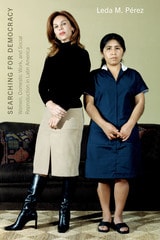
cover of Searching for Democracy: Women, Domestic Work, and Social Reproduction in Latin America

Searching for Democracy

Women, Domestic Work, and Social Reproduction in Latin America

Leda M. Pérez

Temple University Press, 2026

How can we achieve lasting social and political equality for women? Leda Pérez tackles this thorny question in Searching for Democracy by interrogating egalitarianism in Latin America, where nearly 20% of women work in domestic service. She examines how women’s participation in society, labor, and politics continues to be conditioned by their relationship to domestic and care work.

Pérez argues that women’s relationship to these spheres of life is indicative of a nation’s development and democracy. She provides a comparative focus on the socio-cultural valuation of this labor and the experiences of women in Bolivia, Chile, Peru, and Uruguay, among other countries. Pérez asserts that it is only by changing sociocultural views on this “women’s work” that nations can create political change, foster equitable legislation, and ensure implementation of effective policies that benefit women.

Searching for Democracy shows why real and lasting equality cannot be achieved without fully enfranchising women in the lowest tiers of employment and closing the equality gap among women. Pérez’s models for gender equality are relevant for women around the world.

[more]
cover of Searching for Life's Meaning: Changes and Tensions in the Worldviews of Chinese Youth in the 1980s

Searching for Life's Meaning

Changes and Tensions in the Worldviews of Chinese Youth in the 1980s

Luo Xu

University of Michigan Press, 2002

How did a self-centered "me generation" engage in a student movement that developed into the largest urban protest in modern Chinese history? Searching for Life's Meaning explores the profound changes in the beliefs and values of Chinese youth that occurred during the 1980s and that ultimately led to the confrontation in Tiananmen Square in 1989.
Drawing on his own experience as a teacher at Capital Normal University in Beijing, China during the 1980s, as well as exhaustive research, Luo Xu investigates the social and political climate of 1980s China in order to help better define the culture that ultimately drove the events at Tiananmen. Supporting his arguments with solid primary source documents, Xu contends that the contemplation of the meaning of life, along with other philosophical questions, were integral components of the general social crisis leading up to the movement of 1989.
Elegantly written and accessible to a general readership, this study will also be useful to specialists. Searching for Life's Meaning is a concise but detailed introduction to the mentalities of the Chinese generation presently assuming leadership in China. It should be valuable reading in courses on Chinese history and politics, and will be of interest to scholars in the related fields of Asian studies, anthropology, cultural studies, and youth studies. The book will also appeal to business- people and other professionals concerned with managing relations with the world's fastest growing polity.
Luo Xu is Assistant Professor of History, State University of New York College at Cortland.
[more]
cover of Searching for Solidarity: Revolutionary Dreams and Radical Social Movements

Searching for Solidarity

Revolutionary Dreams and Radical Social Movements

Noor Ghazal Aswad

The Ohio State University Press, 2025
In Searching for Solidarity, Noor Ghazal Aswad explores how the emancipatory qualities of transnational revolutionary struggle are often denied, misunderstood, and erased. Drawing on the stories of those in struggle, Searching for Solidarity reimagines solidarity as an affective, ethical, and political capacity that can thrive amid today’s volatile “political economy of emotion”—an environment marked by mistrust, fake news, and disinformation campaigns targeting those in resistance. At the heart of this book is the “radical subject,” which refers to those revolting against repressive forces to achieve liberatory change at the risk of death, injury, or disappearance. These radical subjects offer a new foundation for critical theory—one that rejects “negative solidarity,” the tendency to acquiesce to power or distance oneself from those fighting against systemic injustice. By immersing readers in the testimony, memory, and hopes of these subjects, each chapter reveals solidarity as an affective force capable of cutting through distortive narratives and binding us in a cross-cultural, decolonizing, and nonhierarchical collectivity. Solidarity, through this lens, emerges as a transformative stance that compels us to, as Yassin al-Haj Saleh writes, become “partners in word and deed to change power.”
[more]
cover of Secrecy and Cultural Reality: Utopian Ideologies of the New Guinea Men's House

Secrecy and Cultural Reality

Utopian Ideologies of the New Guinea Men's House

Gilbert Herdt

University of Michigan Press, 2003
Gilbert Herdt is Director of the Program in Human Sexuality Studies at San Francisco State University, where he is also Professor of Human Sexuality Studies and Anthropology.
[more]
cover of Secularism as Misdirection: Critical Thought from the Global South

Secularism as Misdirection

Critical Thought from the Global South

Nivedita Menon

Duke University Press, 2024
In Secularism as Misdirection, Nivedita Menon traces how the discourse of secularism fixes attention to and hypervisualizes women and religion while obscuring other related issues. Showing how secularism is often invoked to serve capital and antiminority politics, Menon exposes it as a strategy of governance that is compatible with both democracy and authoritarianism, capitalism and socialism. Secularism also delegitimizes the nonindividuated nonrational self, Menon argues; exploring this aspect, she tracks the journey of psychoanalysis in the global South. Menon further examines the interconnectedness of religion, caste, the state, and women, showing how the discourse of secularism can also be mobilized by Hindu supremacist politics in India. Menon puts Latin American decolonial theorists in conversation with Asian and African thinkers to examine twenty-first-century global reimaginings of selfhood, constitutionalism, citizenship, and anticapitalist existence. Through a feminist and global perspective, Menon suggests that transformative politics is better imagined by stepping out of the frame offered by secularism and focusing on substantive values such as democracy, social justice, and ecological justice.
[more]
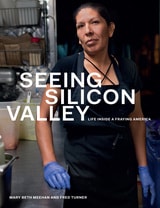
cover of Seeing Silicon Valley: Life inside a Fraying America

Seeing Silicon Valley

Life inside a Fraying America

Mary Beth Meehan and Fred Turner

University of Chicago Press, 2021

Acclaimed photographer Mary Beth Meehan and Silicon Valley culture expert Fred Turner join forces to give us an unseen view of the heart of the tech world.

It’s hard to imagine a place more central to American mythology today than Silicon Valley. To outsiders, the region glitters with the promise of extraordinary wealth and innovation. But behind this image lies another Silicon Valley, one segregated by race, class, and nationality in complex and contradictory ways. Its beautiful landscape lies atop underground streams of pollutants left behind by decades of technological innovation, and while its billionaires live in compounds, surrounded by redwood trees and security fences, its service workers live in their cars.

With arresting photography and intimate stories, Seeing Silicon Valley makes this hidden world visible. Instead of young entrepreneurs striving for efficiency in minimalist corporate campuses, we see portraits of struggle—families displaced by an impossible real estate market, workers striving for a living wage, and communities harmed by environmental degradation. If the fate of Silicon Valley is the fate of America—as so many of its boosters claim—then this book gives us an unvarnished look into the future.
[more]
cover of Seeking Community In Global City: Guatemalans & Salvadorans In Los Angeles

Seeking Community In Global City

Guatemalans & Salvadorans In Los Angeles

Nora Hamilton

Temple University Press, 2001

Driven by the pressures of poverty and civil strife at home, large numbers of Central Americans came to the Los Angeles area during the 1980's. Neither purely economic migrants, though they were in search of stable work, nor official refugees, although they carried the scars of war and persecution, Guatemalans and Salvadorans were even denied the aid given to refugees such as Cubans and Vietnamese. In addition, these immigrants sought refuge in a city undergoing massive economic and demographic shifts of its own. The result was -- and is -- a complex interaction that will help to reconceptualize the migration experience.

Based on twenty years of work with the Los Angeles Central American community and  filled with facts, figures, and personal narratives, Seeking Community in a Global City presents this saga from many perspectives. The authors examine the forces in Central America that sent thousands of people streaming across international borders. They discuss economic, political, and demographic changes in the Los Angeles region and the difficulties the new immigrants faced in negotiating a new, urban environment. They look at family roles, networking, work strategies, and inter-ethnic relations. But they also consider policy issues and alliances, changing expectations, shifting priorities, and the reciprocal effect of the migrants and the city on each other.
[more]